Continue reading
Now on its way to our nearest planetary neighbour, Venus Express tested its VIRTIS optics system by taking pictures of the Earth and the Moon. ESA controllers ran the spacecraft through a commissioning phase to test all of its scientific instruments. It took pictures of the Earth and the Moon when it was 3.5 million kilometres away. The VIRTIS instrument is also on board the Rosetta spacecraft, which also took images of our planet. ESA scientists will be able to compare the images to ensure the instrument is working perfectly.
Continue reading
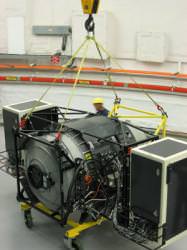
The newly installed AMBER instrument on ESO's Very Large Telescope Interferometer combines the light from two or three 8.2 metre telescopes creating a virtual telescope 40 - 90 metres across (131 - 295 feet). It was used to observe a young, newly forming star called MWC 297, and discovered that it's surrounded by a proto-planetary disc which is strangely truncated near the star.
Continue reading
In this Cassini image of Mimas perched in front of Saturn's moons, you can clearly see its giant crater Herschel. The 130-kilometer (80-mile) crater makes the moon look like the Death Star from Star Wars. Cassini took this image on October 13, 2005 when it was approximately 711,000 kilometers (442,000 miles) from Mimas.
Continue reading
This photograph of a fractured and crater-scarred Dione was taken by Cassini on October 11, 2005, when the spacecraft was only 19,600 kilometers (12,200 miles) away from the moon. Most of the craters in this image have bright walls and dark deposits of material on their floors. Rock slides on the surface of Dione can reveal cleaner ice, while the darker materials accumulate in lower areas.
Continue reading
Bob Christmas took this picture of Mars and the Pleiades on October 3, 2005 from Ontario, Canada. Bob used a Canon 135mm telephoto lens set at f/4.
Do you have photos you'd like to share? Post them to the
Universe Today astrophotography forum or
email them to me directly, and I might feature one in Universe Today.
Continue reading
Continue reading
Amateur astrophotographer
R Jay GaBany took this picture of the
Dumbbell Nebula Nova that was discovered on the 17th - 18th, August 2005. GaBany worked with Wolfgang Renz, of the BAV (German Workgroup for Variable Stars), to provide imagery that confirmed the discovery.
Do you have photos you'd like to share? Post them to the
Universe Today astrophotography forum or
email them to me directly, and I might feature one in Universe Today.
Continue reading
Officials from the Japanese space agency (JAXA) announced yesterday that Hayabusa successfully touched down on asteroid Itokawa last weekend, bounced at least once, and spent 39 minutes "resting" on the surface. It then launched back up into space again. Unfortunately, it failed to drop equipment that would allow it to collect samples from the asteroid's surface. Hayabusa will head back to the potato-shaped asteroid on Friday and attempt another landing.
Continue reading
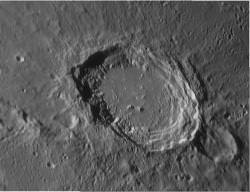
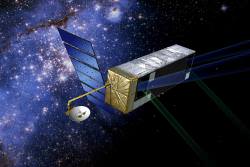
Since the Moon only has a slight tilt, some of its mountains are bathed in eternal sunlight, and would make ideal places to put solar panels to power a future moon base. The European Space Agency's SMART-1 spacecraft is currently mapping the Moon, and one its missions is to identify some of these peaks of eternal light. These peaks could also provide a very stable environment, always approximately 20-degrees below zero Celsius. There are probably also craters in the region which are in eternal shadow, and could contain water ice.
Continue reading
Continue reading
Cassini took this amazing image of Saturn's moon Dione on approach to its recent October 11, 2005 rendezvous; Saturn itself sits in the background. Dione is much darker on its western side in this image, and you can see the bright wispy fresh canyons right at the edge. Cassini took this image when it was approximately 24,500 kilometers (15,200 miles) from Dione.
Continue reading
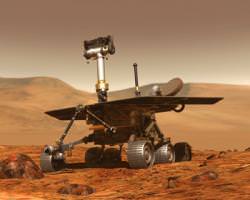
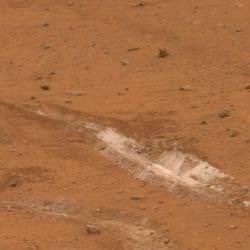
NASA's Spirit rover recently celebrated its one year anniversary on the surface of Mars... that's one Martian year. Spirit has now been exploring the Red Planet for more than 669 days. Not bad considering the rovers were only expected to perform for 60-90 days until their solar panels became so clogged with dust they wouldn't function. And even after surviving more than 7-times their expected lifetimes, Spirit and its twin Opportunity are still going strong, and should be returning much more science.
Continue reading
Researchers from the University of Colorado at Boulder think they've found evidence that the very early Earth had continents soon after the planet formed, overturning theories that the planet was Moon-like, or covered with oceans. The team analyzed a rare element called hafnium in ancient minerals from the Jack Hills in Western Australia. It showed that continental crusts had formed 4.4 - 4.5 billion years ago, and were then recycled into the Earth's mantle.
Continue reading
Researchers are finding that the mysterious dark energy found to be accelerating the expansion of the Universe is remarkably well predicted by Einstein's cosmological constant. Einstein originally added this constant to balance out the gravitation of the Universe, but threw it out after seeing evidence of the Big Bang. An international team of researchers has performed the Supernova Legacy Survey, and found that it calculates dark energy to be within 10% of Einstein's prediction.
Continue reading
If you're going to be traveling by airplane, take a look out the window; you might be amazed. On the side opposite to the Sun, you could see the shadow of the airplane in the clouds, and shimmering rings of colour surrounding it. Look out the sunward side, and you might see ice halos - arcs of light caused by ice crystals in the high clouds. And don't forget to look up. You're above much of the Earth's atmosphere, and should be able to see a clearer view of the night sky than from the ground.
Continue reading
In this Cassini image of Saturn's moon Dione, you can see the wispy features that run across its surface. It's also possible to see the craters Dido and Antenor near the moon's terminator at lower left. Cassini took this image on October 9, 2005 from a distance of 1.8 million kilometers (1.1 million miles).
Continue reading
NASA's Mars Reconnaissance Orbiter fired its main engine for 20 seconds on Friday, fine-tuning its course towards the Red Planet. The spacecraft is schedule to reach Mars on March 10, 2006. Since its August 12 launch, the spacecraft has traveled about 60% of the distance between Earth and Mars, and it will make 4 more adjustments before arriving at Mars. Once it does arrive, MRO will spend about half a year adjusting its orbit before beginning its science phase.
Continue reading
The branch of science called physics comes with a long history of preliminary conjectures later proven or disproved via experimentation. Brave champions pillared their beliefs before friend and foe alike with the simple desire to contribute. Those correct in their postulations live for eternity in textbooks, while those who fail ignobly disappear. Arthur Miller in his book
Empire of the Stars dusts off the fairly recent instantiation of ideas and postulations surrounding black holes. In it he shows that even being correct may not necessarily add your name to the wall of physics fame.
Continue reading
Greetings, fellow SkyWatchers! Let's start the week off with one of the finest globular clusters for both hemispheres - M2. There's plenty in store as we explore history, take a look at planetary nebulae, seek out galaxies and hunt down open clusters. A pair of occultations will round out the week as we keep our eyes on the skies...
And find out what's up!
Continue reading
One of the main challenges of returning humans to the Moon will be how to deal with all that gritty, clingy moondust. Scientists believe that ultraviolet radiation charges individual grains of dust, giving them a static charge. NASA is studying individual grains of moondust returned by Apollo astronauts to how much charge they can build up, and the results have been surprising. Ultraviolet radiation can give a grain of moondust 10 times more charge than the theories had calculated.
Continue reading
Modern spaceflight is dependent on reliable computers to handle navigation, life support, and other functions. The problem is that radiation in space, such as cosmic rays can cause computer chips to calculate incorrectly. NASA is working a solution that would run multiple redundant computers to do the same calculation several times over and then vote on which is the correct result. If a cosmic ray caused one processor to make a mistake, the other processors would still be correct, and the error would be prevented.
Continue reading
Most geologists believe that the early history of our planet was an extreme, "hellish" environment, under constant bombardment from asteroids, and completely devoid of modern formations, like continents. Researchers from ANU disagree, and think they've found evidence that continents had already formed within the first 500 million years, and there was liquid water interacting with rocks. The Earth at that time might have looked remarkably similar to our current planet, complete with continents and oceans.
Continue reading
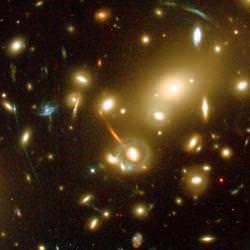
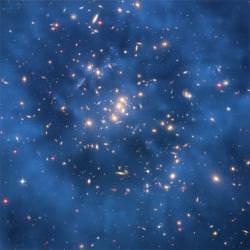
Astronomers have turned up 19 new gravitationally lensed quasars using photographs from the Hubble Space Telescope and the Sloan Digital Sky Survey (SDSS). 8 of these are what are known as "Einstein's Rings", where a nearby galaxy and a more distant quasar are perfectly lined up from our vantage point. The nearby galaxy acts as a lens to gravitationally focus the light from the quasar to magnify our view of it.
Continue reading
After 4 months of operation, Mars Express' MARSIS radar instrument has gathered a tremendous amount of data about the Red Planet. So far, the instrument has been focused on Mars' upper atmosphere, or ionosphere, which is the highly electrically conducting layer maintained by sunlight. ESA scientists are working develop the first conclusions about the nature and behaviour of how this region of Mars' atmosphere interacts with the planet and the surrounding environment.
Continue reading
More than half the stars in our galaxy are small, dim M-class stars. Until now, researchers looking for extraterrestrial civilizations have passed over them, since they probably don't give off enough light to support life. But SETI researchers now think that they might be good candidates after all. A planet in orbit around an M-class star would have billions and billions of years orbiting its slow-burning star for life to evolve.
Continue reading
An Ariane 5 rocket blasted off Thursday from Kourou, French Guiana carrying two satellites: Spaceway 2 broadcast satellite for DIRECTV, and the Telcom 2 communications satellite for PT Telekomunikasi Indonesia Tbk. The combined weight of the two satellites was more than 8,000 kg (17,500 pounds), making this the heaviest double payload ever launched.
Continue reading
NASA/Stanford's Gravity Probe B spacecraft recently wrapped up a year of gathering data about the Earth's gravity field. If Einstein was correct, the Earth's rotation should twist up our planet's gravity field like a vortex. Scientists at NASA and Stanford are now analyzing the mountains of data sent back by the spacecraft to detect any shift in its orientation, which would indicate this vortex of gravity.
Continue reading
Astrophysicists at Lawrence Livermore National Laboratory have developed a computer simulation that fails to support one of two major theories of star formation: the competitive accretion model. In this model, clumps form in hydrogen clouds which then collapse to form stars which compete with surrounding stars for material. The simulation showed that turbulence around the newborn star would prevent additional material from falling into the star.
Continue reading
NASA's Spirit Mars rover recently observed the Martian moon Phobos pass through Mars' shadow. When this event happens here on Earth, it's called a lunar eclipse, as the Moon darkens and then brightens again as it passes through our shadow. This "Phobal eclipse" lasted about 26 minutes, but Spirit was only able to capture images from the first 15 minutes.
Continue reading
This is the best photograph ever taken of Saturn's F ring shepherd moon Pandora, taken by the spacecraft on September 5, 2005. This tiny moon is only 84 kilometers (52 miles) across, and covered in grooves and small ridges. This indicates that it's probably coated in dust-sized material, which then fractures in places. Cassini was 52,000 kilometers (32,000 miles) from Pandora when it took this picture.
Continue reading
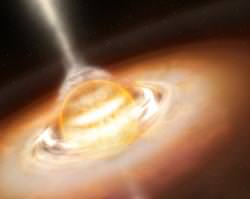
ESA's Integral gamma-ray observatory has discovered a new class of X-ray fast transient binary stars, which had gone undiscovered in previous observations. This new class of double stars systems always has a bright supergiant star with some kind of compact companion - like a black hole, neutron star or pulsar. It gives off energetic busts of X-rays which flare up quickly and then fade away. It's possible that the compact companion tangles up the supergiant's powerful solar wind with its gravity, and then feeds on it in bits and pieces.
Continue reading
Continue reading
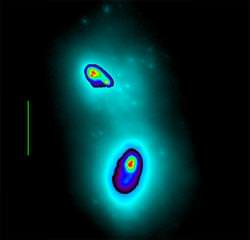
This unique photograph, taken by NASA's Chandra X-Ray Observatory, contains not one, but two supernova remnants. The pair are known as DEM L316, and they're located in the Large Magellanic Cloud galaxy. The gas shell at the upper-left contains considerably much more iron, so it's probably the product of a Type 1a, triggered by the infall of matter from a companion star onto a white dwarf. The lower-right shell is a Type II supernova, the remains of a massive star that exploded a few million years into its short life.
Continue reading
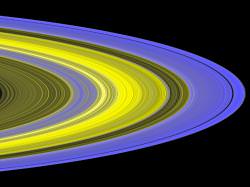
In this face-on view of Saturn's rings, the darker Cassini Division is clearly visible. On the left is Saturn's massive B ring, which is has its edge maintained by Mimas, one of its moons. This photograph was taken on May 18, 2005, when Cassini was approximately 1.6 million km (1 million miles) from Saturn.
Continue reading
NASA has announced that its Ames Research Center will manage the agency's new Robotic Lunar Exploration Program. Before humans set foot on the Moon again, a fleet of robots will map the lunar surface in tremendous detail. NASA Ames has already sent robots to the Moon; most recently the Lunar Prospector, which was launched on January 6, 1998. The spacecraft orbited the Moon, and found evidence of water ice at its poles.
Continue reading
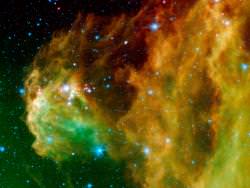
Star-forming region NGC 1333 is located 1,000 light-years away in the constellation Perseus, and is normally enshrouded by thick dust. NASA's Spitzer Space Telescope used its infrared capabilities to pierce this dust layer to reveal the young stars hidden inside. Astronomers are hoping to use Spitzer to spot any nascent planetary structures around these young stars. Now that they're getting going, the young stars are firing out jets of radiation that are steadily clearing the surrounding region of additional dust.
Continue reading
Greetings, fellow SkyWatchers! With plenty of Moon and Mars to go around this week, let's see what else we can find as we begin by honoring the Southern Hemisphere and 47 Tucanae. We'll explore in Cassiopeia, watch for the Leonid meteor shower, capture double stars and look at both northern - and southern - spiral galaxies. So keep your eye on the sky...
Because here's what's up!
Continue reading
Continue reading
Continue reading
One of the most iconic images taken by the Hubble Space Telescope is of the Eagle Nebula, aka the "Pillars of Creation". NASA's Spitzer Space Telescope has taken a similar photograph of a region in the Cassiopeia constellation called W5. This region is dominated by a single massive star blowing powerful solar winds. The surrounding dust and material has been cleared, and compacted into the pillars - these contain clusters of newborn stars.
Continue reading
Venus is our nearest planetary neighbour. Compared to the Earth, it's nearly identical in size and distance from the Sun. But that's where the similarities end. While we enjoy our comfortable temperature, pressure and atmosphere, Venus' environment is downright hostile to life. The European Space Agency's Venus Express blasted off for our "evil twin" planet today, and will hope to help answer the question: what went wrong? My guest today is Larry Esposito from the Laboratory for Atmospheric and Space Physics at the University of Colorado. He's a member of the Venus Express science team.
Continue reading
One of the many hassles of returning humans to the Moon will be the lunar dust. This tiny, gritty, static-loving dust will get into everything, jamming seals, wearing down equipment, and generally causing astronauts endless headaches. Larry Taylor from the University of Tennessee is proposing that astronauts use a heated "lawn mower" to melt the surface of the Moon around their base camp to fuse the dust into larger pieces which won't be so destructive. Lunar dust will melt down with surprisingly little energy because it contains microscopic beads of pure iron which can fuse the grains together.
Continue reading
In this amazing image taken by NASA's Cassini spacecraft, you can see three of Saturn's moons. Dione is on the left, and it's possible to see a large impact crater on the bottom right. Tethys is in the middle, and tiny Pandora is visible against the rings. Cassini took this image on September 22, 2005 when it was 1.2 million kilometers (800,000 miles) from Saturn.
Continue reading
An international team of researchers have developed a new computer model that simulated Jupiter's incredible weather systems. Jupiter's weather is much different from the Earth's, as the strong winds continuously circle the planet, changing very little over time. The massive East-West winds in Jupiter's equatorial region can reach speeds of 550 kph (340 mph). The simulation predicts that the planet's hot interior powers these winds, and explains why they can stay so stable for centuries.
Continue reading
This Hubble Space Telescope photograph shows NGC 346, a star forming region in the Small Magellanic Cloud (SMC). The radiation pouring out of the young hot star at the heart of the nebula is pushing out the surrounding gas and dust creating the beautiful shapes in the image. The small dark globules of material point back at the star like windsocks. NGC 346 can be resolved into at least three different sub-clusters of material each of which contains several more hot, blue, high-mass stars.
Continue reading
Continue reading
"Aruba, Jamaica oh I want to take you, Bermuda, Bahamas, come on pretty mamma, that's where you want to go to get away from it all", or do you? What about the edge of space, low earth orbit or Mare Tranquillitatis? They don't rhyme as well, but the company Space Adventures can take you there or get you as close as any private company can make possible. To show their stuff, Eric Anderson, the president of Space Adventures, together with Joshua Piven, have written,
The Space Tourist's Handbook. In it, they help you decide which space vacation to choose and how to make the best of your special time. So really get away from it all, skip the run-of-the-mill, and read about trying some truly out-of-this-world stuff.
Continue reading
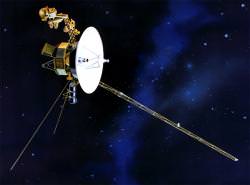
ESA's Venus Express lifted off today atop a Russian Soyuz-Fregat rocket, beginning its journey to Venus. ESA's Space Operations Centre (ESOC) at Darmstadt, Germany made contact with the spacecraft two hours after liftoff, and reported that it has oriented itself correctly and deployed its solar arrays. Its onboard systems are working properly, and its low gain antenna is communicating back to Earth - the high-gain antenna will be deployed in three days. If all goes well, Venus Express will arrive at our closest planetary neighbour in April 2006 and begin orbiting maneuvers.
Continue reading
Scientists have found that hardy bacteria can survive a trip into space, and now the list of natural astronauts includes lichen. During a recent experiment by ESA, lichen astronauts were placed on board the Foton-M2 rocket and launched into space where they were exposed to vacuum, extreme temperatures and ultraviolet radiation for 14.6 days. Upon analysis, it appears that the lichens handled their spaceflight just fine, in fact, they're so hardy, it's possible they could survive on the surface of Mars.
Continue reading