Buffy the Kuiper Belt Object

By Fraser Cain - December 14, 2005 03:31 AM UTC | Planetary Science
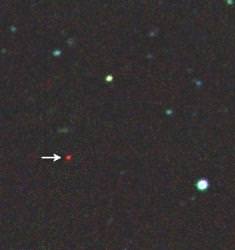
An international team of astronomers have discovered a new large object in the Kuiper Belt; a region of the Solar System beyond the orbit of Neptune. The object's official designation is 2004 XR 190, but the discoverers are calling it "Buffy" for now. Buffy is approximately half the size of Pluto, and orbits the Sun roughly double the distance of Neptune. Although there are larger objects in the Kuiper Belt, Buffy has one of the most unusual orbits: 47-degrees off the plane of the ecliptic, where the other planets orbit.
Continue reading

Strange Bulge in Saturn's Rings

By Fraser Cain - December 13, 2005 05:21 AM UTC | Planetary Science
NASA's Cassini spacecraft took this surprising photograph of Saturn's rings precisely edge-on. What's unusual is the strange bulge right at the edge of the rings. It's possible this bulge is created by a kilometer-sized chunk of material that's disrupting the ring material with its gravity. It could also be an effect of viewing the rings perfectly edge-on; normally faint material becomes visible when viewed at this angle.
Continue reading

Plasma Engine Could Open Up Space Exploration

By Fraser Cain - December 13, 2005 05:08 AM UTC | Space Exploration
The European Space Agency is developing a new thruster based on the same physics that power the northern and southern auroras. This new plasma thruster could eventually deliver more power than the efficient ion engines which have been installed on several spacecraft. ESA engineers calculate that a plasma engine could deliver several times more thrust from a similar sized ion engine, but still be as fuel efficient.
Continue reading

Spitzer Finds More than 100 New Star Clusters

By Fraser Cain - December 13, 2005 04:58 AM UTC | Stars
NASA's Spitzer Space Telescope has found more than 100 new star clusters hidden within the dusty areas of our own Milky Way. The powerful infrared observatory can see through the dark dust that normally obscures our view of this region of the galaxy. The team of astronomers that made the discovery found that there are twice as many clusters in the southern galactic plane (visible from the southern skies) as there are from the northern galactic plane. This may offer hints about the location of the Milky Way's spiral arms.
Continue reading

Sirius' White Dwarf Companion Weighed by Hubble

By Fraser Cain - December 13, 2005 04:50 AM UTC | Stars
The brightest star in the nighttime sky is Sirius, aka the Dog Star. But did you know it has a white dwarf companion called Sirius B? Unfortunately, the light from this burned out star is washed out by Sirius' brilliant glow. Astronomers have been able to use the Hubble Space Telescope's sensitive instruments to isolate the light from Sirius B and measure its mass by how its gravity bends light emitted from the star. Even though it's only 12,000 kilometers (7,500 miles) across, Sirius B has 98% of the mass of our Sun.
Continue reading

Thousands of Auroras on Mars

By Fraser Cain - December 13, 2005 04:39 AM UTC | Planetary Science
On Earth we have the Northern and Southern Lights, and there's a similar phenomenon on Mars too. But instead of sticking to the planet's poles, these faint auroras can show up anywhere on the planet; wherever there are patches of strong magnetic fields. Over the past six years, NASA's Mars Global Surveyor has turned up 13,000 aurora events on the Red Planet, and mapped their locations. These mini magnetic fields can potentially protect the planet's surface from the Sun's solar wind.
Continue reading

What's Up This Week - December 12 - December 18, 2005

By Fraser Cain - December 12, 2005 08:42 AM UTC | Observing
Greetings, fellow SkyWatchers! It's "mid-time of night and the stars in their orbits shone pale through the light of the brighter cold Moon." But, be sure to take the time to "gaze for awhile on her cold smile"! There will be a brief opportunity this week to hide from that light to catch the Geminid meteor shower, as well as plenty of time to check out bright planets, stars and clusters. So turn your eyes to the skies, because...

Here's what's up!
Continue reading

Detailed Dark Matter Maps

By Fraser Cain - December 12, 2005 01:30 AM UTC | Cosmology
Even through scientists have no idea what dark matter really is, they're able to see its effect on regular matter, and use this data to build a map of where it's clustered. Astronomers have used the Hubble Space Telescope to map the dark matter in two very young galaxy clusters. Their observations lend evidence to the theory that galaxies form at the densest regions of dark matter.
Continue reading

Dione and Rhea in the Same Frame

By Fraser Cain - December 12, 2005 01:15 AM UTC | Planetary Science
Two of Saturn's moons, Rhea and Dione posed for Cassini in this photograph. The lower moon is Dione, which has been much more geologically active in the past than Rhea. Dione has a smoother surface and linear depressions, while Rhea looks quite pummeled by impacts, like our own Moon. When Cassini took this image, Rhea was 1.8 million kilometers (1.1 million miles) away, and Dione was 1.2 million kilometers (800,000 miles) away.
Continue reading

Northern Lights on the Move

By Fraser Cain - December 12, 2005 01:00 AM UTC | Planetary Science
For more than 400 years, the Earth's magnetic North pole was in a roughly stable position, but now it's on the move, having drifted nearly 1,100 km (680 miles) in the last century. At this rate, it'll move out of Canada, and into Siberia in the next 50 years. If that happens, Alaska and Northern Canada may lose the beautiful Northern Lights, which are caused by the interaction of the magnetic pole and the solar wind. It could be that this is a normal oscillation of the magnetic pole, or it might be that the Earth's magnetic poles are getting ready to flip.
Continue reading

Hayabusa Probably Didn't Get a Sample After All

By Fraser Cain - December 09, 2005 06:27 AM UTC | Planetary Science
The Japanese Hayabusa spacecraft has moved approximately 550 km (340 miles) away from Asteroid Itokawa, beginning the journey back to Earth. Unfortunately, it appears that the spacecraft probably failed to pick up a sample from the asteroid. JAXA officials now think that a metal bullet designed to blast material off of Itokawa's surface probably failed to fire. Hayabusa is severely damaged, and will attempt to make the return journey to Earth, but managers aren't optimistic about its chances.
Continue reading

Women Wrap Up 60 Days of Simulated Spaceflight

By Fraser Cain - December 09, 2005 06:19 AM UTC | Space Exploration
Volunteers with the Women International Space Simulation for Exploration (WISE) campaign have wrapped up 60 days of bedrest, simulating the effects of weightlessness on the human body. The 24 women spent two months in medical beds which were slightly tilted head down. The data collected during the study will help prepare astronauts for long-duration spaceflight, but it'll also help researchers working on medical problems here on Earth too.
Continue reading

Hopping Microrobots

By Fraser Cain - December 09, 2005 06:11 AM UTC | Space Exploration
The NASA Institute for Advanced Concepts has recently awarded a Phase II grant for a unique robot design that could hop across the surface of Mars. An array of these tiny robots could be deployed on Mars, coordinating with one another like a swarm of insects. Dr. Penelope Boston speaks to Astrobiology Magazine about the research and future potential for this direction of robotic exploration.
Continue reading

Year in Space 2006 Giveaway!

By Fraser Cain - December 08, 2005 08:04 AM UTC | Site News
It's giveaway time again. The folks at Year in Space have agreed to award a free copy of the Year in Space 2006 calendar to one lucky Universe Today reader. As usual, send an email to [email protected] with the subject line "Year in Space 2006 Giveaway" before 8pm PST on Sunday, December 11. I'll pick one email randomly as the winner. If you haven't already, check out the calendar here. I'll only keep these emails for a few days and then delete them all, so they won't be used for anything else.
Good luck!

Fraser Cain
Publisher, Universe Today

Continue reading

Book Review: Miss Leavitt's Stars

By Mark Mortimer - December 08, 2005 07:59 AM UTC | Stars
Press the correct buttons and the ATM spits out the cash you need for the weekend's jaunt. Lying behind the machine's panel, cables connect the ATM to computers that process millions of such transactions every second. Before this nano-age, people kept track of numbers using paper, pencil and an unfailing eye that looked at one item then the next. These human computers supported financiers and as George Johnson tells in his book, Miss Leavitt's Stars, they were also the backbone of early 20th century astronomy.
Continue reading

Saturn's Graceful Crescent

By Fraser Cain - December 08, 2005 04:07 AM UTC | Planetary Science
This beautiful photograph of Saturn was taken when Cassini was lined up directly with the planet's rings. The black line near the top of the photograph are the rings. It's possible to see the intricate cloud patterns across the planet's surface, especially right at the terminator, which separates day from night. Cassini took this image on October 31, 2005 when it was 1.2 million kilometers (800,000 miles) from Saturn.
Continue reading

Dust Storms on the Moon

By Fraser Cain - December 08, 2005 03:59 AM UTC | Planetary Science
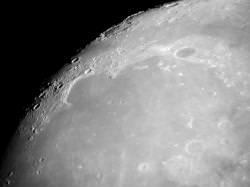
When the Sun rises on the Moon after two weeks of lunar night, the dust begins to stir. This dust storm stretches right across the Moon at the terminator (the line between day and night), from pole to pole. An instrument left by the Apollo astronauts to detect micrometeorite impacts first spotted this strange phenomenon. It could be that the night side of the Moon is negatively charged, and the day side is positively charged. As the terminator shifts across the Moon, it picks up the dust and shifts it sideways.

Continue reading

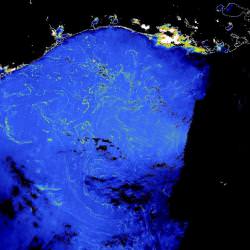
Smaller Ozone Hole This Year

By Fraser Cain - December 07, 2005 04:13 AM UTC | Planetary Science
The ozone hole that developed above Antarctica looks smaller this year than previous years, based on observations from NASA's Aura satellite. The largest hole was measured in 1998; almost triple the size of 1985's hole. The temperature of the atmosphere above Antarctica seems to be one of the biggest factors deciding the size of the ozone hole - the colder it gets, the more ozone that's destroyed.
Continue reading

New Views of Saturn's Moons

By Fraser Cain - December 07, 2005 04:07 AM UTC | Planetary Science
NASA's Cassini spacecraft has wrapped up a successful year exploring Saturn's icy moons, and scientists have released a new set of images to celebrate. New images of Rhea were taken during Cassini's November 26th flyby, when the spacecraft dipped within 500 km (310 miles) of Rhea's surface. Other images include "zoomable" mosaics of Rhea and Hyperion taken at high resolution.
Continue reading

Hubble's Detailed Look at Stellar Jets

By Fraser Cain - December 06, 2005 05:46 AM UTC | Stars
Astronomers from Rice University have created an amazing movie of jets of plasma blasting out of a newborn star. This series of images taken five years apart by the Hubble Space Telescope allow astronomers to track how material flows out of the star. Faster moving particles crash into slower moving material, and the resulting traffic jams create the spectacular shapes in space.
Continue reading

Zeiss Optics in Hubble's Successor

By Fraser Cain - December 06, 2005 05:40 AM UTC | Telescopes
Germany's Carl Zeiss Optronics has signed a contract to supply the optical system for two instruments to be installed on the James Webb Space Telescope; the successor to the Hubble Space Telescope. Due for launch in 2013 on board an Ariane rocket, the telescope will be stationed at a stable position in space called the Lagrangian point L2. JWST will be cooled down to -230 degrees Celsius so that it's highly sensitive infrared instruments can peer through clouds of gas and dust.
Continue reading

Detailed Cloud Features on Saturn

By Fraser Cain - December 06, 2005 05:30 AM UTC | Planetary Science
This image of Saturn shows the giant planet's southwest edge, and a hint of thread-like cloud features. The edge of the planet looks smooth, but right at the terminator (the edge between light and dark), it's possible to see these cloud features. The long shadows make the height differences in the clouds visible. Cassini took this image on October 30, 2005 when the spacecraft was 401,000 kilometers (249,000 miles) from Saturn.
Continue reading

Galaxies Colliding All Around Us

By Fraser Cain - December 06, 2005 05:22 AM UTC | Extragalactic
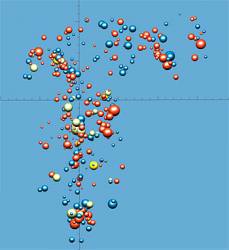
The history of our nearby Universe has been dominated by galactic collisions. More than half of the nearby galaxies have collided other galaxies in the last 2 billion year according to data from two comprehensive sky surveys. By processing 126 galaxies in the NOAO Deep Wide-Field Survey and the Multiwavelength Survey by Yale/Chile, researchers have found that 53% of galaxies have evidence of long tails of stars trailing away from them; the result of a recent galactic collision.
Continue reading

Hilly Terrain on Titan

By Fraser Cain - December 05, 2005 07:23 AM UTC | Planetary Science
This perspective view shows the hilly terrain on Saturn's moon Titan. The image has been colour coded to show the altitude, with red being the highest areas, and blue the lowest. Stereo images were taken by Huygens as it descended into Titan's atmosphere earlier this year, and then the 3-D terrain was rendered in computer.
Continue reading

Dione and Enceladus

By Fraser Cain - December 05, 2005 07:12 AM UTC | Planetary Science
This Cassini photo shows two of Saturn's moons, Dione and Enceladus floating just beneath the ringplane. Smaller Enceladus is on the right, and measures 505 kilometers (314 miles across). Dione is further away at the top left, and measures 1,126 kilometers (700 miles across). This image was taken on October 15, 2005, when Cassini was 2.1 million kilometers (1.3 million miles) from Dione and 1.5 million kilometers (900,000 miles) from Enceladus.
Continue reading

Opportunity Nears its Second Martian Year

By Fraser Cain - December 05, 2005 06:48 AM UTC | Planetary Science
On December 11, NASA's Opportunity rover will join its partner Spirit to celebrate a full Martian year on the Red Planet. Both rovers will now have experienced all of the Martian seasons, and now they're nearing the end of the Martian summer. Opportunity is currently exploring exposed bedrock along a route between Endurance and Victoria craters, and recently found rock that seems to be younger than what it discovered inside Endurance crater. These rocks seem to be petrified sand dunes, and show a longer term cycle of wetness and dryness in the region.
Continue reading

Book Review: Space Systems Failures

By Mark Mortimer - December 05, 2005 06:42 AM UTC | Space Exploration
Get a flat while riding a bike and you fix it, though you may never see the tack on the road that caused the puncture. However on the failure of a space mission, the whole aerospace industry might be left scratching their heads as to what happened and why. David Harland and Ralph Lorenz in their book Space Systems Failures lay down the known space failures before the reader in great detail and full disclosure. There's the occasional rescue of launcher payloads that slightly lighten this otherwise negative subject, but from the number and variety of faults they leave no doubt that space ventures are more a gamble than a certainty.
Continue reading

What's Up This Week - December 5 - December 11, 2005

By Fraser Cain - December 05, 2005 06:19 AM UTC | Observing
Greetings, fellow SkyWatchers! The Moon is back and tonight it will dance with Venus. Selene and the bright planets will grace this week's night skies as our observing year rapidly draws to a close. There will be plenty of lunar features to study, as well as some very colorful stars. As luck would have it, we have not one - but two - meteor showers to watch as well! Let's head out to explore, because...
Here's what's up!
Continue reading

New View of Space Weather Cold Fronts

By Fraser Cain - December 05, 2005 05:41 AM UTC | Solar Astronomy
Scientists from NASA and the National Science Foundation have created a new way to view the Earth's atmosphere during space storms. These large-scale storms resemble weather cold fronts that result from plumes of electrified plasma that flash across the Earth's ionosphere. These plumes used to seem like random events, but scientists have gotten pretty good at predicting them now, using a fleet of spacecraft. For the first time, they can now directly connect plasma observed in the atmosphere with these plumes that can extend thousands of kilometres into space.
Continue reading

Oxygen Levels on Earth Rose Gradually

By Fraser Cain - December 02, 2005 01:50 AM UTC | Astrobiology
The rise of complex life on Earth matches the appearance of oxygen in the atmosphere, and new evidence from University of Maryland scientists suggests that the increase was more gradual than previously believed. According to microbial evidence, oxygen first appeared in our atmosphere 2.4 billion years ago, and a second large increase started 1.3 billion years ago, and reached its current levels about 600 million years ago.
Continue reading

Chandra Views the Perseus Cluster

By Fraser Cain - December 01, 2005 08:13 AM UTC | Extragalactic
NASA's Chandra X-Ray Observatory has gathered 280 hours worth of data on the Perseus galaxy cluster to reveal massive amounts of turmoil in thousands of galaxies. Chandra discovered bright loops, ripples, and jet-like streaks. The supermassive black hole at the heart of galaxy NGC 1275 (Perseus A) is creating low pressure plumes of gas extending out for 300,000 light-years.
Continue reading

Dwarf Galaxies are Ablaze in Star Formation

By Fraser Cain - December 01, 2005 05:59 AM UTC | Extragalactic
When galaxies collide, it's a messy affair. Gas, dust and stars are often spun out into space and can form into satellite dwarf galaxies that continue to orbit their parent galaxies. NASA's Spitzer Space Telescope has spotted a few dwarf galaxies in the process of formation around a recent merger in NGC 5291. Spitzer found that the dwarf galaxies are ablaze with star formation.
Continue reading

Giant Hubble Mosaic of the Crab Nebula

By Fraser Cain - December 01, 2005 05:51 AM UTC | Stars
The Hubble Space Telescope took this amazing picture of the Crab Nebula supernova remnant. The star at the heart of the nebula exploded as a supernova nearly 1,000 years ago, and was recorded by Chinese astronomers as being bright enough to be visible during the day. This photograph was built up from 24 individual Wide Field and Planetary Camera 2 exposures taken over several years.
Continue reading

Huygens Sunk Into Soft Ground

By Fraser Cain - December 01, 2005 05:35 AM UTC | Planetary Science
When ESA's Huygens probe touched down on the surface of Titan earlier this year, it hit hard, and then slumped sideways into the soft ground. After analyzing the landing in detail, ESA scientists have calculated that Huygens probably hit a surface similar to soft clay, lightly packed snow, or wet or dry sand. It penetrated about 10mm into the ground, and then settled slightly over time by a few millimetres, tilting the probe a few degrees. It's possible that Huygens landed on a Titan beach, shortly after the hydrocarbon ocean tide went out.
Continue reading

Titan's Atmosphere Surprised Scientists

By Fraser Cain - December 01, 2005 05:21 AM UTC | Planetary Science
When ESA's Huygens probe passed through Titan's atmosphere on its way to a successful landing, it was buffeted by turbulence unexpected by scientists. Very little was known about Titan's atmosphere before Huygen's landing because the moon is shrouded by a thick hydrocarbon haze. Huygens found that the upper atmosphere was much thicker than expected, and broken up into several distinct layers. The probe also discovered possible evidence of lightning strikes around it.
Continue reading

Mars Express Confirms Liquid Water Once Existed on Mars' Surface

By Fraser Cain - December 01, 2005 05:13 AM UTC | Planetary Science
ESA's Mars Express has confirmed findings by the NASA Mars Exploration Rovers that liquid water must have been present on the surface of Mars for long periods. Mars Express gathered evidence with its OMEGA instrument; a visible and infrared spectrometer, which discovered large quantities of hydrated minerals across the surface of the Red Planet. These minerals, such as phyllosilicates and hydrated sulphates are created by the chemical alteration of rocks by liquid water.
Continue reading

Mars Express Finds a Buried Impact Crater

By Fraser Cain - December 01, 2005 04:56 AM UTC | Planetary Science
Now that its MARSIS radar instrument is working perfectly, ESA's Mars Express has turned up evidence of buried impact craters, layered deposits at the Martian north pole, and deep underground water-ice. One unusual discovery is a 250-km diameter (155-mile) circular structure buried under the ground; probably an impact crater which seems to be a rich source of water ice.
Continue reading

What Mars Looked Like Billions of Years Ago

By Fraser Cain - November 30, 2005 12:55 PM UTC | Planetary Science
NASA researchers working with the Mars Exploration Rovers have released a new set of papers that describe conditions on Mars billions of years ago, when there were large areas of liquid water. Approximately 3.5 billion years ago, the terrain around Endurance Crater probably looked like the White Sands region of New Mexico: salt flats occasionally covered by water and surrounded by dunes.
Continue reading

Teeny Tiny Solar System

By Fraser Cain - November 30, 2005 01:13 AM UTC | Solar Astronomy
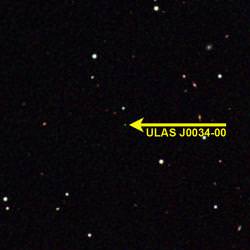
Astronomers from Penn State University and the Harvard-Smithsonian Center for Astrophysics have found a miniature solar system in the making. A failed star with a hundredth the mass of our own Sun seems to have a planet forming disc of dust and gas surrounding it. With only 8 times the mass of Jupiter, this brown dwarf star is more like a large planet, and yet it's capable of forming a planetary system of its own.
Continue reading

Ice Volcanoes on Enceladus

By Fraser Cain - November 29, 2005 06:30 AM UTC | Planetary Science
Cassini has returned amazing photographs of ice volcanoes erupting from the surface of Saturn's moon Enceladus. On a previous pass of the moon, Cassini detected particles of water vapour stretching hundreds of kilometres above its surface, and this photograph shows the ice volcanoes in action. It's believed they're spewing out material that refreshes the ice in Saturn's E-ring.
Continue reading

Hayabusa Successfully Collects an Asteroid Sample

By Fraser Cain - November 29, 2005 06:14 AM UTC | Planetary Science
Japan's asteroid explorer, Hayabusa, successfully touched down onto the surface of asteroid Itokawa Saturday for the second time in a week, and the Japanese Agency announced that it's clutching a sample of material. The spacecraft will now begin the long journey back to Earth, and it all goes well, its sample capsule should land in the Australian outback in June 2007. This will be the first time material from an asteroid will ever be sampled back here on the Earth.
Continue reading

Shadows Cast By Venus

By Fraser Cain - November 29, 2005 06:04 AM UTC | Planetary Science
Have you ever heard that Venus can be so bright it can cast shadows? Well, very few people have ever actually seen their shadow cast by Venus, though. If you're up for the challenge, find a completely dark location before December 3rd; completely away from the lights of the city, and during a time when the Moon is absent from the night sky. As the sky darkens, the brightest object will be Venus. Hold your hand in front of a white piece of paper, and you should be able to see a very faint shadow.
Continue reading

A Supernova in Progress

By Fraser Cain - November 29, 2005 05:52 AM UTC | Stars
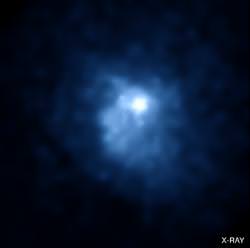
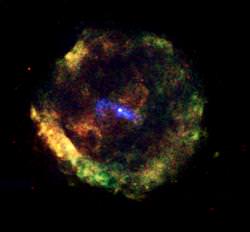
This image taken by the Chandra X-Ray Observatory shows the ongoing expansion of supernova SN 1970G, which exploded more than 35 years ago. Astronomers estimate that the shockwaves from the supernova will crash into shells of material shed by the star about 25,000 years ago, completing its transition into a supernova remnant.
Continue reading

Book Review: Why Explore?

By Mark Mortimer - November 28, 2005 06:06 AM UTC | Space Exploration
Everyday, small children ask the darnedest things. Why is the sky blue? Where does the sun go at night? What's a belly button for? These and endless others keep parents on their toes. But, when it comes to discussing emotions, even the smartest parent may be in a quandary. Just look at the challenges of Cyrano de Bergerac to describe love. Susan Lendroth writes and Enrique Moreiro illustrates the book Why Explore? to bring visual and rythmic nuances to this equally challenging question on why some many people try their darnedest to exceed the boundaries of today.
Continue reading

What's Up This Week - November 28 - December 4, 2005

By Fraser Cain - November 28, 2005 05:55 AM UTC | Observing
Greetings, fellow SkyWatchers! It's New Moon week and time for a galaxy quest ranging from binocular to large scope studies. We'll start out "Messier" with M74 and M77, but it will get more challenging as we locate Caldwell 23 and Abell Galaxy Cluster 347. Don't worry about being a "Dumbbell." because M76 and Mars are here, too. We'll have a look at the planets and head on back to our own galaxy group with M33 by the end of the week and the Moon's return. So, dress warm and head out because...

Here's what's up!
Continue reading

SOHO Celebrates 10 Years

By Fraser Cain - November 28, 2005 03:56 AM UTC | Solar Astronomy
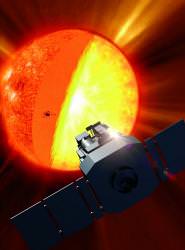
The Solar and Heliospheric Observatory (SOHO) is celebrating its 10th anniversary of operations on December 2nd, 2005. Over the course of these 10 years, SOHO has revealed the nature of the Sun's atmosphere, the links between its magnetic fields and coronal mass ejections, and even discovered more than 1,000 comets. Scientists even figured out how to use SOHO to probe the far side of the Sun.
Continue reading

Upcoming Solutions for Near Earth Objects

By Fraser Cain - November 28, 2005 03:45 AM UTC | Planetary Science
Telescopes from around the world are constantly scanning the skies searching for potential Earth-crossing asteroids. The majority if these objects pose little to no threat to us, but the potentially devastating space rocks are out there. The European Space Agency is working on a mission called Don Quixote which would attempt to shift the orbit of an asteroid to understand the mechanics of this kind of operation.
Continue reading