Universe Today
(This is Part 3 of a series on Hawking's no-boundary proposal. Read Part 1 and Part 2 first.)
I suppose now would be a good time to explain what exactly a wave function of the universe is.
Let's start a little smaller than the cosmos. How about...back to our old friend, the electron. When we say that the electron has a wave function, we mean that we never really know where to find the electron until we go looking for it. It just loves a good game of hide and go seek. The wave function is spread out all over space (technically it fills up the universe) and it tells us the chances of finding the electron in any one spot. Where the wave function is especially dense, or it peaks, we have a good shot of finding the electron there. Where it's a little thinner, eh, we still have a chance but don't bet a lot of money on it.
The wave function tells us the betting odds. But it takes a measurement to find out the winner.
So, wave function of the universe is just that...uh, but for the universe. The wave function encodes all sorts of different possibilities for the universe: different kinds of matter arrangements, different kinds of expansion histories, different kinds of dark energy behaviors, the whole deal. It doesn't tell you exactly which universe you live in, because by itself it contains so many possible cosmologies.
And yes, that means that all of Hawking's machinations when it came to the Wheeler-DeWitt equation didn't even give him a universe. It gave him many possible universes, because that's just how this works. But there is progress here: because it gave him a wave function, it really narrowed down the possibilities.
AND the wave function lets us (or, originally Hawking and his co-author James Hartle on this work) read off the MOST LIKELY universe. Again, it's not a guarantee, just like the wave function of an electron never gives guarantees, but we can take the wave function of the universe and read off the betting odds, and we can ask: is our universe special? Is it common? Is it something in between?
Right away, Hawking's result gave a surprising answer. The peak of the wave function that he derived gets...inflation. That's right: inflation. For free. It predicted that the most likely universe was one that started off small and smooth, got big really really quickly, then settled back down into a more sedate expansion phase.
That's our universe folks. Yes we don't know what inflation is or what powered it or why it shut off, but we strongly strongly strongly suspect that something LIKE inflation happened in the very early universe (check out the episodes on inflation if you're curious). It was originally proposed as a HAMMER to break through some nagging problems with the standard big bang picture.
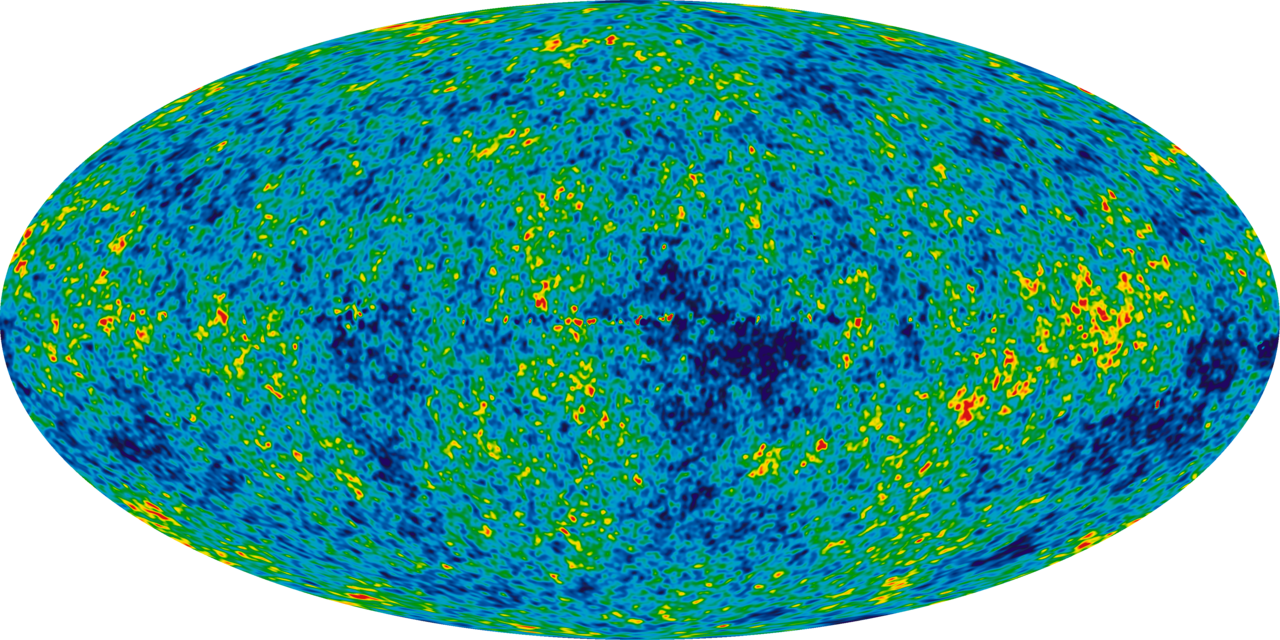
And here was Hawking's proposal. Starting with the assumption that there's no such thing as a beginning to the universe, working through the mathematical requirements of that, reading off the most likely cosmos, and we get inflation. Right there, like inflation and no-boundaries go hand-in-hand. And once you have inflation, you have the rest: flatness, homogeneity, seeds of structure, CMB fluctuations. All the rest of cosmology just falls out.
Oh, you get another bonus too. This universal wave function also predicted that the cosmos started in a smooth, low-entropy state, which is exactly what you need to kick off an arrow of time and give the whole thing a future. That's nice.
This is a lot. And the implications are...well, tremendous. If the no-boundary proposal holds, it means that the cosmos is entirely self-contained. The singularity just dissolves. It's not explained away, but it tells us that it's geometrically meaningless. The south pole is a singularity of sorts. It's a place where all lines of longitude intersect. But if you march down there you don't get sucked into a black hole, or see the face of the creator, or disappear into oblivion. You just take one more step and start making your way back north (be sure to pack a jacket, though, just in case).
This makes the question "how did the universe begin?" MEANINGLESS. There is no answer not because we can't formulate an answer, but because the words in the question lose their proper grammatical meaning. I know your teacher once told you that there are no stupid questions, but here's Hawking saying that this one IS a stupid question.
It also makes the universe entirely self-contained. There's no spark, no flash, no bang. The universe just is, a consequence of the laws of physics. It exists because it can exist. In this view, you don't need a creator (and Hawking was big on pointing this out).
It's all perfect and complete and powerful.
Except for all the places where it goes wrong.
In Part 4, we count the ways this beautiful proposal might be flatly, embarrassingly wrong.