 Universe Today
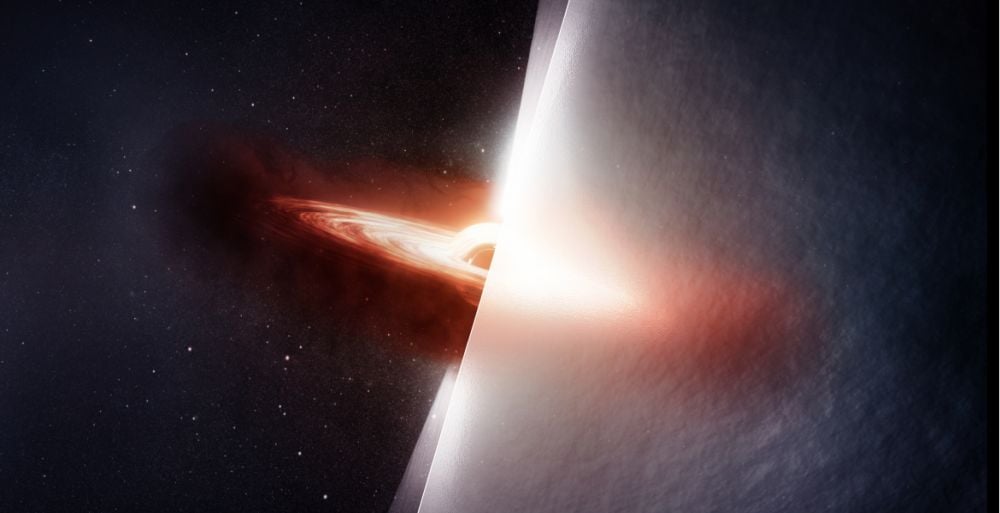
10 billion light-years away, a blazar blasts out powerful radio emissions aimed directly at Earth. Plasma close to the blazar blurs these emissions, detectable by our ground-based radio interferometers. But new research shows that something else is also intervening in the blazar's emissions, adding additional fine substructures that increase the blurring. And it's much closer to home.
The Milky Way's interstellar medium (ISM) is responsible for the additional blurring, and astronomers at the Center for Astrophysics | Harvard & Smithsonian (CfA) and other institutions made the discovery. Their work is published in The Astrophysical Journal Letters and is titled "Direct Very Long Baseline Interferometry Detection of Interstellar Turbulence Imprint on a Quasar: TXS 2005+403." The lead author is Alexander Plavin, an astronomer at the CfA’s Black Hole Initiative.
This issue revolves around the scattering of light as it travels from distant AGN to us. There are two types of scattering: diffractive and refractive. Plasma near the AGN, or in this case a blazar, creates the diffractive scattering. Astronomers already know about this effect and have studied it with the Very Large Baseline Array, a radio interferometer.
"Radio very long baseline interferometry (VLBI), which achieves the highest angular resolution in astronomy by combining signals from telescopes separated by thousands of kilometers, is ideally suited to studying both effects," the authors write. "We previously measured diffractive broadening in large samples of AGNs and constructed all-sky scattering maps."
But refractive scattering is far more difficult to detect. This is where the quasar TXS 2005+403 comes in. Since its light is scattered through diffraction close to the source, it can serve as an ideal probe of refractive scattering caused by turbulence in the Milky Way's ISM.
"AGNs provide background sight lines that sample the full Galactic column," the authors explain. "Exploiting refractive scattering as a probe of the interstellar medium requires bright, heavily scattered AGNs, for which compact substructure is both detectable and not degenerate with the intrinsic emission."
Heavy words, but what do they mean in plainer language?
“Most of what we see in the radio data isn’t coming from the quasar itself, it’s coming from the scattering caused by the turbulence in this region of the Milky Way,” said lead author Plavin in a press release. “That scattering and the distortions that come with it are what allows us to study the turbulence and better understand and infer its structure.”
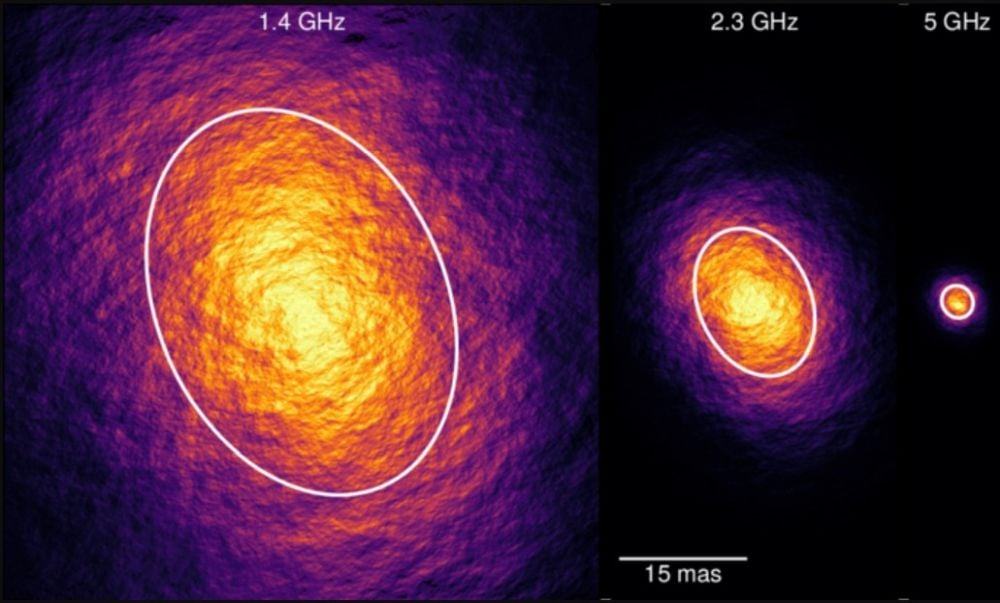 This image from the research shows the simulated scattering of TXS 2005+403 using parameters that are consistent with the researchers' observations. It's a single realization of the scattered image of TXS 2005+403 at 1.8, 2.3, and 5 GHz. It shows the large-scale broadening from nearer the source, and the fine-scale refractive substructure from turbulence in the Milky Way's ISM. Image Credit: Plavin et al. 2026. ApJL
This research is based on a decade of archival observations with the NSF's Very Long Baseline Array, which is made up of ten separate radio antennae spread out over the USA. They create an interferometer, a sort of virtual telescope that's as large as the combined footprint of the geographical space between the separate dishes.
Researchers expected to find that radio emissions from TXS 2005+403 would spread out, create a smoothed blur, and eventually fade away. This is the diffraction caused by plasma close to the quasar. But that's not what they found.
Instead, they found distinct, persistent patterns in the radio emissions that produced structured yet patchy distortions. This refraction could only have come from turbulence in the Milky Way's ISM, according to the researchers.
“The most distant pairs of telescopes should not have seen the quasar image, but to our surprise, they clearly detected its signal, or faint glow,” Plavin said. “It can’t be explained by simple blurring or by the quasar itself, and it behaves the way turbulence is expected to, which is how we know we’re seeing the effects of interstellar turbulence.”
The key to this, and why it's significant, is that the pattern was consistent over a decade of observations.
"We detect a long-baseline signal in its VLBI observations that cannot be explained by the diffractive scatter-broadened profile or by intrinsic source structure," the authors write. "This signal is detected from 1.4 to 5 GHz and remains stable across nearly a decade, with amplitudes consistent with theoretical expectations. This consistency indicates a persistently strong scattering screen with stable properties along this line of sight."
Since it's persistent, it can be reliably corrected for in observations. That means that it can astrophysicists understand the turbulence in the Milky Way's ISM more completely.
"The combination of high flux density, compact intrinsic structure, and strong scattering establishes TXS 2005+403 as an exceptional laboratory for probing Galactic turbulence," the authors explain.
It will also help produce sharper images of the Sagittarius A-star, the Milky Way's supermassive black hole, which is critically important to the Black Hole initiative. It can also help in the study of other, distant AGN.
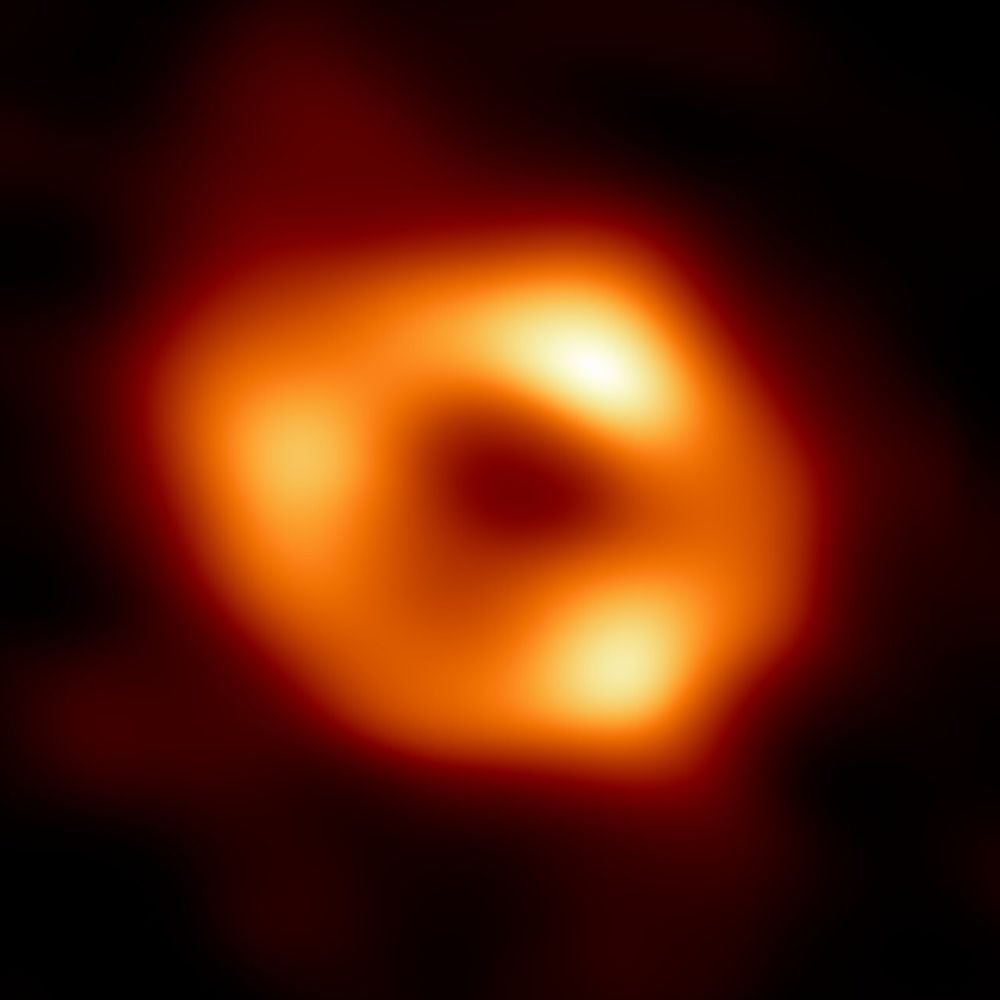 This is the ground-breaking image of Sagittarius A-star, the SMBH at the heart of the Milky Way. It was captured by the Event Horizon Telescope in 2017, and is extracted from multiple observations. These new findings about ISM refraction could help produce sharper images of the SMBH and other AGN. Image Credit: By EHT Collaboration - https://www.eso.org/public/images/eso2208-eht-mwa/ (image link), CC BY 4.0, https://commons.wikimedia.org/w/index.php?curid=117933557
"This detection demonstrates that AGNs can serve as cosmic lighthouses illuminating interstellar plasma across the sky, complementing pulsar scintillation studies and informing scattering mitigation for millimeter-wavelength imaging of Sagittarius A*," the authors conclude.

