 Universe Today
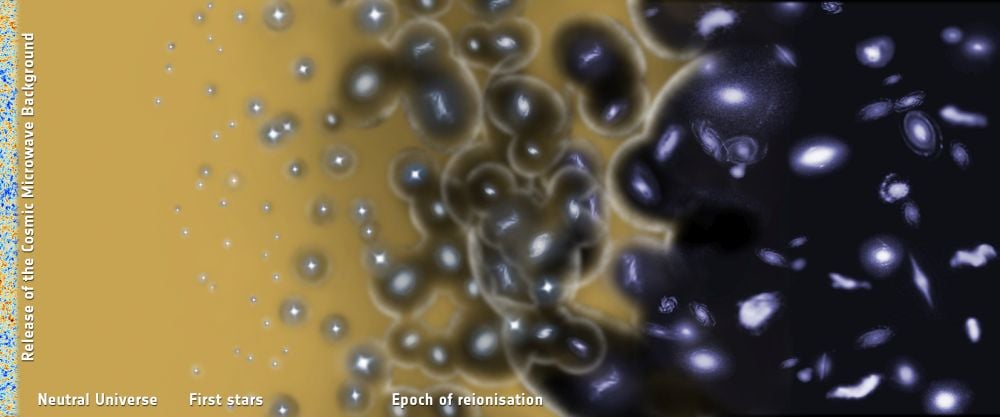
The early Universe and its galaxies are a mysterious realm hidden behind time's veil. The light that escapes that veil and reaches our telescopic eyes is dim, imprecise, and stretched into the red almost beyond recognition. With the advent of the powerful JWST, we've made more sense of some of that light at the end of its billions-of-years long photonic voyage.
But as eye-opening as the JWST's observations are, the telescope has given us little more than a fascinating glimpse at the goings-on in the very early Universe. Scientists hunger for more, and researchers at several institutions have collaborated on a new tool that could deliver what they crave. It's called The Tomographic Ionized-carbon Mapping Experiment (TIME).
TIME is mounted on a 12 meter radio telescope at Kitt Peak Observatory in Arizona. TIME uses an emerging technique called line-intensity mapping (LIM). Rather than focusing on single galaxies, LIM gathers the light from many galaxies at once when individual galaxies are too dim to resolve. LIM is focused on a single, specific spectral emission line from multiple galaxies, and those observations will eventually help astronomers understand how the cosmological structure changes over time. .
TIME began its commissioning run in 2021-22 and researchers have released the very first results. They're in research titled "TIME Commissioning Observations. I. Mapping Dust and Molecular Gas in the Sgr A Molecular Cloud Complex at the Galactic Center," published in The Astrophysical Journal. The lead author is Selina Yang, a doctoral student in the Department of Physics at Cornell University.
TIME is aimed at one of the most critical episodes in the cosmos' history: the Epoch of Reionization (EoR). The EoR was a brief period of time when the Universe's very first stars and galaxies ionized the intergalactic medium (IGM). This was a major phase change in hydrogen at the time, when it shifted from neutral to ionized. That shift changed the Universe from opaque to translucent, and light was then able to travel through the Universe.
Carbon monoxide emission lines are a window into the EoR, and TIME makes maps of both the 12CO(2–1) and 13CO(2–1) rotational emission lines. Carbon monoxide is the second most abundant molecule in the Universe after molecular hydrogen, and they let TIME map hydrogen gas distribution and star formation across time in the early Universe.
“Instead of trying to isolate every tiny galaxy, it measures the combined glow from enormous numbers of galaxies all at once,” lead author Yang said in a press release. Yang used the analogy of observing a city from a distance. “It is less like counting individual streetlights and more like measuring the overall brightness of an entire city from space.”
Abigail Crites is an assistant professor of physics at Cornell who has been developing TIME for a decade. She's also the project's principal investigator. “With TIME, we are trying to probe cosmic history over a range of times,” Crites said. “With a regular telescope, you know where an object is or at most you survey a tiny patch of sky and you see some very bright galaxies. But with TIME, we know the galaxies should be there, and we know they should have some brightness,” Crites said. “You just see a fuzzy patch, but that’s kind of cool because you’re getting all those photons even if you’re not identifying them as this galaxy or that galaxy.”
TIME's first, preliminary results are from observations of Sagittarius A (Sgr A).
"We present the processing of an observation of Sagittarius A (Sgr A) with the Tomographic Ionized-carbon Mapping Experiment (TIME), part of the 2021–2022 commissioning run, to verify TIME’s hyperspectral imaging capabilities for future line-intensity mapping," the authors write.
Since TIME is still being commissioned, this was more of a test than anything else. The researchers wanted to measure the gas in Sgr A and then compare those results to results from measurements from other tools and methods.
Every type of molecule is different, and even without discerning individual galaxies, TIME can measure the abundance of each type by their unique nature. The researchers explain that it's sort of like reading a barcode on a product.
“Even if line-intensity mapping is collecting blended light from millions of distant galaxies at once, we can still look at the spectrum of that light, identify these distinctive barcodes and translate them into an estimation on how much each molecule or atom is there and where it is concentrated across the universe,” Yang said. “This becomes important for studying early star formation because some of these molecules are closely connected to the environments where stars are born.”
“With Sagittarius A, we are pointing the instrument at the center of our galaxy,” said co-author Dongwoo Chung, assistant professor of astronomy at Cornell. “To make sure we can understand observations of molecular gas at redshift two [light that started traveling toward Earth 2.5 billion years ago], we need to make sure we can measure molecular gas at redshift zero correctly.”
TIME's observations focused on three regions near the Milky Way's galactic nucleus: the Circumnuclear Disk (CND), and a pair of gas clouds. These clouds serve as good stand-ins for early starburst galaxies. They're also rich in the emission bands that the researchers behind TIME are interested in.
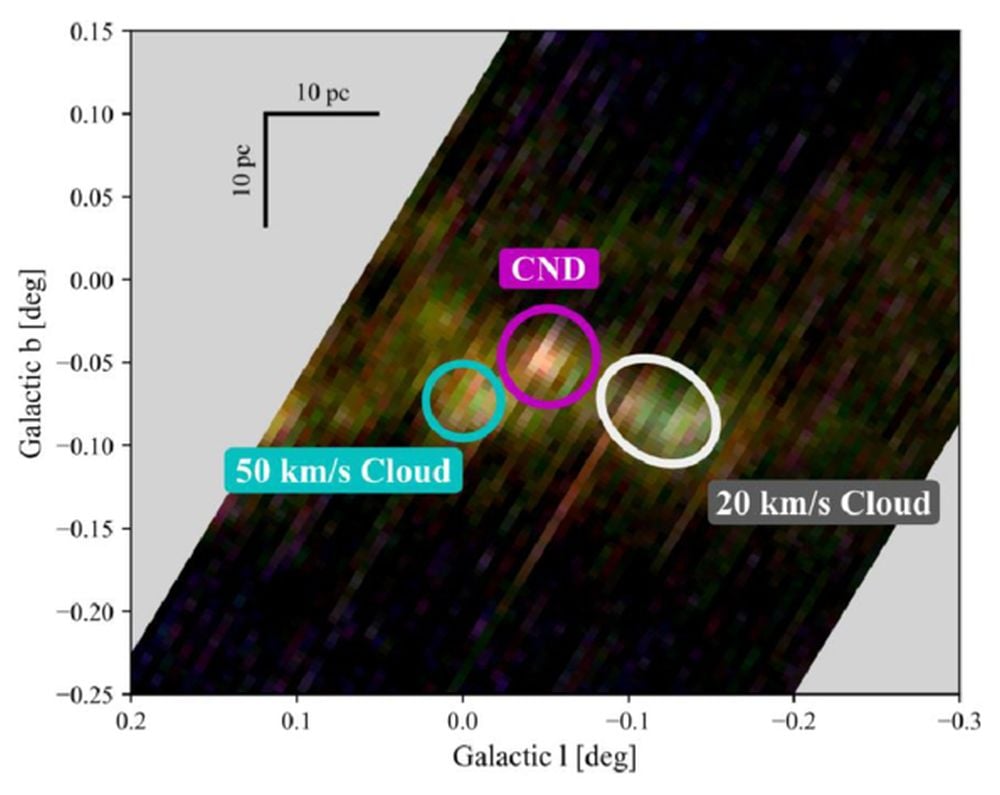 This is a false-color TIME image of the Sgr A region showing the three objects observed by TIME. Image Credit: Yang et al. 2026. ApJ
"The molecular clouds immediately surrounding Sgr A are some of the densest, most emissive clouds in the submillimeter regime, and the highly active nature of the Central Molecular Zone (CMZ) enables local studies of star formation and feedback processes in galactic nuclei in comparison to high-redshift starburst environments," the authors explain.
The CMZ is a heavily-observed region and gave the researchers a good opportunity to test TIME's results against those observations.
"Observing the Sgr A complex with TIME allows us to map CO line emission and continuum dust emission across the region, and also to cross-check our broadband continuum and spectral analyses against the considerable preceding body of work on the CMZ," the authors explain. "This very local map of line intensity is thus a crucial step toward the extragalactic LIM we aim to do with TIME."
The authors are pleased with TIME's first commissioning observations. "Our analysis demonstrates that TIME can successfully acquire and process broadband millimeter-wave spectral maps of complex astrophysical regions, even under the high-noise conditions of early engineering runs and low elevations," they write.
Even though TIME measures carbon monoxide, the results actually tell them about star-forming hydrogen. TIME's results compare will with previous observations by other means, which is the purpose of these test observations. "We are able to derive molecular hydrogen mass estimates using maps of the 12CO and 13CO line fluxes, with results falling well within the expected range reported from the literature," the authors explain.
These results support the maturation of LIM, which faced skepticism in its early days. Much of that skepticism concerned foreground contamination. Since the signal from early galaxies is so faint, some pointed out that brighter emissions from the foreground sources including our own galaxy would be an impossible hurdle to overcome. But now astronomers know different.
"These results demonstrate TIME’s ability to recover both continuum and spectral-line signals in complex Galactic fields, validating its readiness for upcoming extragalactic CO and [C ii] surveys."

