Universe Today
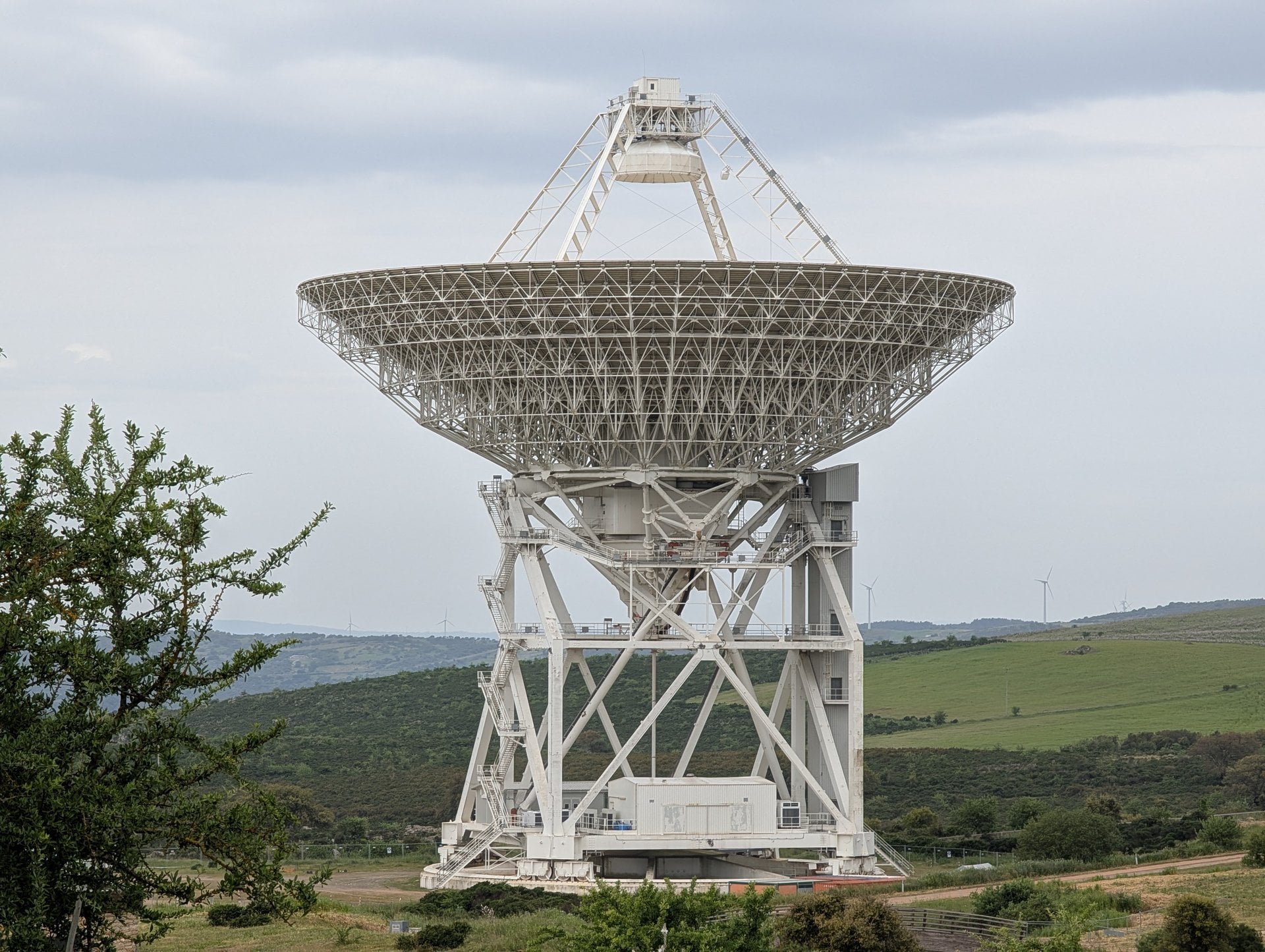
It's a tough, winding haul to reach the Sardinia Radio Telescope (SRT). An hour or so inland from the hardscrabble Italian port city of Cagliari, its rugged, mountainous locale belies a state-of-the-art 64-m radio telescope that in a decade of operation has continually made news.
A stone's throw from miles of sheep and cow pastures, its site was chosen in large part because it was somewhat sheltered by the wind, somewhat radio quiet and on a plateau that rises some 700 meters above the Mediterranean Sea.
The fully steerable SRT’s biggest claim to fame to date has been the first detection of the lowest frequency Fast Radio Burst (FRB) yet found. FRBs are intense, millisecond-pulses of radio waves located at cosmological distances. In the case of SRT’s discovery, FRB 180916 was found at 328 MHz in a star-forming region within a massive spiral galaxy lying nearly 500 million light years away in the northern constellation of Cassiopeia.
Yet the 60-million-euro SRT is offline undergoing a technical upgrade until at least September. That’s because in addition to general radioastronomy observations, the SRT serves as part of the European Space Agency’s (ESA) deep space network.
But when operational, the SRT routinely observes between 300 MHz up to 116 GHz, roughly equivalent to mainstream television at the lower end to current car radar in advanced automobiles. Over a thousand separate aluminum panels keep the telescope’s surface in its parabolic alignment as they are each supported by electromechanical actuators.
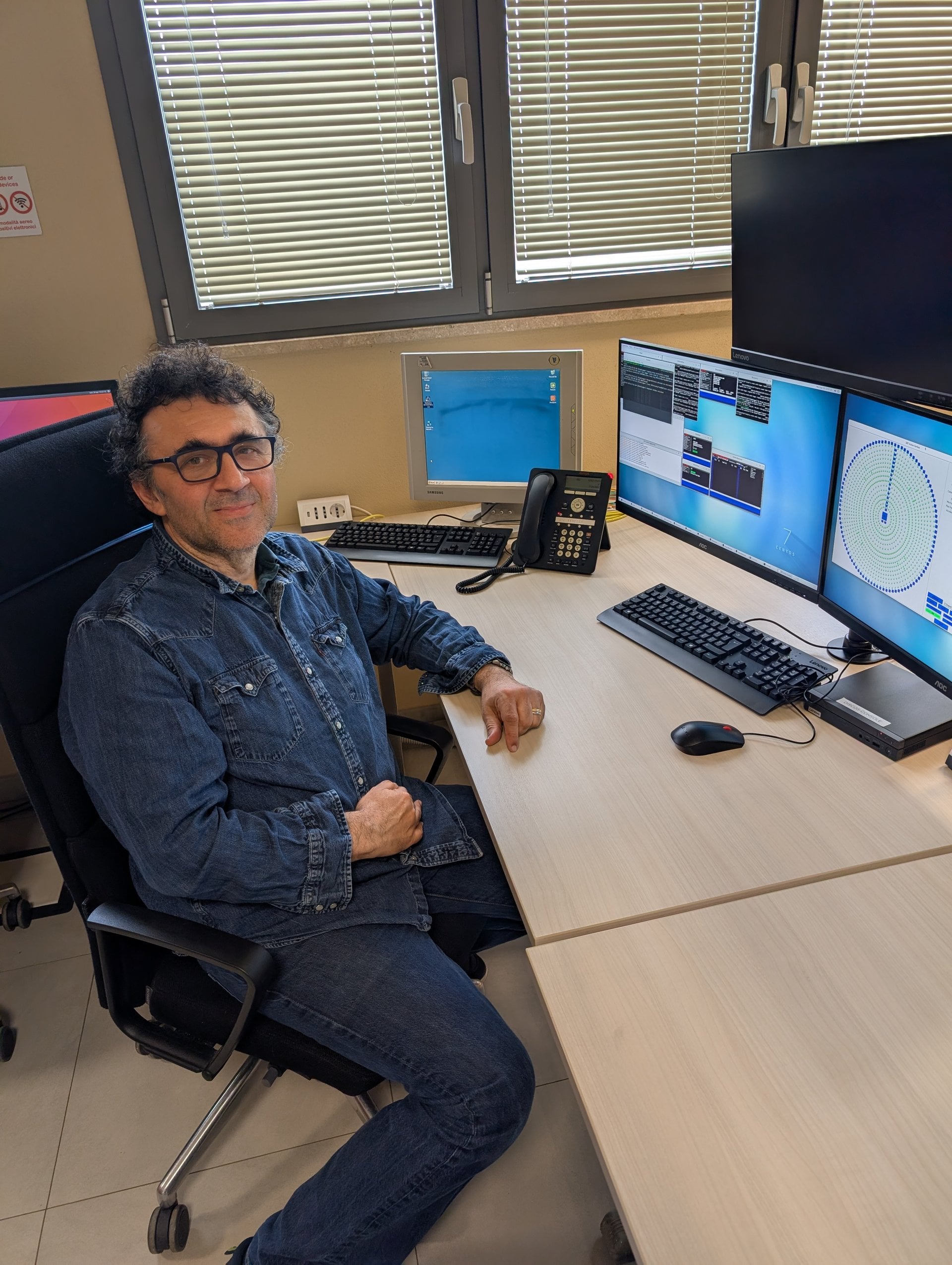 Sergio Poppi, SRT's head of operations in the telescope's control room. Credit: Bruce Dorminey
As for the origin of these FRBs?
They are first distinguished by those that appear to be one-off bursts and those like FRB 180916 which repeat, sometimes with precise periodicities.
One-offs could be caused by a one-time explosion such as the merger of two neutron stars.
Repeaters cannot be caused by a one-time explosion, Maura Pilia, a radio astronomer at Cagliari Astronomical Observatory in Sardinia, told me via email. In the case of repeat bursters, the current favored explanation is that magnetars produce them, says Pilia.
Magnetars are the "most powerful" neutron stars: with extremely intense magnetic fields that are seemingly powered by huge magnetic energy losses. Our own Milky Way Galaxy is rife with magnetars, however, all FRBs thus far detected appear to be extragalactic.
One thing is sure; the source of these FRBs must be an astrophysically compact object. This shortens the list of sources to black holes, neutron stars or white dwarfs.
White Dwarfs are the least energetic of the three, so we tend to exclude them, and black holes do not typically have this sort of short-term emission, says Pilia.
That leaves some sub-category of neutron stars as a possible explanation.
But a typical burst from FRB 180916 is emitted in milliseconds.
This means that a lot of energy is released in a very short time and that the engine behind it is very powerful, because it keeps losing this kind of energy and supplying more, says Pilia.
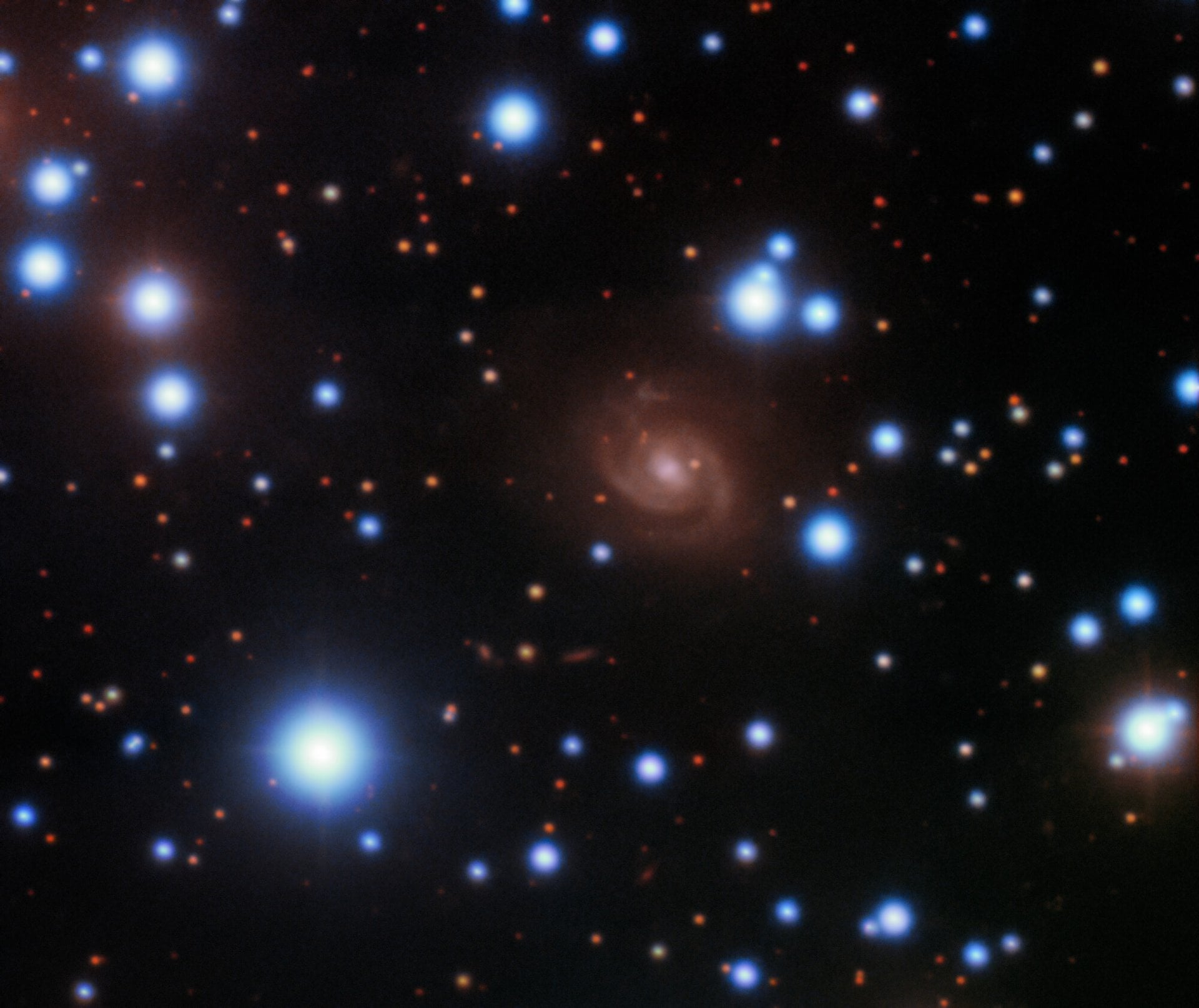 Image of the host galaxy of FRB 180916 (center) acquired with the 8-meter Gemini-North telescope of NOIRLab on Hawaii’s Maunakea. Credit: Gemini Observatory/NOIRLab/NSF/AURA
In contrast, our Sun’s brightest solar flares are emitted over a period of minutes to hours. So, FRBs are inherently the product of some sort of extreme astrophysics.
As for the source of FRB 180916?
SRT observations have shown that FRB 180916 can’t be enshrouded in a thick nebula; that would block low frequency radiation, says Pilia. So, it’s thought that this FRB is not among the youngest, but possibly in a middle-age stage, though still very active, she says.
Other Transient Phenomena
The SRT team is also following up on other transient phenomena which usually light up at other wavelengths (mainly x-rays) such as magnetars, microquasars, and gamma-ray bursts.
There could be a link in how all these systems work, says Pilia. We also regularly monitor pulsars and try to study their single and giant pulses and the pulsars' magnetospheric activity might be a scaled-down version of what happens in FRBs, she says.
SRT’s Observational Advantage
With SRT, Pilia says she and colleagues can perform simultaneous observations at 300 MHz and 1.5 GHz thanks to the telescope’s dual-beam receiver. Within the radio band, FRBs have been observed from 110 MHz to 8 GHz, she says.
What most puzzling about these FRBS?
We still don't know whether they represent one single phenomenon or two, or even more, says Pilia. And she wonders, do the ones that never repeat come from explosions which leave nothing behind?
Could they be some sort of neutron star binary?
This is the toughest question of all; let's say that magnetars' surfaces can be sort of turbulent due to extremely high magnetic fields, says Pilia. So, we might expect moments when something ‘breaks’ and gives rise to bursting phenomena, she says.
Think ‘Starquakes’
When immense forces are sort of trapped and then released, a burst will happen, says Pilia. But just as in the case of earthquakes, this is not predictable, she says.
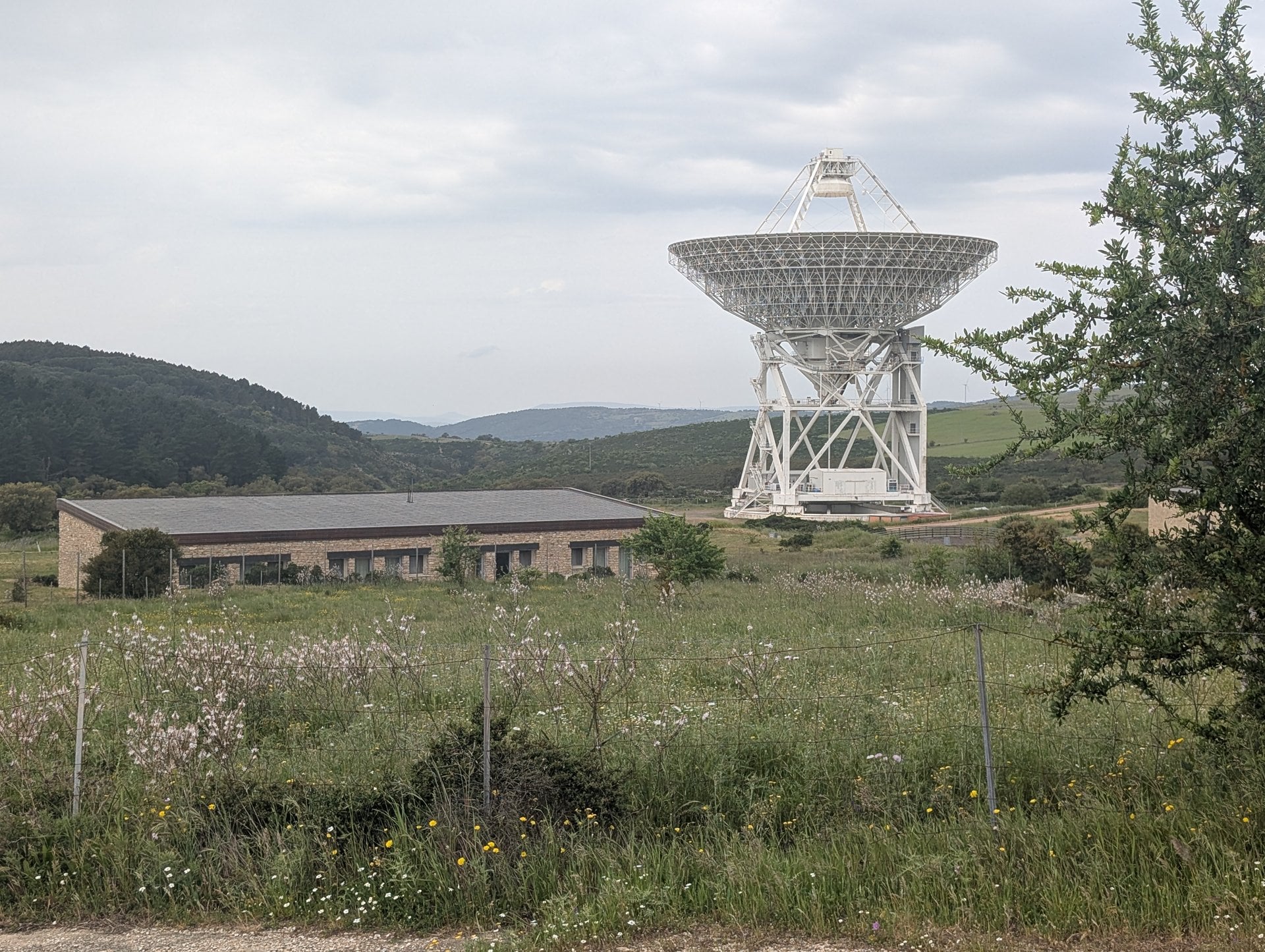 The SRT and its control and operations headquarters. Credit: Bruce Dorminey