Universe Today
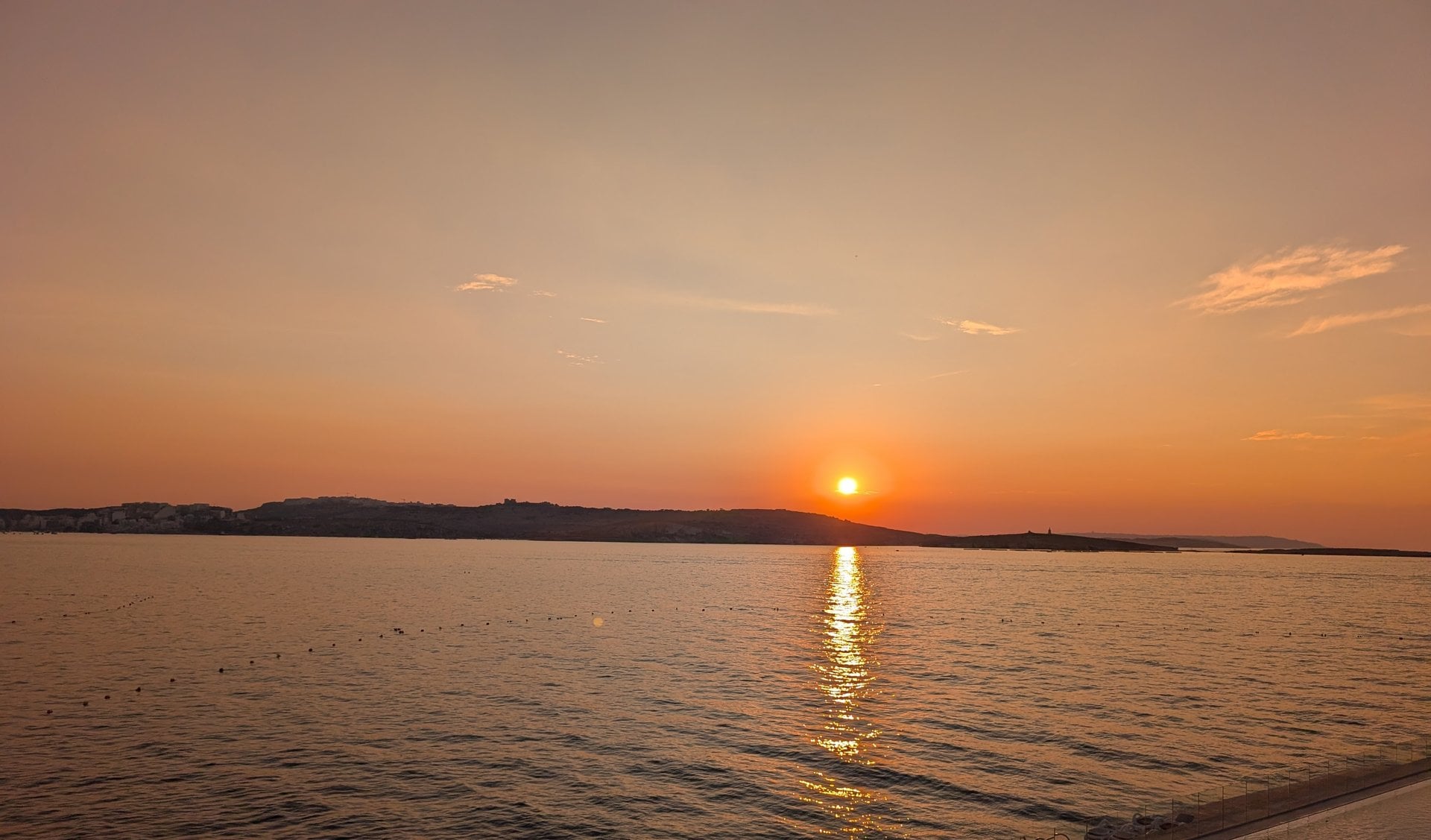
Malta might be the last place one might expect there to be a convergence of archeoastronomy and early cosmology. Today, it's better known as a billionaire tax haven and a favorite production location for big budget Hollywood movies.
But this island nation’s neolithic past --- dating back some 5000 years, once harbored a surprisingly sophisticated culture that likely migrated here from what is now present-day Sicily. It’s a culture that went through a 1500-year period of construction, building more than two dozen structures largely composed of huge megalithic stones.
It’s long been debated whether these so-called ‘temples’ are astronomically aligned to points on the celestial sphere. And perhaps even more significantly, whether these ancient people had a rudimentary cosmology that included what we now term spacetime. Or even whether these people’s putative temple alignments offered practical application in navigating the Mediterranean.
But as one of the most remote islands in the south-central Mediterranean, archeologists agree that that the first neolithic inhabitants of Malta likely migrated here from Sicily. And if so, they logically had to use some sort of celestial navigation.
Between Malta and Sicily, a good part of that nearly 97 km journey is often out of sight of land, Reuben Grima, an archeologist at the University of Malta, told me in Valletta. To get a sense of the enormity of that achievement, keep in mind that these people did not have compasses nor the GPS that we take for granted today, he says.
Once these neolithic peoples established themselves on Malta, in roughly 3600 B.C. they began almost a millennium and a half epoch of construction. As a result, the main island of Malta and its companion Gozo both harbor UNESCO World Heritage Sites that feature megalithic structures that still puzzle archeologists to this day.
The heritage site at Tarzien on the main island of Malta really demonstrates how difficult it is to reconstruct these ancient people’s past. One walks away in awe of what has been conjectured about how they moved the stones to construct these strange structures and then how these temples were actually aligned with equinoxes and/or stellar constellations.
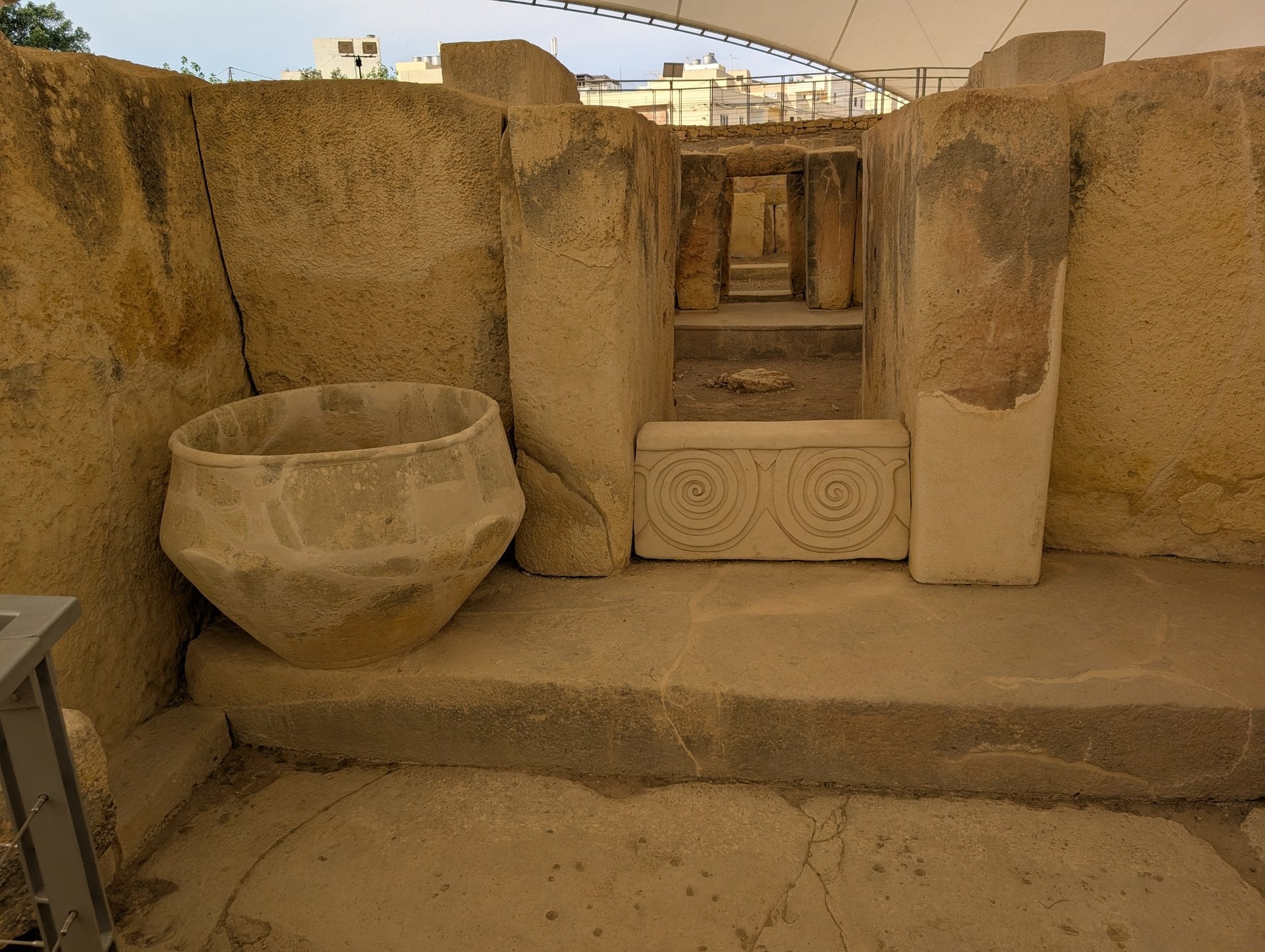 The interior of the Tarxien structure on Malta. Credit: Bruce Dorminey
An alignment with Crux --- the constellation colloquially known as the Southern Cross and composed of four main stars, Alpha, Beta, Gamma and Delta Crux --- is Tarxien’s most significant celestial orientation, note the authors of a 2022 paper appearing in the journal Digital Applications in Archaeology and Cultural Heritage.
This alignment may have been important to these people’s dugout boats traveling from Sicily to Malta. That’s because the journey between Malta and Sicily would have taken longer than a day, necessitating navigation by night, the authors note. A boat heading in a southerly direction would have generally been facing Crux, while the journey in the opposite direction would have had Crux behind it, the authors write.
As for the biggest misconception about the people of Neolithic Malta?
That they were all about big megalithic stones and making pottery, when in fact they were much more complicated, and they had this incredible set of belief systems that we tend to overlook, Isabelle Vella Gregory, an archeologist at University College London, told me by phone. I think the night sky was very much part of their world, since they extend their immediate dimensions to sophisticated concepts beyond the visible world, she says.
A Crude Reflecting Telescope?
Before we put the shelter over Tarxien, water would pond and sit there for quite a long time, says Grima. In a prehistoric society, you have very few good reflecting surfaces; since you don't have metal or even brass mirrors, he says.
Thus, one could argue this ponding water at Tarxien may have acted like a crude telescopic reflecting mirror. It’s even been suggested that some temple entrances may have been used as a teaching map that would help navigators learn the stars.
As for Gozo?
The temple at Ggantija, which is also a World Heritage site, sits on a high Gozo plateau a few kilometers inland. Surrounded by carob trees and date palms, this part of the island truly looks like the contemporary Middle East. But these neolithic migrants likely began building this temple maybe as early as 5600 years ago. And without question this structure predates the Egyptian Pyramids of Giza.
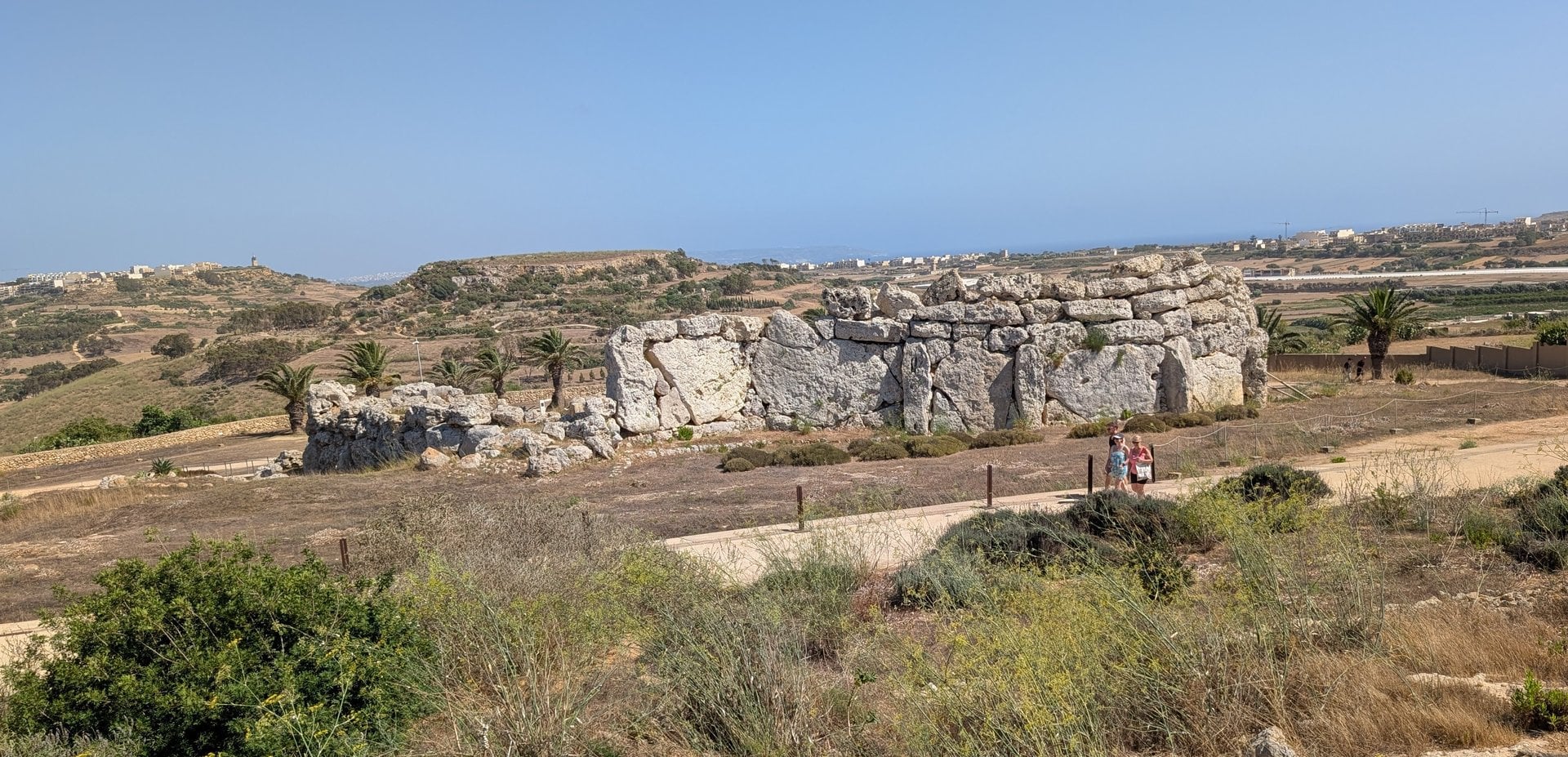 What's left of the Ggantija structure on the Maltese island of Gozo. Credit: Bruce Dorminey
Vella Gregory says it’s also clear that these neolithic dwellers believed in some sort of afterlife.
It's as if they had no real distinction between the concept of life and death; they believed in the past, present, and future, says Vella Gregory.
Their space-time concept was an extension of the life cycle.
It's this idea of having a past, present, and future expressed in how they bury people; how they built these temples, and how they moved across the landscape, says Vella Gregory.
Hard Proof That These People Traveled Around The Mediterranean
We have hard proof that people traveled between the island of Pantelleria and Sicily, and the hard proof is the distinctive volcanic glass obsidian, says Grima.
Obsidian, a dark or black naturally occurring glass, has a very distinctive signature linked to the volcanic eruption from which it originated.
So, you can determine the source of this volcanic glass, says Grima.
Thus, mineralogists and volcanologists have made the link of at least a portion of the obsidian found on Malta as being from the growing volcanic island of Pantelleria. This Italian island harbors a volcano growing out of the bottom of the Pantelleria Rift, an extremely deep canyon bordering the tectonic plates separating North Africa from Europe.
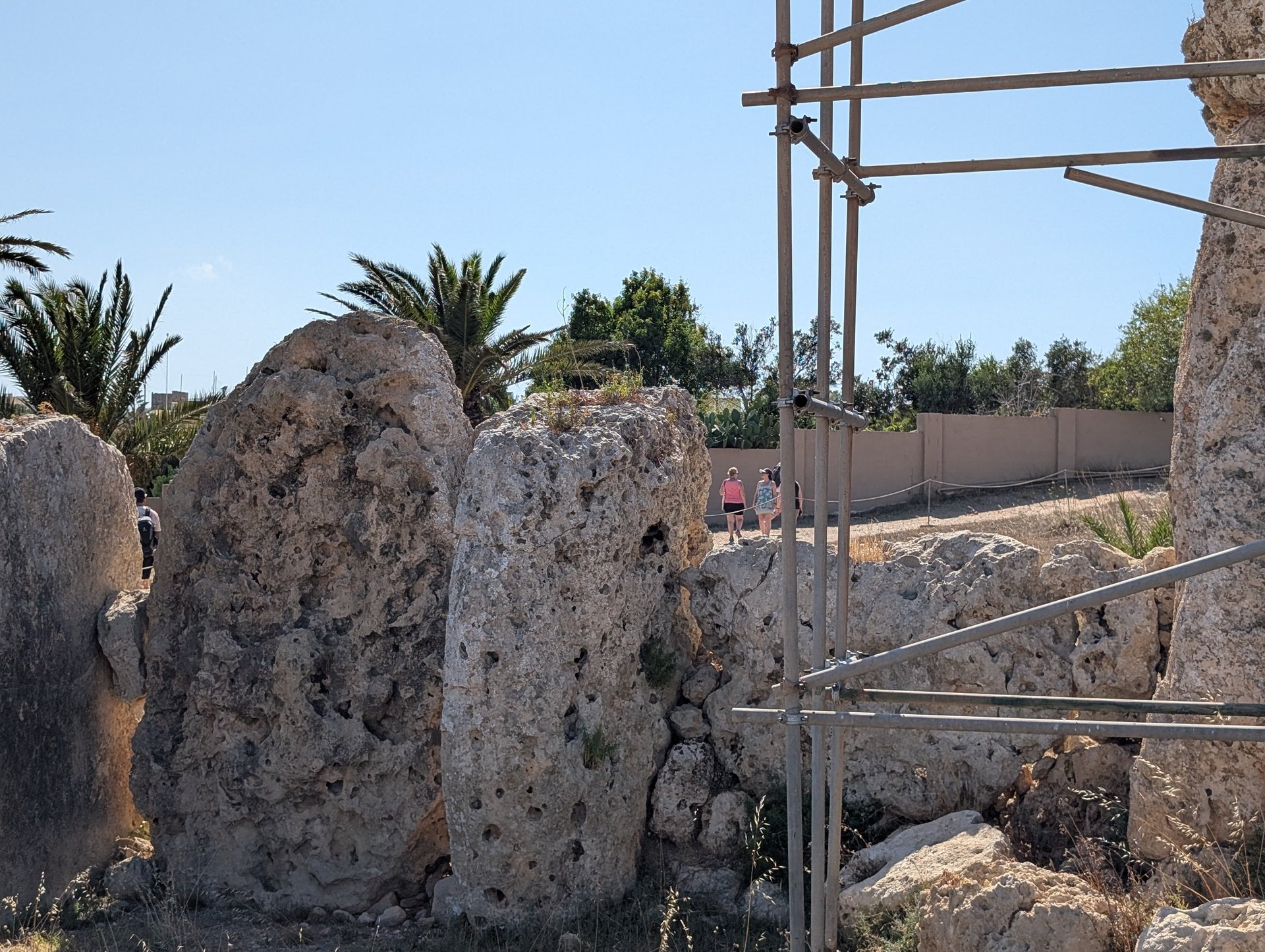 Huge stone boulders on the outer walls of Ggantija. Credit: Bruce Dorminey
They may have even brought the obsidian from Pantelleria itself, a point that’s not lost on Grima.
The crossing from Sicily to Malta is a bit shorter and more feasible than a direct crossing from Pantelleria to Malta, says Grima. But I wouldn’t rule out the possibility that they were capable of a direct crossing between Malta and Pantelleria, he says.
Such Seafaring Is Not Easy
If you go past Malta in the night, or even if you're 30 km off course, you won't see the island at all, says Grima.
The people who migrated here likely did so from Sicily, but Grima also doesn't rule out the fact that they may have come over in dugout boats from what is now present-day Libya.
The answers still lie within these complex archeological structures which at best are difficult to interpret.
We're not seeing the complete structures; in some cases, we’re just looking at a stump, which may be only a third of the structure’s original height, says Grima.
It’s amazing that archeologists have been able to determine much of anything about these temples, since time and the climate have wiped away much of their original structure. But perhaps with enough future willpower and resources, archeologists and archeoastronomers will find new clues to piece together.
We cannot know for sure what their cosmological views were, says Grima. We just get tiny glimpses since we are talking about a culture that had no writing systems, he says.
But it’s indisputable that the celestial sphere helped guide them around the Western Mediterranean.
The glimpses of their cosmology are from what Grima says entail the orientation of their monuments and the way they relate to their environment. This includes their innate interest in the sea; the boundaries between land and sea, and everything that the sea could represent.
It’s also sure that they were both more adept at navigation and more culturally complex than ever thought.
As Grima told me, it's so easy to underestimate people in the past; we've made that mistake many times.
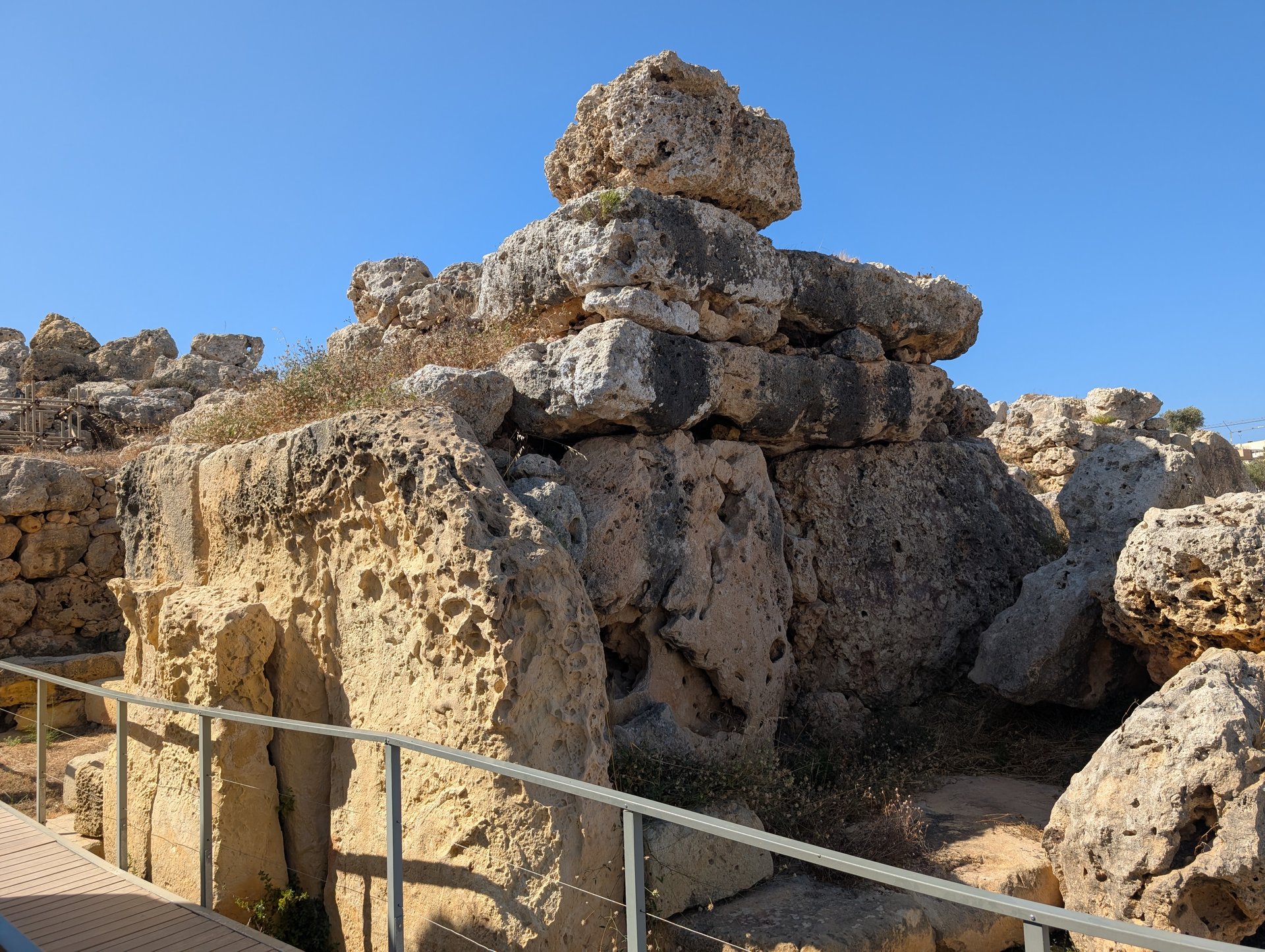 The interior of Ggantija. Credit: Bruce Dorminey
Sources:
Paper in Journal Digital Applications in Archaeology and Cultural Heritage