Universe Today
Some of the best science stories start with a puzzle nobody expected. This one begins in the Large Magellanic Cloud, a small companion galaxy sitting about 160,000 light years from us, in a stellar nursery astronomers have nicknamed the Tarantula Nebula. Officially it's 30 Doradus, and it's one of the most furious star forming regions anywhere near the Milky Way, packed with thousands of young, massive stars still shrugging off the gas and dust they were born in.
Astronomers had a reasonable expectation about this place. Young, massive stars blast out ferocious winds, and those winds should slam into surrounding gas hard enough to heat it to millions of degrees, lighting it up in X-rays. Researchers had already studied how much energy those stellar winds were pumping out and what impact it should be having. The maths said the Tarantula ought to be glowing fiercely in X-ray light. It wasn't.
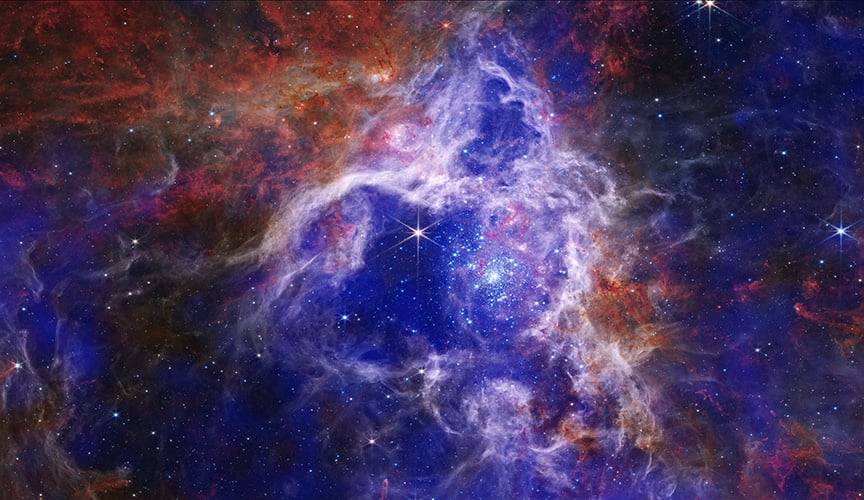 An earlier view of 30 Doradus combining Chandra's X-ray data with infrared from Webb — the deep, diffuse X-ray glow visible here is the very signal researchers found was fainter than their models predicted (Credit : X-ray: NASA/CXC; Infrared: NASA/ESA/CSA/STScI)
There was far less X-ray-emitting gas in the nebula than the models predicted, and that's the kind of gap that makes a research team sit up and look closer. Somewhere, an enormous amount of energy was going missing, and nobody could say where.
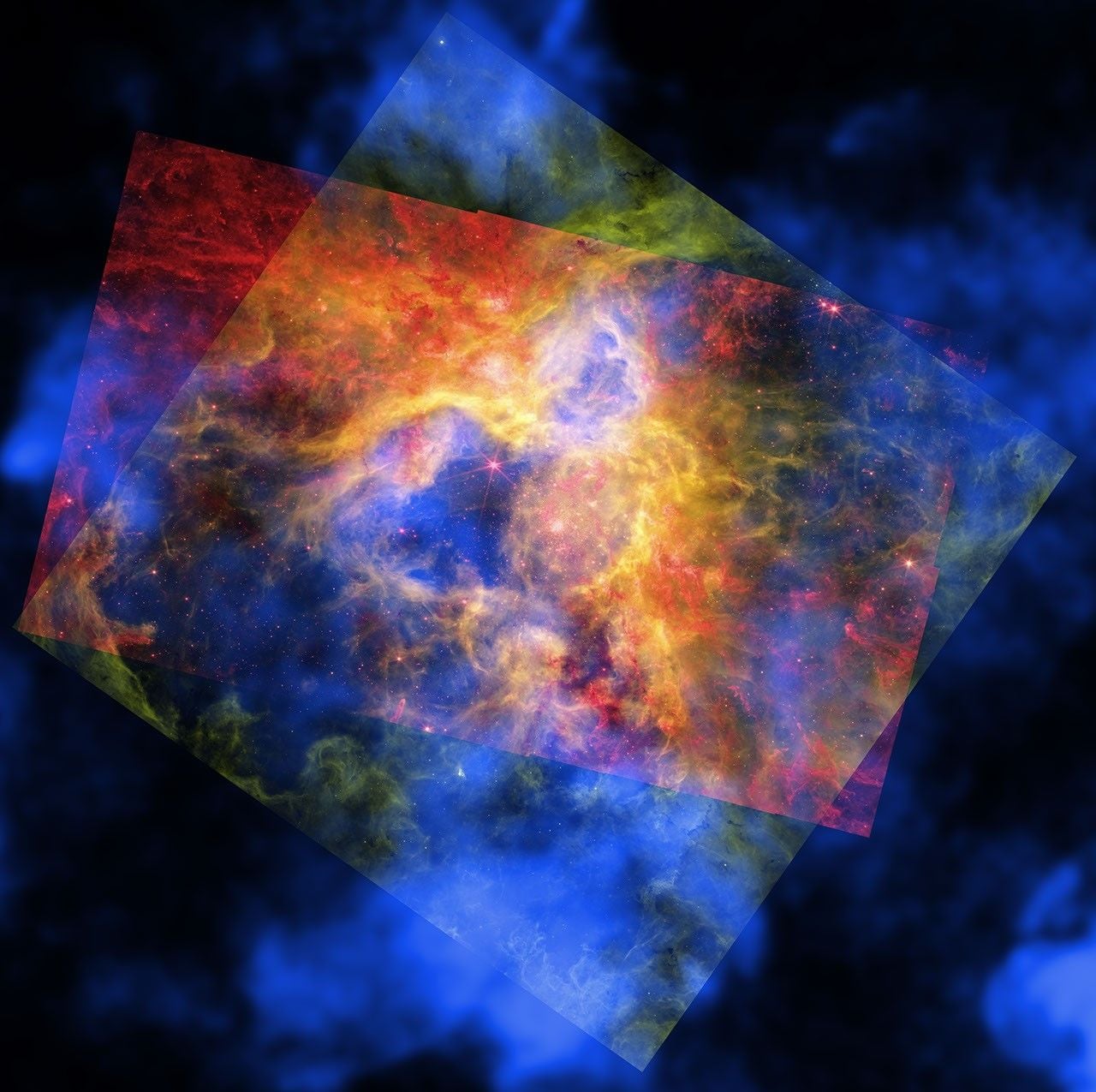
To chase it down, a team led by Jennifer Rodriguez at Ohio State pulled together data from four space telescopes at once; Chandra’s X-ray vision, Webb for infrared, Hubble's optical view, and archival data from the now retired Spitzer. Stacked together, the result is a genuinely striking composite image, built like layers of coloured cellophane. Chandra's X-rays sit in blue, tracing gas superheated by shockwaves, not unlike the sonic boom off a jet. Webb's infrared shows up red, revealing thousands of embedded young stars and the cool dust that will one day seed new stars and planets. Hubble fills in green, picking out warmer hydrogen gas and individual stars threaded through the nebula. Where all three overlap, in the heart of the image, you get a wash of orange, yellow and gold.
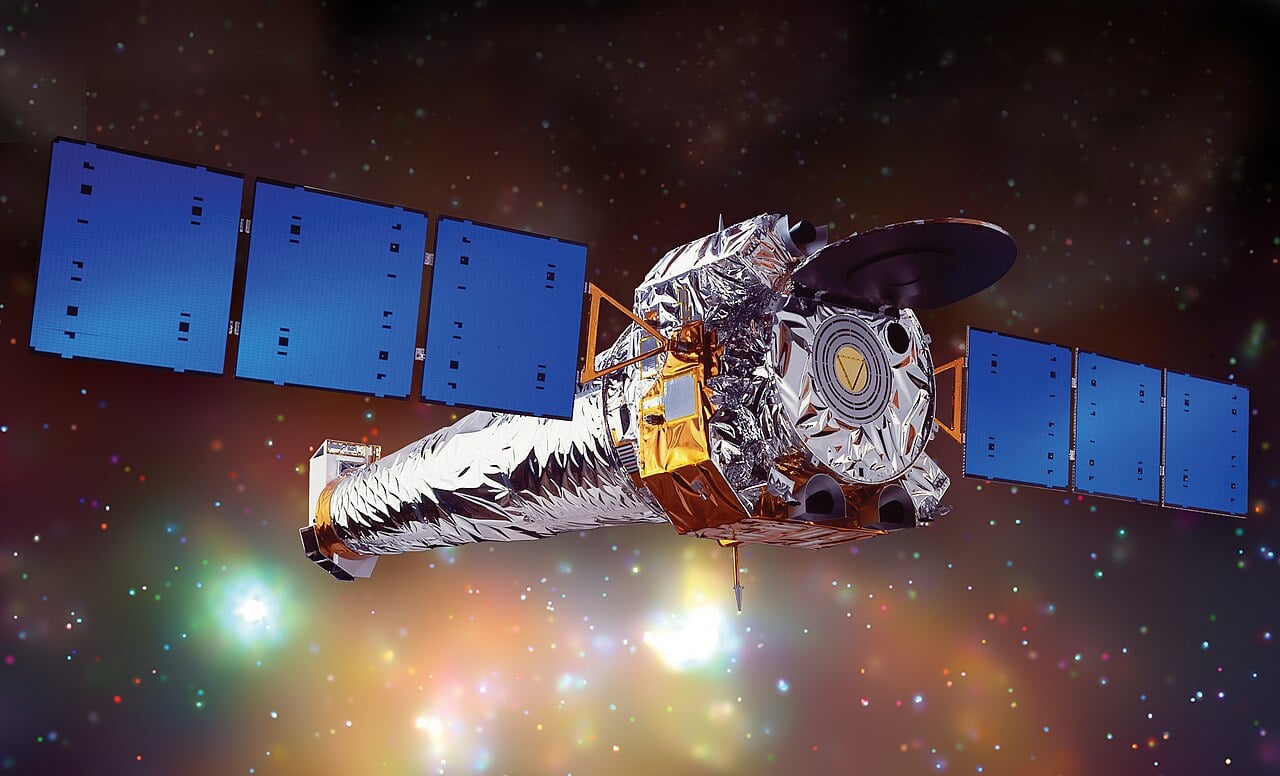 NASA's Chandra X-ray Observatory, the space telescope responsible for the deep X-ray layer in the new Tarantula Nebula composite, and the instrument that first revealed the gap between predicted and observed X-ray brightness in the nebula (Credit : NASA/CXC)
The science behind the picture is where it gets interesting. The team concluded the Tarantula is losing its energy through three separate escape routes working together. As much as half of the hot gas appears to be leaking straight out through the walls of the surrounding gas and dust structures. Some of it is being cooled by turbulent mixing with colder gas nearby. And some, the team believes, is losing heat through simple conduction, hot gas in direct contact with cooler gas, equalising in temperature the way a pan cools once you take it off the heat. None of those three processes alone fully explains the shortfall but together, they do. What I like about this story isn't just the image which really is a beautiful thing to look at. It's the reminder that even in a nebula astronomers have been staring at for decades, there's still a hidden problem that nobody has solved. Instead it took four telescopes, three space agencies, and one very patient team of researchers to finally solve it.
Source : NASA Telescopes Create Colourful "Craft" From Nearby Nebula