 Universe Today
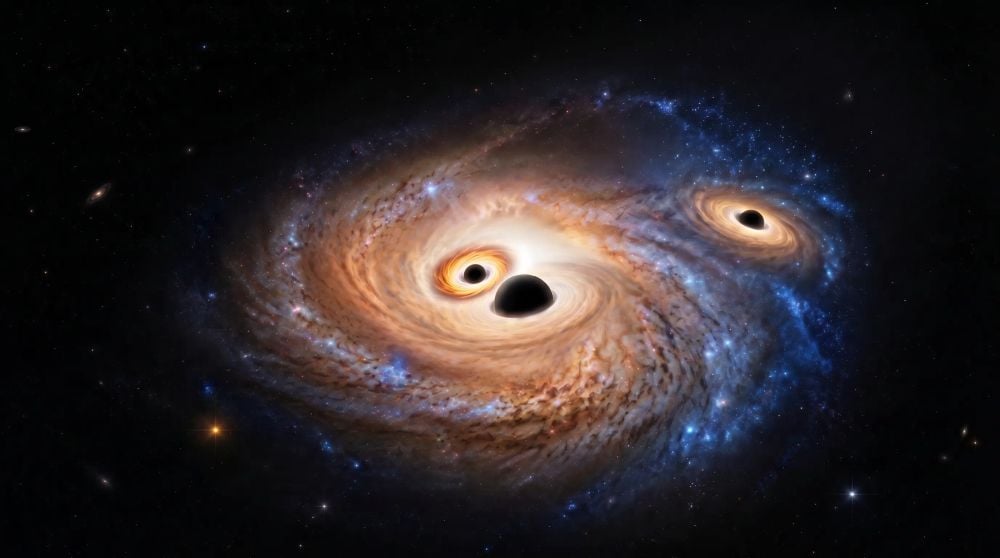
The nature of supermassive black holes (SMBHs) is a hot topic in space science. It appears that all large galaxies like ours host an SMBH in their centers, but how these behemoths grew so massive is not clear. Neither are their origins, though most researchers agree that mergers certainly play a role.
A new discovery is bolstering the idea that mergers are behind the evolution and growth of SMBHs. Astronomers working with the JWST have found three actively accreting black holes in a single galaxy. No triple black hole galaxy has ever been seen before, though instances of three interacting galaxies with SMBHs have been observed.
The discovery is presented in new research in Astronomy and Astrophysics titled "BlackTHUNDER: Evidence of three massive black holes in a z ∼ 5 galaxy." The lead author is Hannah Übler from the Max Planck Institute for extraterrestrial Physics. The term BlackTHUNDER refers to a JWST observing program called "Black holes in the early Universe and their dense surroundings."
The galaxy in question is named J0148-4214 and it's more than 12.5 billion light years away. The JWST observed it as it appeared about 1.2 billion years after the Big Bang. BlackTHUNDER was aimed at observing black holes this old, and the JWST used its NIRSpec Integrated Field Unit to detect the three actively accreting black holes.
They have solar masses of 80 million, 0.6 million, and 2 million. The first two are closest together while the third is more distant. "“The JWST data allowed us not only to identify the three black holes, but also to estimate their masses, accretion rates, and the stellar mass of the galaxy,” said Dr. Giovanni Mazzolari, second author of the study and researcher at MPE. “We find a total stellar mass of about 1.3 billion suns, and the black holes represent a significant fraction of that.”
“This is the first evidence of three active black holes in a single galaxy in the distant Universe,” said lead author Übler from the MPE. Two of the three BH are in the center of the galaxy, only about 620 light-years apart. The third one is in the outer region of the galaxy, about 5500 light-years from the centre. “It suggests that processes in the early Universe were efficient at bringing massive black holes together, setting the stage for the massive black hole mergers we expect to detect with future gravitational wave observatories,” said Übler.
In this work, the researchers found three broad-line regions (BLR) with the JWST. These are regions where hydrogen is moving rapidly. Because of the hydrogen's rapid movement, the Doppler effect spreads or broadens the Hydrogen-alpha emission lines. A BLR can only exist where hydrogen is moving rapidly, including actively accreting BH but also things like supernova, shock, fronts, and stellar winds from massive stars. It's hard to tell from H-alpha alone.
But there's more to this picture. The JWST's observations also show that the OIII (doubly-ionized oxygen) line is narrow. The combination of broad H-alpha and narrow OIII emission lines is a fingerprint of an AGN, and it eliminates the other potential sources of the emissions. This is how the researchers know what they're seeing are BH instead of something else like a supernova or a star-formation region.
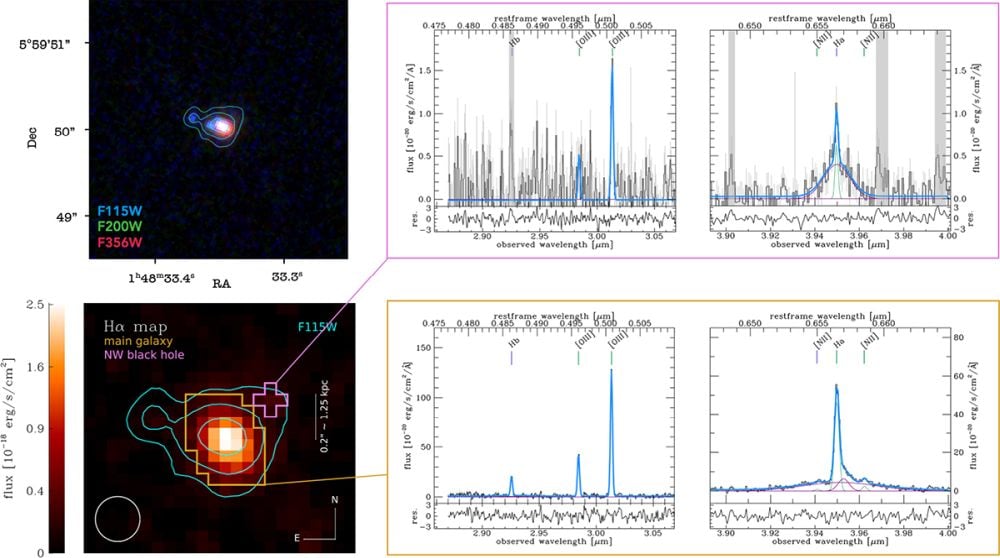 This figure shows JWST images of J0148-4214 on the left, along with spectra in the middle and right columns. The middle column shows narrow OIII lines while the right column shows broad H-alpha emissions. Image Credit: Übler et al. 2026. A&A. https://doi.org/10.1051/0004-6361/202557419
"The black holes are revealed through broad Hα emission (FWHM = 430–2920 km/s) without a forbidden-line counterpart in the bright [O III] doublet," the authors write. "Channel maps of the asymmetric central Hα profile isolate two spatially distinct broad-line regions (BLRs), separated by 190 ± 40 pc, while a third BLR is found in the galaxy outskirts with a projected separation of 1.7 kpc."
There are two paths BHs can follow as they grow. They can merge, and they can accrete material. Over the vast sweep of cosmic time, accretion is the dominant driver of growth. But for certain BH mass ranges and for certain times in cosmic history, mergers make a more significant contribution. These observations show how both mechanisms are active. The detection of BLR shows that active accretion is taking place in J0148-4214, while mergers are also on the horizon.
The closest pair of BH will likely merge soon, while the third outlying BH is slowly approaching the center. Eventually, it too will merge.
“These results are extremely exciting,” said Roberto Maiolino, professor at the University of Cambridge and co-author of the study. “They suggest that black hole merging may be an additional, fast route for their rapid growth in the early Universe.”
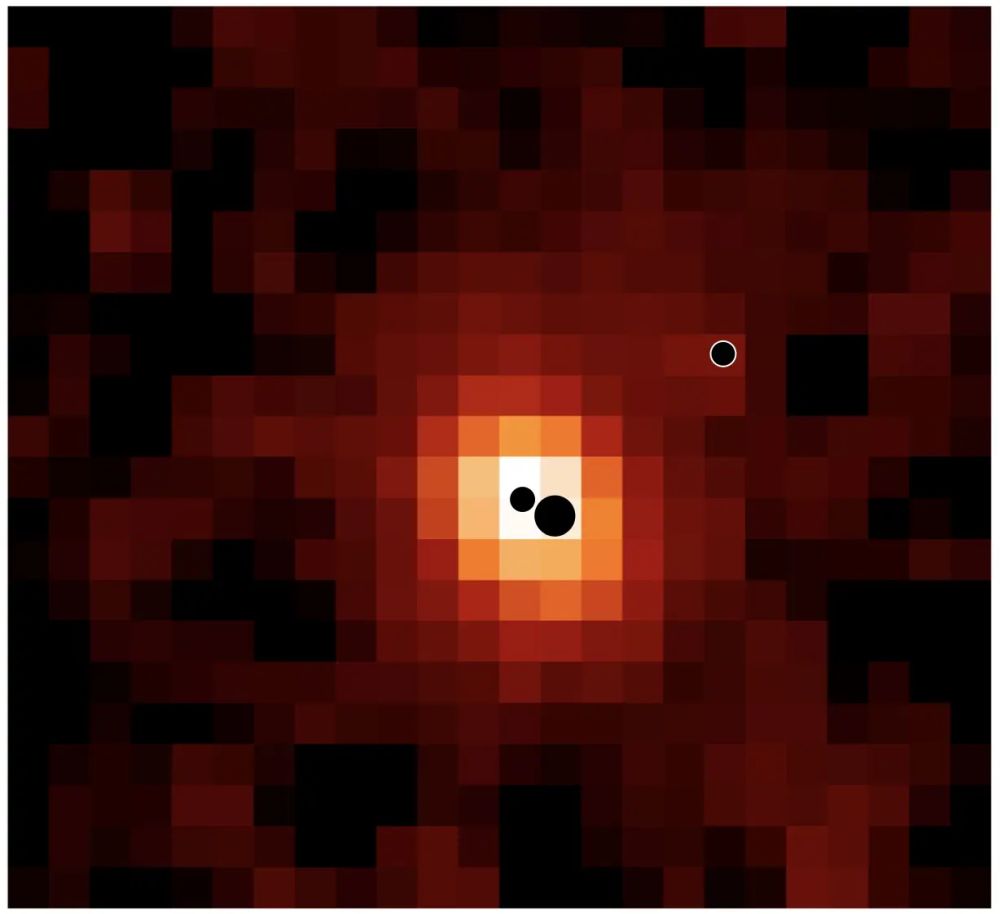 This is an ionized hydrogen map of J0148-4214 from the JWST. The three black circles are the black holes (not to scale). The most and least massive BH are closest together and should merge in about 700 million years. The more distant one is destined for a later merger. Image Credit: Hannah Übler
"We argue that the two central black holes will likely rapidly merge, with a simple dynamical friction time estimate of the order of ≲700 Myr. Assuming that the third off-nuclear black hole is also in the process of sinking towards the centre, it will likely lead to a second merger," the authors write.
The third black hole has another potential explanation, too. "Alternatively, the third black hole may be the result of a previous central three-body interaction or a gravitational recoil," the researchers explain. In that case, the team's observations show that a BH can retain its accretion ring and BLR even after a dynamic event.
The JWST is growing our understanding of the early Universe. These results show that, like many researchers suspected, galaxies with multiple black hole systems weren't rare, and their mergers played a big role in building the SMBH we see today.
"The possible discovery of a black hole triplet at high redshifts, together with other recent results on distant black hole pairs, indicates that multiple massive black hole systems were likely common in the early Universe," the authors conclude.

