Universe Today
The "cosmic web," what we call the large-scale structure of the Universe, is a vast network of interwoven filaments surrounding massive, nearly empty voids. Understanding how this structure expanded and evolved from the beginning of time onwards has always been the central aim of cosmologists. This has always been a challenge due to the limits of our instruments and the very nature of a relativistic Universe.
But thanks to scientists and the next-generation instruments and methods they are using to probe the deep fields of the Universe, we are getting closer to seeing how it all came to be. The latest milestone comes from a team led by astronomers from the University of California Riverside (UCR). Using data from NASA's James Webb Space Telescope (JWST), this team has produced the most detailed map of the cosmic web ever made.
Thanks to Webb's powerful optics and sensitivity, the COSMOS-Web map traces the network of galaxies and filament structures all the way back to when the Universe was emerging from the "Cosmic Dark Ages" 1 billion years after the Big Bang. The team was led by Hossein Hatamnia, a PhD student in astronomy at UC Riverside, and Bahram Mobasher, a distinguished astronomy and physics professor at UCR and Hatamnia’s advisor.
They were joined by researchers from the Laboratory for Multiwavelength Astrophysics, the Cosmic Dawn Center (DAWN), the Millennium Nucleus for Galaxies (MINGAL) in Chile, the Infrared Processing and Analysis Center (IPAC), the Space Telescope Science Institute (STScI), NASA's Jet Propulsion Laboratory, and multiple institutes and universities worldwide. Their study appeared on May 6th in The Astrophysical Journal.
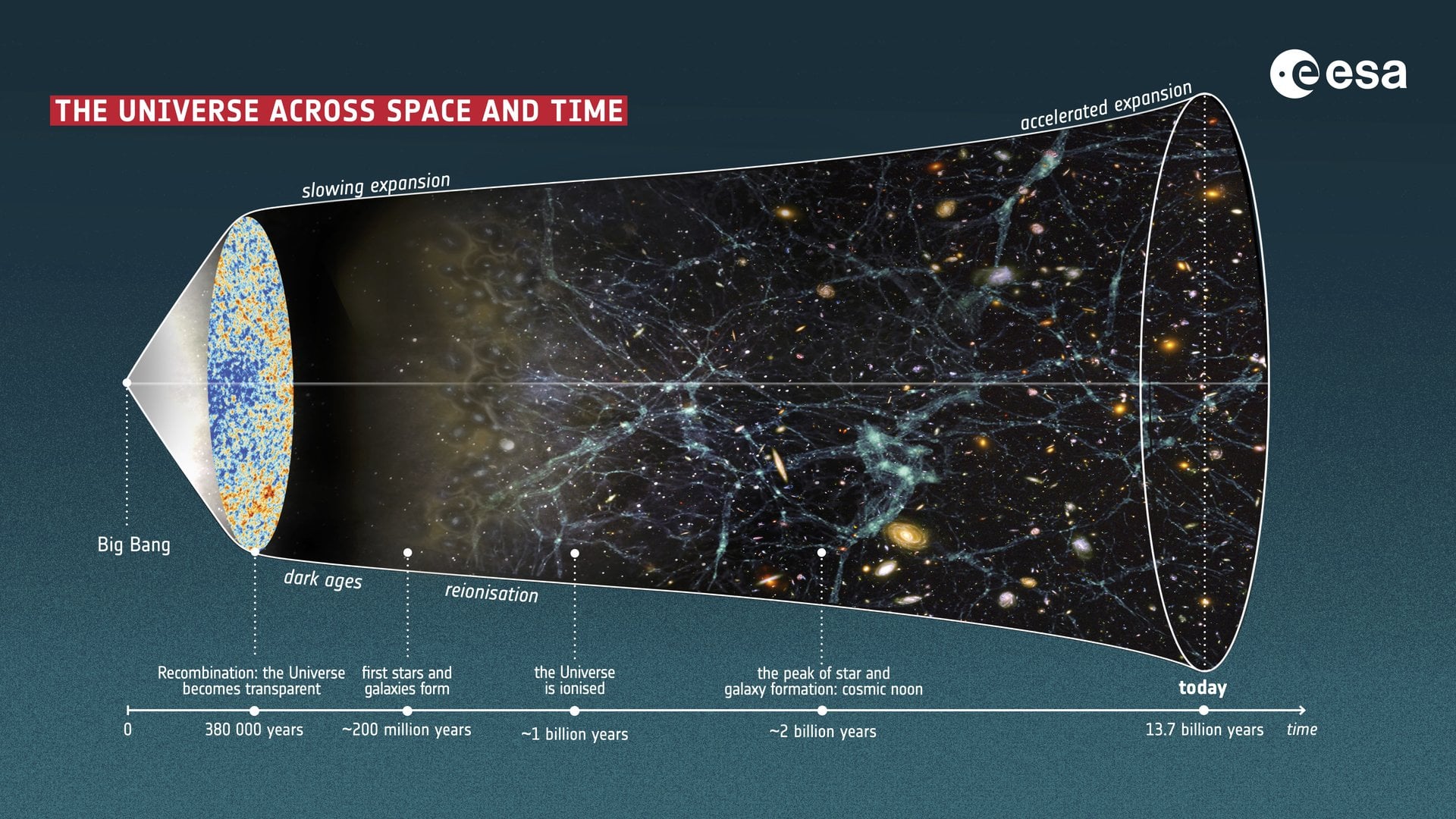 Artist's representation of cosmological history since the Big Bang. Credit: ESA
This latest map was created through COSMOS-Web, the largest of the JWST's Cycle 1 General Observation (GO) programs. This consisted of 152 wide-field observations over 255 hours using Webb's Near-Infrared Camera (NIRCam) and Mid-Infrared Instrument (MIRI) in parallel. The purpose of this ambitious program was to trace the evolution of galaxies from the Epoch of Reionization to the present and to examine the role of Dark Matter.
This program leveraged JWST's extreme sensitivity and sharpness, which have allowed astronomers to map parts of the early Universe that were previously invisible. This includes objects that were obscured by cosmic dust and those that existed less than 1 billion years after the Big Bang. The COSMOS survey began in 2002 as a program that would use the Hubble Space Telescope to image a much larger region of the night sky, about the area of 10 full Moons.
Since then, the program has evolved into an international collaboration and a multi-wavelength survey that includes most of the world's major ground-based and space-based telescopes. By adding Webb's infrared optics to the mix, the new map is much more detailed than the earlier Hubble maps of the same region of the sky. A direct side-by-side comparison shows how much the previous generation of data had been smoothing over structures.
Said Bahram Mobasher, a distinguished professor of physics and astronomy at UCR and Hatamnia’s advisor:
The jump in depth and resolution is truly significant, and we can now see the cosmic web at a time when the universe was only a few hundred million years old, an era that was essentially out of reach before JWST. What used to look like a single structure now resolves into many, and details that were smoothed away before are now clearly visible. The pipeline used to build the map, the catalog of 164,000 galaxies and their cosmic density, and a video showing the cosmic web evolving across billions of years, has been released to the public.
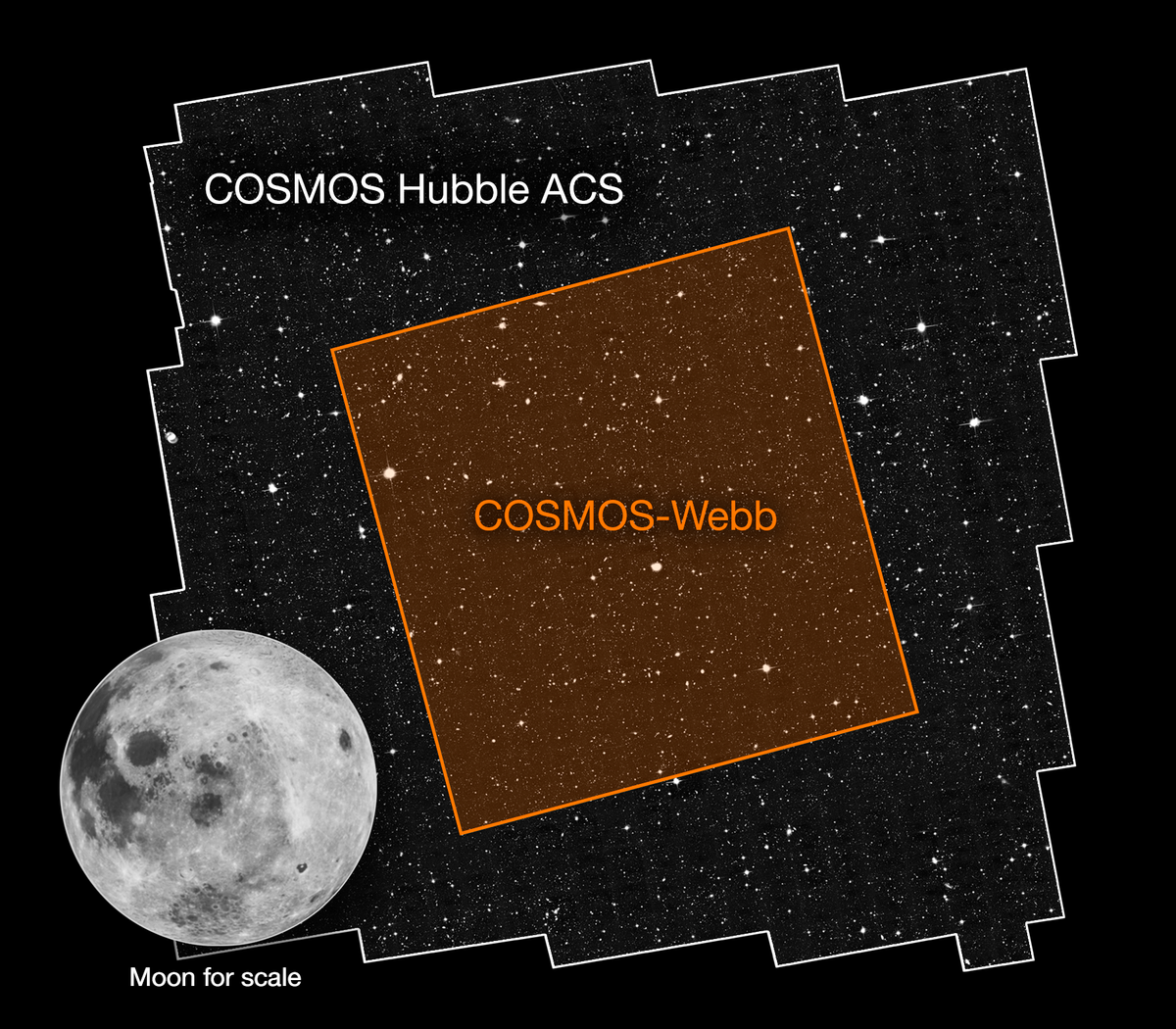 The COSMOS-Webb survey mapped 0.6 square degrees of the sky using the JWST's NIRCam and 0.2 square degrees with MIRI. Credit: NASA/ESA/RIT/UT Austin/STScI
Said lead author Hossein Hatamnia, a graduate student at UCR and Carnegie Observatories, the improvement in the new map comes from two of JWST's greatest strengths working together:
JWST has completely changed our view of the universe, and COSMOS-Web was designed from the start to give us the wide, deep view we need to see the cosmic web. For the first time we can study the evolution of galaxies in cluster and filamentary structures across cosmic time, all the way from when the universe was a billion years old up to the nearby universe.
The telescope detects many more faint galaxies in the same patch of sky, and the distances to those galaxies are measured far more precisely. Each galaxy can therefore be placed into the correct slice of cosmic time, sharpening the map's resolution.
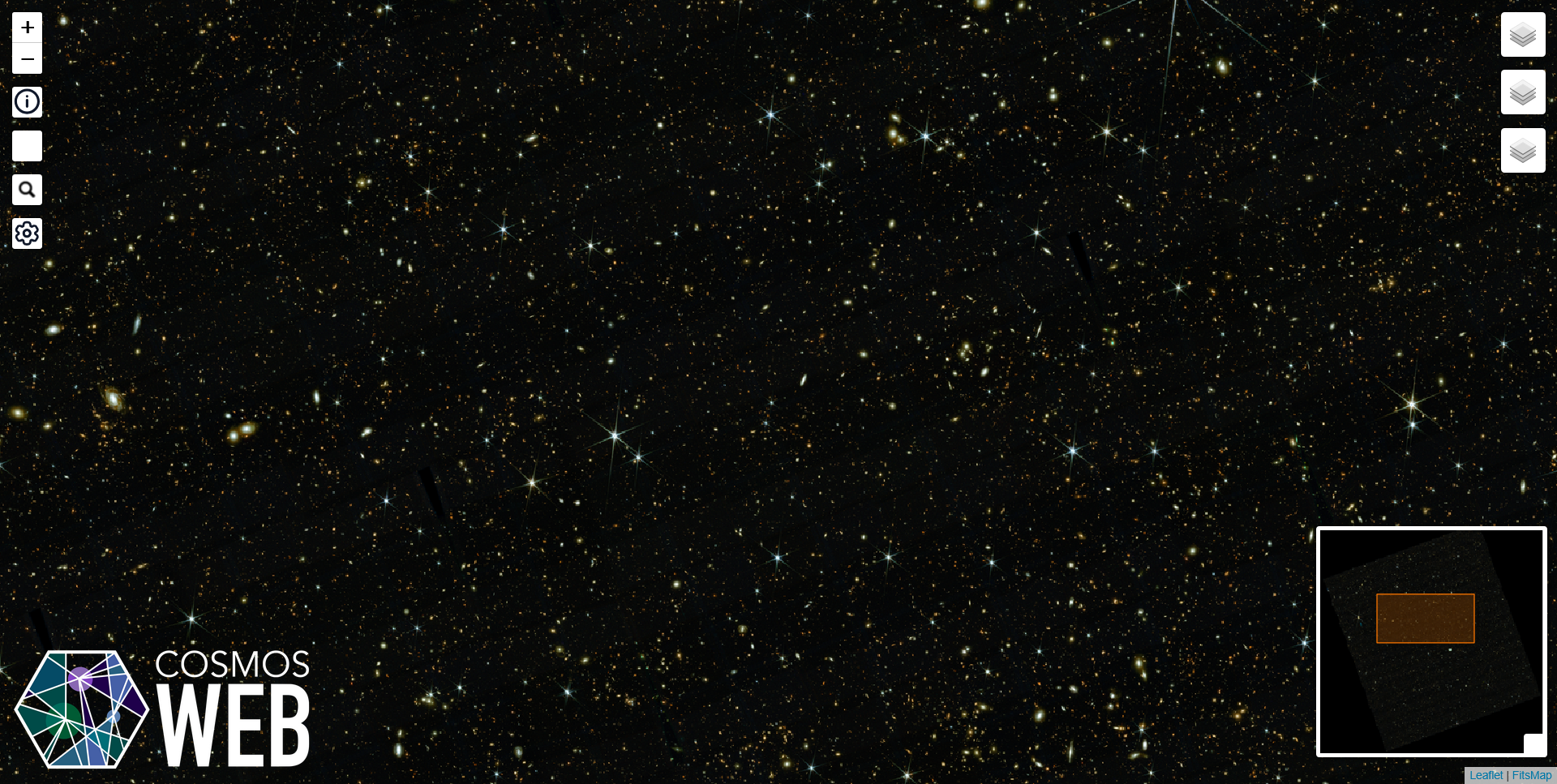
In keeping with COSMOS’s long tradition of open science, the team has released the large-scale structure maps to the public as part of the COSMOS-Web Data Release 1.0. The complete NIRCam and MIRI mosaics plus the COSMOS-Web Catalog can be accessed here, and an interactive version of the mosaics can be seen here.
Further Reading: UCR News