 Universe Today
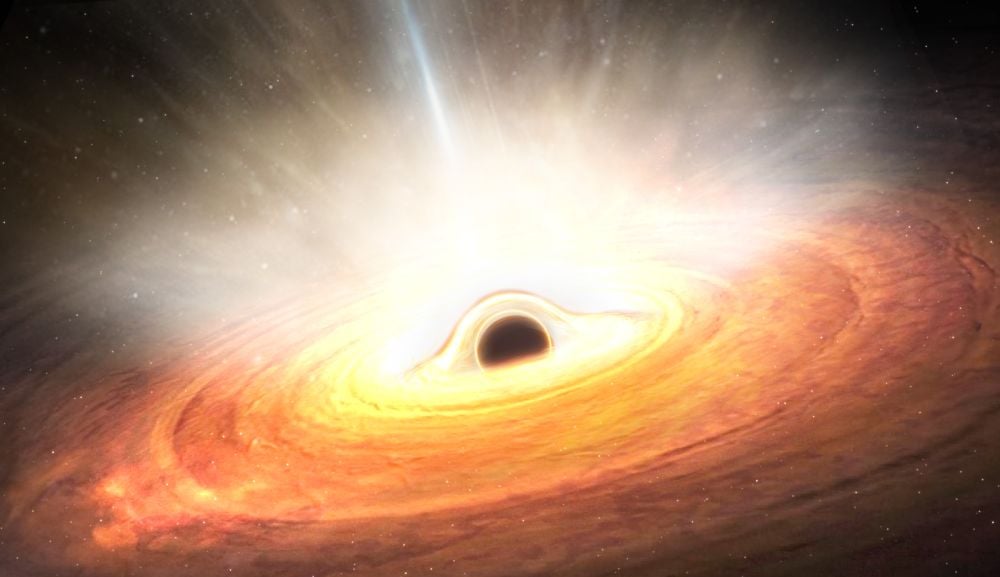
Supermassive black holes are primarily known as one-way entitities. Their overpowering mass warps spacetime, and they swallow dust, gas, planets, stars, and even light itself. But they also blow powerful winds when they're active.
When black holes feed, the material first gathers in an accretion disk around the BH. Material swirls around and heats up in the disk before it crosses the event horizon and disappears forever, or something. But not all of the material in the disk falls into the hole. Magnetic forces inside the disk generate winds that blast out into the BH's surroundings.
The Milky Way's supermassive black hole (SMBH), Sagittarius A-star, must produce a wind just like other SMBH. If it didn't, it would be a very strange outlier in need of a convincing astrophysical explanation. Astrophysicists have spent 50 years searching for its wind, but their efforts have not been fruitful. Until now.
New research in The Astrophysical Journal Letters presents the first detection of Sagittarius A-star's wind. It's titled "The Discovery of an Active Wind from the Milky Way’s Central Black Hole," and the authors are Mark D. Gorski and Lena Murchikova. They're both from the Center for Interdisciplinary Exploration and Research in Astrophysics at Northwestern University in Illinois.
"Every large galaxy has a black hole in its center," the authors write. "The interaction between the black hole and its host profoundly shapes galactic evolution and the Universe as a whole. The key features of this interaction are black hole jets—or more generally, winds—which every black hole must have."
Astrophysics shows us that the only way a SMBH could have no winds or jets is if it's in a total vacuum. But there are no perfect vacuums in our Universe, so Sagittarius A-star must be producing a wind.
"Despite the proximity and importance of our Galaxy’s central black hole, Sagittarius A* (Sgr A*), the active wind from it has eluded scientists for over half a century," the researchers write. It's difficult to see into the center of the galaxy because it's blocked by the plane of the galaxy, and all of its gas and dust.
“To observe our own black hole, we have to look through the plane of our galaxy,” Murchikova said. “That means we have to peer through gas, dust and ionized structures, and you can’t really see through all of that easily.”
It's also possible that the SMBH is in a period of total inactivity, meaning even perfect observations wouldn't detect it. But that never seemed very likely to scientists.
"Unless a black hole exists in a perfect vacuum, it must blow a wind somehow,” said Northwestern’s Mark Gorski, who co-led the study. “And there is no perfect vacuum in the universe. With new observations, this is the first time we’ve had a clean enough view to see the wind’s imprint. We looked at the data and said, ‘There it is. There is the thing that everybody’s been looking for for 50 years.’”
The thing they saw is a large cone-shaped clearing in gas near the SMBH created by the SMBH itself.
“We were the first to show that molecular gas very, very close to the black hole is feeding it,” said Elena Murchikova, who co-led the study with Gorski. “The wind is not powerful, and its direction probably wanders with time. It shows that our black hole is not unique, and our place in the universe is not unique.”
Scientists already knew a lot about this central region of the Milky Way. "It is well established that the inner few parsecs of the Galactic center contain a large amount of molecular gas," the authors write. Most of it is in a structure called the circumnuclear disk or CND. The CND extends to about 3 to5 parsecs from the SMBH. Previous research shows that the CND's inner edge was about 0.5 parsecs from the SMBH. The CND is mostly devoid of the cold molecular gas that forms stars, and full of hot ionized gas and atomic gas.
In this work, the researchers used ALMA to carefully observe the SMBH's neighbourhood. These new observations show that there's plenty of cold molecular gas there.
"Carbon monoxide (CO) is the most commonly used tracer of the molecular gas in the interstellar medium (ISM)," the authors explain. "It emits bright lines and is readily excited at the low densities and temperatures." The authors used ALMA to measure carbon-12's rotation and map out the gas in the region.
"We detect a large conical clearing in the cold molecular gas surrounding Sgr A-star that is at least 1 parsec long and has a ∼45° opening angle," the authors write. "The morphology and energetics of this structure are consistent with active clearing of gas by a hot wind from Sgr A-star."
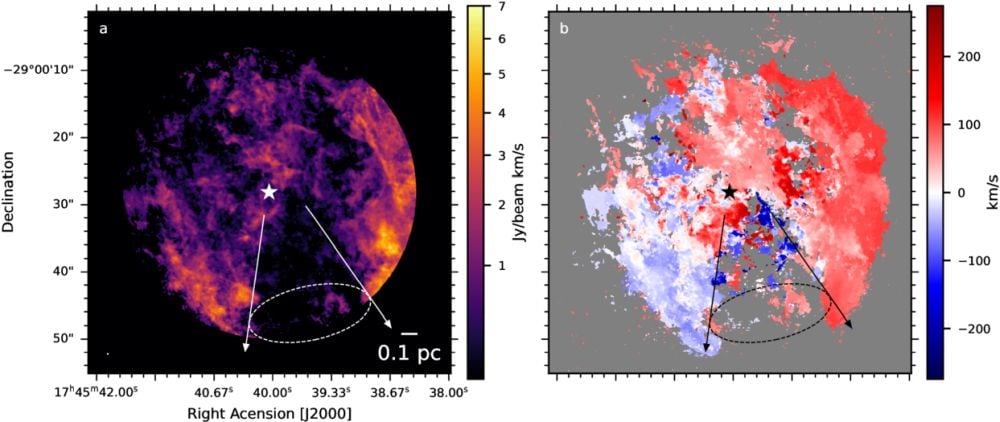 These panels from the research shows the conical clearing in the gas near Sagittarius A-star. The researchers say it's clear evidence of the SMBH's winds. The left panel shows carbon-12 and highlights the molecular gas structure. The right panel shows gas rotation around the black hole. Image Credit: Gorski and Murchikova 2026. ApJL DOI 10.3847/2041-8213/ae63cf
SMBH emit winds from very near the event horizons, where conditions are hottest. As this hot wind moves outward, it slams into colder molecular gas in the CND. "In this context an outflow/wind from the black hole would be identified by a clearing of cold gas on the path of the high-temperature plasma," the authors write. ALMA's data shows a cone-shaped area devoid of cold gas, which is exactly what should be there if Sagittarius A-star does have winds.
“If you blow hot material from the black hole, it’s not going to want to exist with the cold material,” Gorski said. “It’s either going to push the cold material out or heat it up. And, if it’s too hot, you will no longer see the cold gas.”
Nothing else in the region could've created this conical void. Stars have winds, too, but this is far too massive to be from a star. There are a lot of stars there in the nuclear cluster. But even if the winds from all of the stars in the region were combined together, they couldn't create a void this large. And why would it be conical? They also considered a supernova origin for the cone and discarded that. For the authors, there's one clear conclusion.
“It’s a huge absence of material,” Gorski said. “We calculated how much energy was needed to create this cavity. It is more than can be provided by the stars in that area. Basically, there has to be input from the supermassive black hole. And, if you follow the shape of the cone, it’s pointed directly at the black hole.”
"We argue that the observed CO cavity is likely created by a hot active wind originating from Sgr A-star," the researchers write.
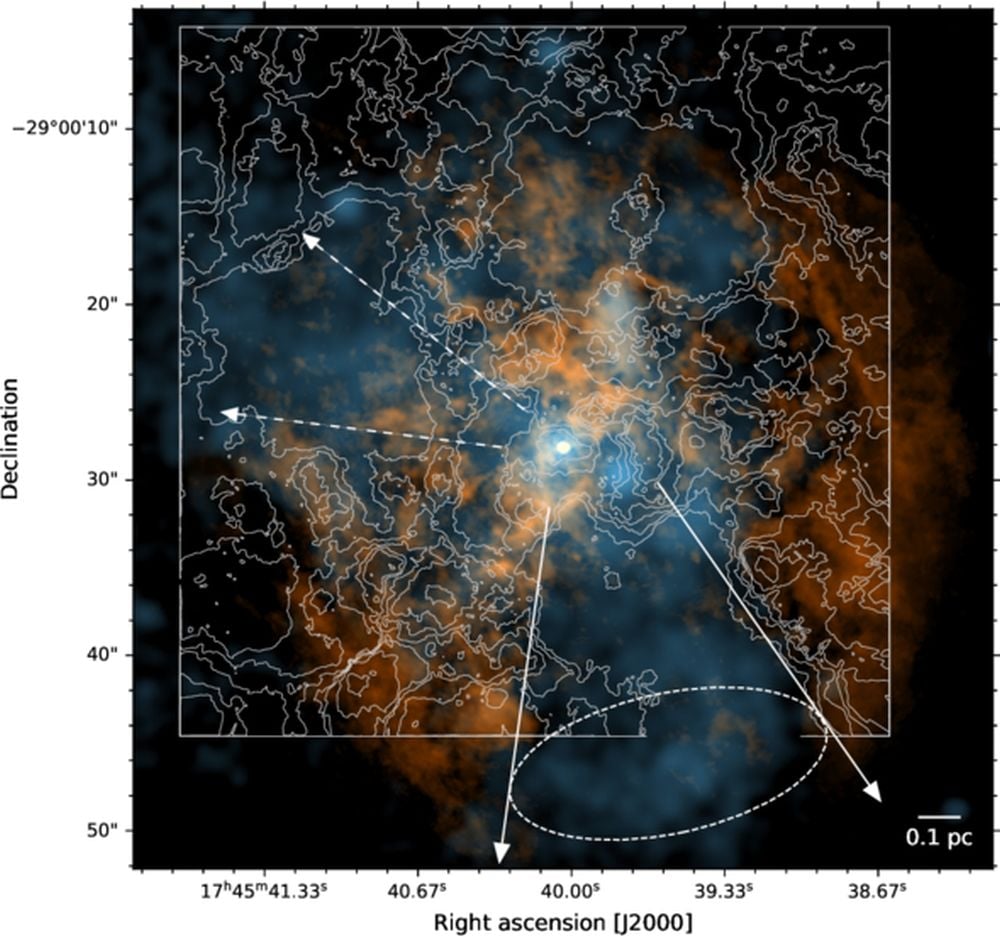 This figure from the research shows the conical void in the lower right. But it also reveals another feature in the upper left. The authors say this is a "tentative counterwind cone," which supports the idea of a black hole wind creating the cone. Image Credit: Gorski and Murchikova 2026. ApJL DOI 10.3847/2041-8213/ae63cf
But before they reached their conclusion, they needed more evidence. Though it's exciting seeing something that nobody else has seen, even after 50 years of trying, it's natural to want to be sure before you go public.
Fortunately, NASA's Chandra X-ray observatory has observed this region and found an x-ray source in the same spot as the conical void.
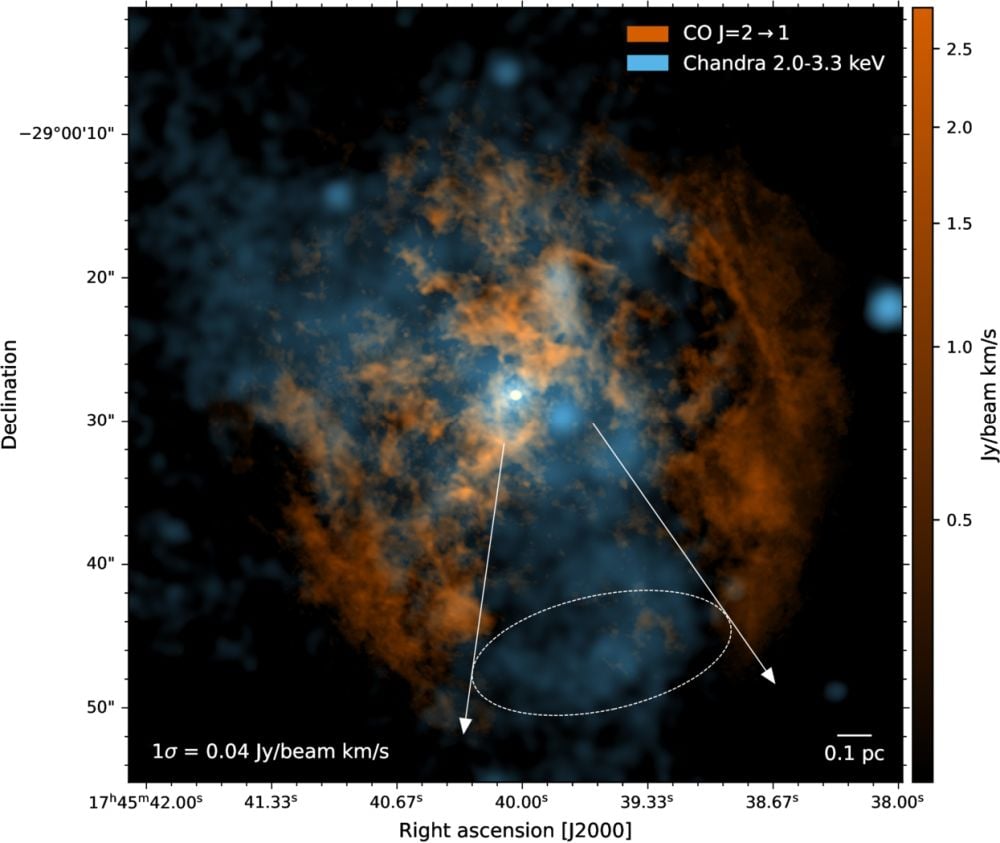 This image shows both molecular gas (orange/brown) data from ALMA and x-ray (blue) data from Chandra. Since hot gas emits x-rays, the blue in the cone shows how Chandra's observations match ALMA's. Image Credit: Gorski and Murchikova 2026. ApJL DOI 10.3847/2041-8213/ae63cf
“Exceptional claims require exceptional evidence,” Gorski said. “We wanted to make sure that we weren’t just looking at some sort of imaging artifact. Then, the X-ray image from Chandra just slotted in perfectly. The molecular features lined up.”
“When you find something that no one has seen before, the first thought that runs through your mind is not ‘Oh my god, we made a discovery,’” Murchikova said. “It’s ‘Oh my god, what’s wrong with my analysis?’ But when we overlaid our image with the X-ray image, it started to make sense.”
The authors say the wind has likely been active for 200,000 years, and that it isn't particularly strong. "The wind is relatively weak and likely deflected from its launch orientation by the interaction with the ambient gas, as evident from the asymmetry of the cavities it creates," they write.
Some winds/jets are stronger and more consistent in their direction. But this wind appears to be far less uniform. This one likely changes direction, depositing energy into different parts of the CND. "The findings in this work are consistent with intricate and tangled phenomena of feeding and feedback in the Galactic center revealed in previous studies," the authors write.
Sagittarius A-Star is the only SMBH that's close in astronomical terms, even though it's 27,000 light years away. But others are far more distant, and are generally only visible when they're active. That only emphasizes how valuable these observations of Sgr A-star are.
“The majority of other galaxies spend most of their lives in a state where they are not particularly active,” Murchikova said. “But we can only see them when they are in a fireworks stage. It is very attractive to study black holes when they are in the fireworks stage, but that’s not actually their dominant state. Sgr A* finally gives us a window into the life of a black hole in this quiet state.”
"We therefore would argue that the phenomena observed here of weak and wandering feedback over the central region of the galaxy are not unique and likely apply to most of the other quiescent galaxies in the Universe," the authors conclude.

