Universe Today
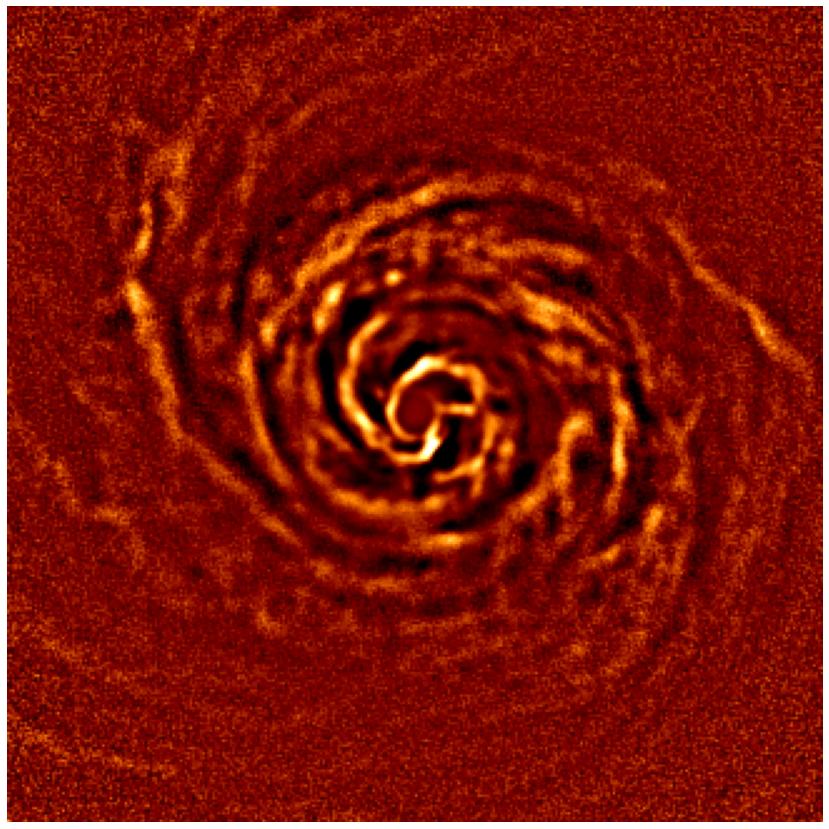
Ever since the first protoplanetary disk was discovered in 1984 around the star Beta Pictoris, these objects have presented astronomers with laboratories to study the births and evolution of worlds around distant stars. A team at France's National Center for Scientific Research (CNRS) and the University of Bordeaux, made a recent breakthrough in understanding these planetary birthplaces when they directly observed the rotation of a protoplanetary disk around the young star AB Aurigae.
The disk appears to rotate as you might expect based on based on the laws of physics. However, there are several regions there that don't quite move as predicted by theory. Such a rotational anomaly likely is caused by the presence of giant planets in the process of formation in the disk.
The team used an instrument called SPHERE (for Spectro-Polarimetric High-contrast Exoplanet REsearch), installed on European Southern Observatory's Very Large Telescope in Chile. This highly sensitive infrared tool allowed the team to track the disk's rotation by focusing on emissions from dust grains embedded in the disk.
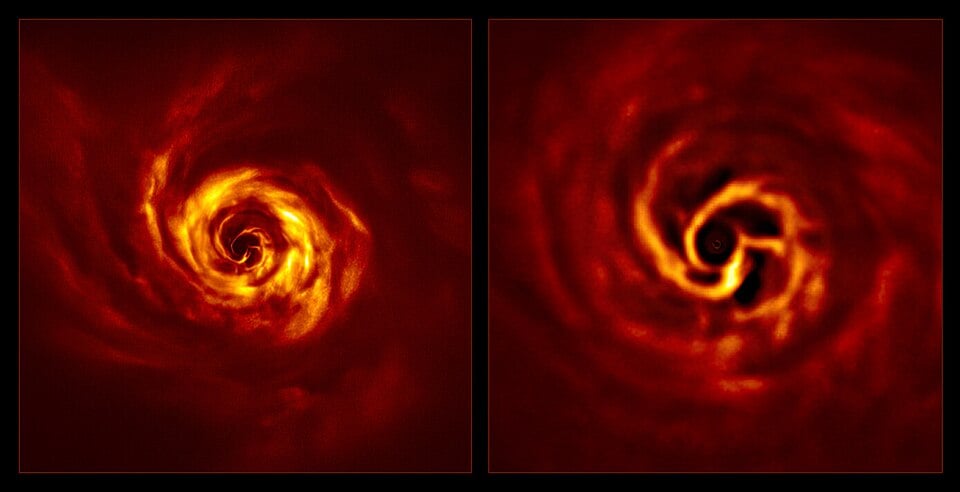 SPHERE images taken in 2020 of the AB Aurigae system showing the disc around it. The image on the right, a zoomed-in version of the central part of the image on the left, shows the inner region of the disc. Courtesy ESO.
AB Aurigae and Its Disk
The Hubble Space Telescope captured some of the first detailed images of the AB Aurigae disk, and ever since then astronomers have studied the disk to find more evidence of planetary birth. The disk actually has several suspected regions where planets could be forming. At least one appears to be associated with strange twists in the cloud. Since planetary birth is still a not-completely understood process, motions like those in AB Aurigae's disk are important clues to the process and may provide signature proof of newly forming worlds.
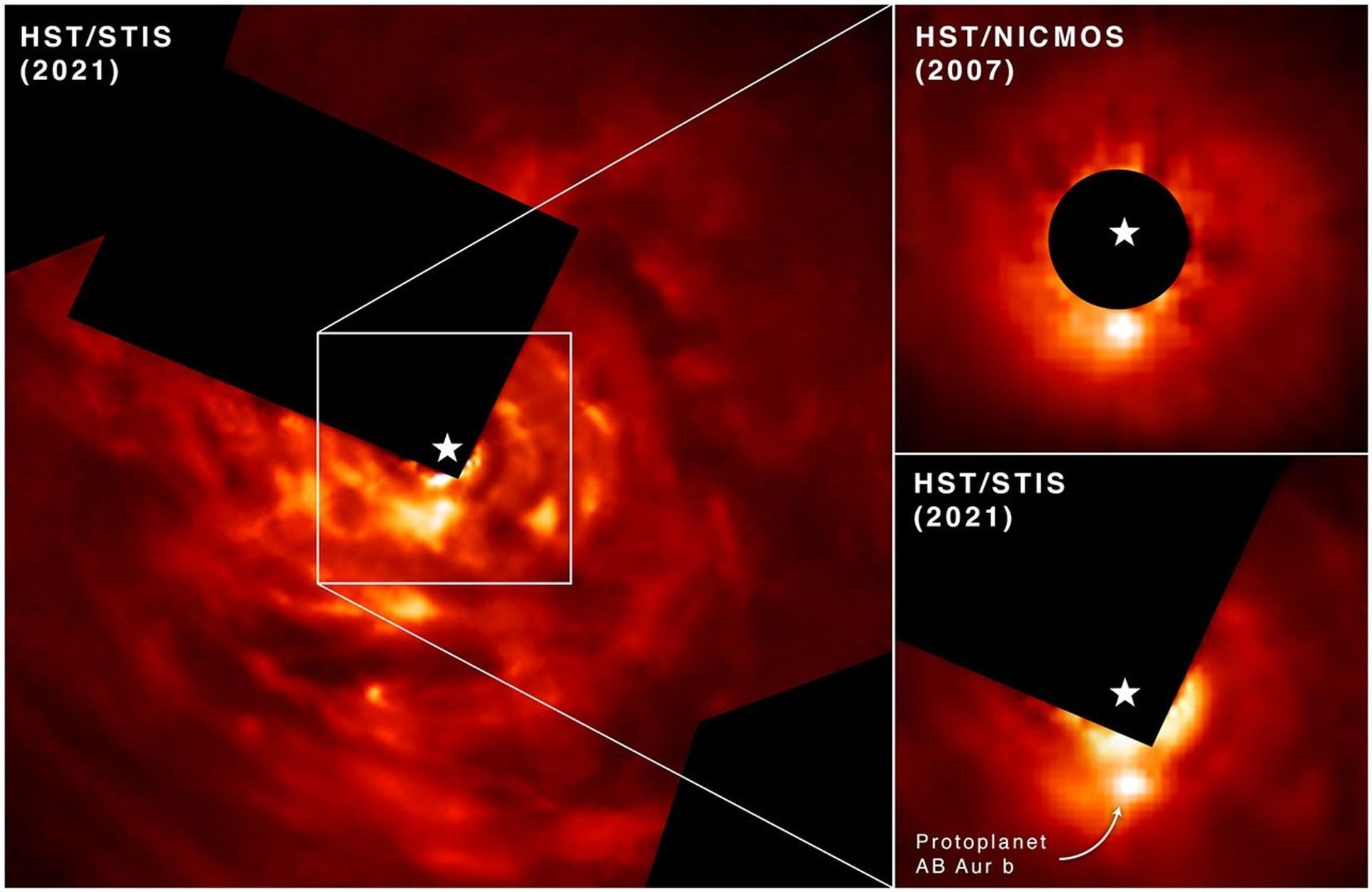 Researchers directly imaged newly forming exoplanet AB Aurigae b over a 13-year span using Hubble's Space Telescope Imaging Spectrograph (STIS) and its Near Infrared Camera and Multi-Object Spectrograph (NICMOS). In the top right, Hubble's NICMOS image captured in 2007 shows AB Aurigae b in a due south position compared to its host star, which is covered by the instrument's coronagraph. The image captured in 2021 by STIS shows the protoplanet has moved in a counterclockwise motion over time. Courtesy NASA/ESA/STScI
AB Aurigae itself is a pre-main-sequence variable star around 4 or 5 million years old. As with any other star, it formed inside a cloud of gas and dust. Something set the cloud in motion, and the force of gravity pulled material into a clump that eventually became a protostar. Over time, the rest of the cloud rotated and flattened to form the protoplanetary disk. Hubble and ground-based observations directly imaged a huge gas giant in the middle of development around AB Aurigae, called AB Aurigae b. It lies fairly far away from the star, at a distance of 93 astronomical units (AU) and appears to be somewhere around 9 Jupiter masses.
There are other suspected sites of planetary formation in the AB Aurigae protoplanetary disk. One may lie about 30 AU from the star and could be why there's a there's a twist in the disk. Another two possible protoplanetary candidates lie around 400 to 600 AU away, and appear as dense clumps in the outer parts of the cloud.
SPHERE Observations Tell the Tale
From the first detailed observations of AB Aurigae's disk, its unusual appearance have suggested a number of events that shaped it. For one thing, it may have interacted with another dense cloud. That could have disrupted the disk. In addition, observations with the Atacama Large Millimeter Array (ALMA), showed gas-rich spiral arms in the cloud. It's likely these arms have formed in response to the existence of a planet within 80 astronomical units of the star. Those other planets are also affecting the cloud. One seems to be clearing out a path through the disk. The one at 93 AU could be creating its own accretion disk. Or, it could be a planet that's still forming and destabilizing its region in the disk.
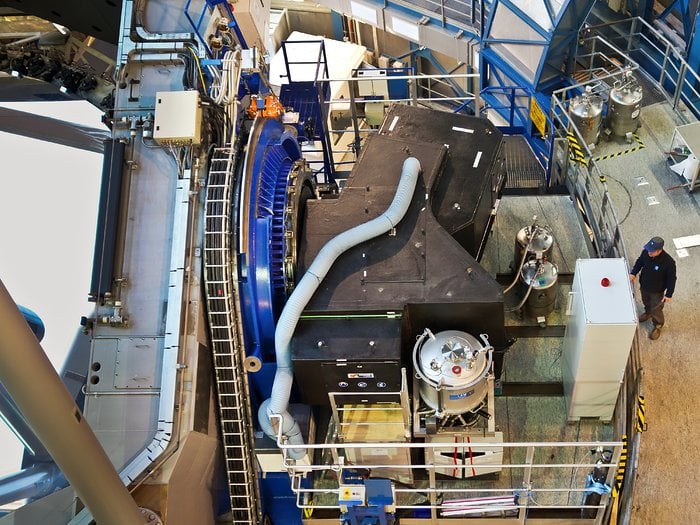 The SPHERE instrument is shown shortly after it was installed on ESO’s VLT Unit Telescope 3. The instrument itself is the black box, located on the platform to one side of the telescope. Courtesy ESO/J. Girard
The SPHERE observations allowed the team to track the disk's structures with a high degree of accuracy. They identified a bright region that is characteristic of accretion zones in disks. These are where gas and dust coalesce and eventually fall onto an object in the process of forming a gas giant planet. Images of the AB Aurigae disc also reveal the rapid rotation of faint shadows cast onto its surface by invisible structures. These could possibly be more planets in the process of formation. Or, they might be opaque clumps of dust orbiting close to the star.
These findings, which show more complex motions than those predicted by theoretical models of disk formation, rotation, and other motions, have opened up new lines of research. Eventually, such observations should give scientists a more richly detailed understanding of the formation and evolution of protoplanetary disks and their eventual planetary offspring.
For More Information
First Ever Live Observation of the Rotation of a Planetary Nursery
Destructuring the disk of AB Aurigae: Dynamics and Accretion