Universe Today
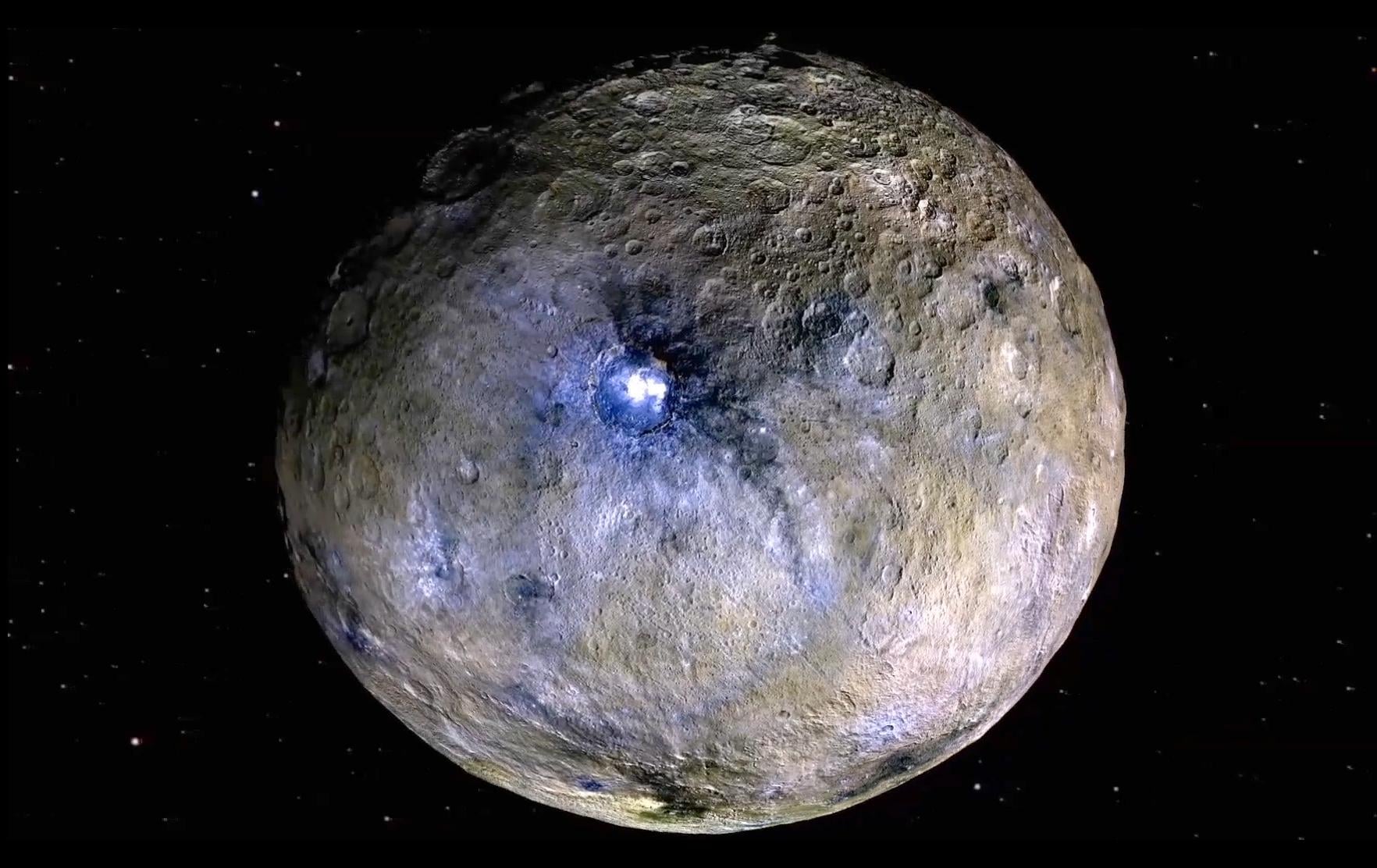
The long, puzzling dwarf planet Ceres, in reality the first named asteroid, has surface features that are much more complex than previously thought. Or at least that’s the conclusion of a recent paper given at the recent European Geosciences Union 2026 General Assembly in Vienna.
New data analysis from NASA’s Dawn mission points to a surface with steep slopes, fractures, and albedo variations complicating crater identification.
In fact, Ceres has perplexed astronomers since its discovery in 1801 by Italian astronomer Giuseppe Piazzi. Yet in 2006, it was controversially reclassified as a dwarf planet, primarily due to its large size and differentiated interior. That is, unlike most asteroids, Ceres has a core, a mantle, and a crust. Some astrobiologists posit that the dwarf planet may have even once developed primitive microorganisms.
Even if so, Ceres was never an astrobiological Valhalla. About a quarter of the size of our moon, Ceres itself only spans about 960 km in diameter. But due to its unique internal history and composition, it remains scientifically compelling.
Toward the end of the Dawn mission, a detailed re-examination of the gravity field in the Occator crater region revealed a gravity anomaly at a depth of some 50 km, Alicia Neesemann, a remote sensing analyst and planetary scientist at Freie Universitat Berlin, told me in Vienna.
This anomaly indicates the presence of less dense material, interpreted as a subsurface reservoir of brines (salty water), says Neesemann. These brines likely ascended through subsurface fractures created by the Occator impact and erupted at the surface, with their remnants visible today as the evaporite deposits Cerealia Facula and Vinalia Facula, she says.
The Occator impactor slammed into Ceres an estimated few million years to 20 million years ago creating an irregular crater some 92 km wide.
By a wide margin, Occator is the youngest crater of its size on Ceres, says Neesemann. The exposure of these carbonate deposits such as the cryovolcano Cerealia Facula is the result of a young, large impact coinciding with a subsurface brine reservoir, she says.
Ceres has this unique high-water content of about 25 percent.
After Dawn visited Ceres and after we analyzed all the data, it became clear that it might have had a subsurface ocean in its past, says Neesemann.
Bright Surface Deposits
The bright deposits of Cerealia Facula within Occator Crater on Ceres are key indicators of recent endogenic activity, most likely linked to cryovolcanic and hydrothermal processes and the presence of subsurface brines, Neesemann and her co-authors write. Constraining the absolute model age of these deposits is essential for understanding the geologic evolution of Occator and the thermal history of Ceres, they note.
A salty subsurface brine pocket lowers the freezing point of water, so that water could still ascend to the surface, says Neesemann. It's ice and water driven volcanism that could have reached the surface, she says.
How does cryovolcanism differ from regular volcanism?
Classic volcanism that happens under very high thousand degree temperatures, BUT on Ceres, cryovolcanism takes place at temperatures well below zero. A cryovolcano is usually volcanism based on water and salt water mixtures, and not on based on silicates or iron.
Such large impacts generate a lot of heat which often creates impact melt in the subsurface. This is likely responsible for allowing this brine water to ascend to the surface in the form of cryovolcanic eruptions.
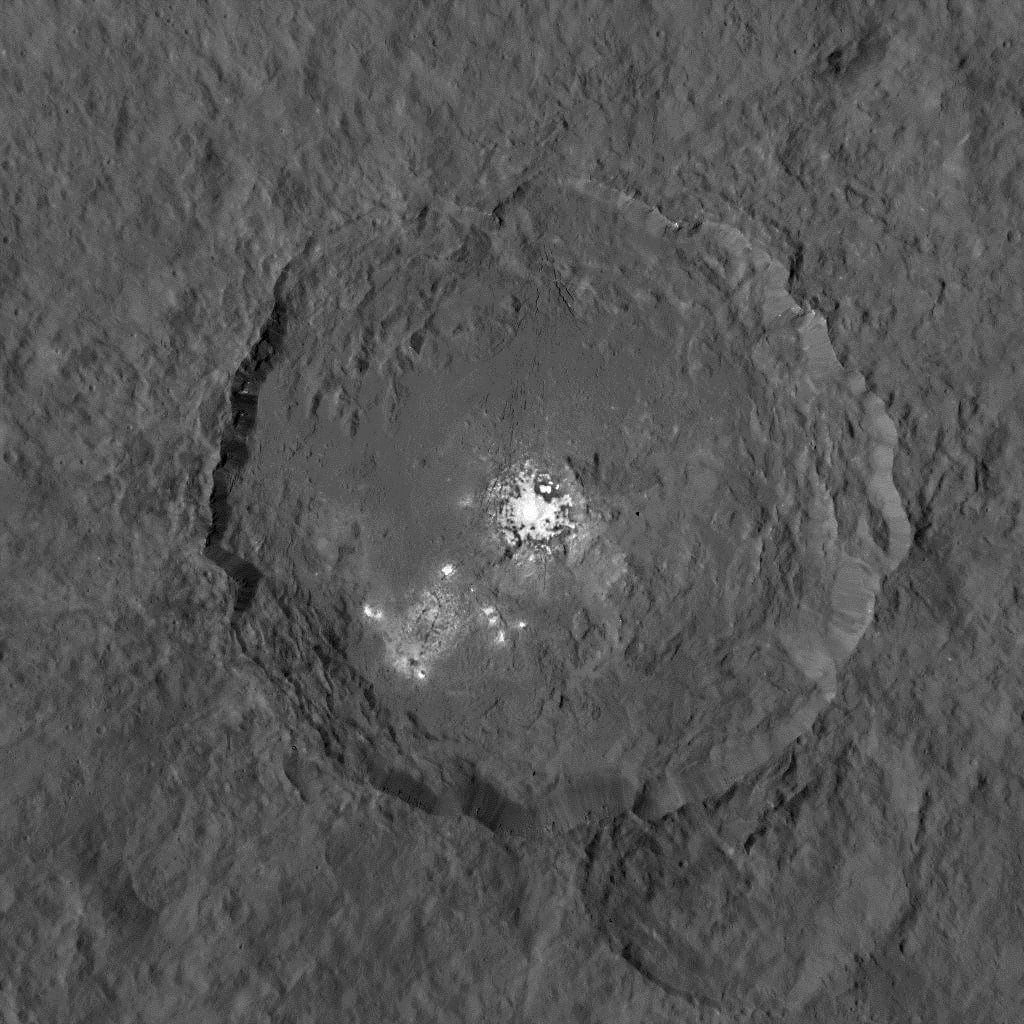 NASA image of the Occator crater on the dwarf planet Ceres which has been rotated to change the position of the shadows and eliminate the crater illusion. Credit: NASA/JPL-Caltech/UCLA/MPS/DLR/IDA via Wikipedia
Could microfossils on Ceres still be preserved?
In the unlikely scenario that microorganisms had formed within the brine pocket at 50 km depth, I would expect them to have been mechanically destroyed or chemically altered beyond recognition during ascent and surface exposure, says Neeseman.
Ceres’ surface continues to be bombarded by smaller meteorites in an ongoing process known as impact gardening. It’s analogous to how our Moon’s surface has been pulverized into a fine, powdery regolith.
Even so, Neesemann is part of a topography working group for a potential NASA JPL Ceres sample return mission equipped with an orbiter and lander.
The orbiter will first take even higher resolution images than the Dawn mission, says Neeseman. That’s because we really need to know, if it’s safe to land on these bright deposit areas, she says.
But Neesemann remains confident about such a mission.
As she points out, Ceres’ surface gravity is 5.7 times less than the Moon. But it’s still significantly higher than that of asteroids like Bennu or Ryugu, on which successful landings have already been achieved.
So, sampling Ceres would be more akin to a planetary mission than a typical asteroid sample-return mission, says Neesemann.