Universe Today
Between the mid-70s and early 80s, two physicists (Michael Hart and Frank Tipler) published a controversial series of papers arguing that extraterrestrial intelligence didn't exist. As they argued, the likelihood that extraterrestrial civilizations (ETCs) would have had enough time to develop advanced computing, spaceflight, and self-replicating machines (Von Neumann probes) means they would have colonized the galaxy (and come to Earth) long ago. Since there was no evidence of this, they reasoned that ETCs must not exist and humanity was alone in the Universe.
This came to be known as "Fermi's Paradox," or more accurately, the Hart-Tipler Conjecture (H-TC). Their arguments have since inspired countless proposed explanations, not the least of which was "Sagan's Response." In a recent study, Professor David Kipping of Columbia University (and the head of its Cool Worlds Lab) offers a new take on this hypothesis known as the "Cosmological Hart-Tipler Conjecture" (CH-TC). This new model employs a simple equation involving emergence, propagation, and time and accounts for cosmic expansion, with potentially disturbing implications.
The Hart-Tipler Conjecture, or "Fermi's Paradox," was inspired by a story involving famed Italian-American physicist Enrico Fermi. In 1950, while having a "lunchtime conversation" with friends at the Los Alamos National Laboratory, Fermi allegedly asked out of nowhere, "Where is Everybody?" His colleagues laughed, knowing he was referring to their earlier discussion of the recent spate of UFO sightings. According to the story, Fermi and his colleagues did some calculations and determined that (assuming interstellar transit was feasible) extraterrestrials should have visited Earth several times by now.
As noted, this inspired numerous counter-proposals, including the 1983 paper authored by Carl Sagan and William Newman, "The Solipsist Approach to Extraterrestrial Intelligence." For starters, Sagan and Newman criticized the calculations used by Hart and Tipler, including propagation rates, the time required to expand across the entire galaxy, and several underlying assumptions in their models. These included the belief that ETCs would pursue unlimited expansion and that their colonies would last for millions or even billions of years.
Nevertheless, as Kipping argues, the H-TC has experienced something of a renaissance in recent years, thanks to advances in additive manufacturing (3-D printing), artificial intelligence, and commercial spaceflight. These advances have led many commentators to suggest that the types of probes Von Neumann envisioned (what he called "Universal Constructors") are inevitable, and even "imminent." In addition, all proposed resolutions to the Fermi Paradox that don't argue for the non-existence of ETCs require special explanations for why humanity has not heard from any.
These include the theory that extraterrestrial civilizations are very rare (the Rare Earth or [Great Filter Hypothesis), that they are avoiding detection (the Zoo Hypothesis or Dark Forest Hypothesis), and that interstellar travel and settlement are very difficult (the Percolation Hypothesis). The main flaws in these arguments are that they generally assume uniformity of motivation, in which all intelligent life is expected to follow similar patterns of development and behavior. They also tend to favor the idea that exploration will involve self-replicating probes.
As Kipping explained to Universe Today via email, he chose to adopt a different approach:
In my paper, I try to move away from the specific notion of self-replicating probes and more generally speak of an artificial infection. That could be a scifi-esque colonization program, some kind of interstellar biological pathogens, AI-powered self-reproducing machines, or something we’ve never even imagined yet. Even so, one might question whether the notion of an infection is plausible.
To paraphrase Feynman, in science you start with a guess (destructive infections spawn at some rate), calculate the consequences of that guess (the Universe should be largely infected by now), and then compare those consequences to observations or experience (we exist, so this scenario seems incompatible).
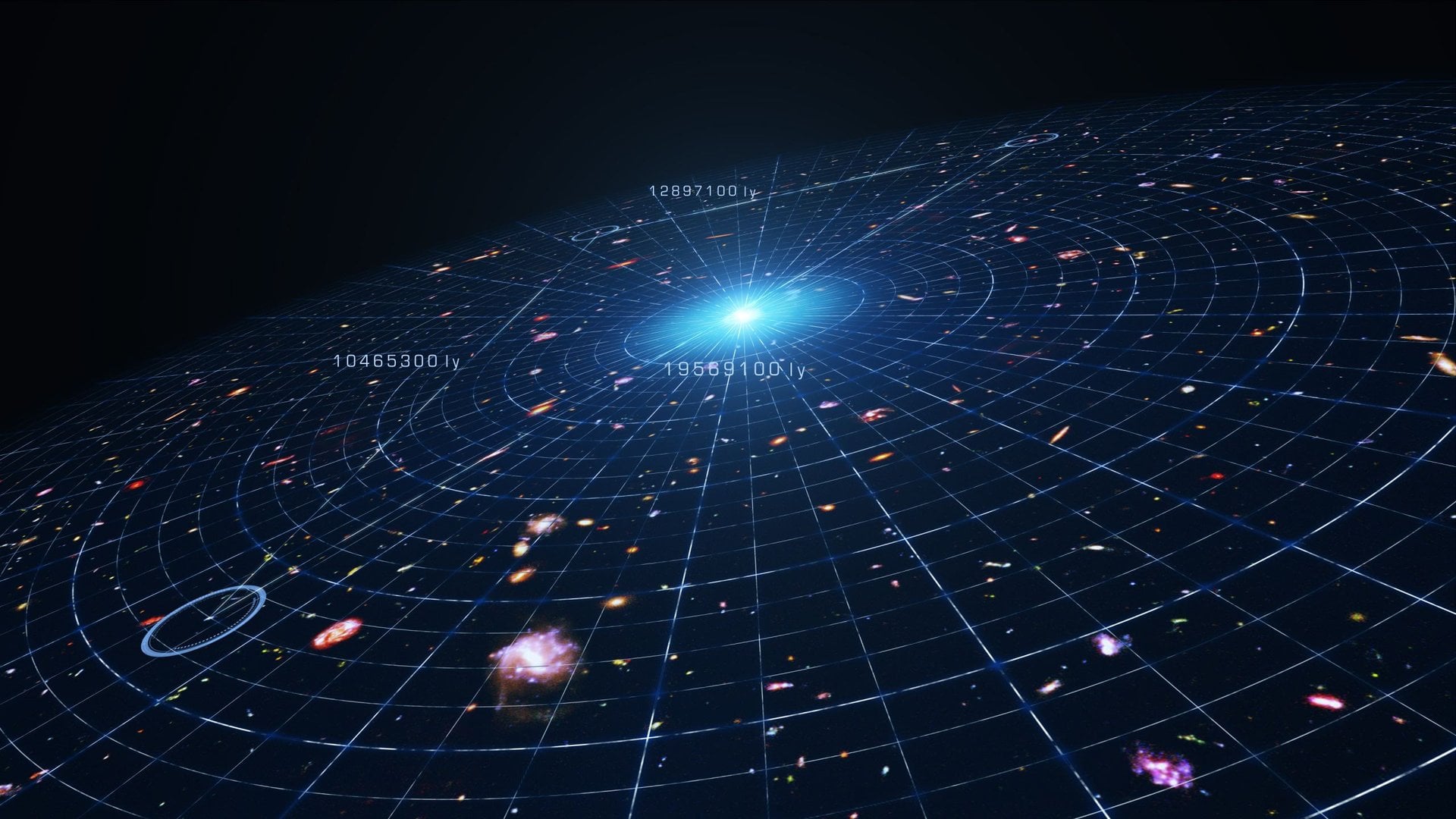
Addressing this, Kipping presents a bare-bones model of "artificial infections" (à la Von Neumann Probes and any other means of expansion across space) on a cosmological scale that accounts for cosmic expansion. The model has only three parameters: a spontaneous rate of intelligent life emerging (λ), a propagation rate (u), and a start time for the calculation (t). Cosmic expansion (the Hubble-Lemaitre Constant) is key, since all previous proposed resolutions to the Fermi Paradox (including the H-TC) focus on our galaxy alone.
But as Kipping argues, if we take seriously Hart and Tipler's proposition that probes could traverse the Milky Way in a short period of cosmic time (300,000 to 20 million years), it naturally follows that they could "infect" other galaxies as well. And considering the rate of cosmic expansion (73.5 km/s per megaparsec, faster than the speed of light), the consequences for spacecraft capable only of sub-light travel (Hart and Tipler considered velocities of 1 to 10% of the speed of light) cannot be ignored. Said Kipping:
Cosmic expansion acts against infection waves; it’s almost like a friction that makes universe-scale infections harder to achieve. My intuition before starting the project was that this would be sufficient to decouple most galaxies from each other, so I was surprised how probe speeds of even 10% the speed of light led to infected universes. Of course, the key thing to remember is that infections spawn randomly across the cosmos in this model, so it’s not as if a single infection seed takes over the universe at 0.1c - it’s a cohort of them sprinkled across the Universe.
His model assumes that each galaxy can transition from an uninfected state (U) to an infected state (I) in one of two ways: either an ETC can emerge within the galaxy (i.e., via the spawn rate) and begin sending out probes or other means of exploration/settlement, or by external infection from another galaxy (via propagation). Rather than producing detectable technosignatures, Kippen's model assumes that "infection" would entail the nullification of local habitability - which is not to say "sterilization," but that they would cease showing signs of activity we would recognize as being indicative of life.
When computing the expected fraction of galaxies infected at cosmic time, several implications emerge. However, none of them are definitive or conclusive. Nevertheless, it does establish some very tight constraints on the possible existence of technological civilizations in our Universe. As Kipping explained, the spawn rate has to be dialed down to staggeringly tiny values, of order 1 in a million galaxies over cosmic history; otherwise, we are left with the disturbing possibility that humanity is alone in the Universe:
The firmest conclusion we can say is that if infections spawn more frequently than 1-in-100,000 galaxies, then 99.9% of the Universe would be infected for a 0.1c infection wave speed. If we take it as a given that this is inconsistent with observation/experience, then this requires that less than 1 in 10 quadrillion star systems have ever spawned an infection. That’s a staggeringly tight observational constraint on alien behavior; it’s by far the strongest statistical statement we can make in all of SETI.
There are possible explanations for this that don't involve the non-existence of intelligent life beyond Earth, as Kipping notes. For what Sagan described as "Contact Optimists," a natural explanation would be that despite there being a large population of ETCs in our Universe, the odds of them ever spawning an infection (i.e., sending out probes or ships) are astronomically small. However, this is difficult to consider if one rejects the idea of uniformity in behavior and motivation. As David Brin argued in his 1983 paper, "The 'Great Silence': the Controversy Concerning Extraterrestrial Intelligent Life," it only takes one species to break the pattern for a proposed resolution to become untenable.
In contrast, the contact pessimist has a much easier job explaining the apparent lack of evidence for ETCs, either by stating that they don't exist or employing the Great Filter argument. But as Kipping stated, this explanation is also difficult to maintain:
If the filter is behind us, then where? Life started so early that it strongly indicates abiogenesis is a rapid and easy process. Perhaps some evolutionary steps are hard and very rarely transpire, but evolutionary biologists have argued against this recently. Or perhaps it’s ahead of us, and we won’t last another century needed to develop infection technologies.
But then it’s hard to imagine how such a future Great Filter is so potent that it can suppress the odds at the level needed here. We can imagine many ways in which humanity continues, so surely someone, somewhere, especially those civilizations with greater wisdom than our own, would sail past the challenges we face today without annihilation.
Consider A Canticle for Leibowitz, the famous science fiction tale that chronicles the collapse of human civilization, its rebirth, and (spoilers!) its imminent collapse again towards the end. Or Foundation, where the collapse of the Galactic Empire (à la The History of the Decline and Fall of the Roman Empire) is inevitable, but is not a permanent condition. In short, the data supports no conclusions, something that Kipping acknowledges.
"Frankly, I don’t have a good answer for this," he tells us. "I suspect I will be wrestling with this question for the rest of my life in frustration and wonder." The same may apply to the rest of us, and humanity as a whole!
Further Reading: arXiv