Universe Today
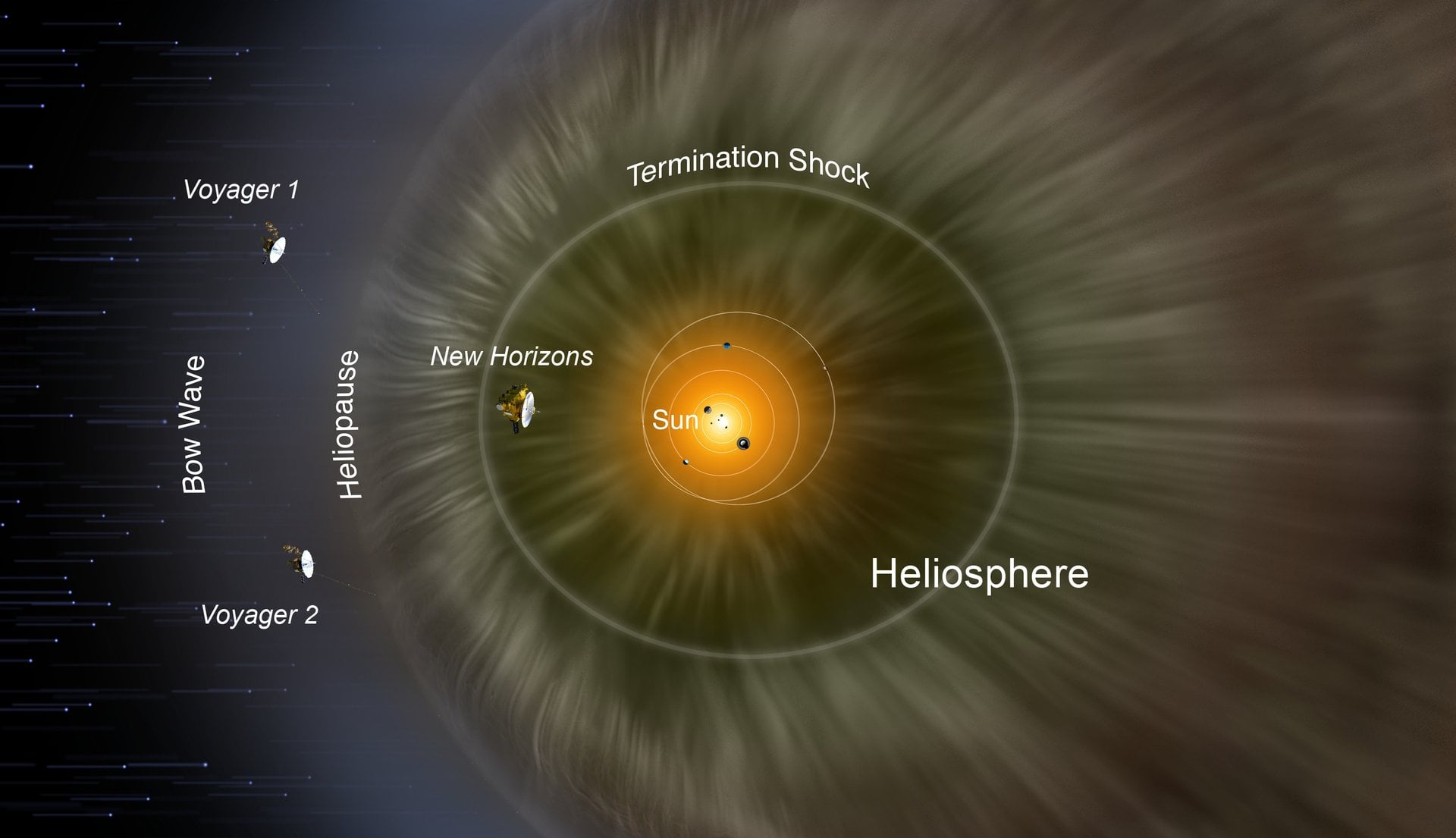
The Solar System is surrounded by a vast bubble of plasma created by solar wind flowing outward from the Sun. This bubble shields the system from most of the cosmic radiation that passes through the interstellar medium. Meanwhile, as our system orbits the center of the Milky Way, it creates a rounded "nose" region ahead of it and a "tail" in its wake. Scientists are divided as to the shape of the heliosphere, with some arguing that it resembles a comet, while others favor a croissant-shaped profile.
The boundaries of the heliosphere are dynamic, the outer edge constantly shifting in response to changing solar conditions, expanding during solar maximum and contracting at solar minimum. Researchers at the Southwest Research Institute (SwRI) are busy studying the heliosphere so astronomers can create predictive models that will tell them the location of the termination shock - the heliosphere's outer boundary - in the direction the New Horizons probe is traveling.
Their findings were presented in two scientific papers that appeared in The Astrophysical Journal and the journal Advances in Space Research. The team, led by SwRI Post-Doctoral Researcher Dr. Jonathan Gasser, combined a solar wind forecasting method with analytical and numerical heliosphere models to determine where New Horizons will encounter the first plasma boundary in the outer heliosphere.
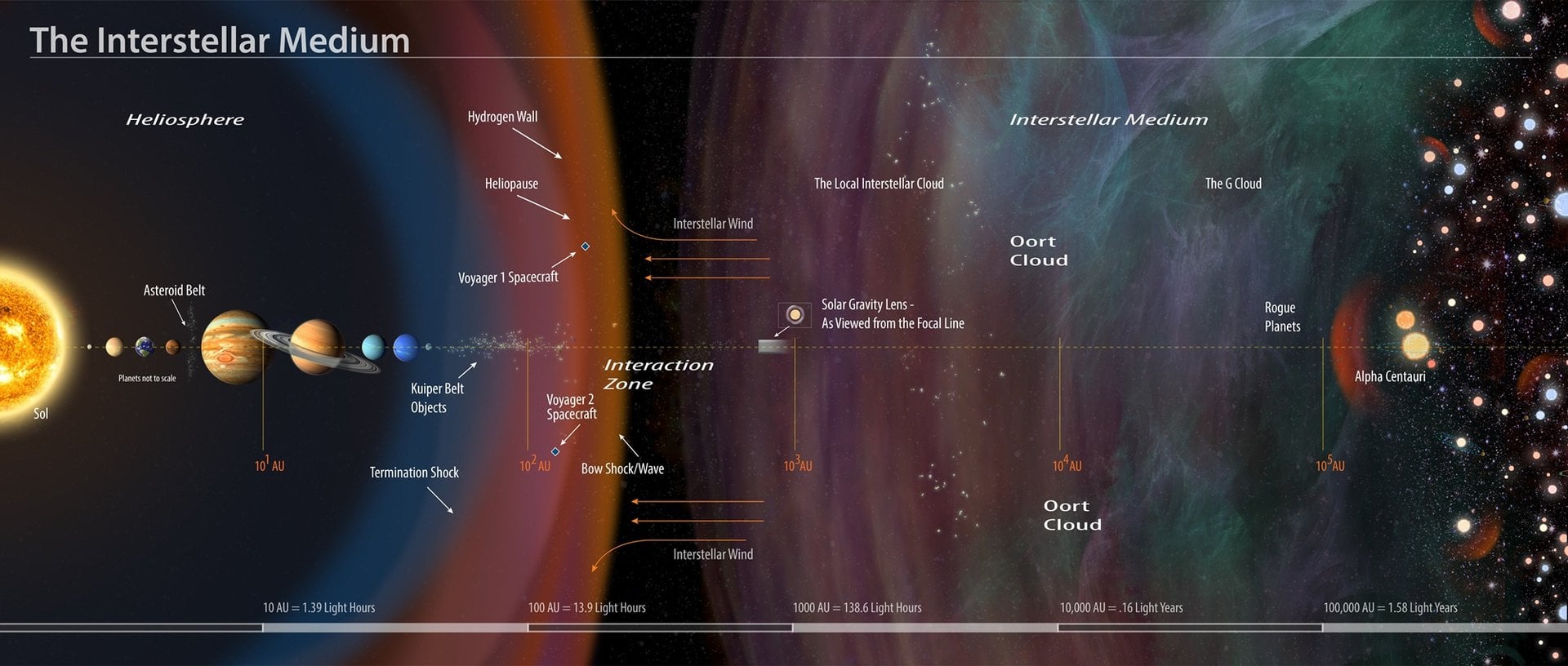 An annotated illustration of the interstellar medium on a logarithmic scale. Credit: Charles Carter/Keck Institute for Space Studies
After completing its historic flyby of Pluto, New Horizons became the first probe to rendezvous with a Kuiper Belt Object (KBO), Arrokoth, on January 1st, 2019. The study of this contact binary yielded valuable data about the kinds of objects that populate the Trans-Neptunian region. Since then, the probe has continued to venture toward the boundary between the Solar System and interstellar space, following in the footsteps of Pioneer 10 and 11 and the Voyager 1 and 2 probes.
It is hoped that this research will help future missions explore the boundaries between the Solar System and the interstellar medium (ISM). As Glasser stated in a SwRI press release:
We want to understand when the spacecraft will reach the termination shock to prepare to take measurements and download data about this region. Based on our research, we predict that New Horizons will encounter the termination shock as early as 2029 or as late as 2040. And it is possible that it could cross the boundary more than once as the heliosphere continues to expand and contract.
Further Reading: SwRI, The Astrophysical Journal