Universe Today
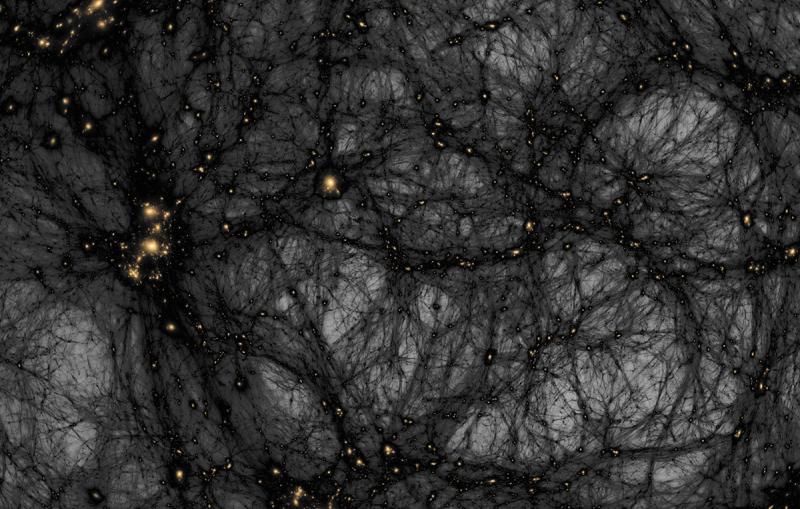
Dark Matter (DM), that mysterious matter that accounts for 85% of the Universe's mass, continues to fascinate and puzzle scientists. While we are unable to resolve it in visible light, its influence can be seen in the rotational curves of galaxies, Dark Matter halos, and the gravitational lenses they cause. The Bullet Cluster, consisting of two colliding galaxy clusters located about 3.7 billion light-years from Earth, is of particular interest to astronomers searching for DM. The reason being that gravitational lensing studies are claimed to provide strong evidence for its existence.
When examining the Bullet Cluster, scientists noted that galaxies located beyond it appeared distorted, the result of the cluster's gravity warping spacetime around it. Using the James Webb Space Telescope (JWST), an international team of researchers analyzed new data and existing images to gain new insight into this cluster. According to their analysis, there is an alternative explanation for the observed effects of the cluster that does not involve DM at all. Their findings could force astronomers to reevaluate what was considered to be some of the most compelling evidence for DM.
The collision that created the Bullet Cluster occurred around 4 billion years ago, when two clusters containing hundreds of galaxies collided at speeds of over 2,500 km/s (1,550 m/s). While galaxy clusters contain stars in the trillions, the majority of their visible matter consists of gas located between star systems - aka. the interstellar medium (ISM). During the collision, the two gas clouds experienced frictional forces as they passed through each other, causing them to both heat up and slow down. These gas clouds are visible today as diffuse patches that glow brightly in the X-ray spectrum.
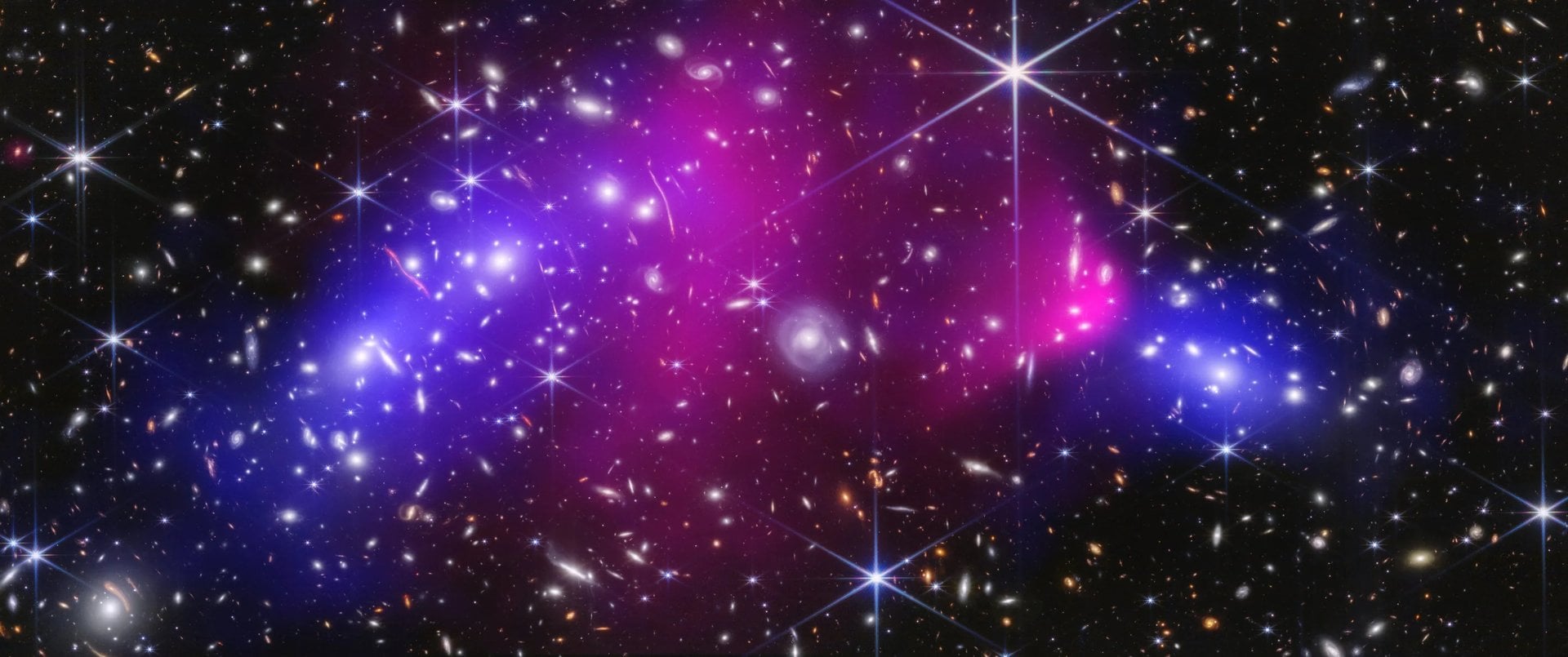 Image from the James Webb Space Telescope of the inner region of the Bullet Cluster. © Image: NASA/ESA/CSA/STScI/CXC/Caltech/IPAC
However, the galaxies in the two clusters passed through each other without incident, since the distance between individual stars was so great that they were able to fly past each other. As a result, the two clusters were separated from the interstellar gas they carried with them. In the Webb image (shown above), the hot gas clouds appear in pink, while the distribution of dark matter appears in blue. Cluster 1 is visible to the left of the left-most gas cloud, while Cluster 2 is just to the right of the right one. These four structures form the entirety of the Bullet Cluster.
Another thing that is clear from the image is how galaxies beyond the cluster appear distorted and crescent-shaped. Strangely, the galaxy clusters show the strongest lensing effect, despite their relatively low mass. Meanwhile, the two luminous clouds, where the greatest mass should be concentrated, show a comparatively weak effect. This suggests that there is additional matter hidden in these galaxies that astronomers cannot detect.
According to current theories, DM interacts with normal matter only through gravity, and not through the other fundamental forces (electromagnetism, the weak and strong nuclear forces). Because of this, it is not slowed down by friction and would not be separated from the galaxy clusters. The data also supports another interpretation: Modified Newtonian Dynamics (MOND), the cosmological model that does away with DM entirely. To this day, MOND has been considered something of a fringe theory because it cannot explain phenomena such as the Bullet Cluster.
"However, we show in our study that, on the contrary, the Bullet Cluster is actually particularly consistent with the MOND scenario," said HISKP researcher Dong Zhang, the lead author and the one who carried out a large proportion of the calculations. "If massive stars eventually burn up, they become neutron stars or black holes. Like dark matter, both are invisible and can only be detected by the huge gravitational forces that they exert."
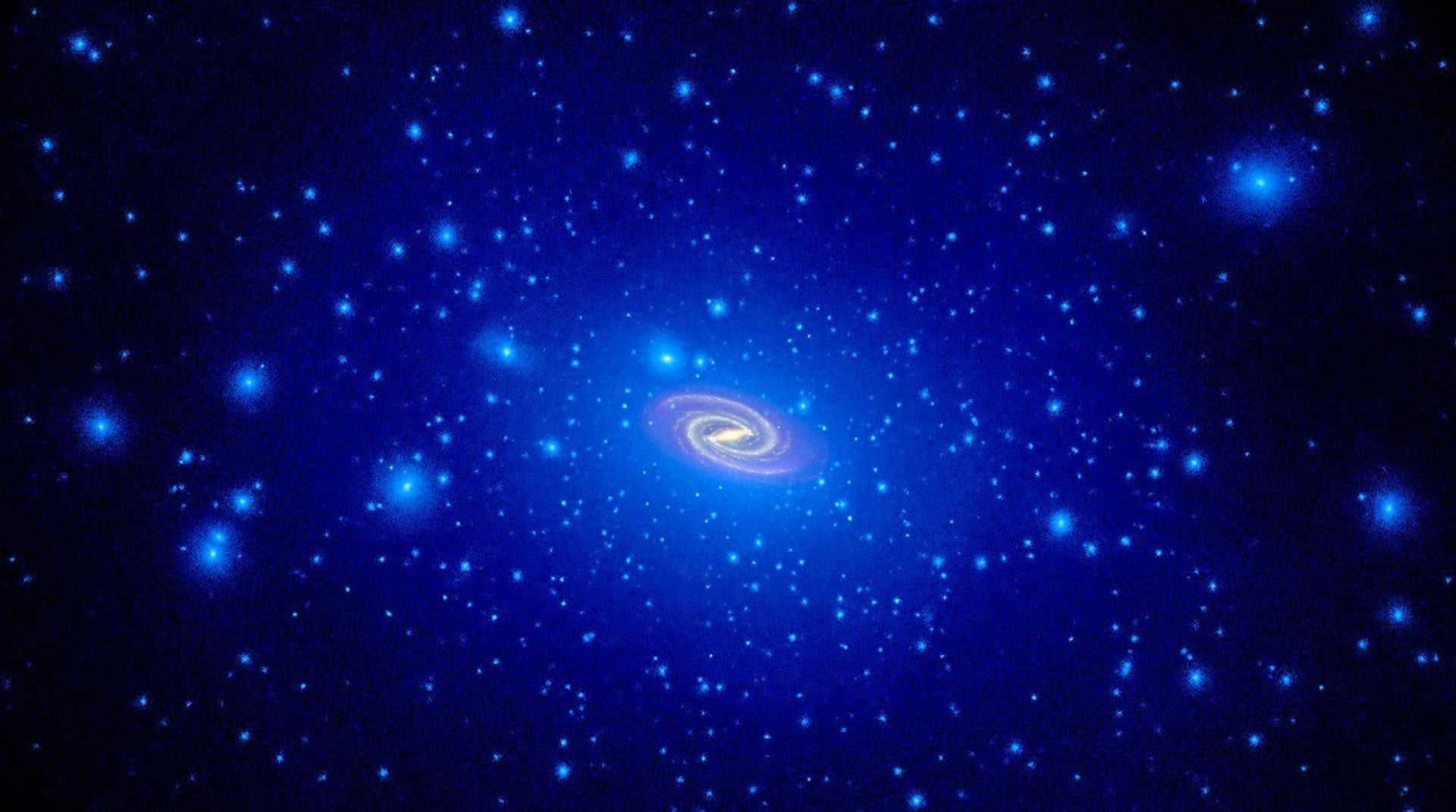 Artist's impression of "ghost galaxies" within the Milky Way's Dark Matter Halo. Credit: NASA, ESA, and T. Brown and J. Tumlinson (STScI)
As HISKP Professor Pavel Kroupa, a co-author on the study, added:
This observation has so far been considered evidence of the existence of dark matter. The remnants of massive stars take on the role of dark matter to a certain extent in the MOND scenario. Even in the standard model, which assumes the existence of dark matter, its postulated quantity would have to be significantly reduced – by around half.
Additionally, new data from Webb have enabled more precise calculations of the number of stars and heavy elements in both clusters. Dr. Indranil Banik of the Institute of Cosmology and Gravitation at the University of Portsmouth (another co-author) showed that the newly calculated numbers of stars and other objects can account for the observed gravitational lensing effect. This new data and insight into the Bullet Cluster have cast doubt on a key piece of evidence for DM and made for a more compelling case for MOND.
Further Reading: Universität Bonn, Physical Review D