Universe Today
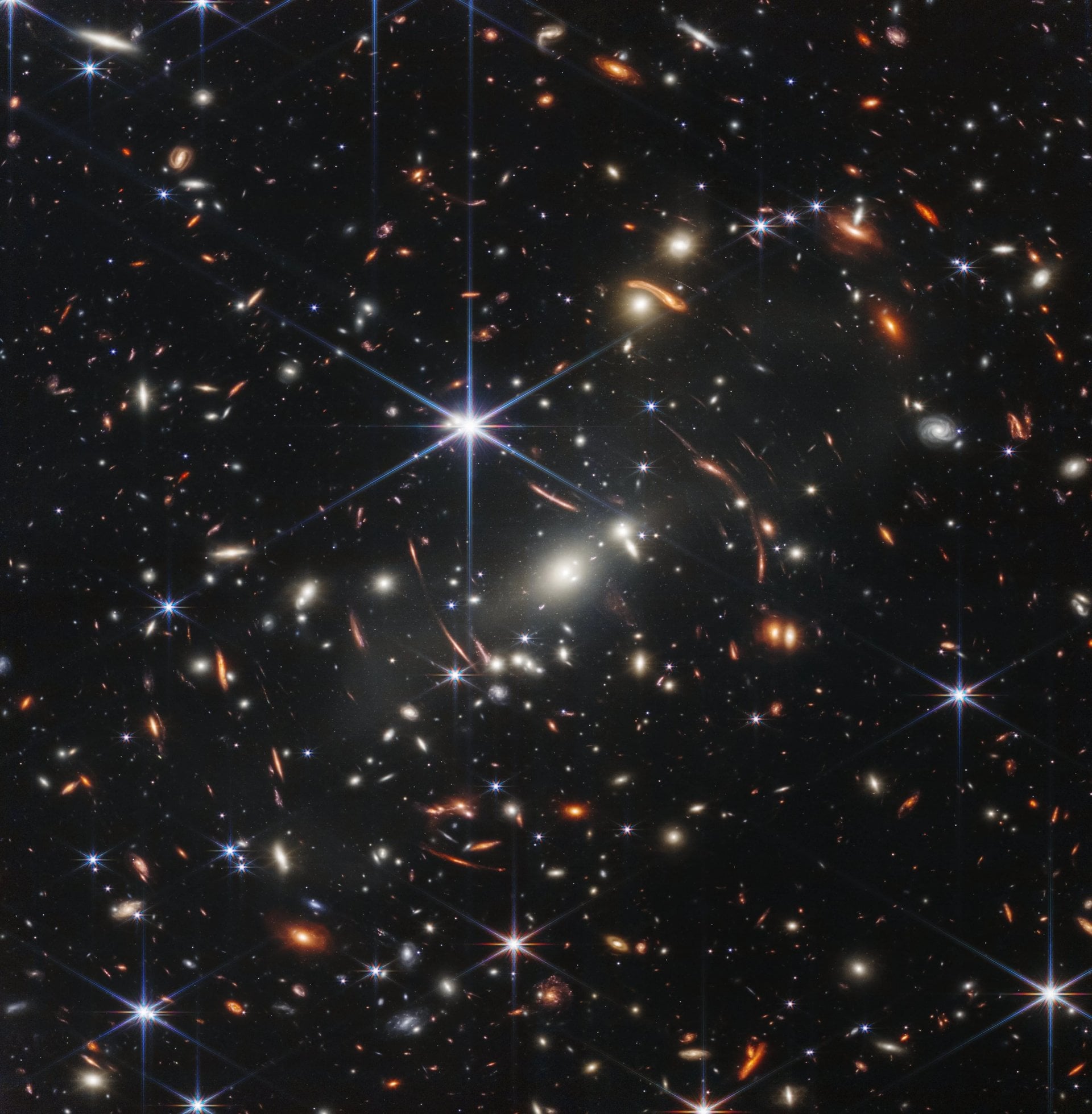
Since it became operational in 2022, the James Webb Space Telescope (JWST) has released some truly breathtaking views of the cosmos. These images highlight how advancements since the days of the venerable Hubble Space Telescope are now providing the deepest and clearest views of the cosmos to date. This was especially evident with the galaxy cluster MACS J0308.9+2645, a deep field image originally taken by Hubble showcasing galaxy clusters and several gravitational lenses.
These lenses, in turn, revealed even more distant galaxies that existed 13 billion years ago, when the Universe was just 1 billion years old. These galaxies appear as distorted "gravitational arcs" in the image, their light having been warped and amplified by the MACS J0308.9+2645 cluster's gravitational field. As it turns out, there were more galaxies remaining to be found. In a recent paper, astrophysicist Homer Dávila Gutierrez identified another gravitational arc candidate in the galaxy cluster MACS J0308.9+2645.
Dr. Gutierrez is the founder and director of SKYCR.ORG, the leading Spanish-language news source for astronomy and space exploration, the first Costa Rican elected Fellow of the Royal Astronomical Society (FRAS), and a member of the European Astronomical Society (EAS). He reported the finding of the arc candidate (A1) after searching through JWST archival Near-Infrared Camera (NIRCam) data gathered through Webb's General Observation (GO) 5293 campaign.
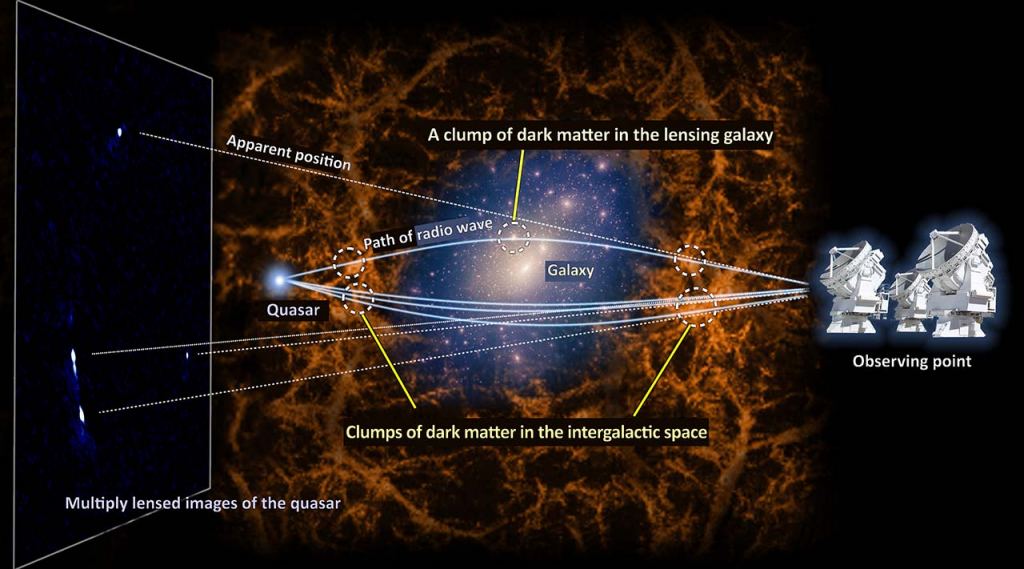 A conceptual diagram of the gravitational lens system MG J0414+0534. Credit: NAOJ, K. T. Inoue
Gravitational lenses are a phenomenon originally predicted by Einstein's Theory of General Relativity, in which objects with mass alter the curvature of spacetime around them. When light intersects with a gravitational field, it traces this curvature, which amplifies and distorts it. For decades, astronomers have used these lenses (created by objects in the foreground) to observe light from more distant, fainter objects located behind them.
The galaxy candidate Dr. Gutierrez observed is characteristic of this phenomenon, having an elongated and curved morphology. He found A1 while searching through 54 public JWST/NIRCam fields and evaluating 1,591 possible candidates. Of these, only A1 was considered a robust candidate for a gravitational arc that could have existed when the Universe was very young. As Dr. Gutierrez told Universe Today via email, there are three things that make A1 stand out from the rest:
First, its geometry: A1 is extremely elongated (axis ratio ~6.5) and aligned tangentially with respect to the cluster center to within about a degree - exactly the orientation gravitational lensing produces. Second, its brightness: it is the brightest of the highly elongated sources at that radius, which made it measurable. And third, its absence from every catalog: it does not appear in the published strong-lensing inventory of this cluster, nor in SIMBAD, NED, or VizieR. \
When I contacted the GO-5293 team, they confirmed it did not overlap with the systems they were analyzing. A real, bright, uncatalogued arc-like source in a massive Planck-selected cluster - that is what made it worth pursuing.
After conducting a multi-band analysis with the EAZY (Easy and Accurate Zphot from Yale) photometric tool, Dr. Gutierrez obtained a redshift value of z ≈ 4.4, placing A1 within the first billion years of the Universe. This was followed by analysis with the tool developed by Israeli astrophysicist Ana Acebron and collaborators in 2018 that placed constraints on the mass of the MACS J0308.9+2645 cluster. From this, he determined that A1 was subject to a magnification factor of seven.
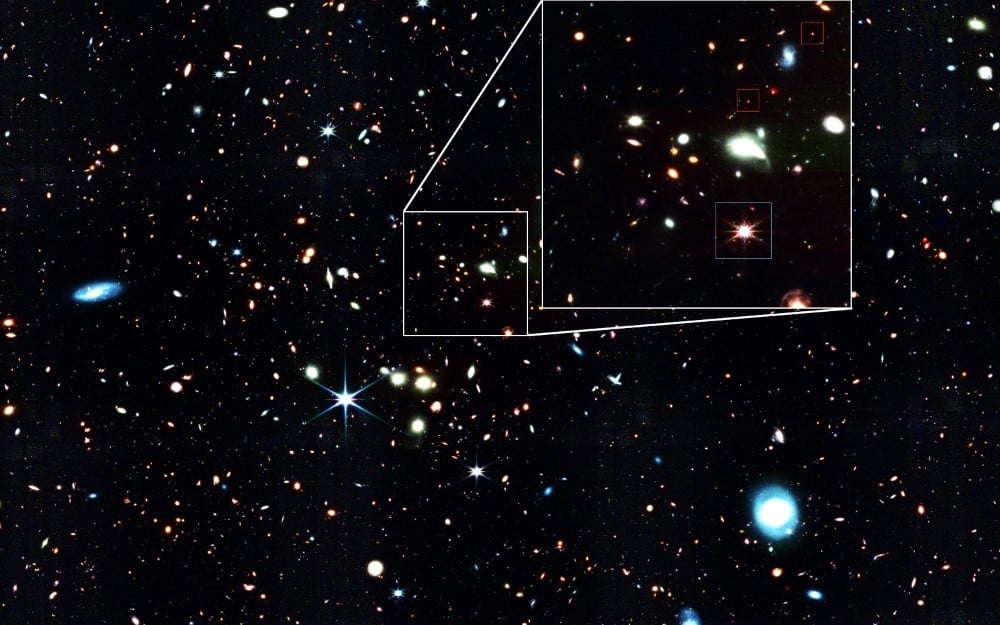 The little red dots could represent galaxies in an evolutionary phase predating the luminous quasar phase. Credit: NASA/ESA/CSA/ISTA)/ETH Zurich/NAOJ
While the analysis is evolving and follow-up observations are needed, there are still some characteristics that can be gleaned from the data. Said Dr, Gutierrez:
With the corrected photometry, A1 is a galaxy at z ≈ 1.4 — we see it as it was roughly 9 billion years ago — lying behind the cluster MACS J0308.9+2645 (z = 0.356), one of the most massive clusters known. Its light passed close to the cluster on its way to us, and the working interpretation, shared by the program team’s lensing experts, is that it is a singly lensed image: stretched and modestly magnified by the cluster’s gravity, but not multiply imaged.
Its projected position, about 51 arcseconds from the cluster’s X-ray center, and its tangential elongation are consistent with that picture. The definitive test — an updated lens model of the cluster built from the new JWST data — is in progress.
The analysis also revealed a second potential candidate, designed A2, which has similar geometry to A1. This light source is significantly fainter, smaller, more elongated, and its photometry is less constrained. It also has a similar projected distance from the central cluster as A1. "And that matters: the photometric issue that affected A1's original redshift estimate — catalog aperture magnitudes that capture only a small fraction of an extended source's light — applies even more strongly to a faint source like A2. So I treat its nature and redshift as open questions pending the same corrected reanalysis I applied to A1," said Dr. Gutierrez.
The exciting thing about these results is that they imply that there could be many more early galaxy candidates hiding in Webb's data.
Webb’s public archive is growing faster than anyone can fully exploit, and this find shows that genuine discoveries are sitting in already-released data, accessible to any researcher willing to do careful work. But there is a second lesson, just as important: automated catalog photometry can badly mislead you for extended sources — in this case it initially suggested a much higher redshift — so verification, independent remeasurement, and contact with the original program team are essential.
The most rewarding part of this process has been exactly that: the GO-5293 team responded generously, confirmed the object was uncatalogued, and we are now working with their updated lens model to establish A1’s nature definitively. Independent researchers and program teams collaborating over public data — that is Webb’s archive working exactly as intended.
The work is currently being reviewed for publication in the journal Publications of the Astronomical Society of Japan.