Universe Today
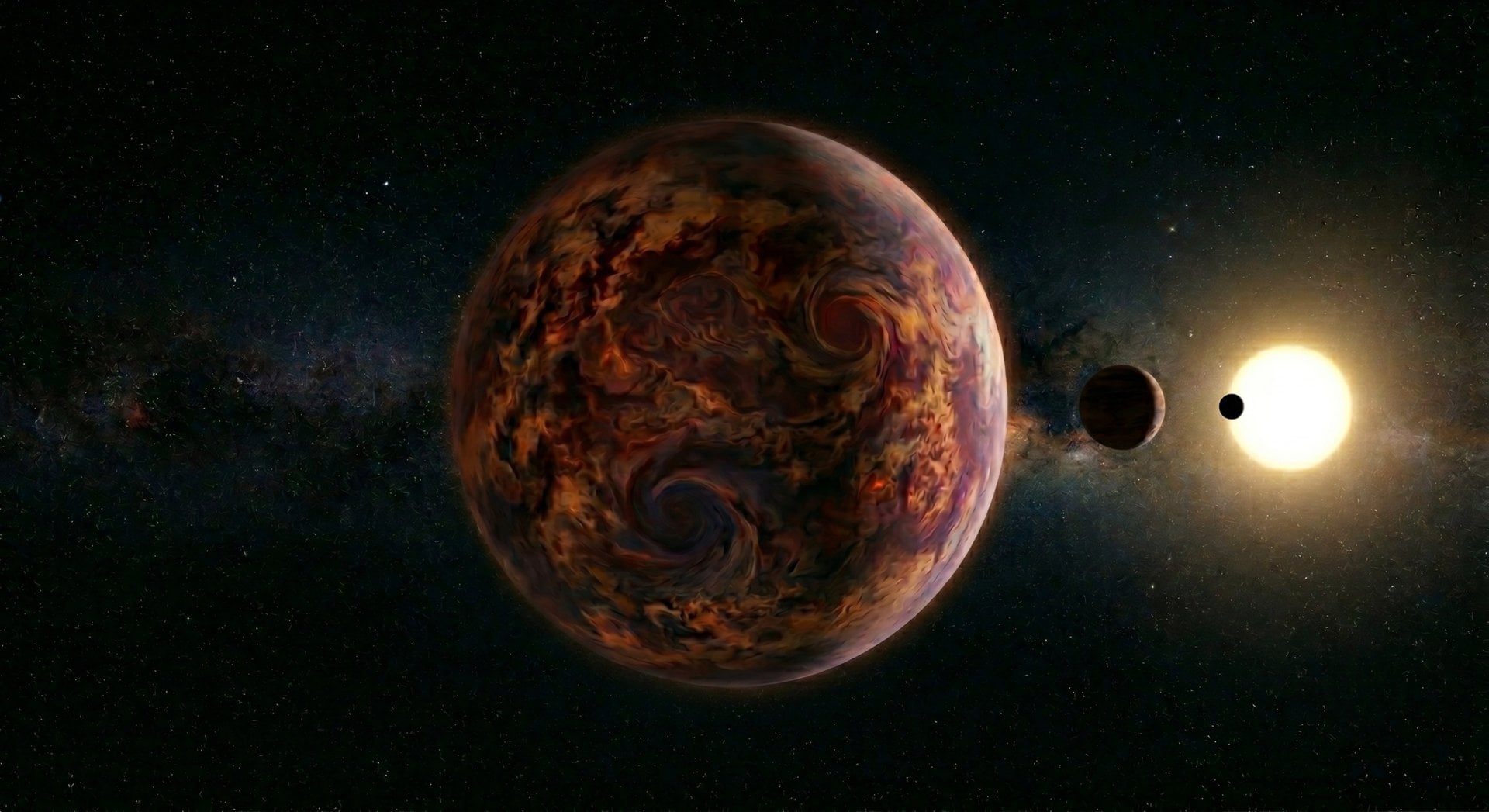
In the course of studying planets beyond our Solar System (6,316 confirmed exoplanets and counting), scientists have discovered some very interesting systems. Consider TOI-201, a compact system populated by three bodies, including a brown dwarf, orbiting on the same plane. The system was recently observed by an international team led by the European Southern Observatory(ESO) and the National Institute for Astrophysics (INAF) using data from NASA's Transiting Exoplanet Survey Satellite (TESS).
Their findings, which were recently published in the journal Nature, showed that despite its highly elliptical orbit, the brown dwarf played a major role in shaping the system's orbital dynamics. In short, TOI-201 c's gravitational influence allowed the system's two other planets to form in a narrow zone within its orbit. These findings present a completely new and unexpected scenario that is challenging astronomers' understanding of the mechanisms of planet formation.
The team constrained TOI-201 c's mass by observing it as it made a single transit in front of its star. This was combined with existing spectroscopic data from ground-based telescopes and new radial velocity measurements from the Fiber-fed Extended Range Optical Spectrograph (FEROS) and PLATO Spec, located at the ESO’s La Silla Observatory. According to their estimates, TOI-201 c has a mass near the upper limit for giant planets and an orbital period of 2,881 days. making it a highly unique object in the exoplanet census.
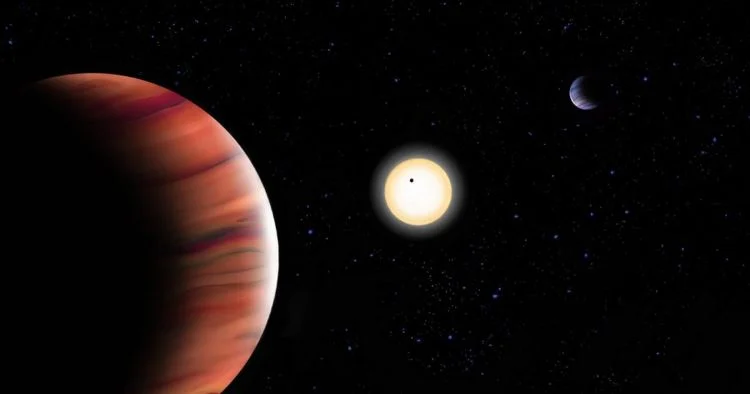 Artist's illustration of the TOI-201 system. Credit: University of New Mexico/Tedi Vick
"It is the transiting object with the longest orbital period for which the mass is known," said INAF researcher and co-author Luca Naponiello in an INAF press release. Its neighbor planets include a rocky super-Earth (TOI-201 d) with an orbital period of just 5.8 days, and a gaseous warm Jupiter (TOI-201 b) with an orbit of about 53 days.
In addition to its mass, the brown dwarf also has a highly elliptical orbit (with an eccentricity of 0.622), which causes severe gravitational perturbations and makes regions beyond 1.5 Astronomical Units (AUs) from its parent star - about the distance between Mars and the Sun - dynamically unstable. However, the big takeaway of the team's observations is that the other two planets transit on orbital planes perfectly aligned with the brown dwarf - something astronomers define as a "restricted system."
According to traditional models, astronomers predict that gas giants typically form at distances of 2 to 3 AU from their parent star. In the case of TOI-201, astronomers would expect a massive object with such an eccentric orbit to interfere with the formation of additional planets. Instead, TOI-201 c forced its neighbor planets to form by occupying the innermost edges of the primordial disk. Moreover, the data showed that when the warm Jupiter makes its closest approach to the Sun, it experiences strong variations in its transit timing, suggesting it has an intense and dynamic interaction with TOI-201 c.
"This discovery provides a crucial insight into how planets form even around massive, eccentric objects," said INAF researcher Aldo S. Bonomo. Such long-period objects discovered using the Transit Method are extremely rare, and TOI-201 c is the first to have its mass confirmed through precise measurements using the Radial Velocity Method. Said Alessandro Sozzetti, director of the INAF-Astrophysical Observatory of Turin:
[It represents] the first celestial body that can be characterized simultaneously through four different methodologies: namely, photometric transits, transit timing variations (TTV), radial velocities, and, as soon as the data from the Gaia DR4 release are published, space astrometry. With Gaia's fourth data release, we will also be able to reconstruct the 3D orbit of the brown dwarf.