 Universe Today
Earth's surface water puts the planet into its own, privileged category among the Solar System's bodies. Nowhere else is it found, and this water allowed life to appear and fluorish. Nobody argues that, but what's still up for debate is the source of this water.
Did this water arise from hydrogen off-gassing from Earth's molten body when it was a young planet? Or was it delivered by watery asteroids and icy planetesimals and comets? Or did both mechanisms contribute?
New research in Nature Communications tackles the problem of Earth's water by looking at a distant solar system. It's titled "Potential sublimating exocomets around the young star PDS 70," and the lead author is Aline Novais. Novais is a post-doctoral researcher in the Department of Physiscs at Lund University in Sweden.
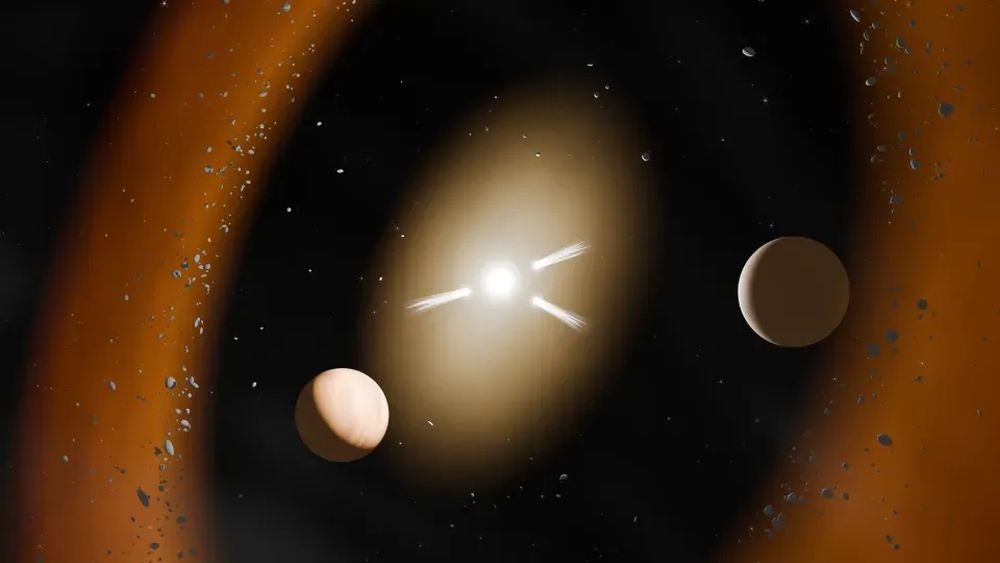
PDS 70 is a young star about 370 light years away. It's a T-Tauri star that's only about 5.5 million years old, meaning it still hasn't reached the main sequence. It's noteworthy because its two planets, PDS 70b and PDS 70c, were directly imaged by the ESO's Very Large Telescope in 2018 and 2019 respectively.
JWST observations of the PDS 70 system found water in the system's inner disk. "In the very centre of the inner disc of PDS 70, recent infrared observations using the Mid-InfraRed nstrument (MIRI) aboard the James Webb Space Telescope (JWST) revealed spectroscopic emission signatures of a gaseous water reservoir," the authors write. The water's origins are unclear, and in this work, the researchers worked with archival High Accuracy Radial velocity Planet Searcher (HARPS) spectra from PDS 70 to try to shed light on the source of the water.
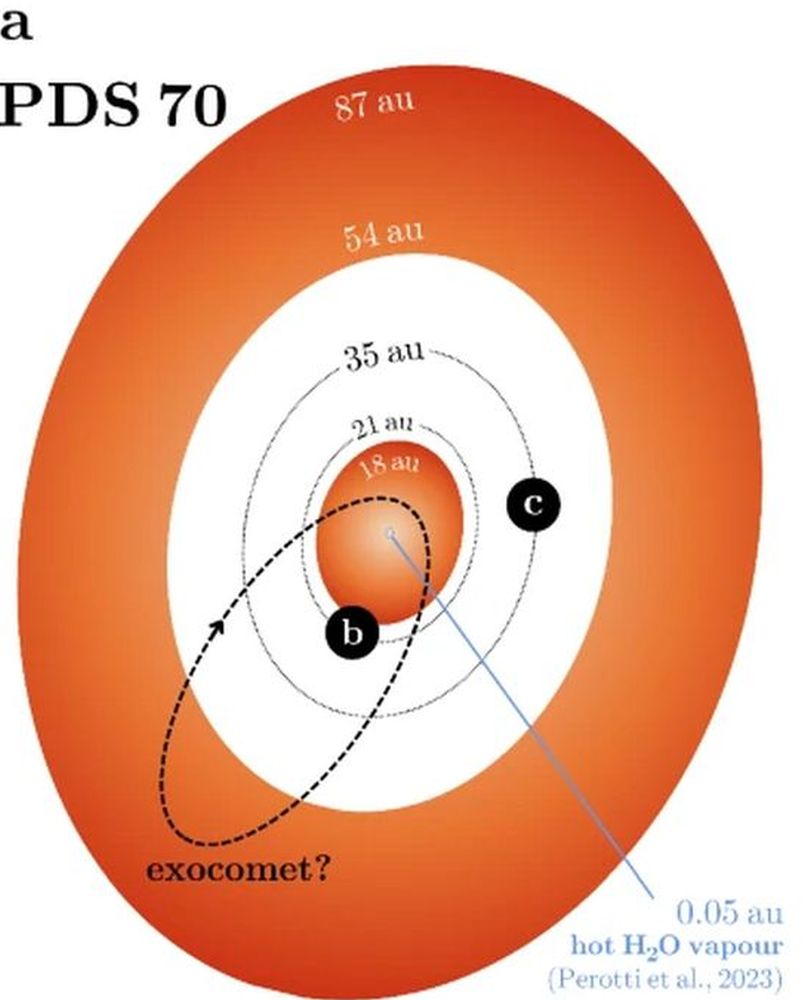 This figure shows the PDS 70 system. The tiny blue circle shows where water vapour was detected in the inner disk. The dotted black ellipse shows the potential orbit of a possible exocomet. Image Credit: Novais et al. 2026. NatComm.
"Here we report the discovery of variable absorption lines of neutral sodium in archival High Accuracy Radial velocity Planet Searcher (HARPS) spectra of PDS 70," the researchers write. "These lines vary strongly and stochastically on a daily basis, in amplitude, number, and radial velocity."
The key is that the absorption lines aren't widespread or uniform. They only cover part of the stellar disk, so in effect, they're clumpy. The lines are variable, showing that something like a standard, stable disk wind isn't responsible.
"Our measurements indicate that this gas tends to be optically thick, and partially cover the stellar disc, meaning this fast-moving gas is often spatially confined," the authors write.
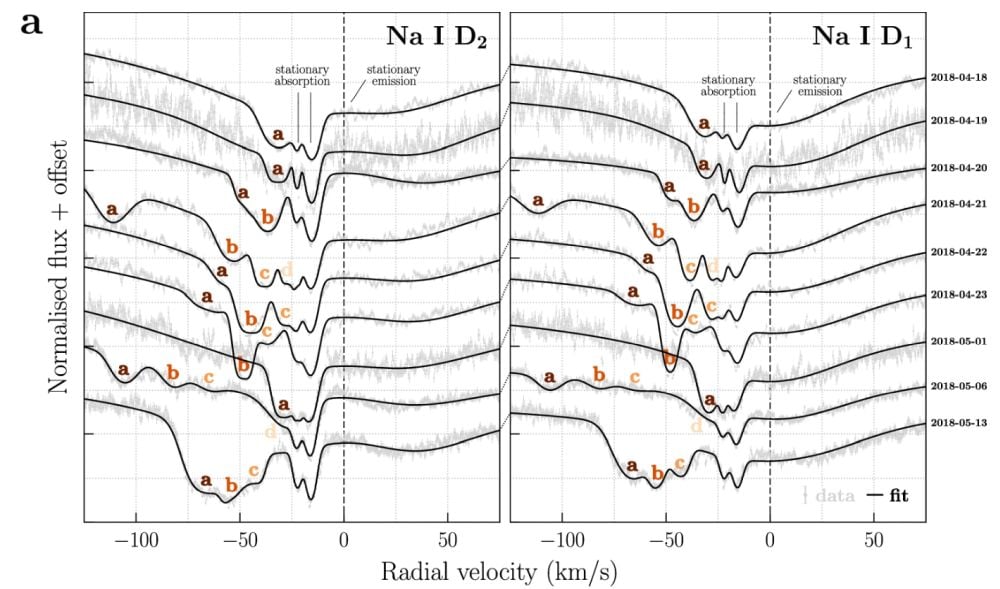 This figure shows HARPS spectral data for PDS 70. While there are two stationary lines and one stationary emission line, other spectral features are variable. "Variable Na I absorption line components are labeled from most blue-shifted (a) to least blue-shifted (d)," the authors write. Image Credit: Novais et al. 2026. NatComm.
The gas appears and disappears over the course of several nights, and moves faster than PDS 70. That's consistent with a comet passing in front of the star and volatiles sublimating off of it. The sublimating gas creates the variable spectral lines. Since the gas appears and disappears over the course of several nights, and since it's moving faster than PDS 70, the researchers favour the exocomet hypothesis.
"We explore several hypotheses for the origin of these lines, and conclude that a likely source of the observed sodium is sublimation of planetesimals that transit the star on highly elliptical orbits, reminiscent of the exocomet phenomenon seen in other seen in other extrasolar systems," the researchers explain.
“Our study suggests that comets may be responsible for transporting water to the inner parts of the planetary system, where planets can form, in the same way as in the early Solar System,” lead author Novais said in a press release.
“This is the first time we have seen evidence of exocomets orbiting a star that is relatively cool, much like our Sun. Furthermore, this system is the youngest in which exocomet activity has been proposed,” Novais said.
To add to the exocomet hypothesis, the researchers also modelled the orbits of exocomets in the PDS 70 system. They found that gas giants in the system could perturb distant icy solar system objects and bring them careening toward the star. This is in line with what may have occurred in our Solar System.
“It is reminiscent of a possible process in the early Solar System, in which comets may have helped to deliver water to the young Earth,” said co-author Alexandra Stockwell Murphy, also from Lund University.
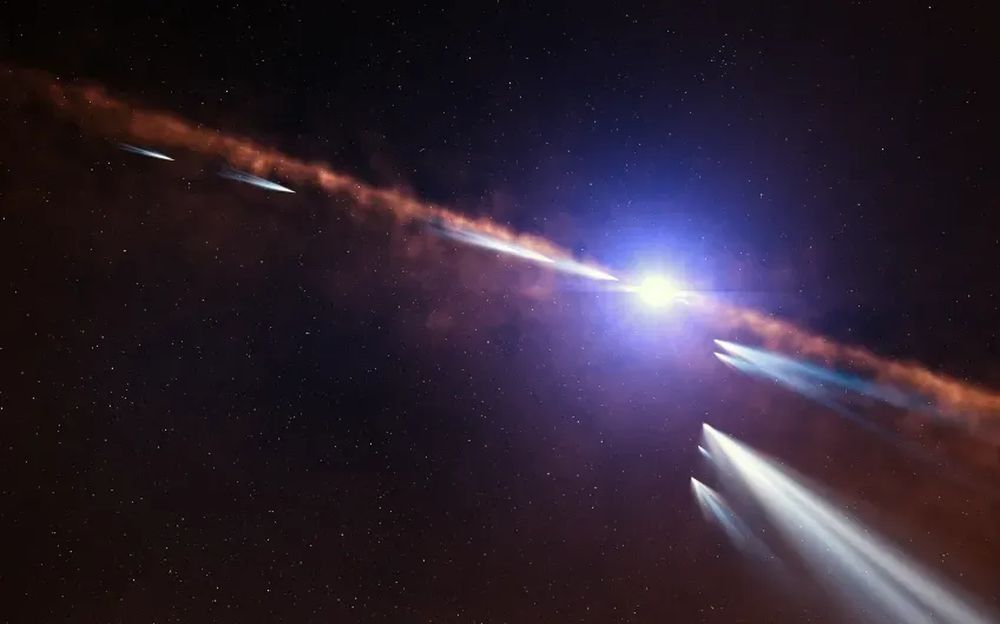 This illustration shows exocomets approaching a distant star. As the comets are warmed, volatiles sublimate off of them, creating the type of puzzling spectral lines found around PDS 70. Image Credit: ESO/L. Calçada
While the researchers support the exocomet hypothesis, it is still possible that a disk wind is responsible for the varying spectral lines. "Given that some model parameters (including the stellar accretion rate) are significantly uncertain, this simple model prevents us from definitively ruling out the disc wind scenario for our variable absorption lines of Na I," the authors write. However, as a young T-Tauri star, PDS 70 both accretes and loses mass. The model also relies on knowing what the star's mass loss rate is, and the researchers are working with an estimate.
Overall, the authors say that the sodium lines disfavour the disk wind scenario, and that more observations are needed to understand the PDS 70 system better. "To unambiguously confirm exocomet activity in PDS 70, we believe that subsequent observations would be needed," the authors write in their conclusion.
“When the Extremely Large Telescope, which is currently being built in Chile, becomes operational in the coming years, we will be able to find out whether there are any further planets in the system and thus gain an even clearer picture of how water and other building blocks of planets are transported,” said co-author Jens Hoeijmakers, an astronomy researcher at Lund University.
The debate over Earth's water, and by extension any exoplanet's water, is akin to the 'nature vs. nurture' debate that used to rage in human development discussions. That one or the other approach is now deemed of little relevance; is the same thing happening in the discussion around Earth's water? Could some water have been delivered, and some arise from the molten Earth? The two ideas may not be in conflict with each other when it comes to the source of our planet's life-enabling water.
The same is likely true for PDS 70, and confirming exocomet water delivery in that system would be an important finding.

