 Universe Today
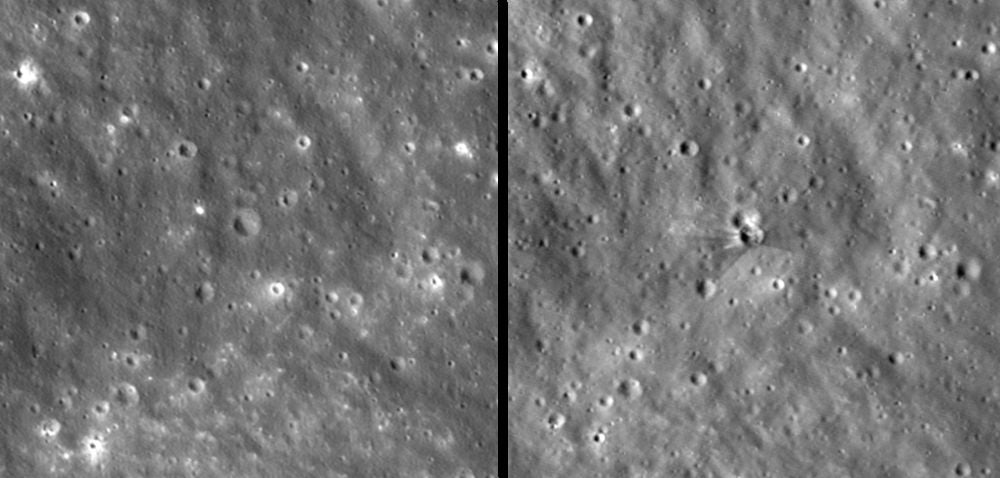
A SpaceX Falcon upper stage crashed into the Moon on August 5th when their orbits brought them into conflict. The upper stage was from launching a pair of lunar landers toward the Moon: Firefly Aerospace's Blue Ghost and ispace's Resilience. The upper stage weighed about 4,000 kg and slammed into the Moon at almost 9,000 km per hour. It struck the Moon's near side close to the Einstein crater.
A few days later, between August 11th and 12th, NASA's Lunar Reconnaissance Orbiter (LRO) imaged the new crater. It imaged from an altitude of about 96 km. The LRO is in a polar orbit over the Moon, and it images whatever is underneath it as the Moon rotates. That's why there are six days between the booster's crash and the images.
Imaging a specific target like this can be a tricky maneuver. The LRO had to be tilted toward the crater so that each time it passed over it, the Lunar Reconnaissance Orbiter Camera's (LROC) narrow and wide angle units could capture it. Nailing the pointing was only part of the challenge: the timing had to be accurate, too. Being off by only a few seconds means that the crater would drift off center, even entirely out of view.
But the maneuver was successful and the LRO's before and after images show how the crater appeared on the surface.
The images in this gif are from the LRO's narrow-angle camera and are enlarged three times. They cover an area about 1/4 of a mile wide, and north is up.

Image Credit: NASA Goddard/Intuitive Machines
The images had different viewing angles, meaning different lighting and shadows. NASA personnel determined from the images that the crater is about 18 meters wide and about 3 meters deep.
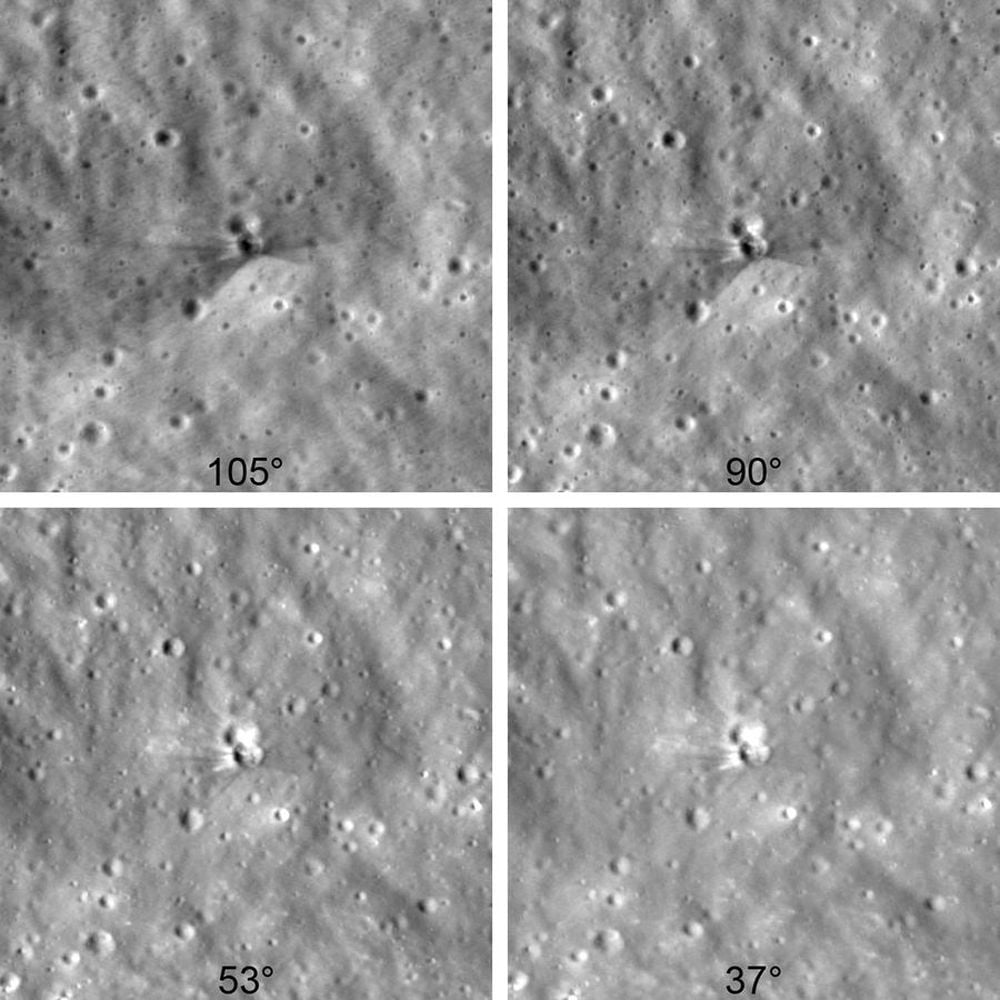 These four images were each captured from a different angle, and the sunlight angle is different, too. The different angles highlight different features. The white rays and splotches are ejecta from the impact, made of fresh material excavated by the impact, while the surrounding material is darker due to space weather and micrometeorite impacts. Each image is enlarged by two times and each one covers an area about 300 meters wide. Image Credit: NASA Goddard/Intuitive Machines
NASA didn't wait for the crash then leap into action. They calculated beforehand where the Falcon's upper stage was likely going to impact the Moon. NASA's Center for Near Earth Object Studies (CNEOS) examines asteroids and calculates their trajectories, checking for objects on course to come close to or strike Earth. In this case, the CNEOS gradually refined the impact area as the upper stage's trajectory evolved.
This resulted in two potential landing ellipses.
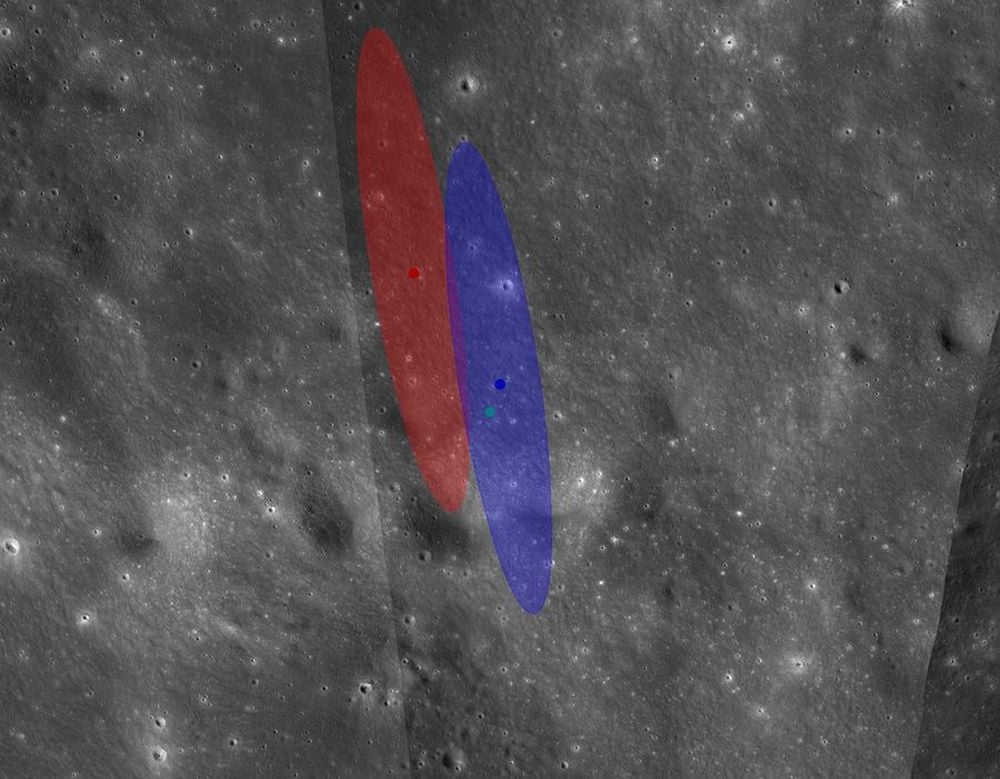 NASA's Center for Near-Earth Object Studies calculated two landing ellipses for the Falcon upper stage. Both are about 3.3 km long and about 640 meters wide. The blue one takes into account the lunar terrain, while the red one does not. Red and blue dots show the locations for the predicted impact, and the cyan one shows the actual impact. Image Credit: NASA/JPL-Caltech
They handed this data off to another lunar orbiter, the Republic of Korea's Pathfinder Lunar Orbiter, named Danuri. A few hours later, Danuri captured images of the impact site, showing that the CNEOS' coordinates were accurate to within about 1 km. They then gave the coordinates to the LRO, which captured its images.
SpaceX says they follow all applicable rules and regulations, and that this impact was a one-off. They normally dispose of space junk like this responsibly, they say, but a combination of gravity and solar activity made the booster crash into the Moon.

