 Universe Today
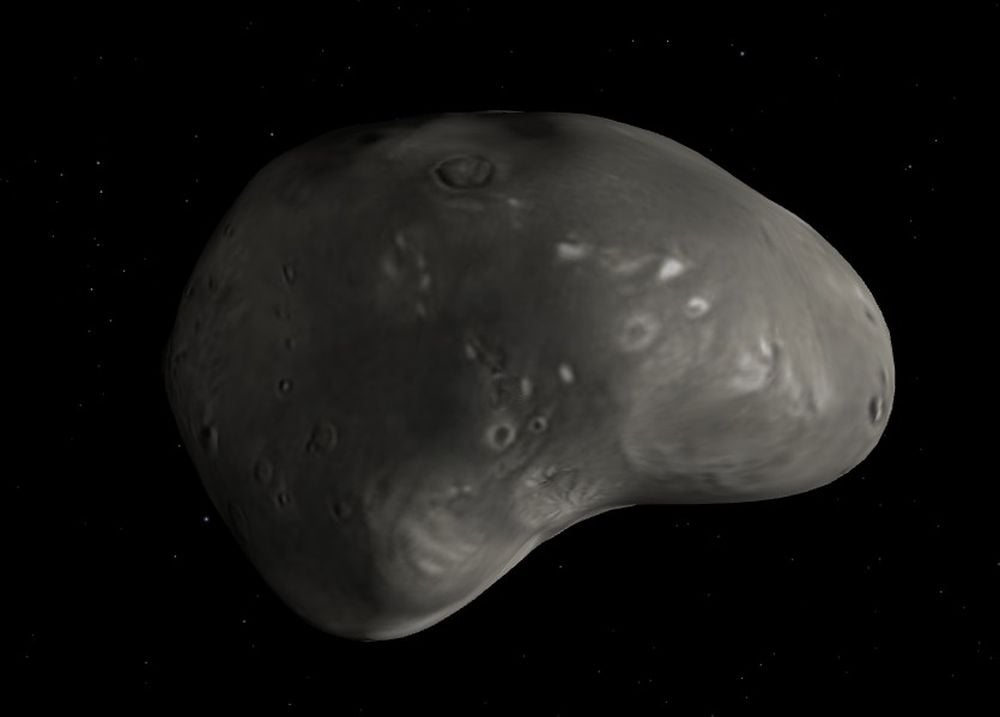
Both of Mars' moons are oddballs. They're small and lumpy like potatoes, and for a long time, astronomers thought they may be captured asteroids. A newer explanation, that they may be the result of an impact on Mars' surface, is gaining ground.
But regardless of their origins, Phobos (26 km across) and Deimos (12 km across) have both been knocked around and subjected to collisions like other Solar System objects.
In March 2025, the ESA's Hera spacecraft performed a gravity-assist maneuver at Mars, and it used that opportunity to observe Deimos. Hera tested its navigation system by locking onto surface features of the lumpy moon, including impact craters. Deimos is known for having a smooth, regolith-covered surface compared to its more heavily-cratered sibling, Phobos. But Hera's observations revealed ancient craters buried under dust.
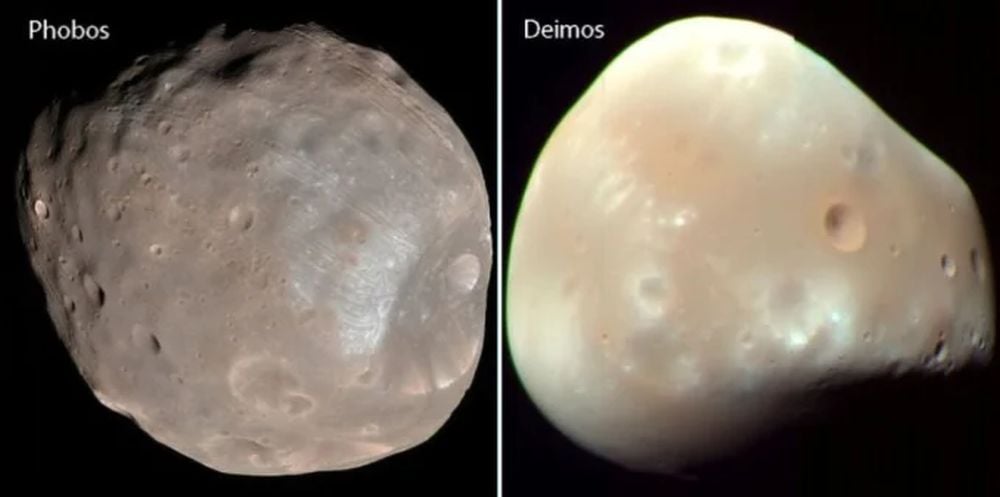 The cratered surface of phobos (Left) compared to the smooth surface of Deimos (right). Hera showed us that while Deimos appears smooth, it's actually cratered, but many of its craters are underneath a layer of regolith. Image Credit: NASA/JPL/MRO
One of Deimos' craters is particularly noteworthy. It's on the moon's south pole and new research shows the impact that created it is also responsible for Deimos' dust-covered surface.
The research is titled "Deimos’s shape and geology explained by a subcatastrophic impact," and it's published in Nature Astronomy. The lead author is Sabina Raducan from the Space Research and Planetary Sciences department at the University of Bern. Raducan is also co-chair of the Hera Impact Physics Working Group for ESA’s Hera mission.
"Small planetary bodies record the processes that shaped the Solar System, but their surfaces and interiors often evolve in unexpected ways," the researchers write. "Deimos, the potato-shaped, 12-km-diameter outer satellite of Mars, has a strikingly smooth surface covered by fine regolith, in contrast to its heavily cratered and grooved sibling, 22-km-diameter Phobos."
The large crater on Deimos' south polar surface dominates the moon's shape. It's 10 km wide, and Deimos is only about 12 km across. The researchers wondered if a single impact could be responsible for both the crater and the surface debris that's so effective at hiding some of the other craters. "Here we propose that a single, large-scale impact that excavated the 10-km-wide depression at Deimos’s south pole is responsible for the thick, globally distributed regolith observed today," they write.
Raducan and her co-researchers used a powerful simulation called the Bern Smoothed Particle Hydrodynamics (SPH) code to test the idea. SPH simulations are particularly effective for problems like large surface deformations and violent disruptions from large impacts.
“The code runs on a high-performance computing cluster here at the University of Bern and is one of the few codes capable of performing this type of simulation,” lead author Raducan said in a press release.
“Run on a High Performance Computing Cluster at the University of Bern, our Bern Smoothed Particle Hydrodynamics, SPH, impact code works by recreating bodies of interest into millions of adhering particles whose interplay is governed by various programmable variables, including gravity levels, material strength and cohesion," lead author Raducan said in a press release. She added that this is one of the few codes that can run this type of simulation.
“In this case we created a detailed shape model of Deimos out of SPH particles, having filled in the southern depression to leave it ready for the impactor to strike. Then we ran about a hundred simulations – each one taking about a week at a time to complete – to experiment with various impactor masses and angles of approach,” Raducan explained.
The simulations included an impactor between 300 m and 360 m and a range of impact angles between 0 and 60 degrees. The impact velocity was set at 8.2 km s−1 for all simulations, based on previous research into Deimos' craters.
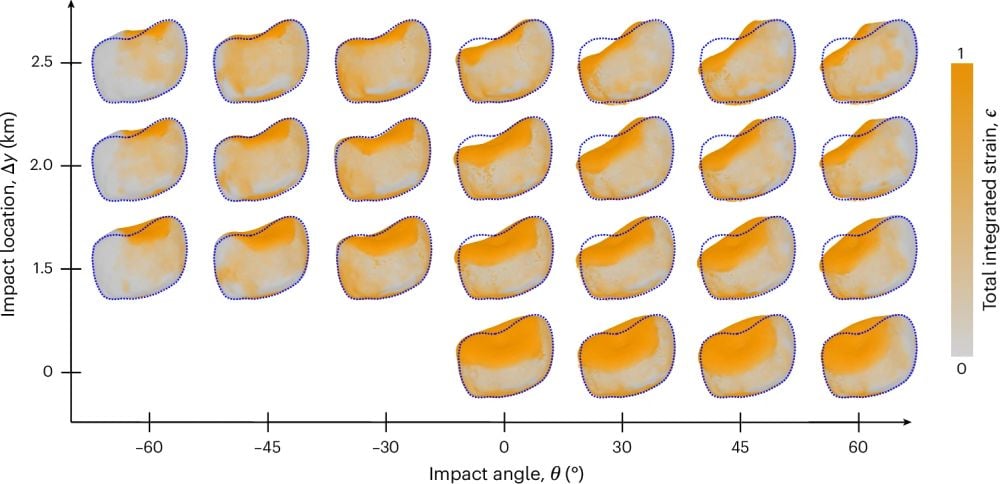 This figure shows some of the simulation's results. The x-axis shows the simulated impact angle, and the y-axis shows location. "The blue dashed outline shows the South Polar Crater shape model profile extracted in the same fixed cross section displayed in each panel," the authors write. Image Credit: Raducan et al. 2026. NatAstr.
The simulations showed that the impactor was a small asteroid only 320 meters wide striking Deimos at about 45 degrees. Obviously, the moon wasn't shattered, but the impact did cover the small moon in regolith. In some place on the surface, the regolith is 200 meters deep. This regolith obscures many of Deimos' surface craters, giving the moon a smooth appearance.
“Our simulation is consistent with patterns of brightness observed across the moon’s surface, linked to the gradual migration of regolith that behaves more like loosely packed dust than anything more cohesive. The same is true of the way the southern depression subsequently smoothed out, rather than retaining a sharp crater," Raducan said.
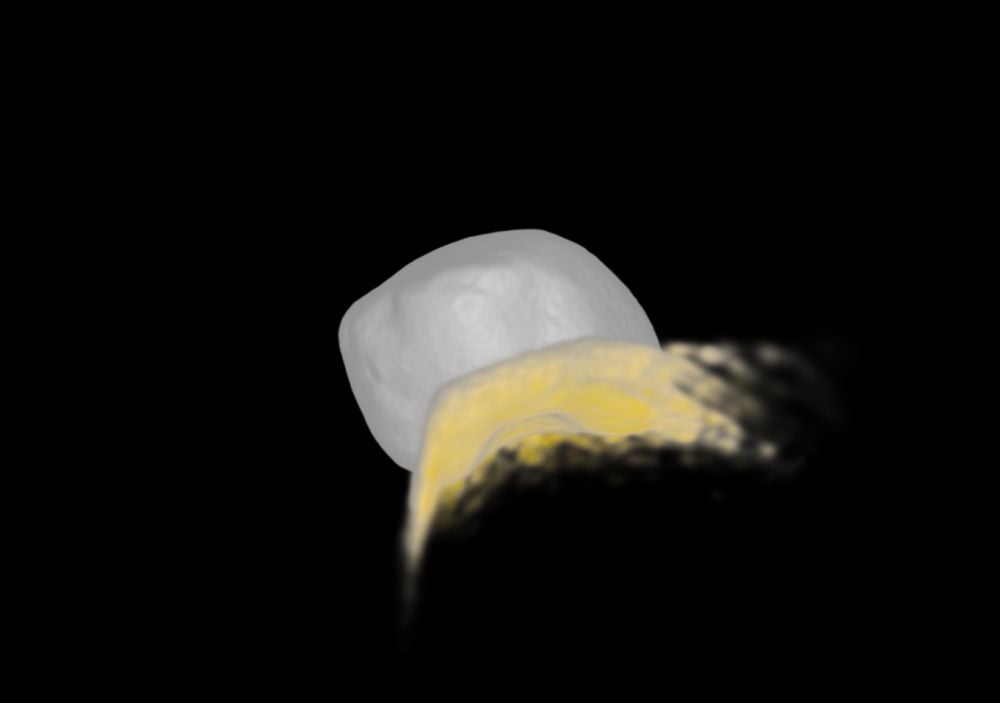 This is a screenshot from the simulations, showing the impactor striking Deimos and creating the south polar crater. The yellow is ejecta, most of which has fallen back to the moon's surface, blanketing it in regolith that's up to 200 meter deep in some places. Image Credit: S.D. Raducan. Licence: ESA Standard Licence
Determining the size, speed, and angle of the impactor also revealed things about Deimos' interior.
The research shows that the materials and structure of the moon's interior are more like rubble-pile asteroids than solid, cohesive rocky bodies like Earth's Moon. "The low surface cohesion (≲100 Pa) required for the crater to collapse and the high-porosity, low-interior crushing strength required to dissipate the impact shock suggest that it is essentially a rubble pile, like Dimorphos, Ryugu and Bennu," the researchers explain.
While many spacecraft have observed Deimos, Hera's data helped make these simulations accurate. In fact, the researchers had Hera's Mars flyby in mind when they began this research.
"We began this simulation campaign before Hera’s Mars flyby, but with the hope that Hera’s observations would help constrain the results even more. This indeed turned out to be the case, as the side of the moon imaged by Hera turned out to show additional buried craters," Raducan said.
In an interesting side note, Queen guitarist Brian May is part of the research team, having earned a PhD in astrophysics in 2008.
“These were really the last pieces of the puzzle I needed – although they weren’t immediately obvious to the naked eye. Instead I first made them out via spectroscopic depictions of the Hera images made immediately afterwards by Sir Brian May, who is part of the Hera science team,” Raducan added.
The hidden craters found by Hera pre-date the impact that created the south pole depression. Their presence shows that Deimos' interior is rather fragile. If it were stronger, then shock waves from the impact would've erased them. Instead, the porous and fractured interior dampened the shock waves.
“This simulation therefore implies that Deimos is a rubble-pile body, akin to many asteroids," said ESA’s Hera project scientist, Michael Kueppers, in the press release. "This does not necessarily mean the moon is in fact a captured asteroid – it might well have formed out of material kicked up from Mars by surface impacts – but more that it may have formed in a similar way and therefore shares comparable properties. This is the first of a series of results demonstrating how tuning Hera’s Mars flyby to get close to Deimos has paid off well in terms of science.”
This research supports the idea that an impact shaped Deimos' surface, but there other possible explanations for the moon's features. We may not have to wait long before this idea, and others, can be tested with more observations.
"Finally, although the present scenario is one of potentially several viable explanations, it makes several testable predictions for future observations, for example by the Martian Moons Exploration mission," the authors write.
The Japan Aerospace Exploration Agency (JAXA) is getting ready to launch the Martian Moons eXploration (MMX) mission in November of this year. While MMX's crowning achievement will be returning a sample from Phobos, the mission will also observe Deimos. We don't yet know how close it will get to Deimos, because as a secondary target, its flybys of the moon will depend on how the spacecraft has to maneuver around Phobos, it's main target.
Since MMX won't land on Deimos, no true deep probing of its interior can take place. But its refined surface measurements, from its LIDAR and gamma-ray/neutron spectrometer in particular, will help determine its mass and bulk density more accurately. Those measurements will help refine its surface composition, especially the properties of its regolith. High-resolution images will also help scientists understand the moon.
It's possible that the impact hypothesis outlined here isn't what actually happened. Scientists think it's possible, for example, that the regolith layer is because of continuous micro-meteorite bombardment over billions of years. Only more and better data can say, and MMX may provide it.
"High-resolution imaging and topographic mapping could assess whether the south-polar depression exhibits diagnostic crater morphology consistent with a large oblique impact or instead favours alternative origins," the authors explain.

