 Universe Today
When astronomers studying the Milky Way's center found a group of stars orbiting the center very rapidly, it proved that a supermassive black hole (SMBH) was located there. The stars, dubbed S-stars, showed that a massive object with about 4 million solar masses resides in the galactic center and accelerates the stars and shapes their orbits.
Now astronomers have discovered another S-star in the region, the fastest one yet. Not only is it moving very rapidly, but it's extremely close to the SMBH. It's so close that the black hole's spin is affecting its rotation.
The discovery of this star is in new research to be published in Nature titled "Discovery of a star sensitive to the spin of Sgr A*." The lead author is K. Abd El Dayem from the Laboratory for Instrumentation and Research in Astrophysics at the Paris Observatory. The paper is currently available at arxiv.org.
“What is special about this star is that it’s orbiting Sagittarius A* on a very tight orbit, taking just 8.7 years to complete it, and is approaching the black hole at a mere 12 times the distance of Earth to the Sun. That is unprecedented,” said study co-author Felix Mang, a PhD student at MPE.
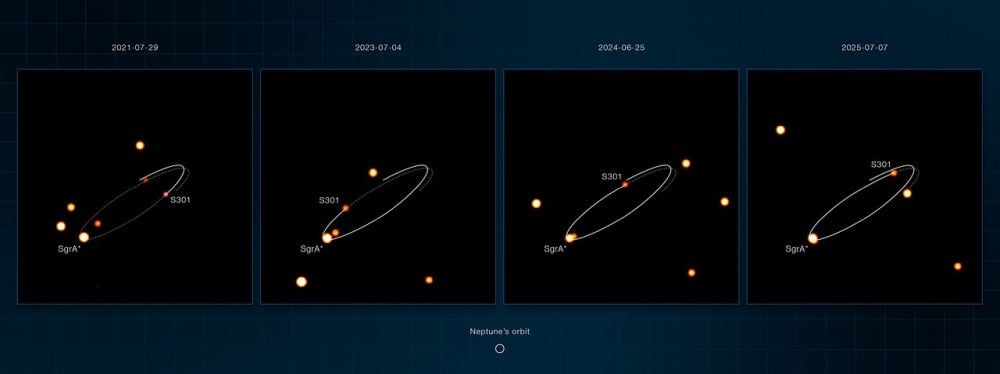
The star is named S301 and it travels at about 25,000 kilometers per second. At this speed, it only takes about 8.7 years to complete an orbit. S301 also gets to within 12 au of the SMBH. That means that S301 is both the closest star to the SMBH and the fastest S-star ever detected.
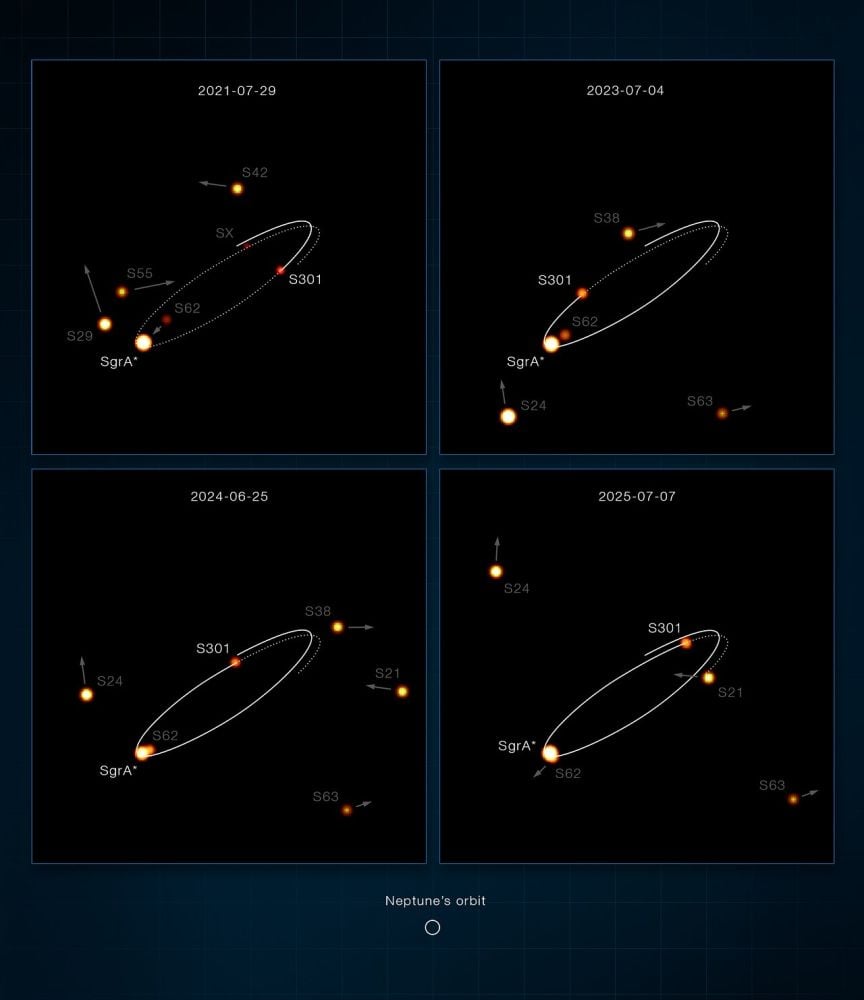 The VLT captured this series of images with its GRAVITY instrument. It shows several of the S-stars, including the newly-discovered S301, orbiting Sgr A. Neptune's orbit around the Sun is shown for comparison. Image Credit: ESO/GRAVITY collaboration*
“Decades carefully tracking stars orbiting our galaxy’s central black hole, Sagittarius A*, have led to this breakthrough discovery of a very promising star," Nobel Prize Winner Reinhard Genzel said in a press release. "Because it orbits so close to Sagittarius A*, S301 opens a new window to the fundamental properties of spacetime in this extreme black-hole environment.” Genzel is the Director at the Max Planck Institute for Extraterrestrial Physics (MPE) in Garching, Germany, and founding member of the collaboration that made the new observations.
S301 is so close to Sgr. A* that it's an opportunity to test an aspect of Einstein's General Theory or Relativity. Since the Milky Way's SMBH is so massive, it drags spacetime along with it as it rotates, affecting nearby stars. That means that S301 can be used to measure the the black hole's spin.
“With this star we hope to measure, within the next 10 years, the spin of the black hole," said Mang.
MPE researcher Stefan Gillessen, who also had a leading role in the new study, adds: “For the first time, we would actually be able to measure very directly the spin of a massive black hole, which would be a key test of Einstein’s theory.”
When a star gets close to Sgr. A*, they let researchers test relativity with the Lense-Thirring effect.
The SMBH is so massive that it drags and twists spacetime when it rotates. When the star gets closest to the black hole, it gets dragged along with it. This causes orbital precession, and a star this close to a SMBH will have its closest point to the SMBH shift each orbit.
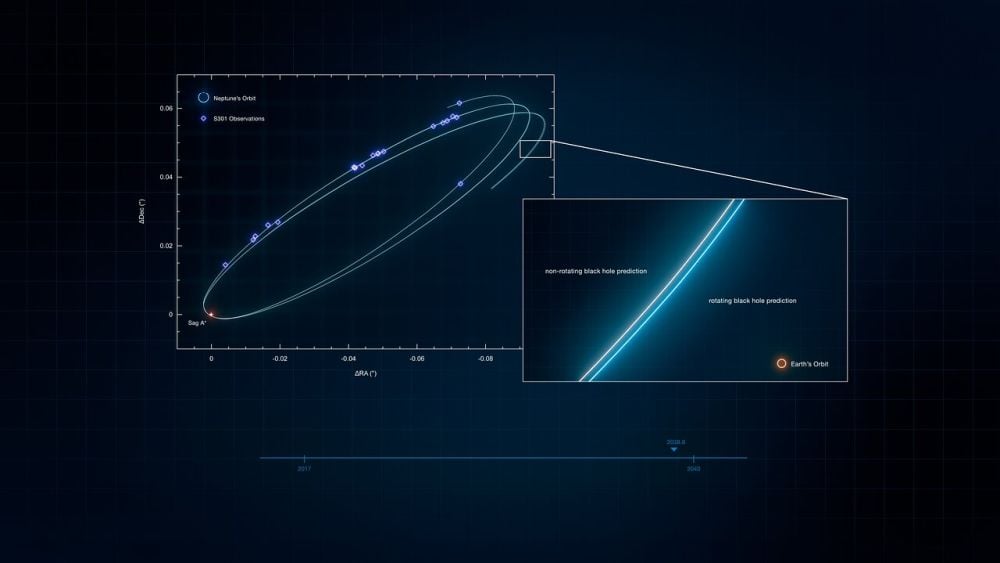 This figure illustrates how the black hole's rotation changes the star's closest point to the black hole each orbit. This is due to the Lense-Thirring effect. Image Credit: ESO/GRAVITY collaboration/L. Calçada
S301's proximity to Sgr. A* is a boon to researchers. Because it's so close, they won't have to spend decades measuring more stars in order to determine the black hole's spin.
“Without this star, we would need to measure the motion of other stars for several more decades to get anywhere close to measuring the spin of the black hole,” said study co-authorJuan Osorno, an astronomer at LIRA Observatoire de Paris–PSL, France.
Discovering S301 was no simple matter, since it's two billion times dimmer than Betelgeuse. The researchers conducted a dedicated, multi-year campaign to observe the region around Sgr. A* with its GRAVITY instrument on the Very Large Telescope Interferometer. For about 100 hours every year since 2017, they used GRAVITY to track stellar motions. The data from all of these observations was combined, analyzed, and modelled.
"In spring 2023, we discovered a faint star 15 mas north-west of Sgr A*, which in the following months moved outward, and which we labeled S301," the authors write. They found the star in four different positions in 2023's observations, and they determined its speed and trajectory. "We followed S301 with dedicated pointings in 2024 and 2025, yielding eight and five additional astrometric measurements respectively," the researchers explain.
Working backwards from there, they also found the star in previous observations, strongly in 2021 observations and more weakly in 2017 observations. "Overall, we have 19 astrometric positions of S301 that outline an ellipse on the sky and yield a consistent orbit," the authors write.
As for how this star found itself so close to the SMBH, migration was the likely path. Stars can't form this close to an SMBH, so S301 formed elsewhere and migrated into its current orbit. It most likely had a binary partner at one time, but was separated from it by a Hills disruption.
"Taken together, the properties of S301 suggest a simple and self-consistent picture: a compact main-sequence binary was tidally separated by Sgr A*, leaving behind S301 on the most relativistic stellar orbit known and ejecting its companion as a hyper-velocity star," the authors conclude.

