Universe Today
: NASA/JPL/Voyager-ISS/Andrea Luck/[CC 4.0 license](https://creativecommons.org/licenses/by/4.0/deed.en)](/article_images/51935821827_8b49b64b45_c_20260922_183835.jpg)
The planet Neptune presents a fine late September target at dusk.
Never seen Neptune for yourself? Late September 2026 presents an ideal opportunity to cross the outermost ice giant off of your ‘life list,’ as the planet reaches opposition for 2026, rising opposite to the setting Sun and riding high to the south towards local midnight.
Following Neptune in 2026
Neptune reaches opposition for 2026 at ~1:00 Universal Time (UT) on September 26th (9:00 PM EDT on Friday the 25th). +7.6 magnitude, gray-blue Neptune presents a tiny 2.4” dot of a disk at the eyepiece near opposition.
The September 2026 Harvest Moon (the nearest Full Moon to the southward Equinox) hangs near Neptune in its corner of the astronomical constellation Pisces the Fishes on opposition evening, Friday/Saturday September 25th/26th.
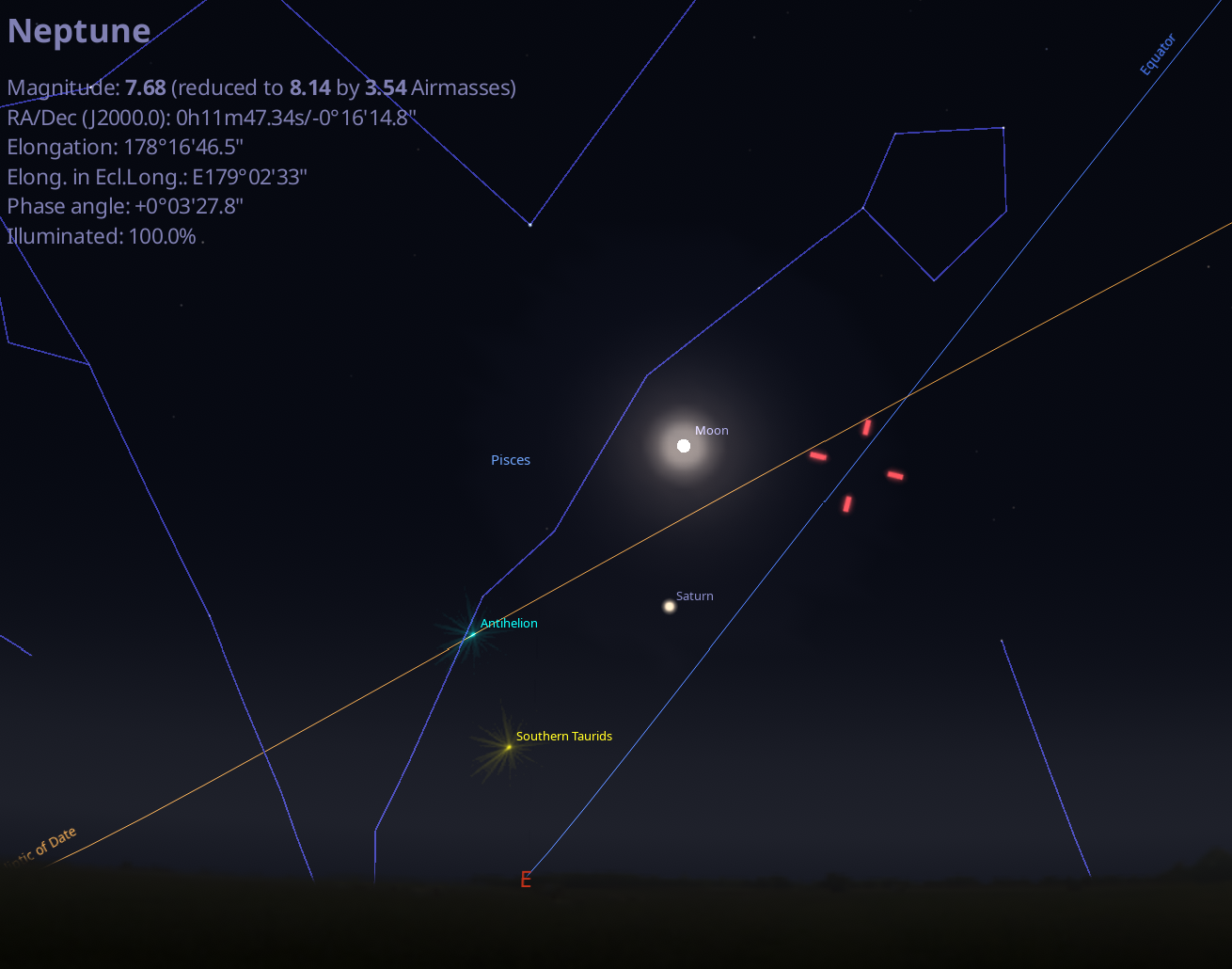 Neptune and the Moon on the night of September 25/26th. Credit: Stellarium.
Orbiting the Sun at a leisurely once every 165 years, Neptune is actually closest to Earth on September 25th, at just over 4.3 billion kilometers distant. That’s still four light-hours away, staking out the fringes of the planetary solar system.
2026 is a special year for Neptune, as it sits very nearly on the celestial equator in near the March equinoctial point, opposite to the September equinox Sun. This position equally favors observers in both hemispheres. Neptune makes a long, overlapping two degree-wide loop annually, and will now move slowly northward reaching its northernmost declination in 2066.
To round out this year, Neptune reaches eastern (dusk) quadrature on December 23rd, before once again reaching solar conjunction next year on May 27th, 2027. Neptune moves so slowly, that oppositions and solar conjunctions only move forward on the calendar about 4-5 days a year.
Neptune was the first planet discovered using math. It was soon noticed shortly after Sir William Herschel’s discovery of Uranus in 1781 that the planet wasn’t precisely where it should be. French Mathematician Urbain Le Verrier hypothesized that an undiscovered planet was pulling on Uranus, and the two worlds should have passed one another in the direction of Sagittarius in 1821.
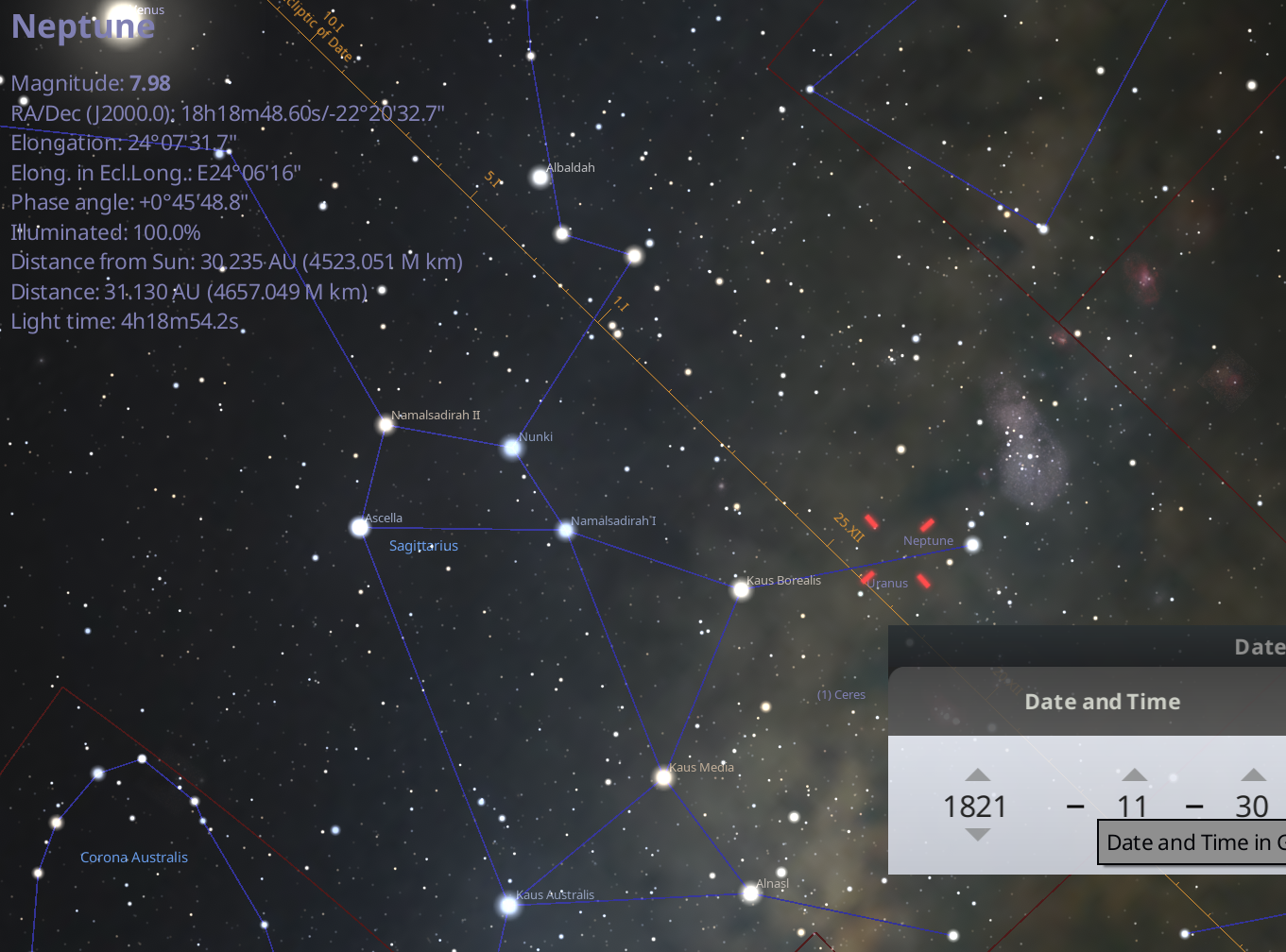 Uranus versus Neptune in 1821. Credit: Stellarium.
Word went out, and astronomers Johann Gottfried Galle and Heinrich d’Arrest spotted Neptune on the Aquarius-Capricornus border (very near Saturn at the time). They used the 9”-refractor at the Berlin observatory on the night of September 23rd, 1846 to make the discovery. Neptune was very nearly right where Le Verrier said it should be, less than a degree (two Full Moons) away. This was a triumph for Newtonian physics and predictive astronomy at the time, and a win for the prestige of France. Ironically, Neptune actually turned up on several star charts pre-discovery, and was even noted as an anomalous ‘star’ sketched by Galileo near Jupiter (!) in late December 1612 and again (!!) in January 1613.
Observing and Imaging Neptune
Shining at +8th magnitude, you can pick up Neptune with binoculars if you know exactly where to look for it. Even at high magnification, Neptune only displays a slight grayish-blue disk, looking maybe like a star that stubbornly refuses to snap into focus, or a tiny planetary nebula.
Follow or image the background star-field from one night to the next, and you might just be able to tease out Neptune by its slow orbital motion.
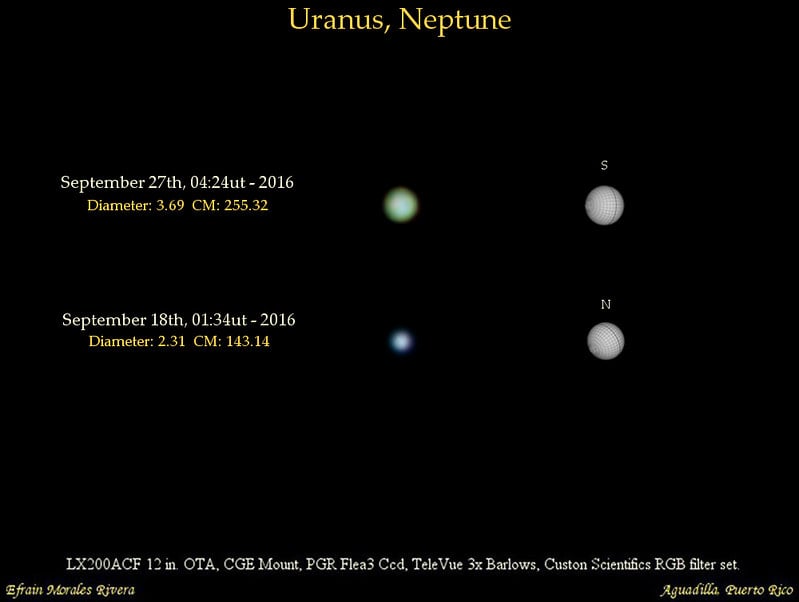 Uranus versus Neptune at the eyepiece. Credit: Efrain Morales.
Spotting the Moons of Neptune
Though Neptune currently has 16 known moons, +13th magnitude Triton and perhaps +18th magnitude Nereid are the only two within reach of dedicated large light bucket owners. I remember way back as a child of the 1970s when two moons were all that Neptune was thought to have. NASA’s Voyager 2 made the only flyby of Neptune to date in 1989, giving us close up views of the enigmatic world and adding to the moon count.
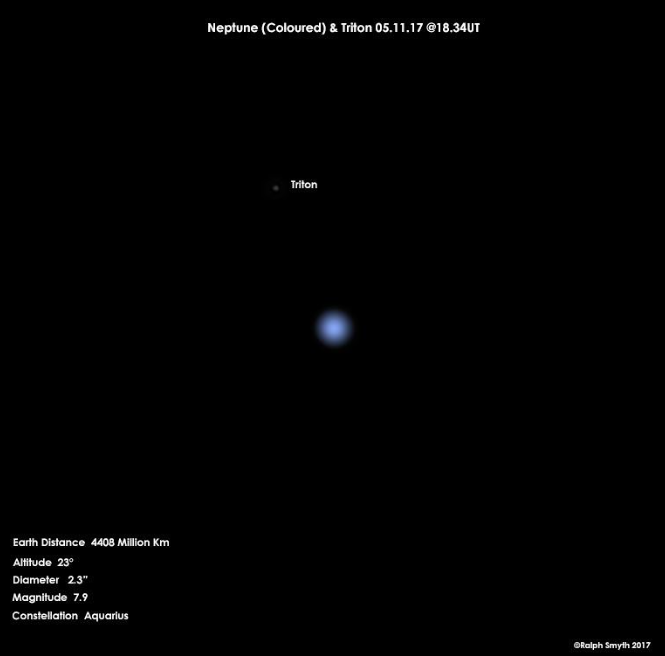 Neptune and Triton. Credit: Ralph Smyth.
You’ll want to try for Triton in the weeks around opposition, right when it’s at greatest elongation 15” from the planet itself. Triton orbits Neptune once every 6 days, while Nereid takes a much more stately 360-day path around Neptune. Use PDS Rings Node to generate a custom ‘Triton Tracker’ by date.
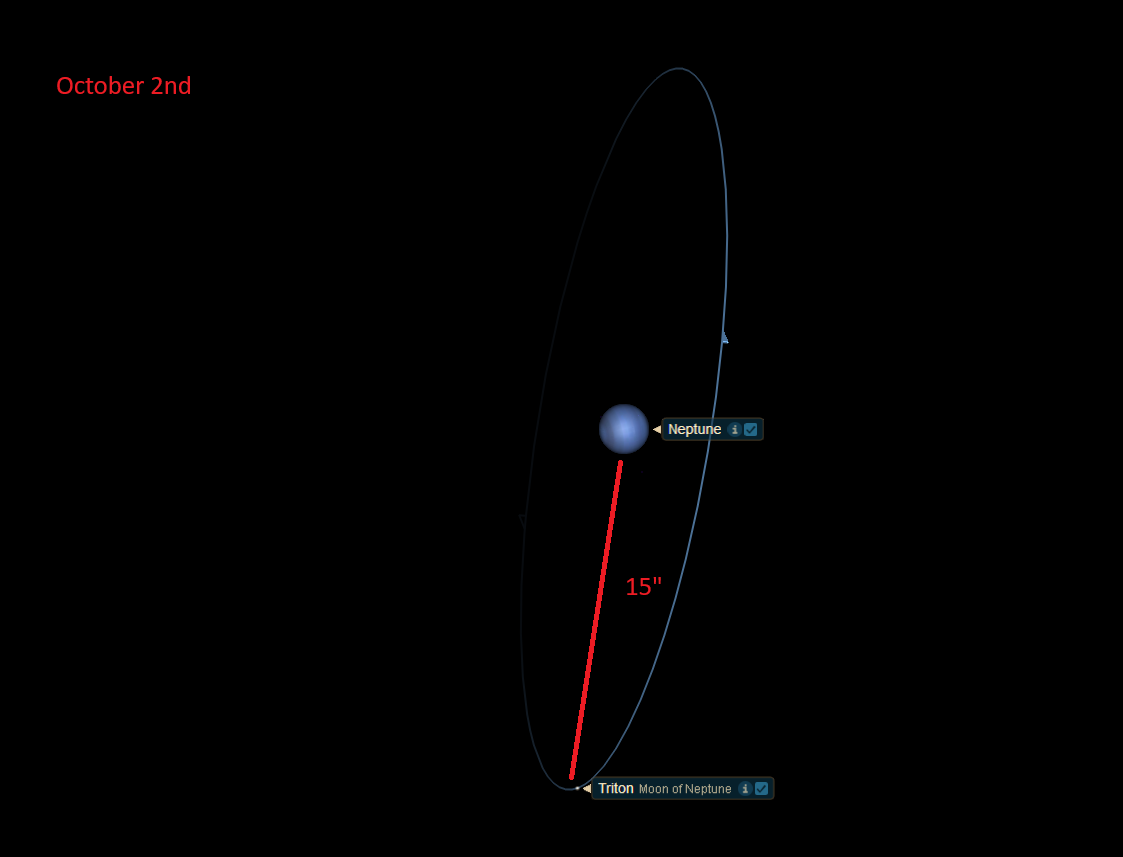 Neptune versus Triton at greatest elongation around October 2nd. Credit: Stellarium.
Of course, we’d love to head back to Uranus and Neptune on a future mission, and explore these enigmatic worlds up close. Rather than a simple flyby, the next step would be to park dedicated orbiters around the ice giants and explore these worlds over time, much like Cassini did with Saturn. These would, however, be lengthy missions, and may not depart the Earth until the 2040s.
Be sure to give Neptune a try in the coming weeks around opposition. Like much of observational astronomy, the ‘wow factor’ in showing off a faint dot at the eyepiece lies in knowing just what you’re actually seeing, and the object’s amazing backstory in the drama of modern astronomy.