Universe Today
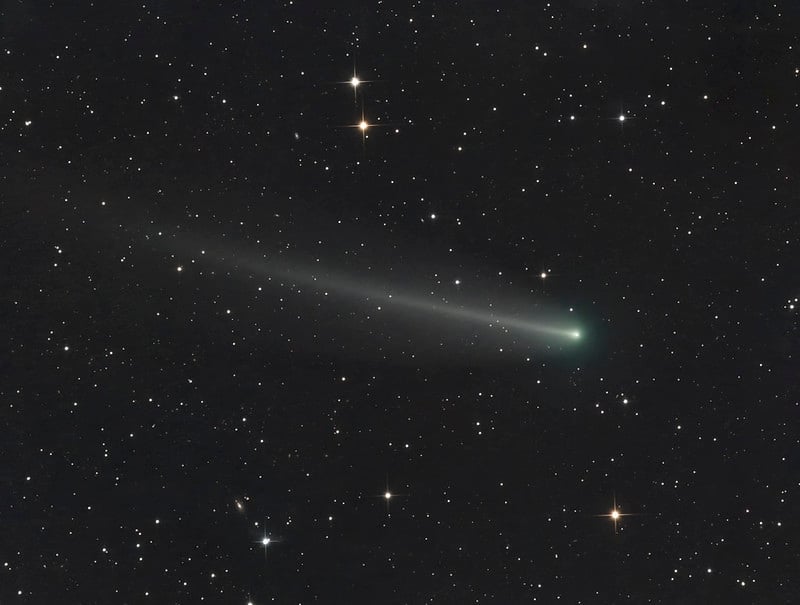
Comet 220P flares back into binocular visibility.
It has been a busy month for astronomy. In the midst of an eclipse season bookended by the total solar eclipse on August 12th and the deep partial lunar eclipse coming right up this week on August 28th, an outbound comet hanging high in the dawn sky just refuses to die: 220P/McNaught.
We wrote about this active comet earlier this year, leading up to its favorable 2026 perihelion apparition.
Periodic comet 220P was first discovered by prolific comet hunter Robert McNaught on the night of May 20th, 2004 as he was observing from the Siding Spring Observatory in Australia. On a 5.5 year orbit, the periodic comet is a Jupiter-family member, caught long ago in the inner solar system on a 2:1 resonance with the gas giant.
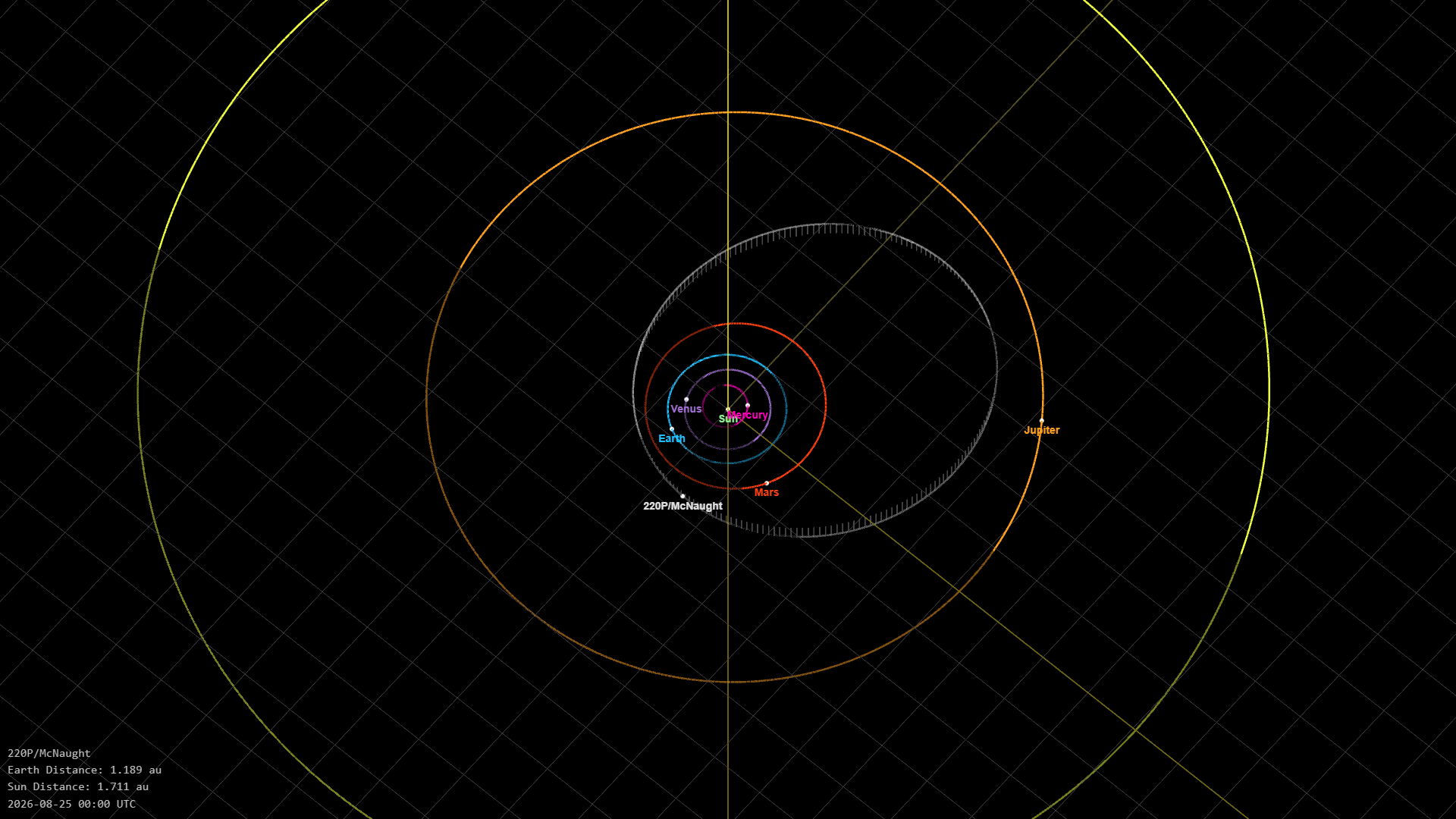 Comet 220P McNaught's orbital path through the inner solar system. Credit: NASA/JPL/Horizons.
The comet reached perihelion earlier this summer on June 14th, 1.6 Astronomical Units (AU) from Sun just exterior to the orbit of Mars. Comet 220P is due to make its closest pass versus Earth coming up on October 12th, at 1.043 AU distant. The comet is running ahead of us on its orbit outbound, loitering for most of summer in the dawn sky.
What’s really grabbed astronomers’ attention is the recent outbursts from this normally obscure comet. A large eruption in early June vaulted the comet almost 10 magnitudes in brightness, an 8,000-fold increase only bested by 17/P Holmes in 2007 and Comet 289P/Blanpain in 2013. Early August saw another marked increase of 600 times or about 7 magnitudes. Something interesting is afoot with Comet 220P for sure, and I would not be surprised if we saw another outburst leading up to its closest Earth passage in October.
The comet topped out at over +8th magnitude in June, and is still holding steady at a respectable +9th magnitude in late August. The comet joins the ranks of another notable active comet we’ve been following in 2026, Comet 10P Tempel.
Astrophotographer Dan Bartlett is composing a sequence of images showing the comet’s progress through the summer.
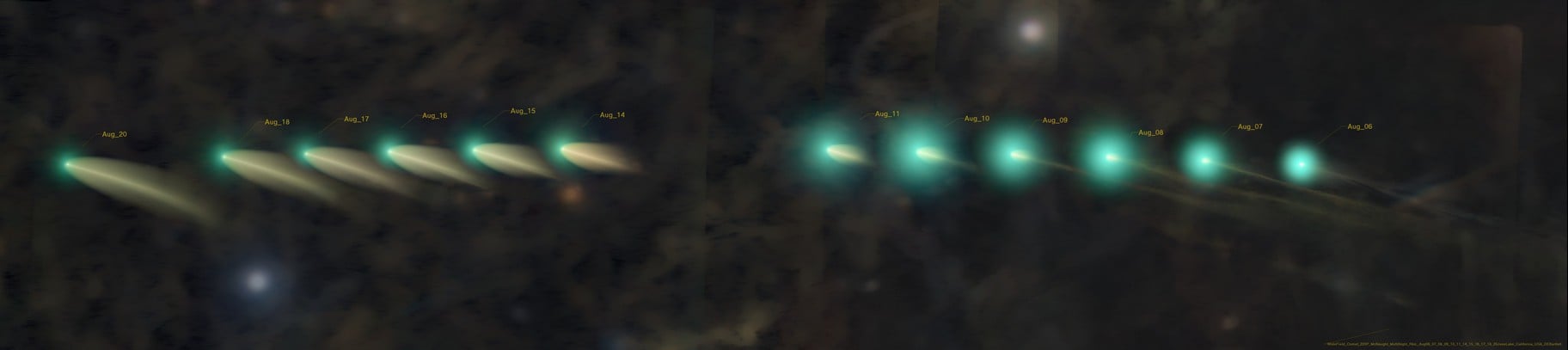 An ongoing montage of comet 220P through August 2026. Credit: Dan Bartlett.
There’s a true “Multi-personality of this comet, (it) almost looks like a different comet,” from one night to the next, notes Bartlett on his AstroBin page. “The blue-green coma expands at first and then dissipates and contracts as the nights progress. A faint dust tail can be seen in the early days of the outburst and all but disappears after August 10.” The sequence then shows the tail starting to unfurl again this past week.
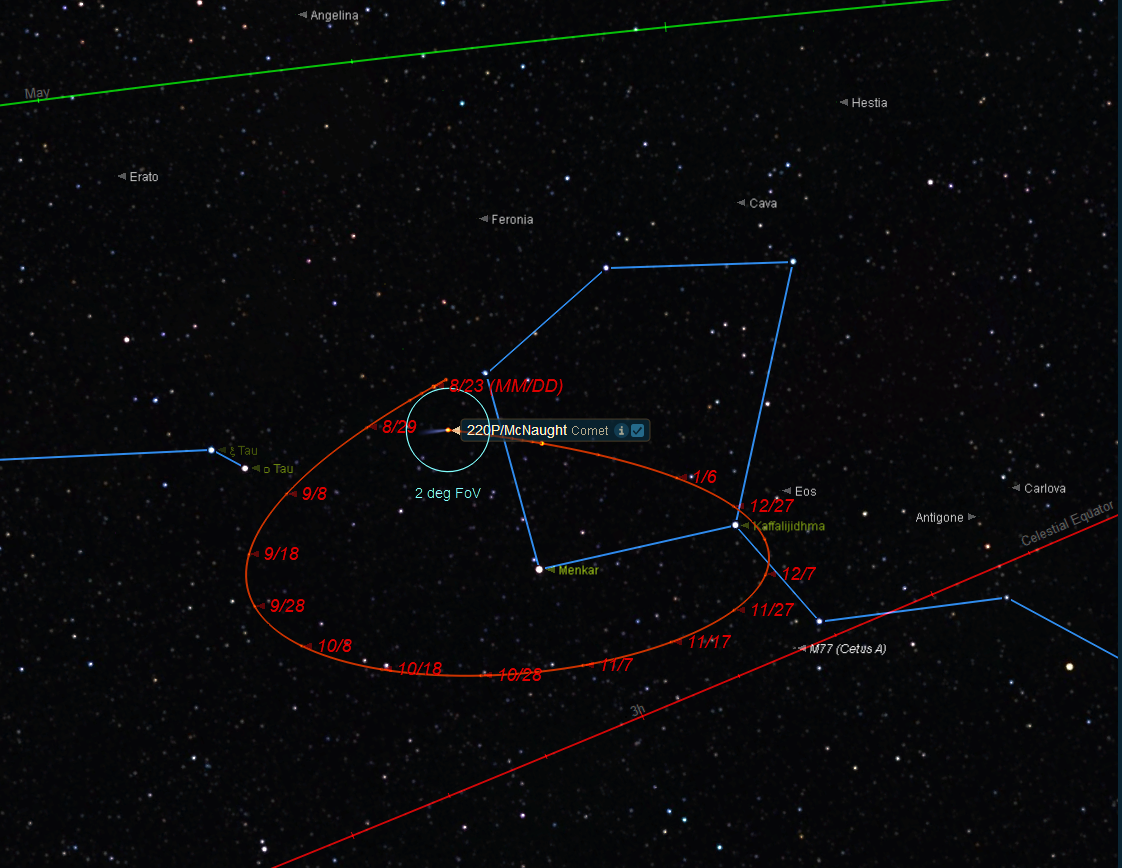 The path of Comet 220P through Cetus in the last half of 2026. Credit: Starry Night.
Comet 220P spends the end of August 2026 between the stars Omicron Tauri and Lambda Ceti. The comet then loops in and out of the Circlet of Cetus asterism through the remainder of 2026, circling the +2.5 magnitude star Alpha Ceti (Menkar). This puts comet 220P high to the south for northern hemisphere observers in the pre-dawn hours through August into September and October.
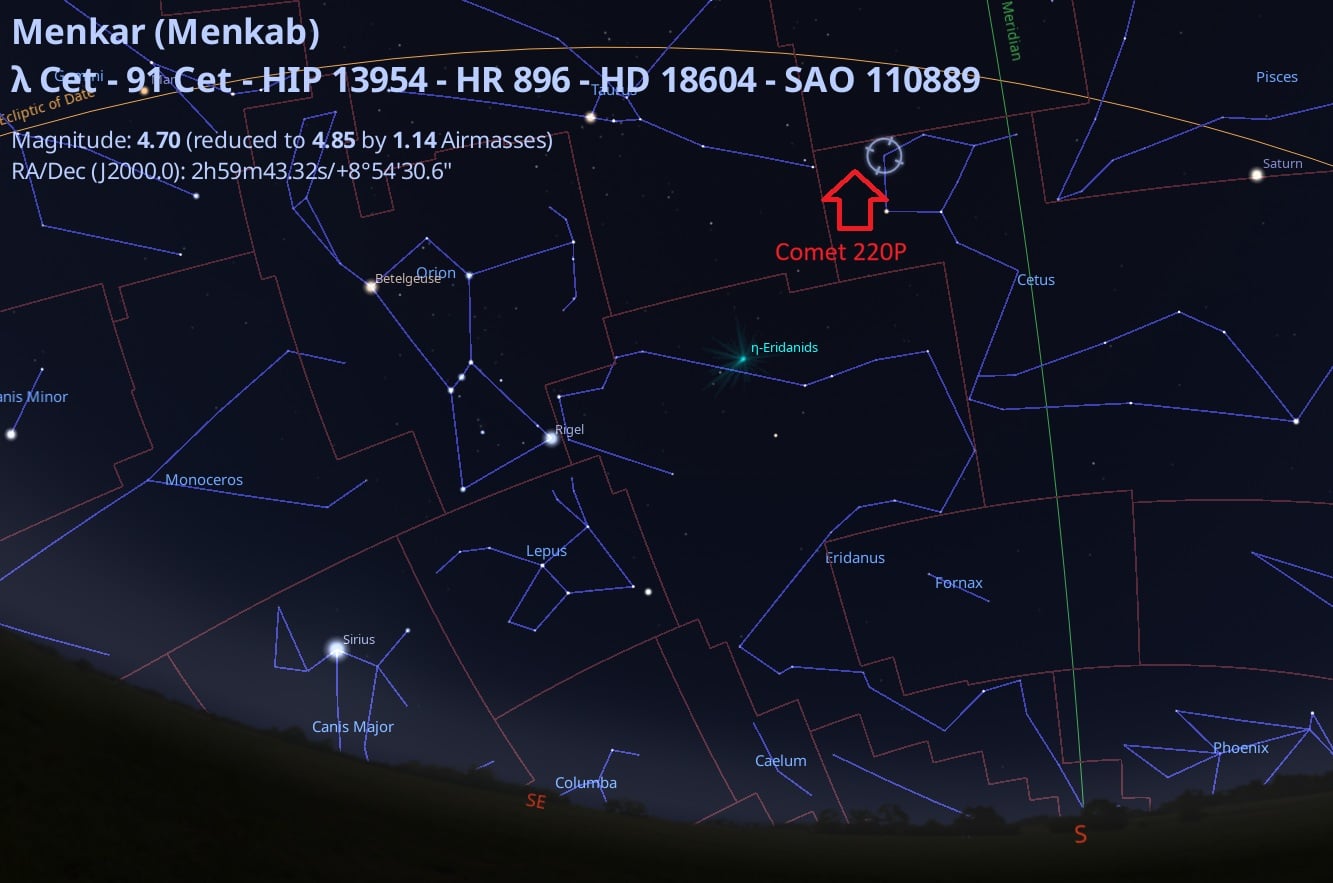 The location of Comet 220P/McNaught, about an hour prior to local sunrise in late August. Credit: Stellarium.
I usually consider a comet to be of interest to visual observers and backyard imagers when it breaks +10 magnitude, and public interest when it tops +6th magnitude or brighter. Keep in mind, unlike a pinpoint star, the brightness of a comet like 220P is spread out, much like a deep-sky object such as a globular cluster.
These sorts of binocular comets are however, great targets for smartscopes like the SeeStar or Dwarf Lab’s Dwarf Mini:
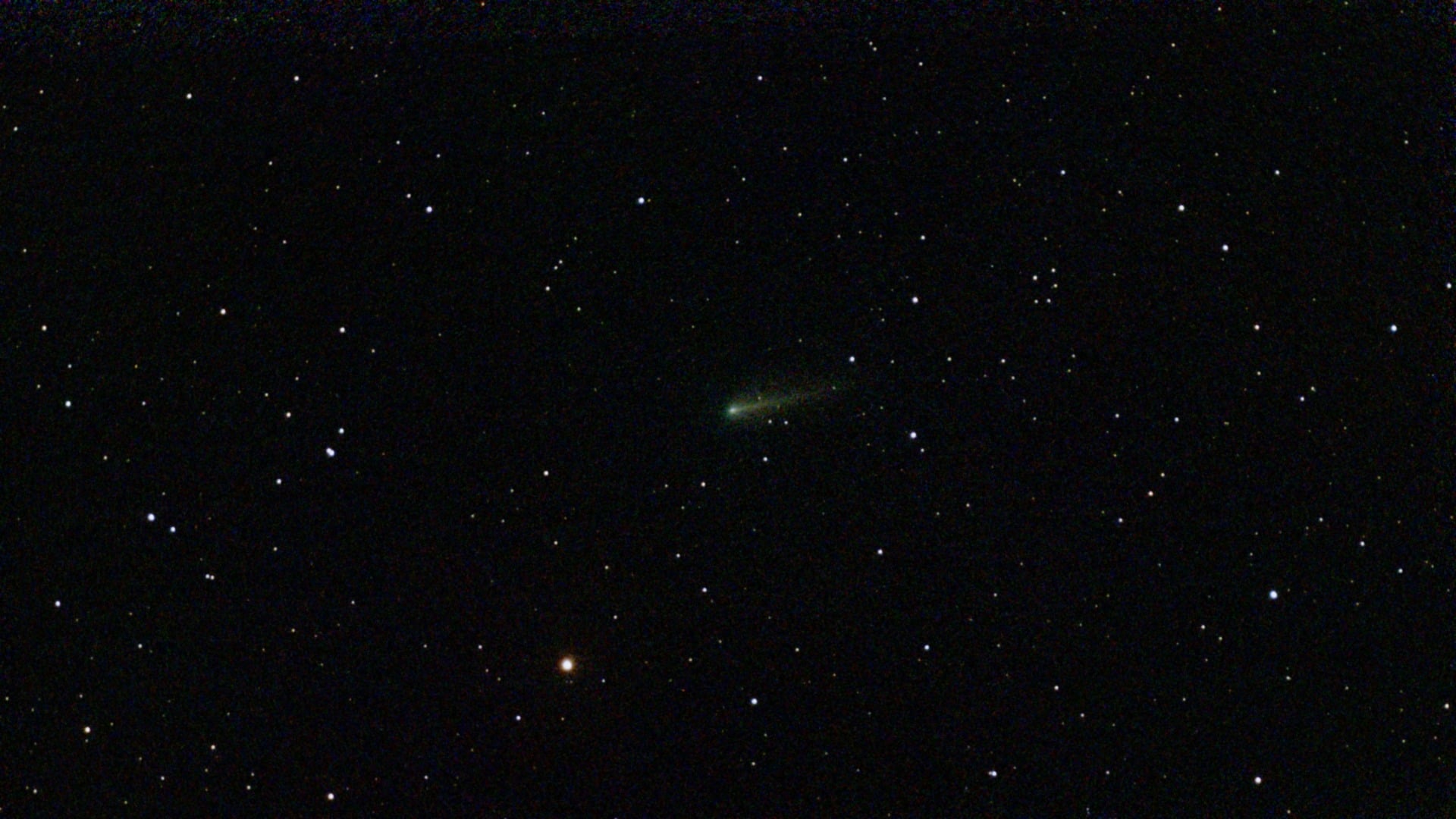 A Dwarf Mini capture of Comet 220P from downtown Asheville, North Carolina in early August. Credit: Dave Dickinson
Comet 220P McNaught reaches aphelion 4.679 AU from the Sun on March 12th, 2029, and we’ll see it again on its next perihelion apparition in late 2031.
Could we witness a breakup before Comet 220P McNaught departs the dawn sky scene in late 2026? One thing is for certain: in an otherwise clockwork Universe, comets seem to have a ‘mind of their own’ when it comes to outbursts and changes in brightness. Be sure to keep an eye on 220P McNaught into Fall, as its final act for 2026 may be yet to come.