Universe Today
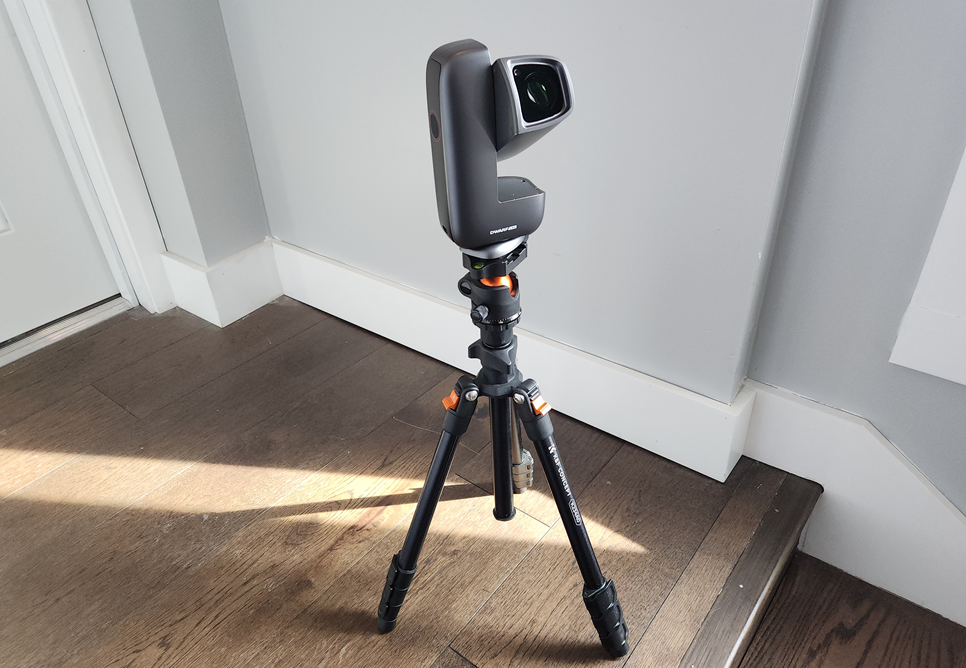
Dwarf Lab’s newest entry into the smartscope market is also the smallest yet.
Telescopes are getting smaller. It’s strange to think: smartscopes have been with us for over half a decade now. Since 2020, we’ve tested units from Vaonis, Unistellar and more. In a short time, these smartscopes have revolutionized amateur astronomy, putting deep-sky imaging within reach of causal users. Recently, we had a chance to put Dwarf Lab’s latest unit the Dwarf Mini through its paces.
Smartscopes work by connecting to the unit via WiFi or Bluetooth straight to your smartphone or tablet. In most cases, there’s no eyepiece to peer through, like in a traditional telescope. Along with SeeStar, Dwarf Lab is becoming a leader in the small smartscope field. In addition to portability, the key to these units is trading aperture size for time. After a brief alignment routine, the telescope simply stares at the appointed target, building up an image after repeated exposures. You can even simply leave the unit imaging a single target for hours if needed.
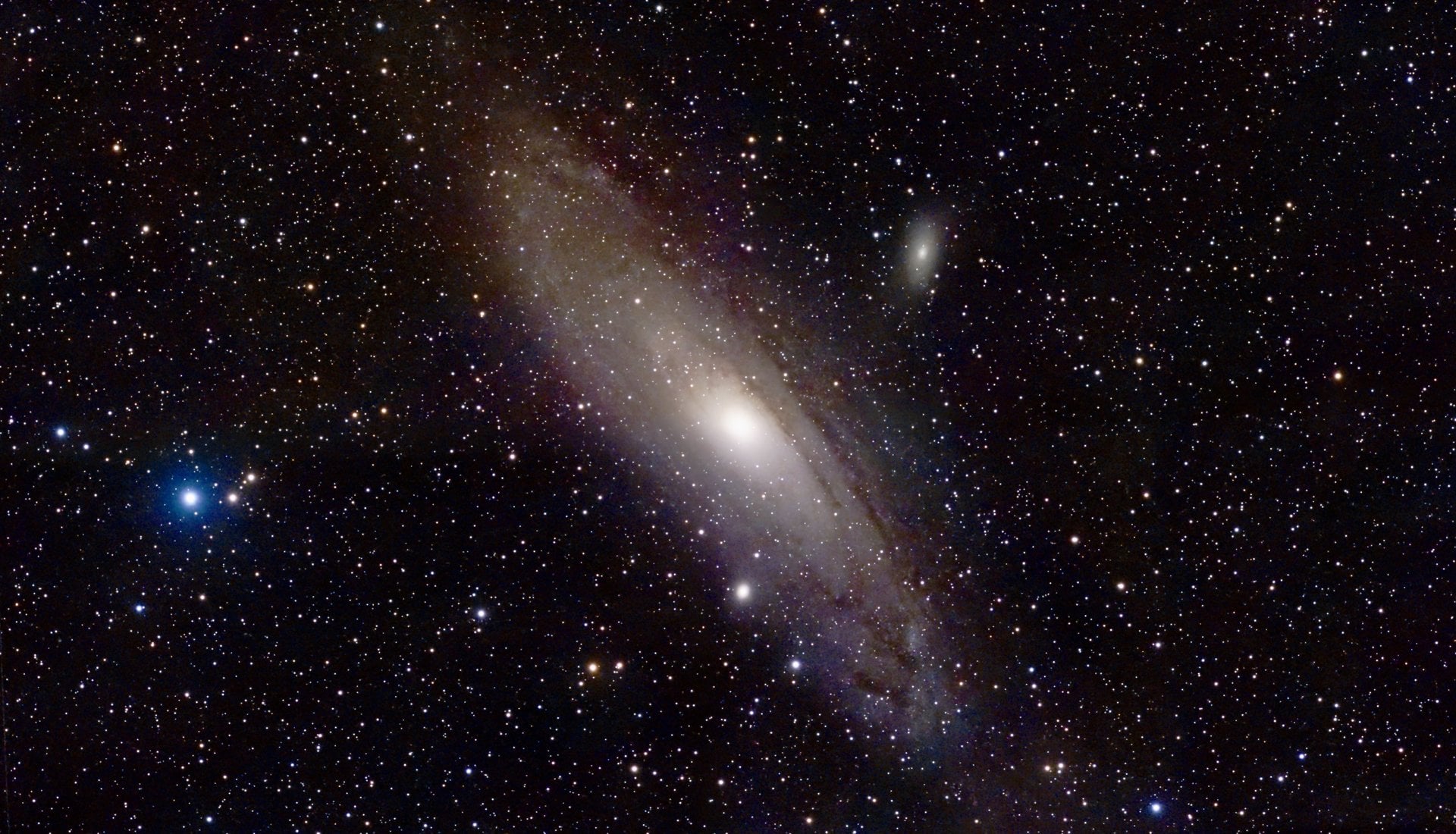 A capture of the Andromeda Galaxy (Messier 31) of several hours, showing what the Dwarf Mini is capable of. Credit: Aaron Fothergill/Processing: Stellar Studio and iPhoto.
"It's just mind-blowing how well it works and fits in your pocket," says Fraser Cain (Publisher-Universe Today). "The key to these little telescopes is that they trade aperture for time. So, just let it run all night and it'll catch up to a much bigger telescope."
What I really enjoy about the Dwarf Mini is how seamless it is to operate. It powers up, aligns and is ready to go in minutes. Nothing is more frustrating in the field than a balky telescope that refuses to align or restarts the whole process with the least little change in temperature or sky conditions. The Dwarf Mini worked with no problems, even from the light-polluted, cluttered horizon environment of a downtown urban cityscape. This, I feel, is one of the great pluses for smartscopes: putting deep-sky imaging within reach of urban astronomers.
The technical specs for the Dwarf Mini underline how powerful the unit is in a small package: it has a small 30mm aperture (half that of the traditional 60mm refractor) and a short 150mm f/5 focal ratio. This yields a zoomed-in 2.4 degree wide field of view, about five times the size of a Full Moon’s diameter. The unit has an advertised 4 hours of battery time, and worked well when tested in sub-zero temperatures. Dwarf Mini user Aaron Fothergill recommends purchasing an external USB battery power pack for use during ultra long exposures.
The heart of the Dwarf Mini is an IMX662, 2.9µm pixel 1/2.8-inch sensor supporting 2MP RAW astrophotography. The unit has 64 GB of storage, and you can download images from the unit straight to your phone after capture.
You can also solar image with a small magnetically attached aperture filter (included), and even use the unit for capturing International Space Station solar and lunar transits, though it really shows its stuff during deep-sky captures. The unit even features a mosaic mode, allowing for wider captures of extended objects. The Dwarf Mini is pocket-sized, weighing in at just 840 grams, versus 1.3 kilograms for the Dwarf 3. The unit can stand alone on a table top, though it has a 1/4” attachment point for mounting it on a lightweight tripod. This makes the unit ideal for carry-on airline travel.
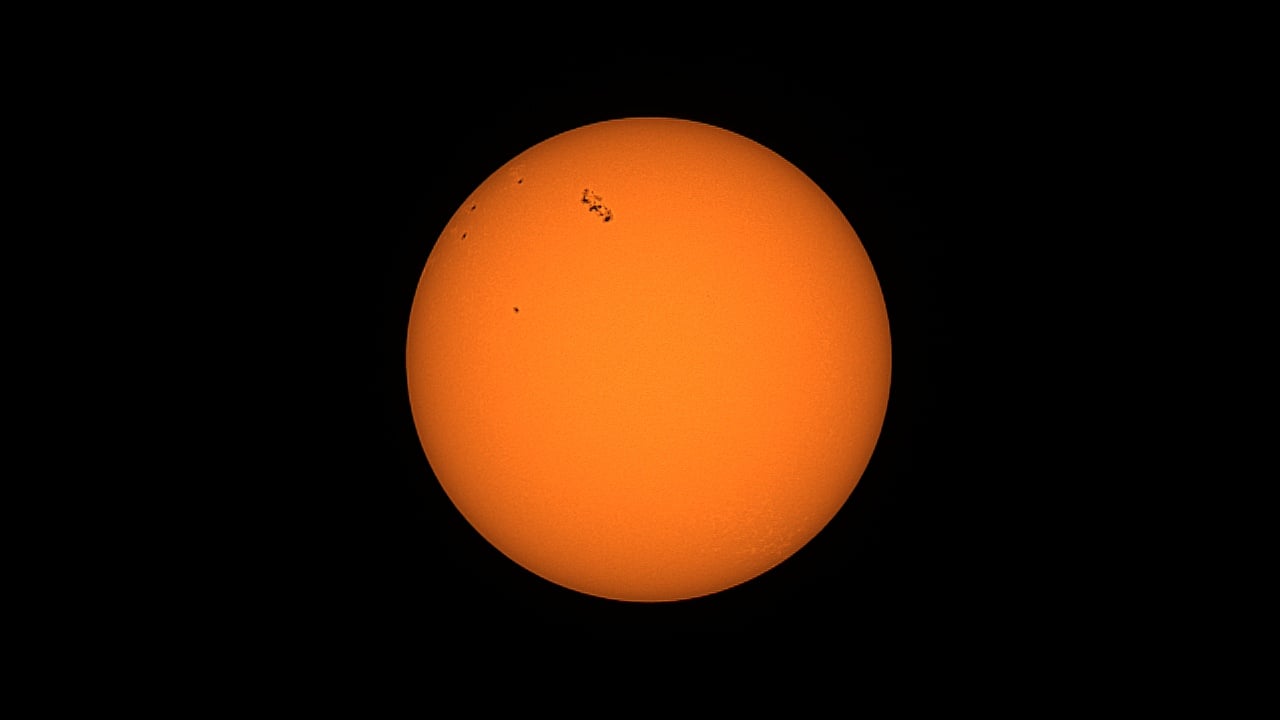 A solar shot taken with the Dwarf Mini, showing a massive sunspot group rotating into view. Credit: Dave Dickinson.
The App for controlling the smartscope is intuitive and easy to use, and comes with a virtual planetarium-style database. You can also manually aim it at a given patch of sky, handy for tracking down newly discovered comets. The App has built-in dark frame, astro-contrast and dual band filter features, automating much of the deep sky capturing process.
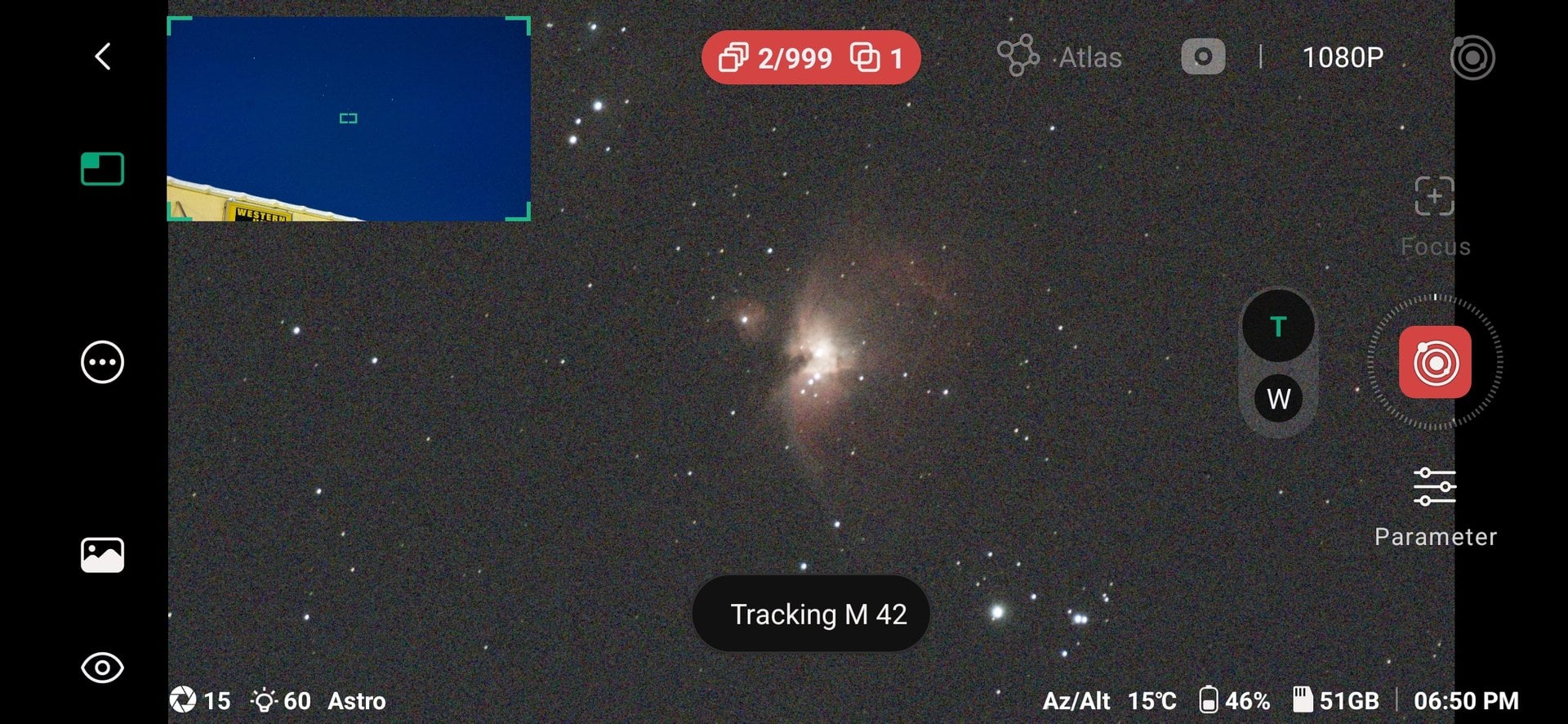 A screen capture of the Dwarf Lab App, showing a live capture sequence of the Orion Nebula (Messier 42). Credit: Dave Dickinson.
My one quibble is how a recent update changed the joystick mode… now, slewing from fast to slow is a bit of a touchy process that takes some getting used to. On the plus side, the unit seems to know to automatically clean up images under sub optimal conditions, removing clouds, satellite streaks, etc. This step in image processing workflow is becoming compulsory in the modern era of a sky filled with Starlinks, and Dwarf Lab has automated the process.
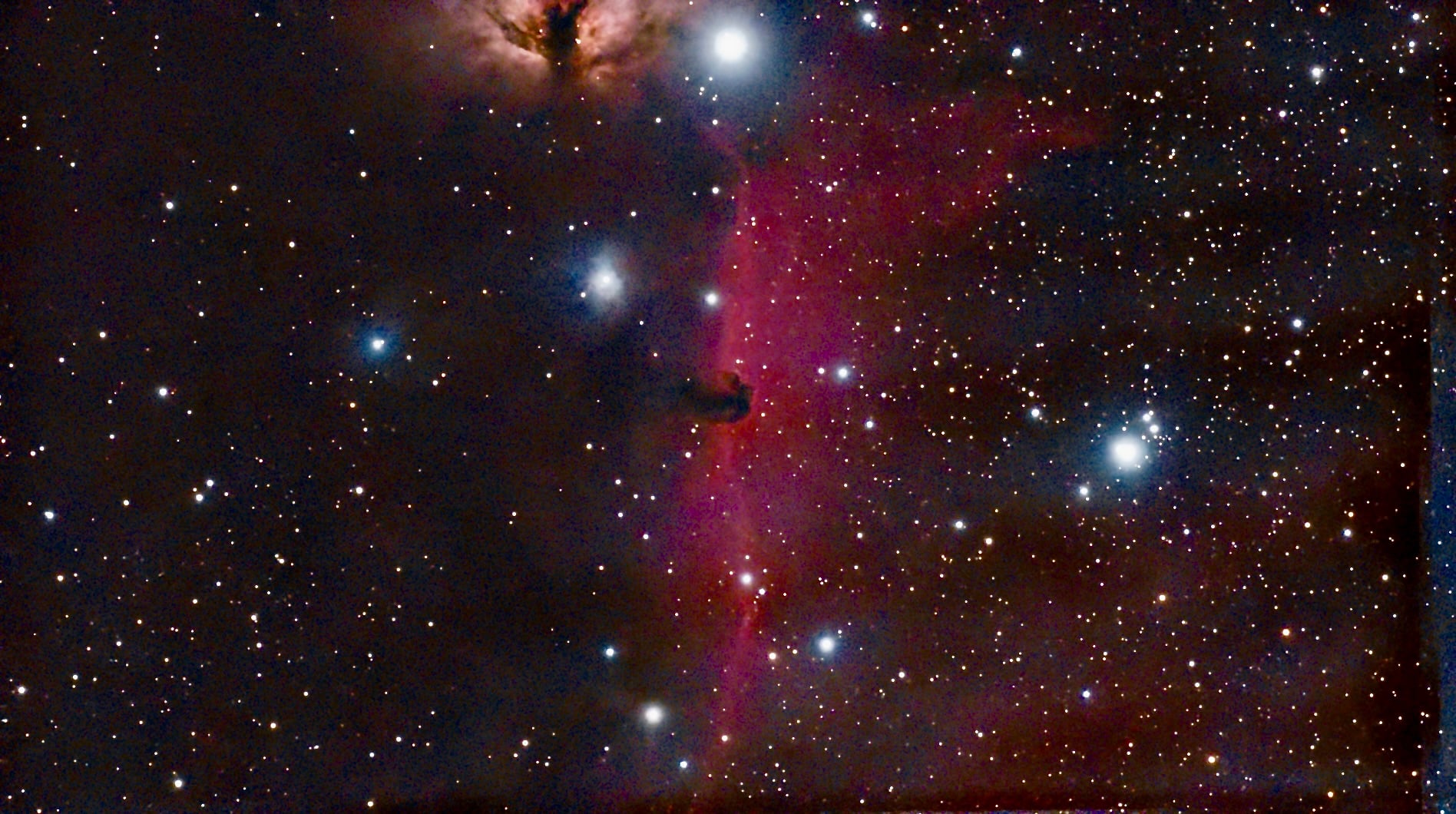 A several hour capture of the Horsehead and Flame Nebula in Orion. Credit: Aaron Fothergill/Processing: Stellar Studio and iPhoto.
I only see a slight loss in resolution in the Dwarf Mini images versus the Dwarf 3… this is to be expected, with the slightly smaller optical aperture of 30mm versus 35mm, though its certainly not objectionable or even noticeable in the final processed images.
"Both Dwarf Mini and Dwarf 3 have wide-angle and telephoto lens, and Dwarf Mini's astrophotography function is nearly the same as Dwarf 3," Jimmy Lu (Dwarf Lab) told Universe Today. "We will keep on optimizing the app using experience, and next we will develop the co-shooting feature."
The quoted cost of the Dwarf Mini from the company site is 399$ U.S. As expected, smartscope prices are coming down, to where more curious users are giving them a go. What I really like about the Dwarf Mini and Dwarf Lab’s line of telescopes is that it gets me thinking about what’s possible. I could see using the unit to capture videos of lunar occultations, or see it placed in its own permanent mini-observatory, ready to go or even under remote control.
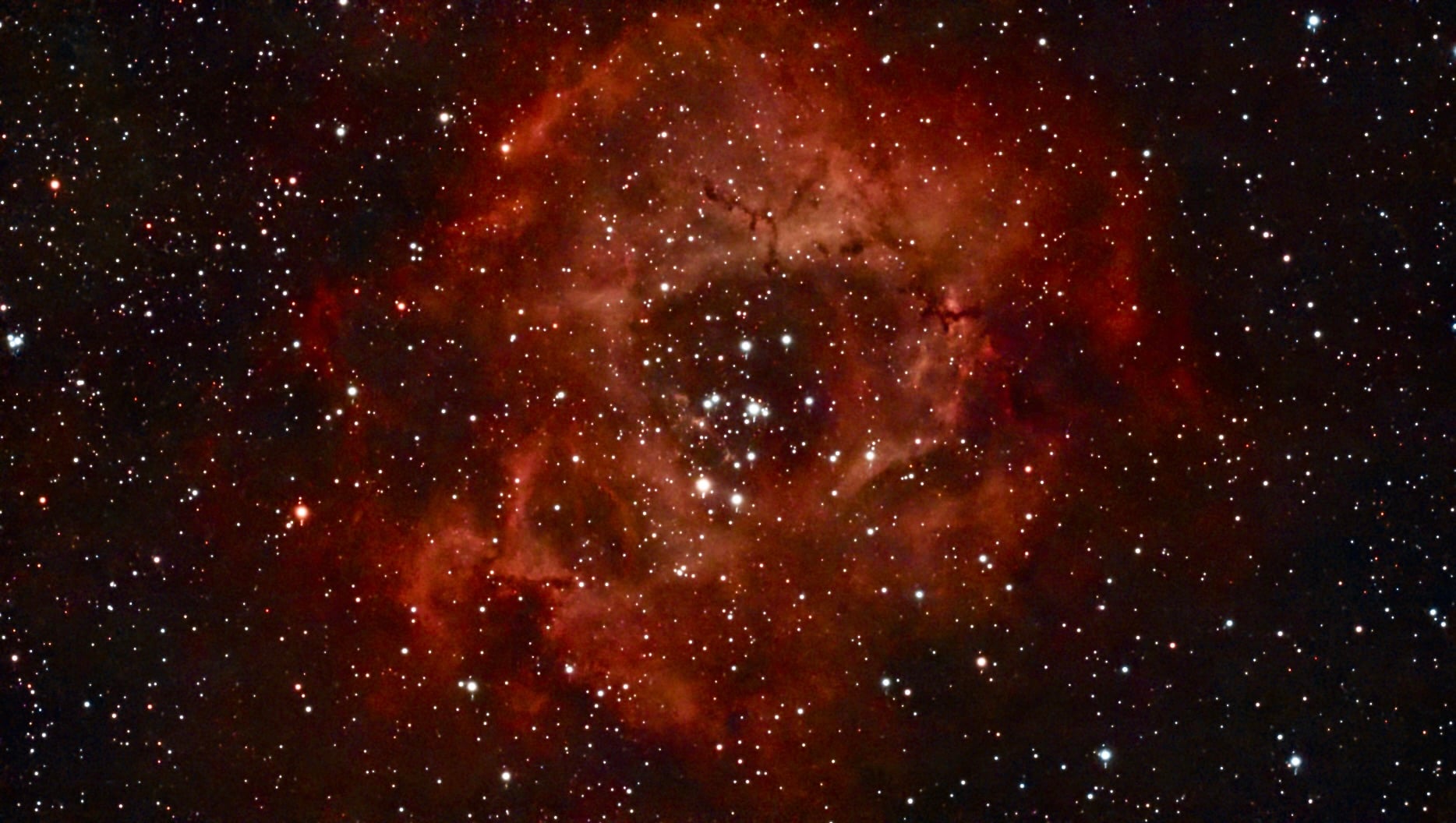 A several hour capture of the Rosette Nebula in Monoceros. Credit: Aaron Fothergill/Processing Stelar Studio and iPhoto.
The Dwarf Mini is an amazing instrument, and shows just how far smartscopes have come in a short time. Be sure to check it out as a great option for ‘astronomy on the go.’