Universe Today
It’s 2035 and NASA’s Dragonfly quadcopter has been “hopping” around the surface of Saturn’s largest moon Titan for just over a year taking images, scanning pebbles, drilling holes, and analyzing surface material for potential signs of life. You’re at NASA JPL and just moved to Blue Team (12am-8am) from Red Team (4pm-12am), so you’re hyped up on coffee, Red Bull, and will power. It’s 3:30am, you’ve been analyzing data since you clocked in, and you keep discarding what you’ve been told looks like positive signs of life but is more commonly known as false positives. In the meantime, some microbes on Titan that got scanned by Dragonfly keep posing in front of its main camera with signs saying, “We’re here!”
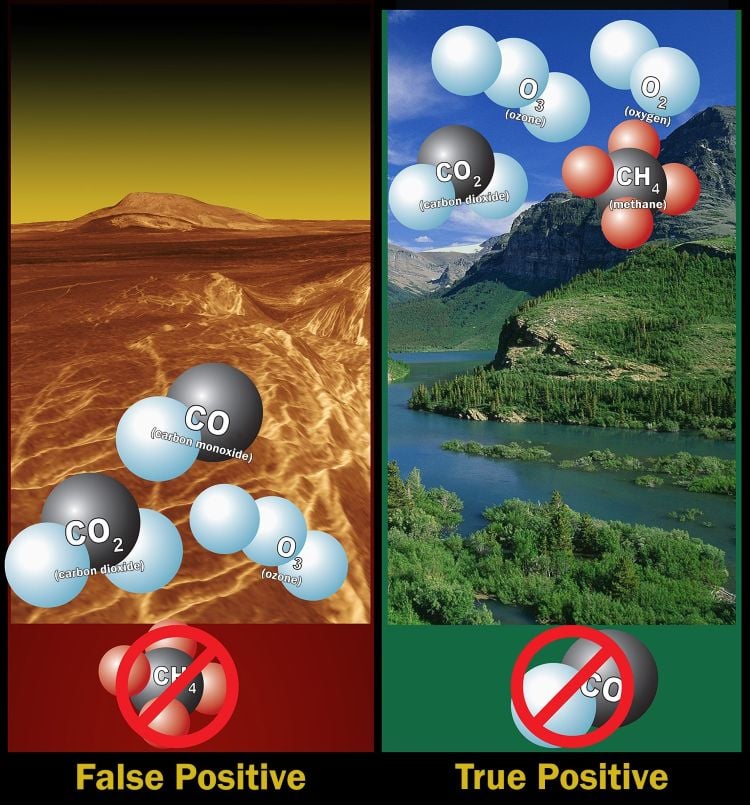
The above story might be a bit of a stretch (Titan microbes probably don’t know English), but the purpose is to address a common scientific statistical concept called false positives and its cousin false negatives. While false positives are what appears to be good data but turn out to be either human or instrument error, false negatives are what appears to not be valid data but could turn out to be good data. The identification of false negatives is a focus of a recent study published in Nature Astronomy, as an international team of researchers investigated new methods for properly identifying false negatives that could otherwise be mistaken for signs of alien life.
For the study, the researchers discuss how false negatives tend to rank low on the priority list for astrobiologists, as false positives have traditionally received greater levels of scrutiny. The researchers note this is because questionable results frequently occur due to researchers mistakenly thinking they found signs of alien life only to discover the data resulted from human or instrument error. The study notes how we might completely miss alien life because there isn't enough of it, it's currently hibernating, it doesn’t look like Earth biology, or it is hiding just out of our instrument’s reach.
To combat this, the researchers call for a more extensive and thorough investigative approach to thoroughly determine if all avenues have been explored in finding signs of alien life, regardless of the exploration context or endeavor. One such method the researchers propose is using artificial intelligence for data analysis and recognizing specific patterns or sequences that would otherwise be overlooked or potentially have been overlooked up until now. Instead of searching for large pieces of evidence of active alien life, like an active microbe or potentially something larger, the study notes researchers could search for even for just traces of life and have scientific instruments trained to do this, too.
“Space missions and instruments are designed to detect potential signs of life, but the risk of overlooking something is not taken into account,” said Dr. Inge Loes ten Kate, who is a professor in astrobiology at Utrecht University and the University of Amsterdam and lead author of the study. “The search for signs of life should go hand in hand with better-defined questions and testable hypotheses to justify specific measurement or observation targets. Because, then you might well uncover things that we would never be able to see on our own. And with new observations, you can then work out how and where they fit into such a pattern.”
The study emphasizes that continued false negatives might lead to astrobiologists targeting the wrong locations to search for life, when in actuality they could have been searching in the right place all along. This could include planetary surfaces, atmospheres, and even exoplanets. The study and authors note how widening the requirements for what we consider life could be a new direction.
What new insights into the search for alien life will researchers make in the coming years and decades? Only time will tell, and this is why we science!
As always, keep doing science & keep looking up!