
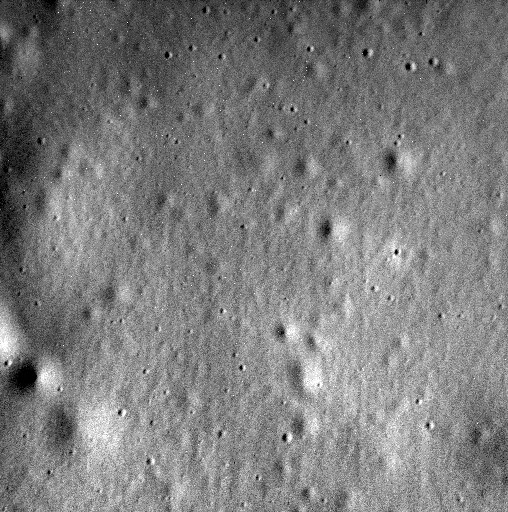
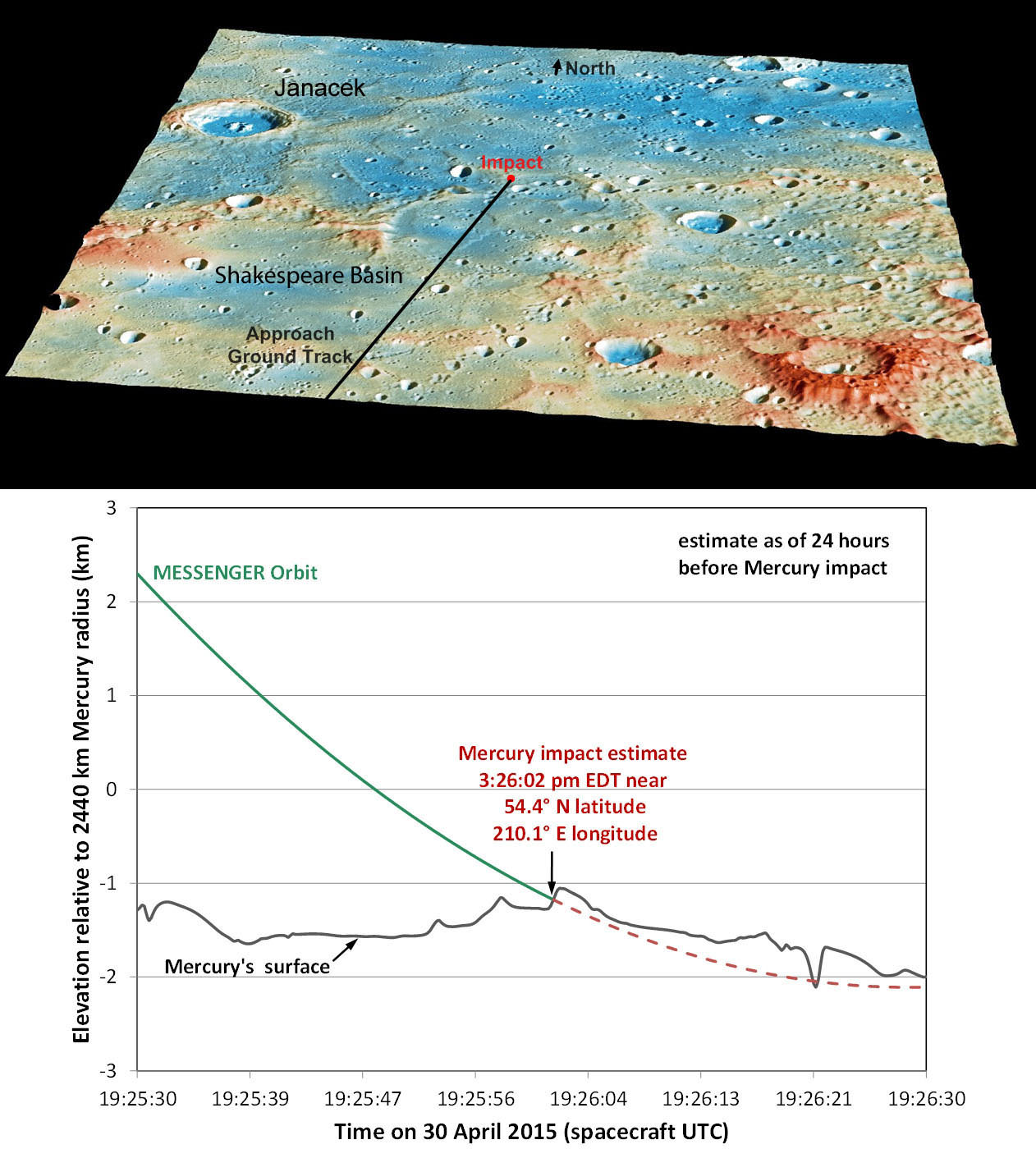
The planet Mercury has a brand new 52-foot-wide crater. At 3:26 p.m. EDT this afternoon, NASA’s MESSENGER spacecraft bit the Mercurial dust, crashing into the planet’s surface at over 8,700 mph just north of the Shakespeare Basin. Because the impact happened out of sight and communication with the Earth, the MESSENGER team had to wait about 30 minutes after the predicted impact to announce the mission’s end.
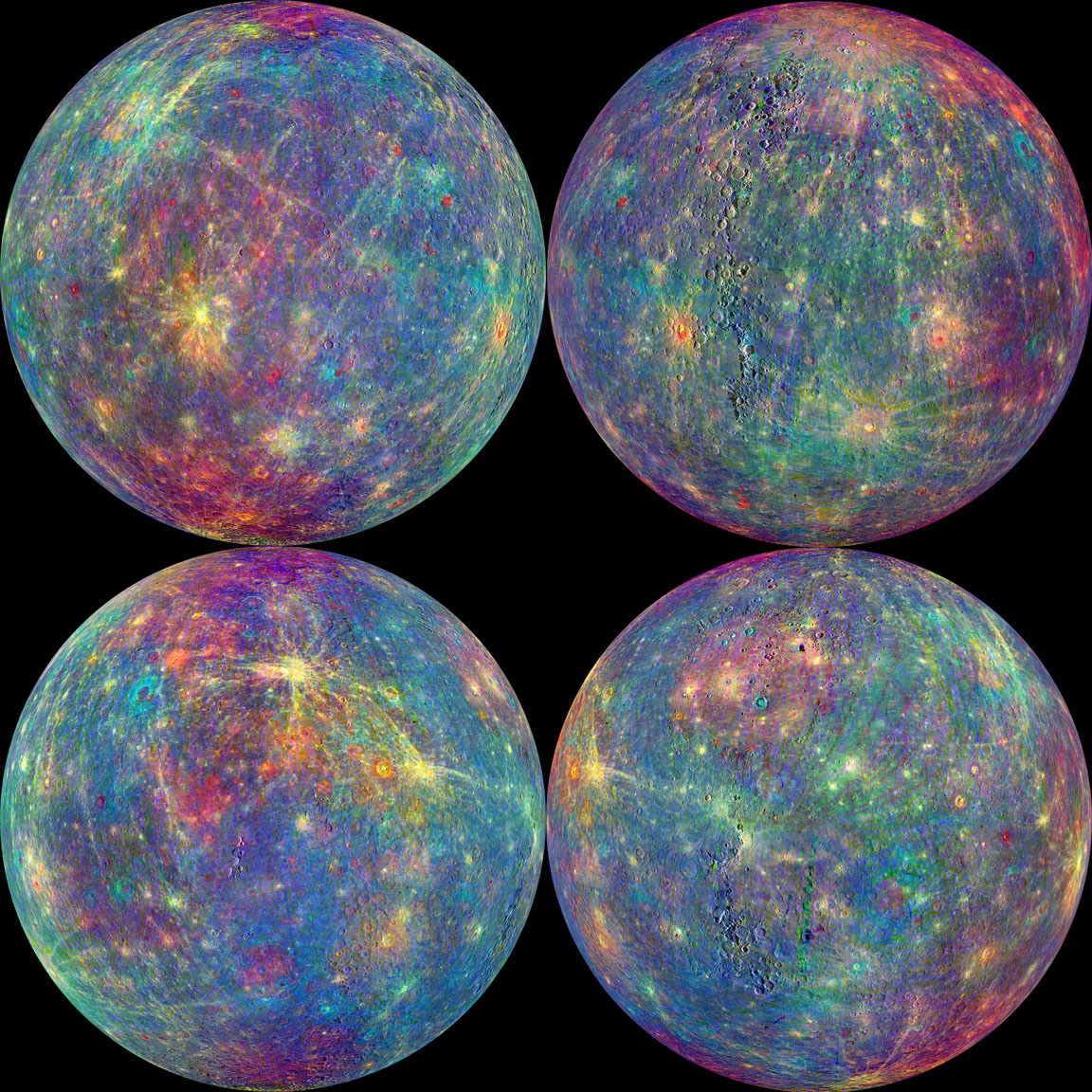
Even as MESSENGER faced its demise, it continued to take pictures and gather data right up until impact. The first-ever space probe to orbit the Solar System’s innermost planet, MESSENGER has completed 4,103 orbits as of this morning. Not only has it imaged the planet in great detail, but using it seven science instruments, scientists have gathered data on the composition and structure of Mercury’s crust, its geologic history, the nature of its magnetic field and rarefied sodium-calcium atmosphere, and the makeup of its iron core and icy materials near its poles.

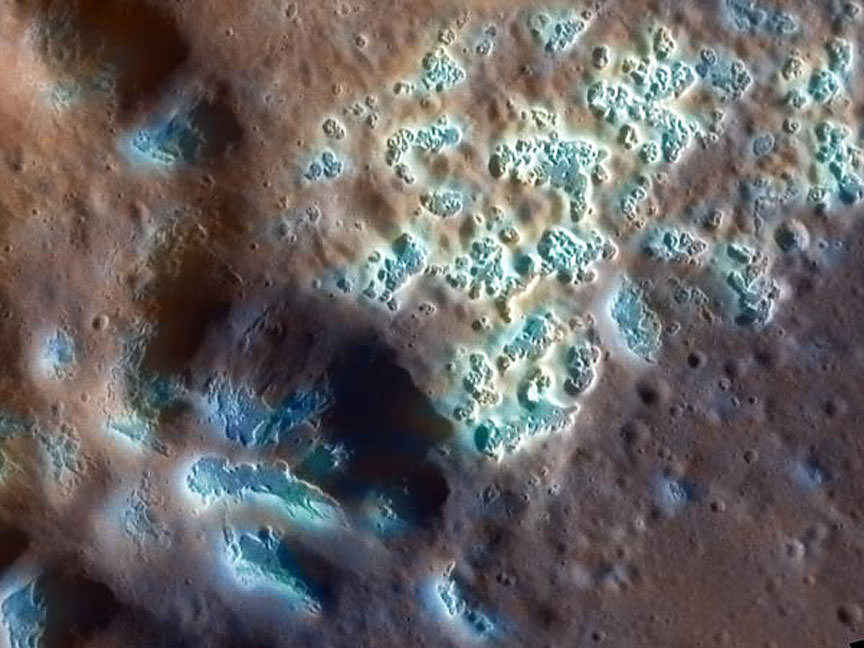
Images show those ubiquitous craters but also features that set its moonlike landscape apart from the Moon including volcanic plains, tectonic landforms that indicate the planet shrank as its interior cooled and mysterious mouse-like nibbles called “hollows”, where surface material may be vaporizing in sunlight leaving behind a network of holes. To learn more about the mission’s “greatest hits”, check out its Top Ten discoveries or pay a visit to the Gallery.
MESSENGER mission controllers conducted the last of six planned maneuvers on April 24 to raise the spacecraft’s minimum altitude sufficiently to extend orbital operations and further delay the probe’s inevitable impact onto Mercury’s surface, but it’s now out of propellant. Without the ability to counteract the Sun’s gravity, which is slowly pulling the craft closer to Mercury’s surface, the team prepared for the inevitable.
The spacecraft actually ran out of propellant a while back, but controllers realized they could re-purpose a stock of helium, originally carried to pressurize the fuel, for a few final blasts to keep it alive and doing science right up to the last minute. During its final hours today, MESSENGER will be shooting and sending back as many new pictures as possible the same way you’d squeeze in one last shot of the Grand Canyon before departing for home. It’s also holding hundreds of older photos in its memory chip and will send as many of those as it can before the final deadline.
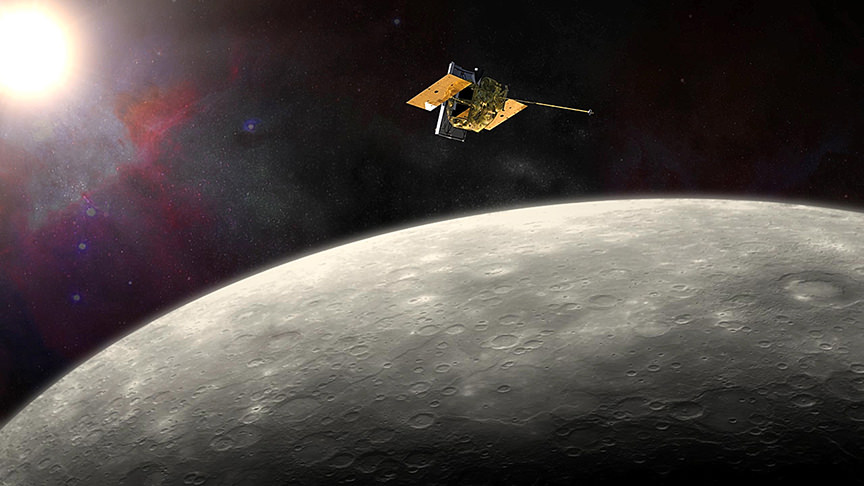
“Operating a spacecraft in orbit about Mercury, where the probe is exposed to punishing heat from the Sun and the planet’s dayside surface as well as the harsh radiation environment of the inner heliosphere (Sun’s sphere of influence), would be challenge enough,” said Principal Investigator Sean Solomon, MESSENGER principal investigator. “But MESSENGER’s mission design, navigation, engineering, and spacecraft operations teams have fought off the relentless action of solar gravity, made the most of every usable gram of propellant, and devised novel ways to modify the spacecraft trajectory never before accomplished in deep space.”

Ground-based telescopes won’t be able to spy MESSENGER’s impact crater because of its small size, but the BepiColombo Mercury probe, due to launch in 2017 and arrive in orbit at Mercury in 2024, should be able to get a glimpse. Speaking of spying, you can see the planet Mercury tonight (and for the next week or two), when it will be easily visible low in the northwestern sky starting about 45 minutes after sundown. The planet coincidentally makes its closest approach to the Pleiades star cluster tonight and tomorrow.
Use the occasion to wish MESSENGER a fond farewell.
“Even as MESSENGER faces its demise, it will continue to take pictures and gather data right up until impact.”
But how will it send those final pictures and data if it is hidden behind the planet? I’m guessing the actual transmission deadline is when MESSENGER drops below Mercury’s horizon for the last time. Congratulations NASA on another successful mission.
Exactly Jim. It sent until it could no more.
RIP Messenger…. Thank you!
Methinks it poetic justice the Messenger Mission ended near the Shakespeare basin..
So, parts of this article were written after Messenger _actually_ crashed, while other parts of this article were written when it was merely _predicted_ to crash. These two perspectives aren’t clearly demarcated, and moreover, actually overlap. The result, I’m sorry to say, is a jumbled mess.
How accurate was the predicted crash location? Well, the predicted site was 54.4°N 210.1°E and it actually crashed in Jokai Crater, which Wikipedia tells me is 106km wide and centered at 72.4°N 224.7°E (converted from 135.3°W). Plugging that into Wolfram Alpha (using polar circumferences because of the high latitudes) we get a distance of 814km between the two locations, but of course it could be anything between 761km and 867km depending on where in Jokai Crater Messenger crashed.
So, in light of that, what score out of ten would you give the prediction?
Hi Adrian,
Sorry for the confusion. I didn’t mean to write that MESSENGER landed in Jokai. A slip of the pen as it were. As correctly stated in the first caption, the probe’s LAST IMAGE was of Jokai. My apologies. It’s corrected now. MESSENGER landed a little north of the Shakespeare Basin (which I updated), so not too far from predictions. So I’ll give the prediction 9.5 out of 10! Thank you for your comment as it helped me to track down the error. I trust the story reads more smoothly now.
The impact site will be an awesome target for the upcoming European Mercury orbiter. 🙂
thanks for your service messenger and ground crew!
Another excellent article, Bob. More impressive is your timely responses to some of the comments. Well done!