
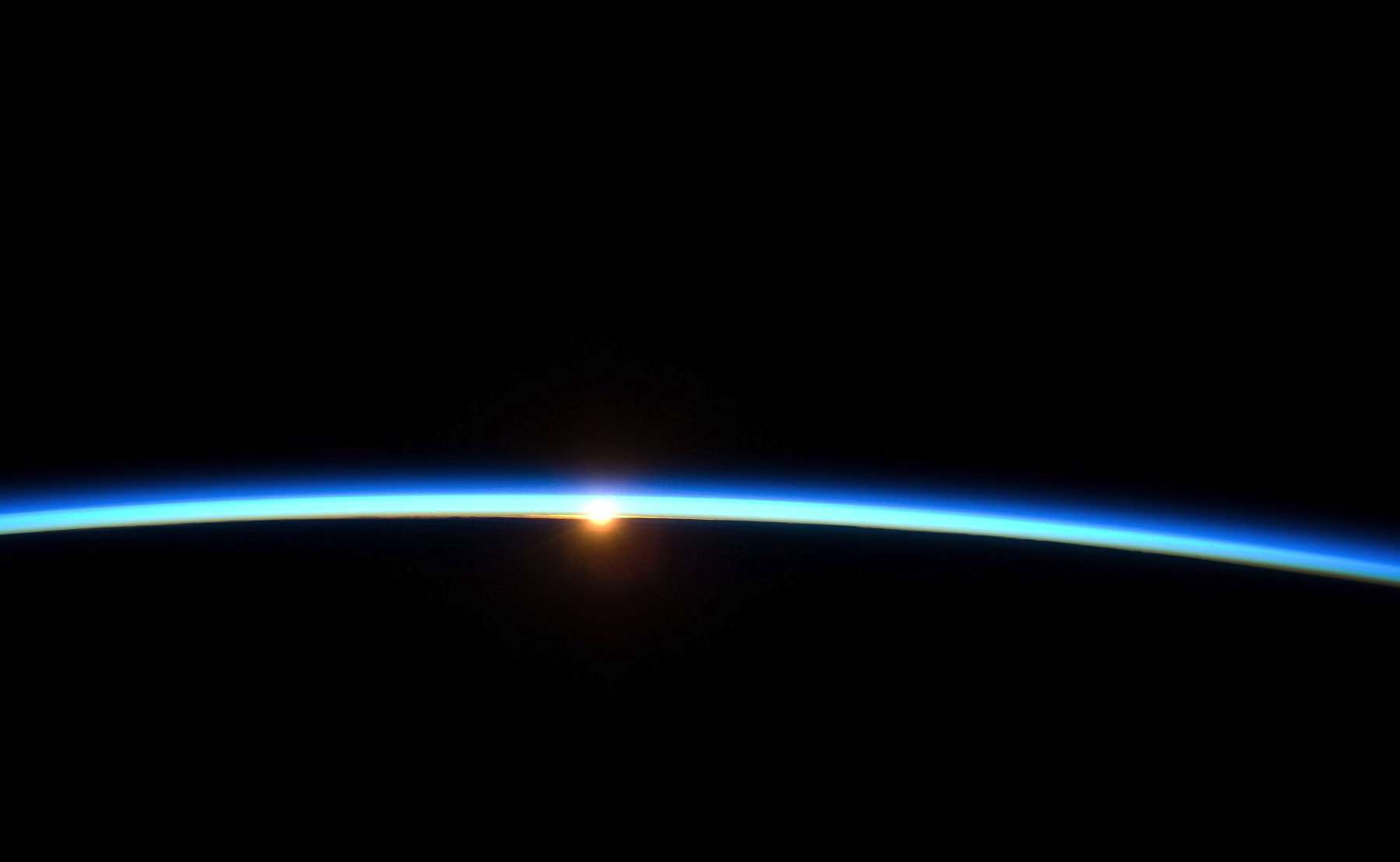
Look up at the night sky, and what do you see? Space, glittering and gleaming in all its glory. Astronomically speaking, space is really quite close, lingering just on the other side of that thin layer we call an atmosphere. And if you think about it, Earth is little more than a tiny island in a sea of space. So it is quite literally all around us.
By definition, space is defined as being the point at which the Earth’s atmosphere ends, and the vacuum of space begins. But exactly how far away is that? How high do you need to travel before you can actually touch space? As you can probably imagine, with such a subjective definition, people tend to disagree on exactly where space begins.
Definition:
The first official definition of space came from the National Advisory Committee for Aeronautics (the predecessor to NASA), who decided on the point where atmospheric pressure was less than one pound per square foot. This was the altitude that airplane control surfaces could no longer be used, and corresponded to roughly 81 kilometers (50 miles) above the Earth’s surface.
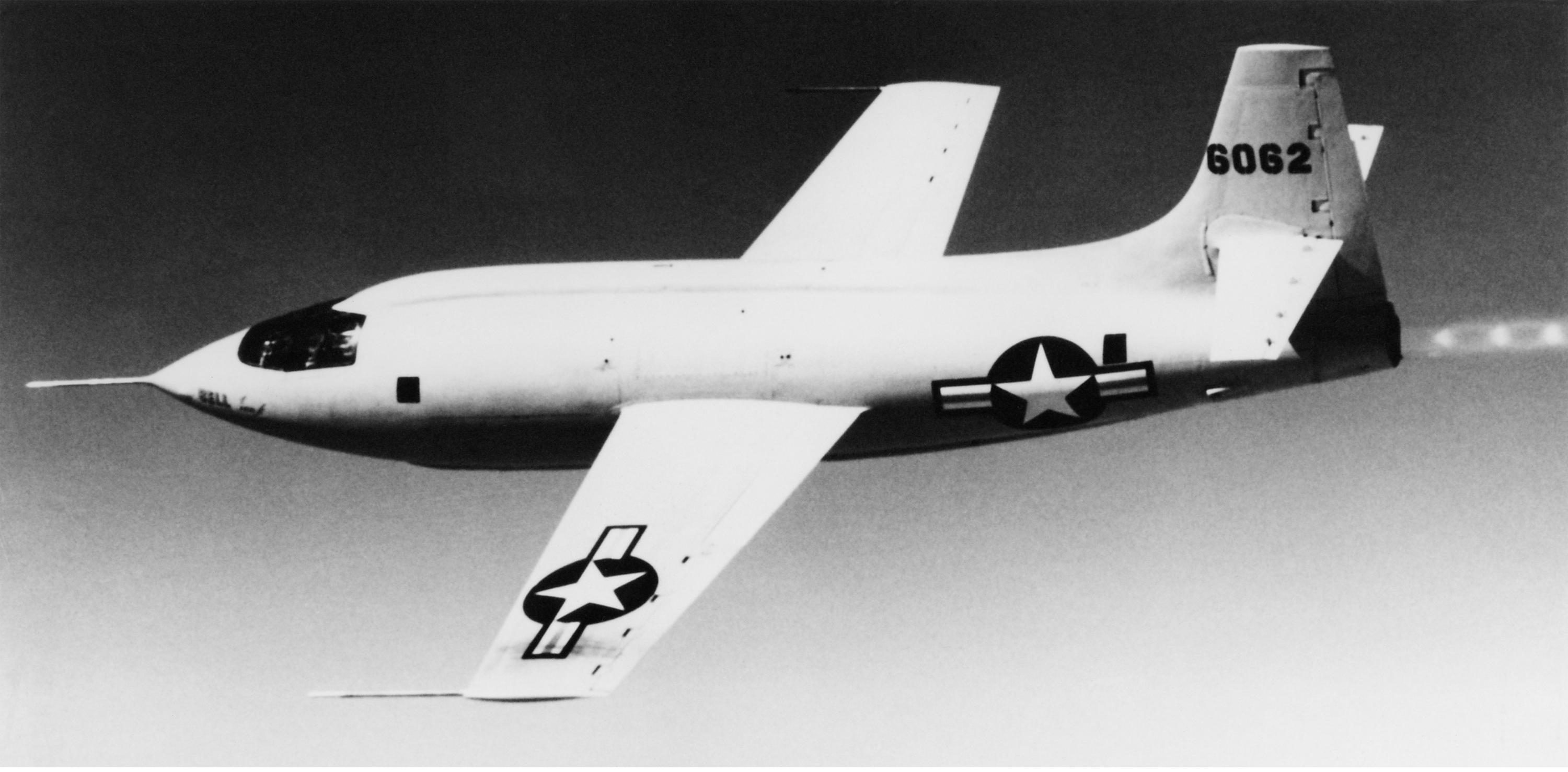
Any NASA test pilot or astronaut who crosses this altitude is awarded their astronaut wings. Shortly after that definition was passed, the aerospace engineer Theodore von Kármán calculated that above an altitude of 100 km, the atmosphere would be so thin that an aircraft would need to be traveling at orbital velocity to derive any lift.
This altitude was later adopted as the Karman Line by the World Air Sports Federation (Fédération Aéronautique Internationale, FAI). And in 2012, when Felix Baumgartner broke the record for the highest freefall, he jumped from an altitude of 39 kilometers (24.23 mi), less than halfway to space (according to NASA’s definition).
By the same token, space is often defined as beginning at the lowest altitude at which satellites can maintain orbits for a reasonable time – which is approximately 160 kilometers (100 miles) above the surface. These varying definitions are complicated when one takes the definition of the word “atmosphere” into account.
Earth’s Atmosphere:
When we talk about Earth’s atmosphere, we tend to think of the region where air pressure is still high enough to cause air resistance, or where the air is simply thick enough to breath. But in truth, Earth’s atmosphere is made up of five main layers – the Troposphere, the Stratosphere, the Mesosphere, the Thermosphere, and the Exosphere – the latter of which extend pretty far out into space.
![Space Shuttle Endeavour sillouetted against the atmosphere. The orange layer is the troposphere, the white layer is the stratosphere and the blue layer the mesosphere.[1] (The shuttle is actually orbiting at an altitude of more than 320 km (200 mi), far above all three layers.) Credit: NASA](https://www.universetoday.com/wp-content/uploads/2012/03/Endeavour_silhouette_STS-130.jpg)
Hence, this is where the phenomena known as Aurora Borealis and Aurara Australis are known to take place. The International Space Station also orbits in this layer, between 320 and 380 km (200 and 240 mi), and needs to be constantly boosted because friction with the atmosphere still occurs.
The outermost layer, known as the exosphere, extends out to an altitude of 10,000 km (6214 mi) above the planet. This layer is mainly composed of extremely low densities of hydrogen, helium and several heavier molecules (nitrogen, oxygen, CO²). The atoms and molecules are so far apart that the exosphere no longer behaves like a gas and the particles constantly escape into space.
It is here that Earth’s atmosphere truly merges with the emptiness of outer space, where there is no atmosphere. Hence why the majority of Earth’s satellites orbit within this region. Sometimes, the Aurora Borealis and Aurora Australis occur in the lower part of the exosphere, where they overlap into the thermosphere. But beyond that, there is no meteorological phenomena in this region.
Interplanetary vs. Interstellar:
Another important distinction when discussing space is the difference between that which lies between planets (interplanetary space) and that which lies between star systems (interstellar space) in our galaxy. But of course, that’s just the tip of the iceberg when it comes to space.
If one were to cast the net wider, there is also the space which lies between galaxies in the Universe (intergalactic space). In all cases, the definition involves regions where the concentration of matter is significantly lower than in other places – i.e. a region occupied centrally by a planet, star or galaxy.
In addition, in all three definitions, the measurements involved are beyond anything that we humans are accustomed to dealing with on a regular basis. Some scientists believe that space extends infinitely in all directions, while others believe that space is finite, but is unbounded and continuous (i.e. has no beginning and end).
In other words, there’s a reason they call it space – there’s just so much of it!
Exploration:
The exploration of space (that is to say, that which lies immediately beyond Earth’s atmosphere) began in earnest with what is known as the “Space Age“, This newfound age of exploration began with the United States and Soviet Union setting their sights on placing satellites and crewed modules into orbit.
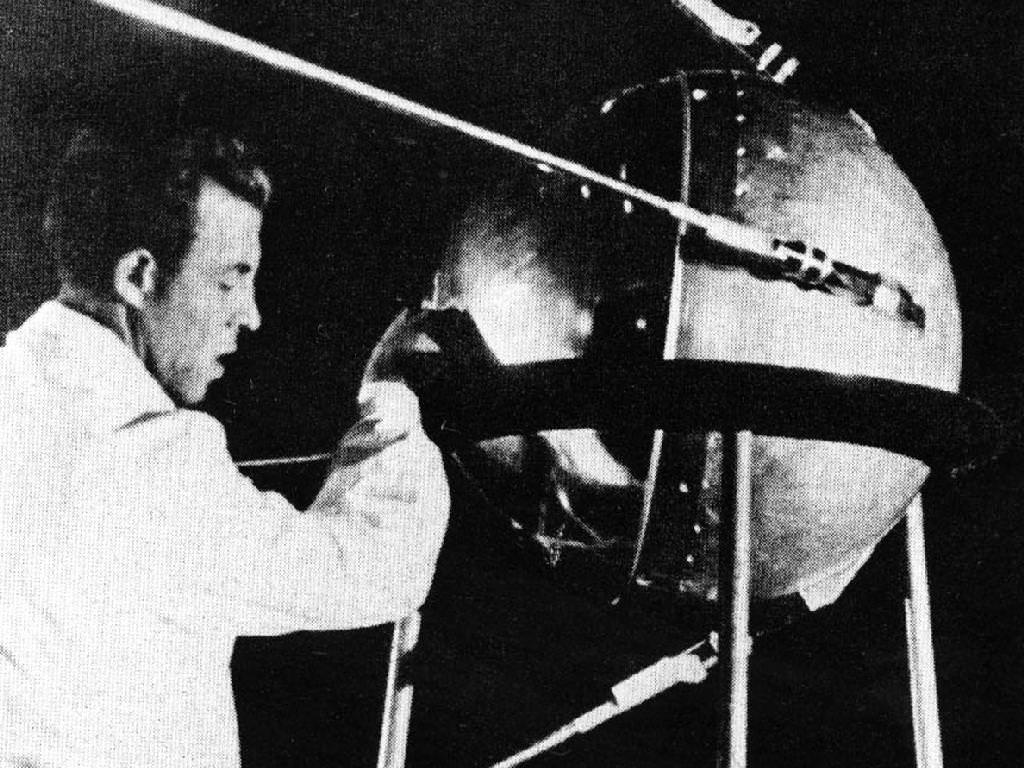
The first major event of the Space Age took place on October 4th, 1957, with the launch of Sputnik 1 by the Soviet Union – the first artificial satellite to be launched into orbit. In response, then-President Dwight D. Eisenhower signed the National Aeronautics and Space Act on July 29th, 1958, officially establishing NASA.
Immediately, NASA and the Soviet space program began taking the necessary steps towards creating manned spacecraft. By 1959, this competition resulted in the creation of the Soviet Vostok program and NASA’s Project Mercury. In the case of Vostok, this consisted of developing a space capsule that could be launched aboard an expendable carrier rocket.
Along with numerous unmanned tests, and a few using dogs, six Soviet pilots were selected by 1960 to be the first men to go into space. On April 12th, 1961, Soviet cosmonaut Yuri Gagarin was launched aboard the Vostok 1 spacecraft from the Baikonur Cosmodrome, and thus became the fist man to go into space (beating American Alan Shepard by just a few weeks).
On June 16th, 1963, Valentina Tereshkova was sent into orbit aboard the Vostok 6 craft (which was the final Vostok mission), and thus became the first woman to go into space. Meanwhile, NASA took over Project Mercury from the US Air Force and began developing their own crewed mission concept.

Designed to send a man into space using existing rockets, the program quickly adopted the concept of launching ballistic capsules into orbit. The first seven astronauts, nicknamed the “Mercury Seven“, were selected from from the Navy, Air Force and Marine test pilot programs.
On May 5th, 1961, astronaut Alan Shepard became the first American in space aboard the Freedom 7 mission. Then, on February 20th, 1962, astronaut John Glenn became the first American to be launched into orbit by an Atlas launch vehicle as part of Friendship 7. Glenn completed three orbits of planet Earth, and three more orbital flights were made, culminating in L. Gordon Cooper’s 22-orbit flight aboard Faith 7, which flew on May 15th and 16th, 1963.
In the ensuing decades, both NASA and Soviets began to develop more complex, long-range crewed spacecraft. Once the “Race to the Moon” ended with the successful landing of Apollo 11 (followed by several more Apollo missions), the focus began to shift to establishing a permanent presence in space.
For the Russians, this led to the continued development of space station technology as part of the Salyut program. Between 1972 and 1991, they attempted to orbit seven separate stations. However, technical failures and a failure in one rocket’s second stage boosters caused the first three attempts after Salyut 1 to fail or result in the station’s orbits decaying after a short period.

However, by 1974, the Russians managed to successfully deploy Salyut 4, followed by three more stations that would remain in orbit for periods of between one and nine years. While all of the Salyuts were presented to the public as non-military scientific laboratories, some of them were actually covers for the military Almaz reconnaissance stations.
NASA also pursued the development of space station technology, which culminated in May of 1973 with the launch of Skylab, which would remain America’s first and only independently-built space station. During deployment, Skylab suffered severe damage, losing its thermal protection and one of its solar panels.
This required the first crew to rendezvous with the station and conduct repairs. Two more crews followed, and the station was occupied for a total of 171 days during its history of service. This ended in 1979 with the downing of the station over the Indian Ocean and parts of southern Australia.
By 1986, the Soviets once again took the lead in the creation of space stations with the deployment of Mir. Authorized in February 1976 by a government decree, the station was originally intended to be an improved model of the Salyut space stations. In time, it evolved into a station consisting of multiple modules and several ports for crewed Soyuz spacecraft and Progress cargo spaceships.
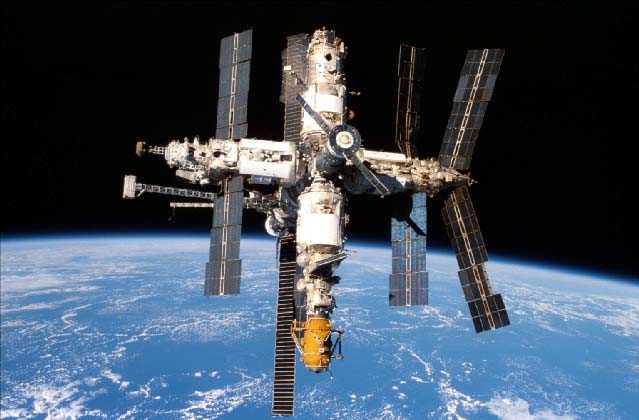
The core module was launched into orbit on February 19th, 1986; and between 1987 and 1996, all of the other modules would be deployed and attached. During its 15-years of service, Mir was visited by a total of 28 long-duration crews. Through a series of collaborative programs with other nations, the station would also be visited by crews from other Eastern Bloc nations, the European Space Agency (ESA), and NASA.
After a series of technical and structural problems caught up with the station, the Russian government announced in 2000 that it would decommission the space station. This began on Jan. 24th, 2001, when a Russian Progress cargo ship docked with the station and pushed it out of orbit. The station then entered the atmosphere and crashed into the South Pacific.
By 1993, NASA began collaborating with the Russians, the ESA and the Japan Aerospace Exploration Agency (JAXA) to create the International Space Station (ISS). Combining NASA’s Space Station Freedom project with the Soviet/Russian Mir-2 station, the European Columbus station, and the Japanese Kibo laboratory module, the project also built on the Russian-American Shuttle-Mir missions (1995-1998).
With the retirement of the Space Shuttle Program in 2011, crew members have been delivered exclusively by Soyuz spacecraft in recent years. Since 2014, cooperation between NASA and Roscosmos has been suspended for most non-ISS activities due to tensions caused by the situation in the Ukraine.
However, in the past few years, indigenous launch capability has been restored to the US thanks to companies like SpaceX, United Launch Alliance, and Blue Origin stepping in to fill the void with their private fleet of rockets.
The ISS has been continuously occupied for the past 15 years, having exceeded the previous record held by Mir; and has been visited by astronauts and cosmonauts from 15 different nations. The ISS program is expected to continue until at least 2020, but may be extended until 2028 or possibly longer, depending on the budget environment.
As you can clearly see, where our atmosphere ends and space begins is the subject of some debate. But thanks to decades of space exploration and launches, we have managed to come up with a working definition. But whatever the exact definition is, if you can get above 100 kilometers, you have definitely earned your astronaut wings!
We have written many interesting articles about space here at Universe Today. Here is Why is Space Black?, How Cold is Space?, Space Debris Illustrated: The Problem in Pictures, What is Interplanetary Space?, What is Interstellar Space?, and What is Intergalactic Space?
For more information, check out NASA Reveals Mysteries of Interstellar Space and this list of Deep Space Missions.
Astronomy Cast has episodes on the subject, like the Space Stations Series, Episode 82: Space Junk, Episode 281: Explosions in Space, Episode 303: Equilibrium in Space, and Episode 311: Sound in Space.
Sources:
How would the numbers it look like from orbit degradation perspective? Is there a noticeble jump between surface and space that indicates some kind of sudden drag reduction? (Like water/air, but air/space).
@Zousteen: There isn’t a clear boundary between gas & vacuum as there is between liquid & gas (the primary reason for the latter being liquid surface tension) or liquid & solid (molecular lattices, crystalline structure, etc.). As a gas’ temperature increases, the space between molecules & atoms typically gets larger… and that’s the key: “space” between molecules/atoms is what makes it a “gas,” instead of a liquid or a solid.
Earth’s gravity does a fair job keeping most of our air in the troposphere, and from there the whole atmosphere generally describes a pressure curve that decreases with altitude — swiftly, & then more gradually with height, approaching but never quite reaching zero density. The part of the atmosphere which is barely distinguishable from the vacuum of space (exosphere) is what’s responsible for the eventual de-orbiting of anything in LEO lacking a working thruster out to a couple-few thousand km (takes longer the further out one goes & depends a lot on solar activity, hence my super-specific altitude reference!).
There is no firm upper altitude designated for the exosphere. Any such ‘edge’ is likely to be highly dynamic, asymmetric, heterogeneous in composition & extend some distance beyond the outer Van Allen belt, depending on solar conditions & if it exists at all.
I said: “There is no firm upper altitude designated for the exosphere.” I know Fraser said “10,000 km” in the vid, but that’s really just a ‘best estimate’ sort of thing. I’m not saying he’s “wrong,” at all, just saying that the actual exospheric edge is pretty fuzzy: no one can really tell whether it’s space or exosphere a thousand km or more to either side of that point without sampling the few particles they find out there to determine their origin (space vs. Earth)…
…Which at the end of the day makes 10,000 km just as good an estimate as any, and not worth arguing over. Just wanted to be clear I wasn’t disputing Fraser’s number. 🙂
For a tea party right wing republican; space usually begins at sea level.
…Oxygen starved brains
Not as high as any of the folks at a Dead concert back in the day….
”………Some scientists believe that space extends infinitely in all directions,……….” sums up the dimensions of the space/universe.
Hi d s r rao,
Please remember that even if the curvature of space is zero, that for the universe to be of infinite size, it would have to be “simply connected”.
Other conditions such as for an infinite size, the universe would have to have expanded at an infinite rate since the big bang.
When I look at all of the conditions necessary for an infinite size, plus the implications of M-Theory, I am in the camp that believes that the size of the universe is bounded.
It has to be noted that the research and knowledge are only in the beginning phases, and there is a great deal to be found out before any definite answers are possible.
Hi Zoutsteen, The drag curve is quite smooth as altitude increases. i.e. No discontinuities.