Universe Today
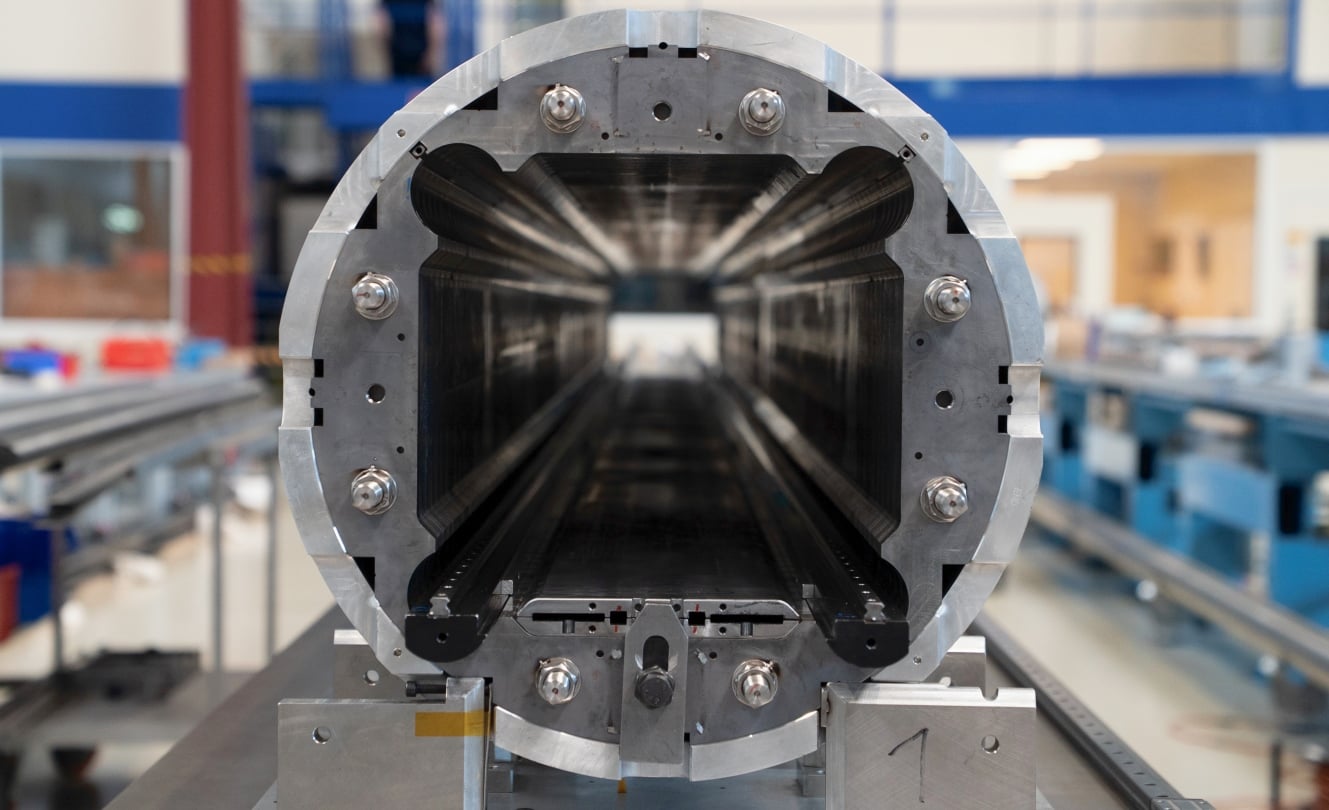
After nearly 18 years of operation, highlighted by the detection of the elusive Higgs boson, Europe's CERN physics research center says it's bidding "Farewell" to the Large Hadron Collider. But it's actually more like "See You Later, Accelerator!"
The new, improved High-Luminosity LHC is due to make its debut in 2030, with up to 10 times the luminosity of the original LHC. CERN officials talk about HiLumi LHC almost as if it will be a brand-new machine.
“The LHC has exceeded every expectation,” Oliver Brüning, CERN's director for accelerators and technology, said today in a news release. “For nearly two decades, it has transformed our understanding of the universe and inspired generations of scientists, engineers and citizens around the world. Today we say goodbye to the LHC as we have known it, while preparing to welcome its successor: the HiLumi LHC, which will extend this scientific adventure far into the future.”
HiLumi LHC will use the same 17-mile-round (27-kilometer-round) ring that straddles the French-Swiss border. But the equipment inside the ring will undergo an extreme makeover. Over the next four years, workers will install next-generation magnets to sharpen the focus of the proton beams, dramatically increasing the maximum particle collision rate — also known as luminosity. The LHC's ATLAS and CMS detectors will be rebuilt to monitor more than 5 billion interactions per second and select the most interesting collisions for further analysis.
Since the LHC first spun up in 2008, physicists have used the "Big Bang machine" to explore subatomic oddities — including quark-gluon plasma, which is thought to have existed in the instant after the Big Bang, and the cosmic imbalance of matter and antimatter.
The collider's crowning achievement came 14 years ago this week when scientists laid out their evidence for the existence of the Higgs boson, which had been predicted by theory decades earlier but could be detected only at the LHC's unprecedented energy levels. The Higgs boson, and its associated Higgs field, play a key role in determining the mass of subatomic particles.
The Higgs boson was the last fundamental particle predicted by the Standard Model of particle physics to be detected. Scientists expect the HiLumi LHC to add much more to their understanding of how the Higgs boson works — and they hope it will point the way to physics beyond the Standard Model, perhaps including evidence for supersymmetry or the existence of exotic dark-matter particles.