Universe Today
Jezero Crater on Mars is a 45-kilometer-wide (28-mile) crater that once hosted a lake billions of years ago fed by two distinct river valleys with Jezero eventually forming an exit channel over time. One of Jezero’s most prominent features is the massive river delta that consists of sediments that were deposited as the inflow slowed down. Researchers hypothesize that the delta and lake were formed under freshwater conditions, indicating the potential for life as we know it, also called biosignatures.
Now, an international team of about 60 researchers might be one step closer to finding evidence of ancient biosignatures on Mars with NASA’s Perseverance rover, which has been exploring Jezero Crater since February 2021. In findings recently published in the journal Science Advances, the researchers discussed signs of organic matter within rocks in Jezero Crater, with organics referring to carbon-based molecules, which life on Earth is built on.
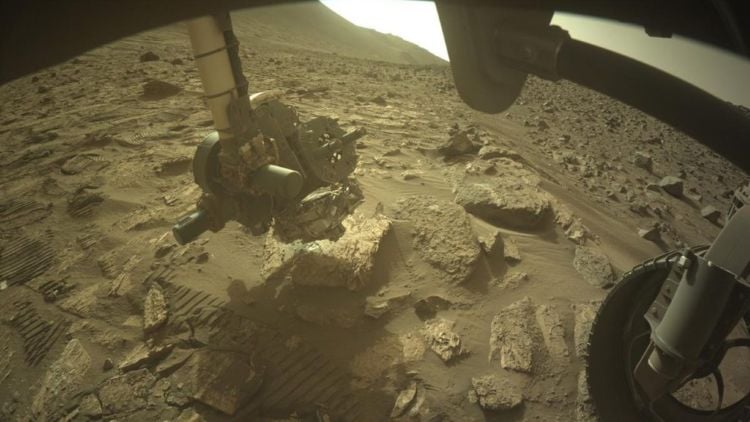
For the study, the researchers used Perseverance’s Scanning Habitable Environments with Raman & Luminescence for Organics & Chemicals (SHERLOC) instrument to zap rocks dubbed Cheyava Falls with a laser light using Raman spectroscopy. This light is analyzed to determine what molecules are present in a sample. In this case, SHERLOC examined rocks in Jezero crater’s Bright Angel formation, which is a geological region within an ancient river valley that is comprised of sedimentary mudstones. This study comes after Perseverance found "leopard spots" on Cheyava Falls in July 2024.
For context, mudstones on Earth help to shield organic matter from the environment. Therefore, scientists have focused on studying Martian mudstones for organic matter that might be shielded from the harsh radiation that blasts the surface, since Mars lacks a magnetic field or ozone layer that would otherwise protect the surface from solar or cosmic radiation.
In the end, the researchers found evidence that the rocks contained organics with several secondary minerals, or minerals that arrived after the organics formed, including carbonates (i.e., chalk or limestone) and sulfates (i.e., plaster or Epsom salts). Most notably, the researchers found evidence of macromolecular carbon (MMC), which is a three-dimensional network of carbon atoms arranged in a complex manner. The data couldn’t ascertain whether these MMCs were formed under biotic (life origin) or abiotic (non-life origin), but the MMCs were found surprisingly close to the surface, less than the width of a piece of paper.
“The Martian surface environment includes radiation and chemical oxidants that are destructive to organics, and terrestrial laboratory simulations have shown that the survival time of organics in Martian-like conditions – especially at or near the surface – depends on factors such as the type of organic molecule and the surrounding minerals,” said Dr. Ashley Murphy, who is a Postdoctoral Research Scientist at the Planetary Science Institute and lead author of the study. “The MMC detected in the Bright Angel mudstones is either resistant to degradation and/or has been sufficiently shielded by other minerals, such as clays, or iron-rich Martian soil.”
While Perseverance has been busy findings evidence of organics in Jezero Crater, NASA’s other car-sized rover, Curiosity, recently discovered evidence of organics about 3,800 kilometers (2,360 miles) away in Gale Crater. In findings published in Nature Communications in April 2026, researchers discussed how Curiosity identified more than 20 organic molecules from clay sandstones. Like Jezero, this is significant since Gale Crater was also the home of a lake billions of years ago, though Gale Crater is much larger at 154 kilometers (96 miles) in diameter. While Jezero is known for its massive river delta, Gale is known for Mount Sharp, which is massive central mountain right in the middle of the crater.
What new insights into ancient Mars and other geologic formations on Mars will researchers make in the coming years and decades? Only time will tell, and this is why we science!
As always, keep doing science & keep looking up!