 Universe Today
Nature doesn't conform to our definitions of things. Brown dwarfs are a prime example of this. They're not exactly stars, and they're not exactly gas giant planets. They occupy the space between those definitions.
The identity of brown dwarfs may be a little confusing, but their formation pathway is clear. They form the same way other stars do: by the collapse of giant clouds of cold hydrogen.
This same mechanism produces stars in a wide range of masses, from small, dim M-dwarfs, that will burn for trillions of years, all the way up to massive type O stars, which live brief lives and explode as supernovae. Astronomers are curious about the smallest objects that can be produced by gas cloud collapse, and new research examines this facet of star formation.
The research is titled "A New Spectral Class of Brown Dwarfs at the Bottom of the IMF in IC 348," and it's published in The Astrophysical Journal Letters. The authors are Kevin Luhman from the Department of Astronomy and Astrophysics at Penn State University, and Catarina Alves de Oliveira, Head of the Science Operations Development Division at the European Space Agency.
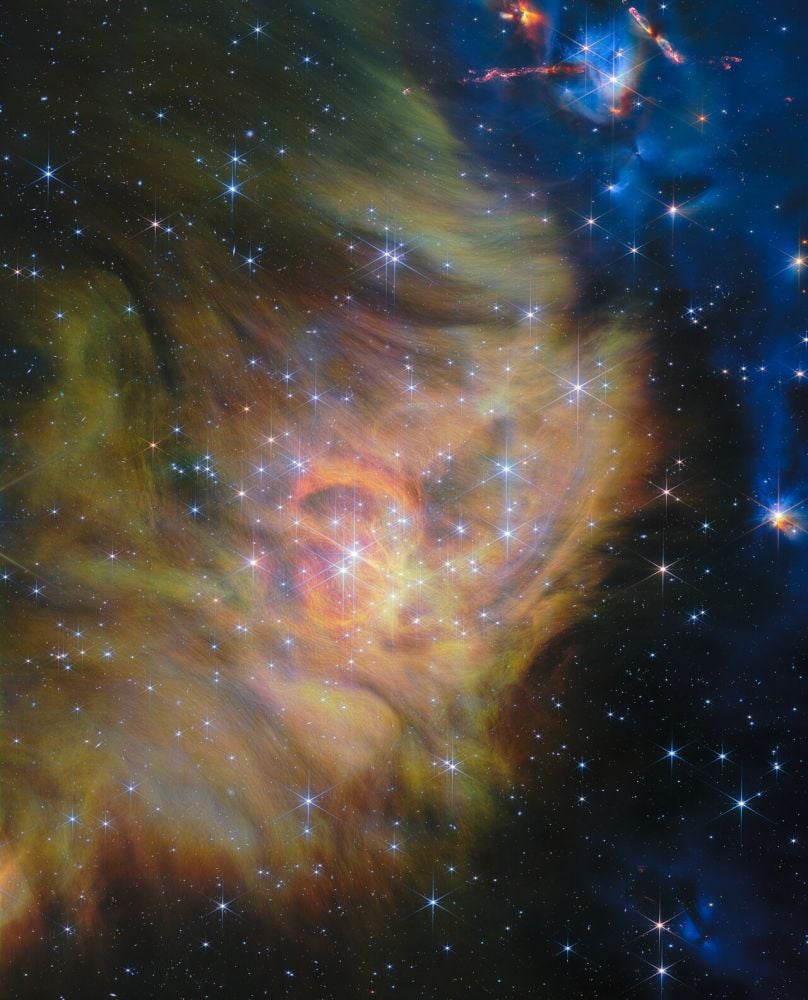
The research focuses on IC 348, a star-forming region about 1,000 light years away. IC 348 is part of the larger Perseus Molecular Cloud. It's a cluster of about 400 stars about 2-5 million years old, surrounded by nebulosity. Because of its relative proximity to Earth, it's a good location to study the smallest brown dwarfs. Astronomers have already found planetary-mass brown dwarfs there, as small as 4 Jupiter masses.
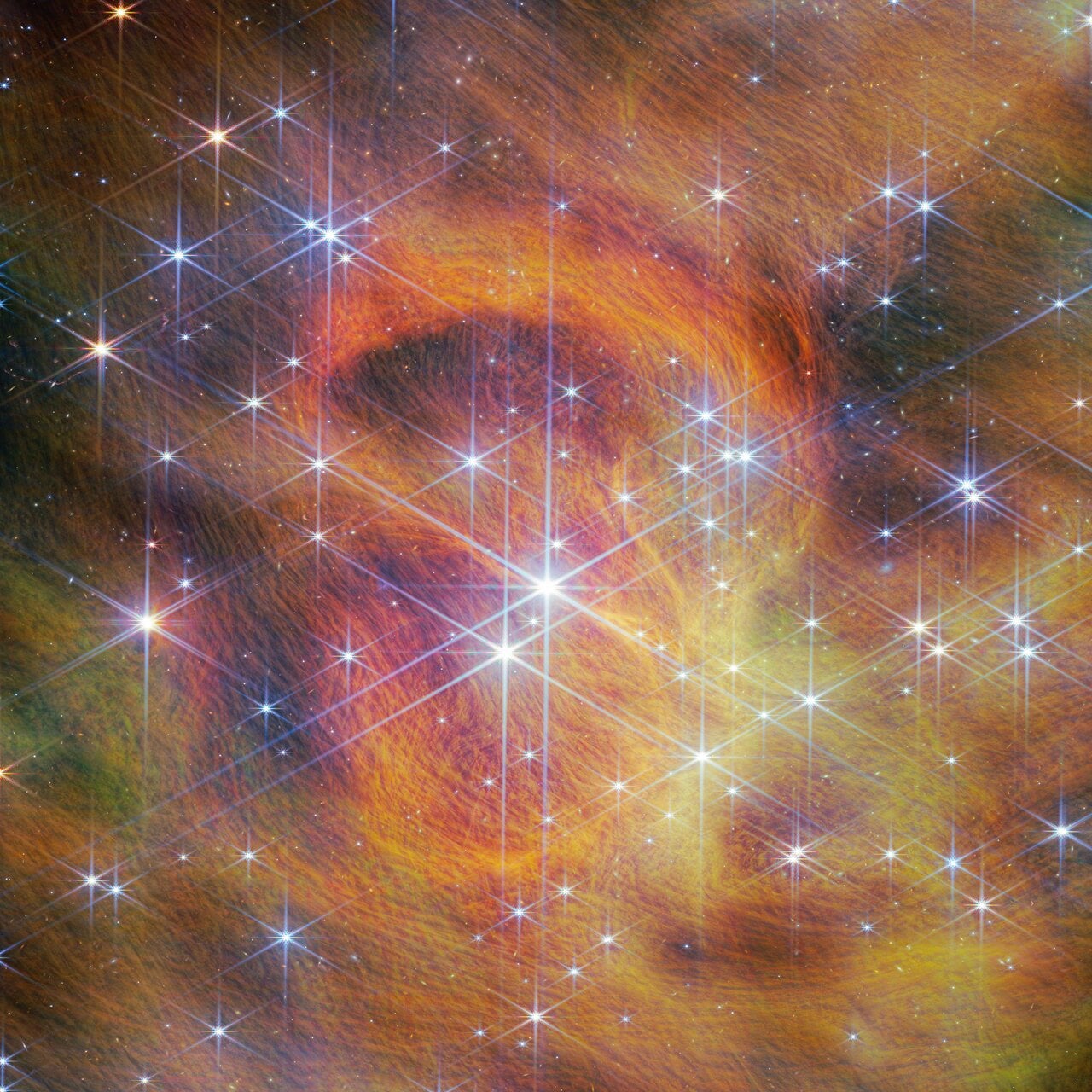 This JWST image highlights the central part of the IC 348 cluster. Wisps of gas and dust are lit up by the young stars in a reflection nebula. Image Credit: ESA/Webb, NASA, CSA, K. Luhman, C. Alves De Oliveira, M. Zamani (ESA/Webb)
"In a previous study, we used James Webb Space Telescope (JWST) to identify three new brown dwarfs in the center of a nearby star-forming cluster, IC 348," the authors write. "The faintest object had an estimated mass of 3–4 MJup, making it a contender for the least massive brown dwarf confirmed with spectroscopy."
But astronomers want to find the lowest mass limit for brown dwarfs, and they think the limit may be even lower than 3-4 Jupiter masses.
In this work, the astronomers turned again to IC 348. This time, their survey was deeper, and covered a larger area of the star-forming region. They found 39 new brown dwarf candidates and obtained spectra for 15 of them using NIRSpec. Nine of these 15 are classified as sub-stellar members of the IC 348 cluster, meaning they are not massive enough to ignite hydrogen fusion. That means they're brown dwarfs.
"The faintest new members have mass estimates of ∼2 MJup, providing a new constraint on the minimum mass of the IMF," the authors write. To put that into perspective, that's only 0.19% of the Sun’s mass. Brown dwarfs this small challenge our understanding of star formation.
The main focus of this research is finding the lowest-mass brown dwarfs, and that's related to a feature in their spectra.
Of the three brown dwarfs detected in the previous study, two of them had an unusual feature in their spectra. "Two of the new brown dwarfs also exhibited absorption features from an unidentified aliphatic hydrocarbon, which were not predicted by atmospheric models and were not previously detected in atmospheres outside of the solar system," the authors explain.
In these new observations, the same unidentified hydrocarbon was detected in the new brown dwarfs. That means there are a total of 11 brown dwarfs in IC 348 with the hydrocarbon feature. The authors write that since this feature is stronger at fainter magnitudes, the hydrocarbons are a natural feature of the coolest brown dwarfs. It's not a chance observation, and it's not contamination of some type.
That's led them to declare a new class of brown dwarfs.
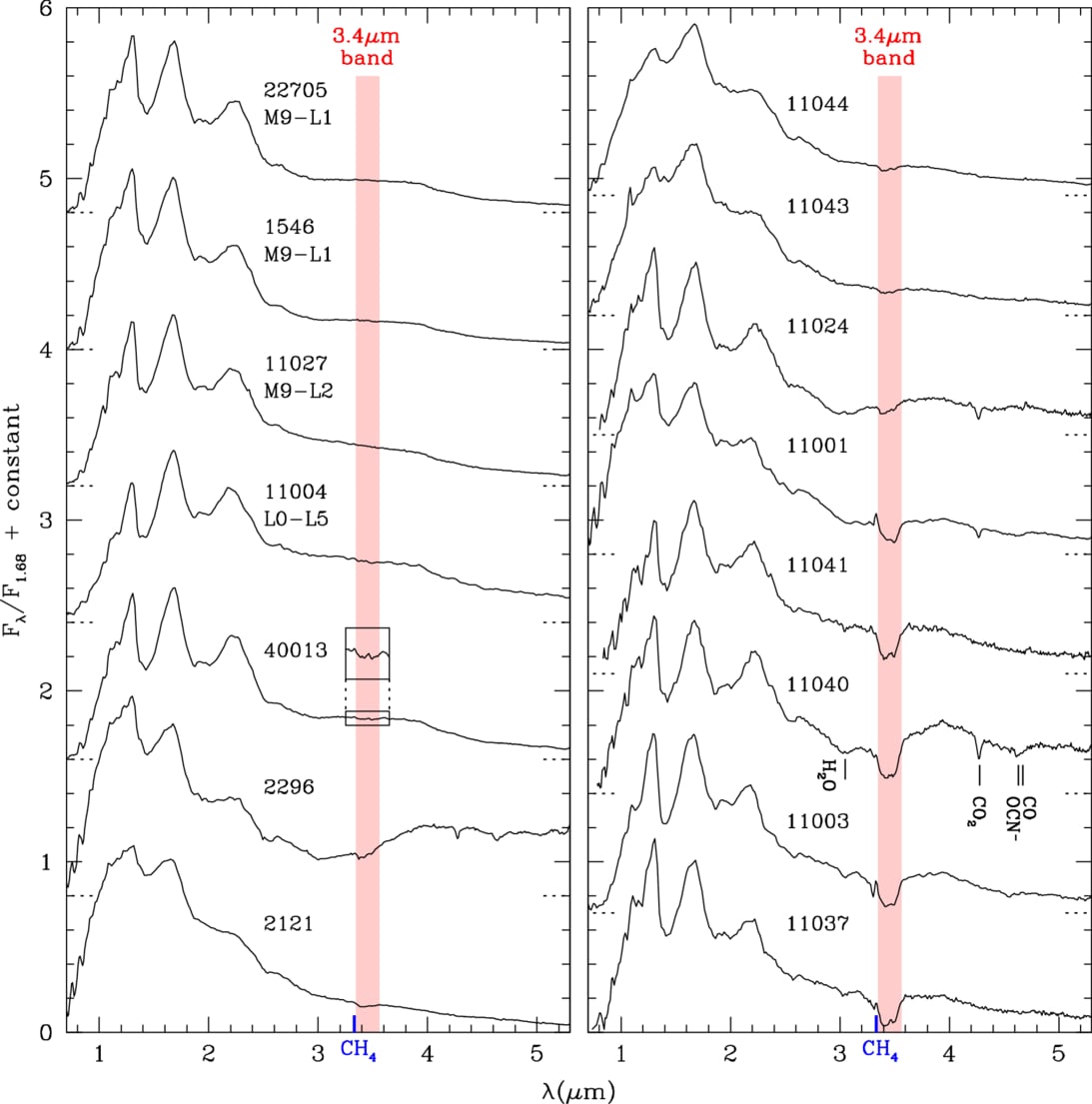 This figure shows spectra for brown dwarfs in IC 348. The first four lack the hydrocarbon feauture at 3.4 μm. The feature is evident in the rest, helping confirm a new class of brown dwarf. Image Credit: K. Luhman, C. Alves De Oliveira, 2026. ApJL
"We propose a new spectral class “H” that is defined by the presence of the 3.4 μm fundamental band of the hydrocarbon," they write.
Some of these objects appear to have what it takes to eventually form planets. "Two new members (∼2 and 10 MJup) exhibit large excess emission from circumstellar disks, demonstrating that they harbor the raw materials for planet formation," they explain. A sub-stellar object with only 2 Jupiter masses, which has its own planets, is another exmaple of our definitions not lining up with nature. This is more like a binary planet. Or maybe a sub-stellar hierarchy instead of the classic star+planet hierarchy.
Fuzzy definitions aside, this work is yet another example of how the capable JWST is performing exactly like it was intended to. The space telescope has driven progress in multiple areas of astronomy and astrophysics. Searching for and finding the lowest-mass brown dwarfs is, in some ways, an effort to find the point where definitions break down.
This work is also another example of the stunning images that arrive with the JWST's science results.
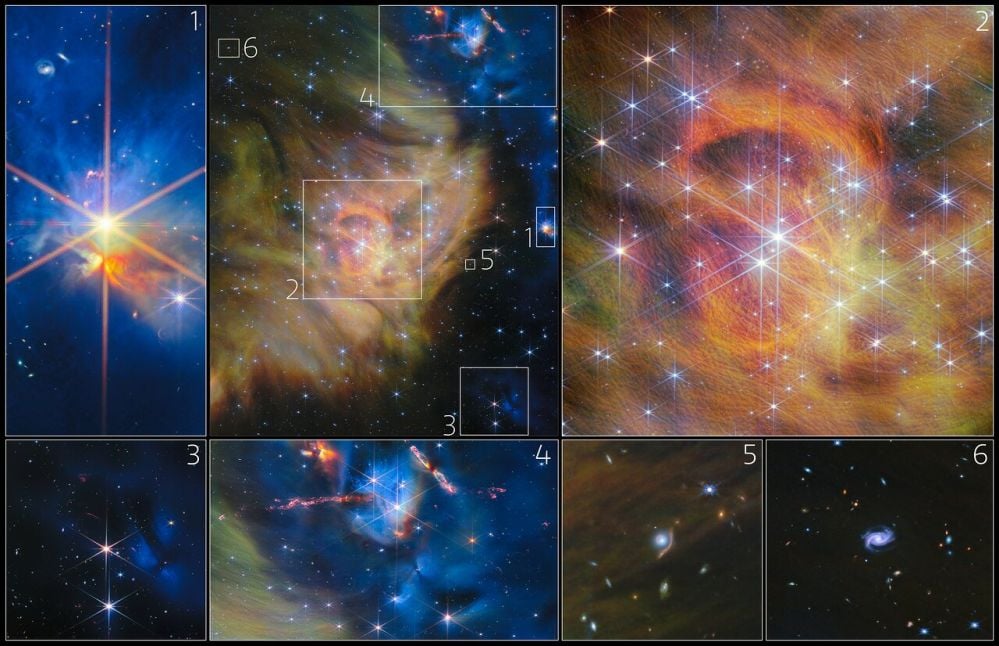 There's more to this than a new class of brown dwarfs. Since it's the JWST, it also treated us to stunning new images. The images show things like stars inside a nebula (1), the central star cluster (2), stars and faint outflows (3), Herbig-Haro objects (4), gravitational lensing (5) and background spiral galaxies (6). Image Credit: ESA/Webb, NASA, CSA, K. Luhman, C. Alves De Oliveira, M. Zamani (ESA/Webb)

