 Universe Today
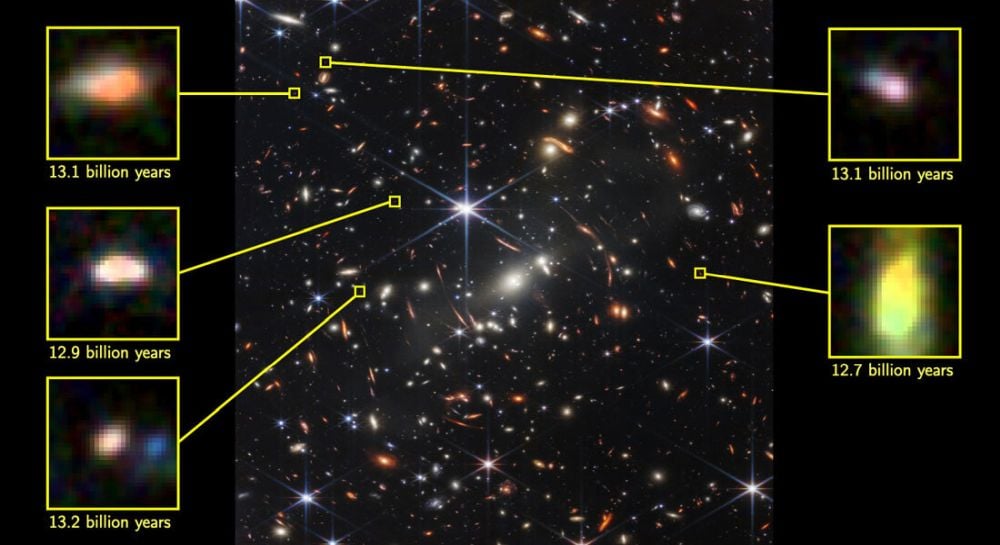
One of the surprises delivered by the JWST concerns the sizes of early galaxies. The powerful telescope examined the ancient light from galaxies at high redshifts, within about 500 million years after the Big Bang. The observations showed that these galaxies were already much larger than they should be, according to our understanding of galaxy formation and evolution.
But new research says that these galaxies were actually even more massive than thought.
Astronomers can't count and measure every star in a galaxy. Resolving individual stars in distant galaxies is challenging. Instead, they measure the masses of galaxies based on the Initial Mass Function (IMF).
The IMF is an important link between stars and their galaxies. It not only describes an initial stellar population of a galaxy in terms of their masses, formation, and evolution, but by extension, the evolution of the galaxy itself. The IMF basically assigns probabilities to stars and their masses at the time of formation.
Now, new research published in Nature Astronomy examines how the IMF may be giving us the wrong idea about the JWST's problematic early galaxies. The research is titled "Hidden mass in early galaxies revealed by bottom-heavy initial mass functions," and the lead author is Chloe Cheng. Cheng recently earned her PhD at Leiden University in the Netherlands, partly based on this work.
"James Webb Space Telescope (JWST) observations have revealed that massive galaxies formed and evolved faster than predicted by galaxy formation models, with many having already assembled a large mass in stars approximately 12 billion years ago," the authors begin in their paper. But the authors highlight that the masses of these ancient galaxies are uncertain. They're based on the Milky Way's (MW) IMF, which is an assumption.
The researchers say that when astronomers observe and measure a distant galaxy, they're not seeing a representative sample of its stars. This is skewing the mass measurements of the puzzling high redshift galaxies found with the JWST.
"Specifically, the contribution from low-mass stars, which make up the bulk of stellar mass, is not directly observed but inferred on the basis of an extrapolation of the Milky Way IMF," the authors write.
Extrapolations, while powerful, can give us the wrong idea. When astronomers observe a distant galaxy, they're not resolving individual stars. They're examining the collective spectra of all of its stars and working backwards from their to understand their collective masses. But these spectra are dominated by massive bright stars. Dimmer, lower-mass stars can be lost in their light. This has implications for the JWST's massive, high-redshift galaxies.
“If a galaxy were a city, the brightest stars would be the skyscrapers that immediately catch your eye from afar,” lead author Cheng said in a press release. “Our models demonstrate that a far more numerous population of low-mass stars is concealed by those rare, bright stars, like houses hidden between skyscrapers. As a result, this galaxy turns out to be much more massive than previous estimates suggested.”
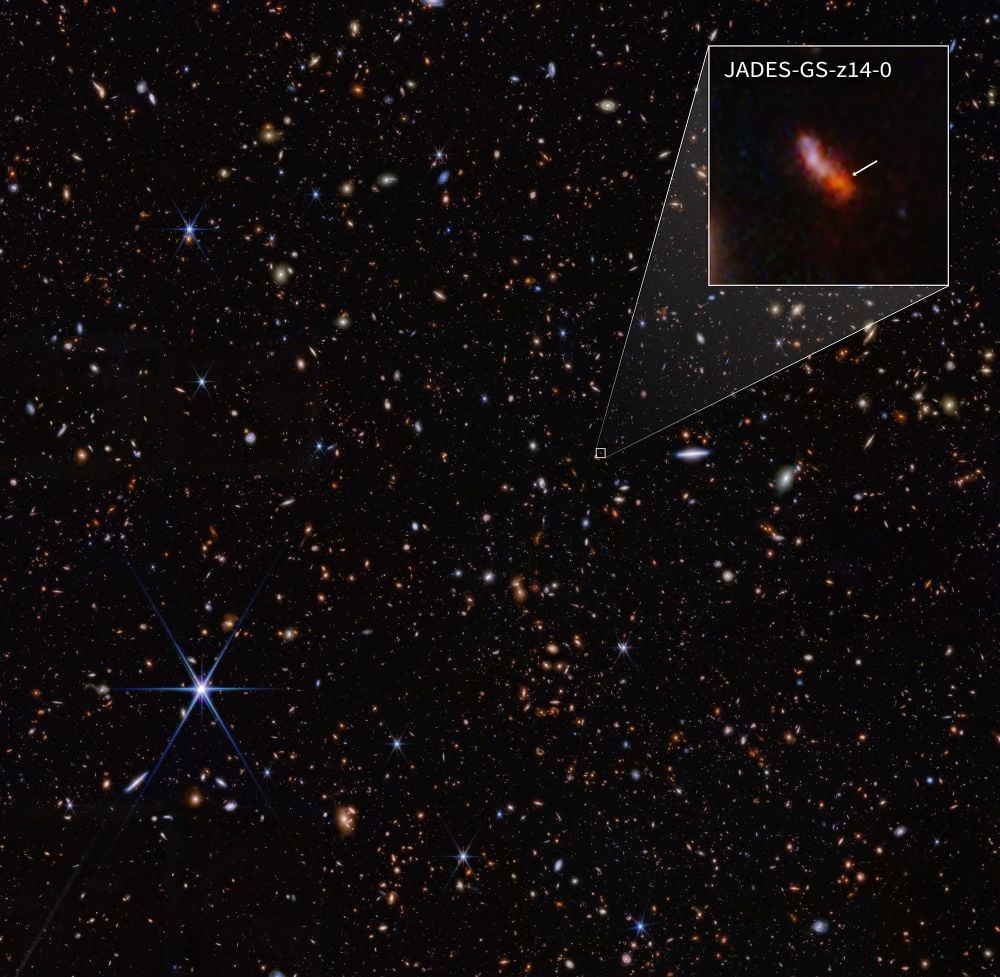 JADES-GS-z14-0 is one of the JWST's early galaxies that is much more massive than we thought galaxies could be so soon in the Universe's history. The JWST observed the galaxy only about 300 million years after the Big Bang, when it was already massive and luminous. While the JWST's observations of early galaxies is perplexing, the new mass measurements mean they're even more massive than we thought. Image Credit: NASA, ESA, CSA, STScI, B. Robertson (UC Santa Cruz), B. Johnson (CfA), S. Tacchella (Cambridge), P. Cargile (CfA)
In this work, the researchers used data from the JWST's NIRSpec instrument and the Very Large Telescope's Large Early Galaxy Astrophysics Census (LEGA-C). Their research covered 9 quiescent galaxies at high redshifts to understand their IMFs. The results show that these 9 galaxies contain more low-mass stars than thought.
"Using ultra-deep spectra of nine massive quiescent galaxies at redshift z ≈ 0.7 from the JWST Initial Mass Function of Early Red NIRSpec Objects program, extended to bluer wavelengths with deep Very Large Telescope Large Early Galaxy Astrophysics Census spectra, we find that the most massive galaxies have excess low-mass stars," the authors write.
“Until recently, measurements like these were simply impossible,” says co-author Martje Slob (Leiden University). “We needed not only a telescope capable of magnifying very distant galaxies, but also spectra of exceptional quality and new analysis techniques to reliably detect the subtle signatures of faint, low-mass stars hidden within these cosmic titans.”
These findings further disrupt our understanding of the masses of these early galaxies. Though they already seemed more massive than we can account for, they're actually even more massive than that. Even more shocking, the oldest of these 9 galaxies has the most low-mass stars.
"Remarkably, our oldest galaxy (formation redshift, zform > 5) has the most bottom-heavy IMF," the authors write. "This galaxy may be a descendant of JWST’s ‘impossibly early’ galaxies, implying that the latter may have had similarly bottom-heavy IMFs," they explain. That would increase their masses by a factor of about 4.
Scientific models of galaxy formation and growth were already struggling to explain the JWST's early galaxies. Now, according to these results, the strain is even greater. "Our findings may thus amplify the tension with galaxy formation models," the researchers write. Models now need to account for many more low-mass stars.
The authors say this work is a huge leap in how we understand galaxy growth. "Our finding of bottom-heavy IMFs at z∼0.7, particularly in our oldest galaxies, implies that the most massive quiescent galaxies discovered at high redshifts (stellar mass ≳1011M⊙), likely have even higher masses than originally reported," they write. These galaxies are quiescent, but the results imply that their star-forming progenitors were also more massive, which only strains models even more.
There's lots of unsettled debate about the nature of the IMF. Astronomy is all about light and how it gets captured, measured, dissected, and modelled. This research shows how different the results are when our understanding of light can be wrong by a factor of 4. And those results affect more than just stars.
“This result shows that much more mass than previously thought is hidden in low-mass stars,” says Mariska Kriek (Leiden University), who led the research. “That has consequences for many areas of astronomy. For example, as many planets orbit low-mass stars, this could even indicate that more planets formed in the early universe than we had previously assumed.”

