 Universe Today
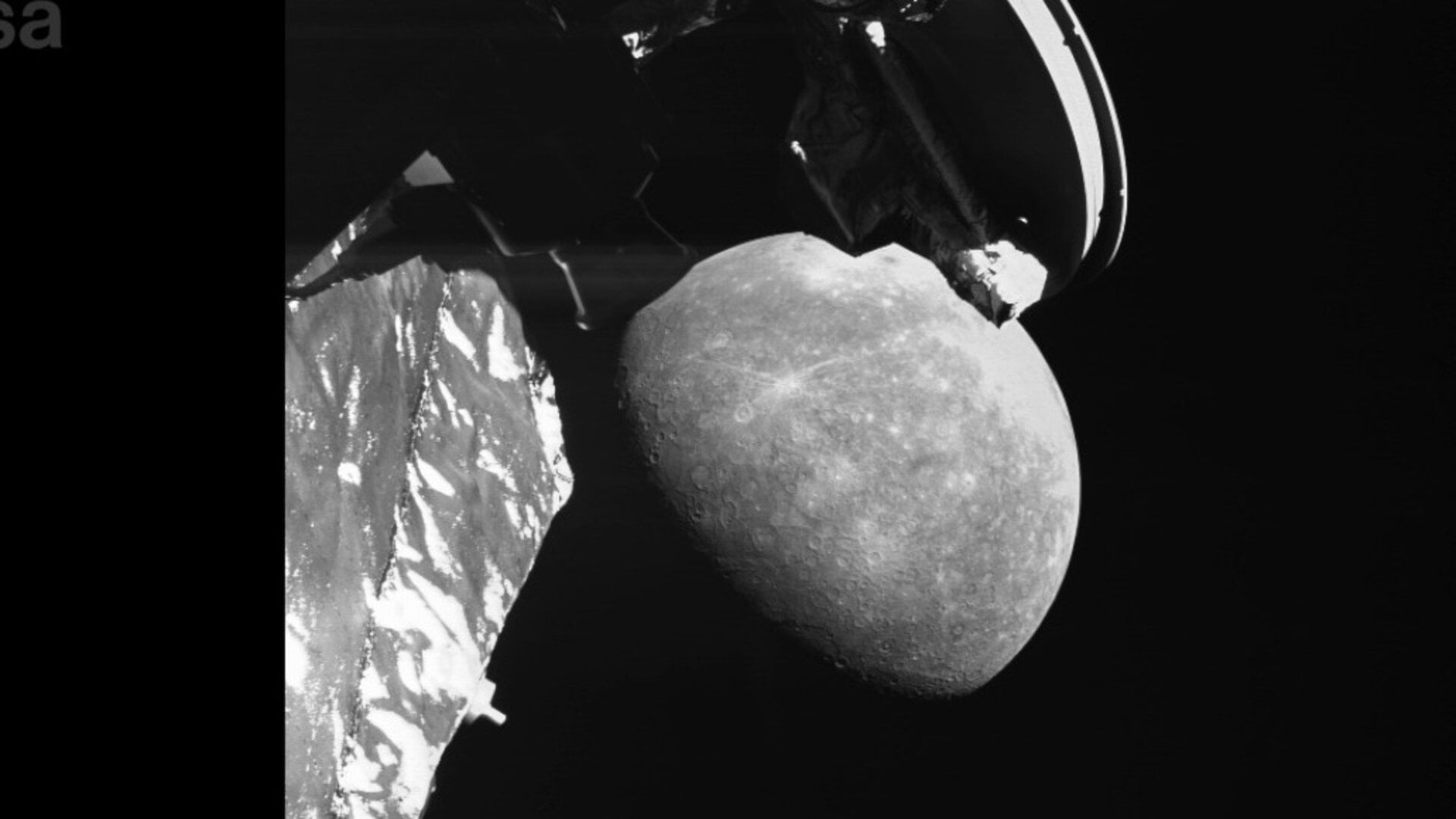
A first of its kind instrument shows its stuff prior to arrival at Mercury.
The joint ESA/JAXA BepiColombo mission has arrived at Mercury, and among its arsenal of detectors ready to explore the innermost world is an innovative new instrument.
A University of Leicester team recently released an image of an iconic deep-sky object as a proof of concept test for their Mercury Imaging X-ray Spectrometer (MIXS). Located on the Mercury Planetary Orbiter segment of the BepiColombo spacecraft stack, UK-built MIXS is the first x-ray instrument on an interplanetary spacecraft, and UK Space Agency’s instrument contribution to the mission.
The image shows the Crab Nebula (Messier 1) in x-ray light. Located 6,500 light-years distant, ‘The Crab’ is a prominent x-ray source, located 6,500 light-years distant in the constellation of Taurus the Bull. The Crab Nebula made a fine target for calibration and testing. It’s rare for an interplanetary mission to deliberately image a deep-sky object, though they do occasionally turn up in star-tracker navigation frames.
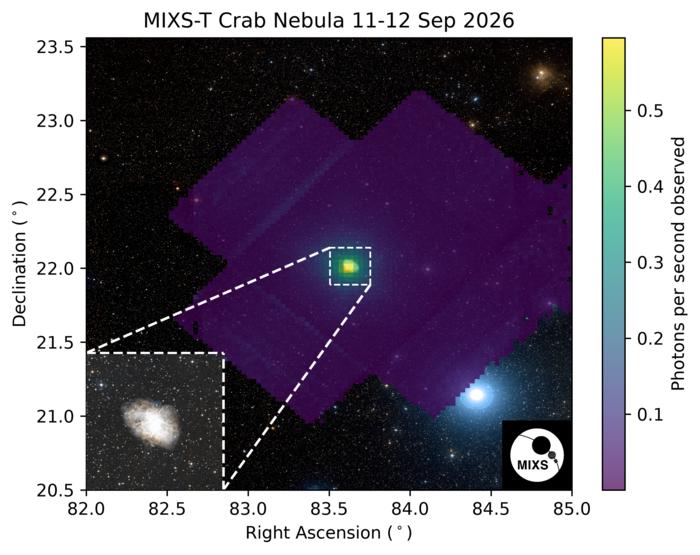 MIXS image of the Crab Nebula (inset) overlaid on a visible light background. Credit:ESA/University of Leicester/NASA/GSFC
New Horizons once captured the ‘Wishing Well’ open cluster NGC 3532 using its LORRI imager.
“X-rays cannot penetrate Earth's atmosphere to the ground so all X-ray telescopes must be in space,” Adam Fox (MIXS Operations Scientist) told Universe Today. “X-rays can only be reflected to a focus at very shallow angles, which means conventional X-ray telescopes must have very long focal lengths (~10 meters) with nested mirrors, meaning a mass of hundreds of kilograms.”
“MIXS uses novel X-ray optics called micro-pore optics which have millions of tiny pores (20 microns wide) to allow an X-ray telescope which is 1 meter in length and weighs only 11 kilograms, making it small and light enough to be flown to Mercury.”
The MIXS instrument had to wait through 8-long years of space travel, until the Mercury Transfer Module (MTM) was jettisoned from the stack joined to the Mercury Magnetosphere Orbiter (MMO) and the Mercury Planetary Orbiter (MPO) this past September 3rd. This finally exposed MIXS to space, allowing the team an opportunity to calibrate and test the instrument prior to arrival.
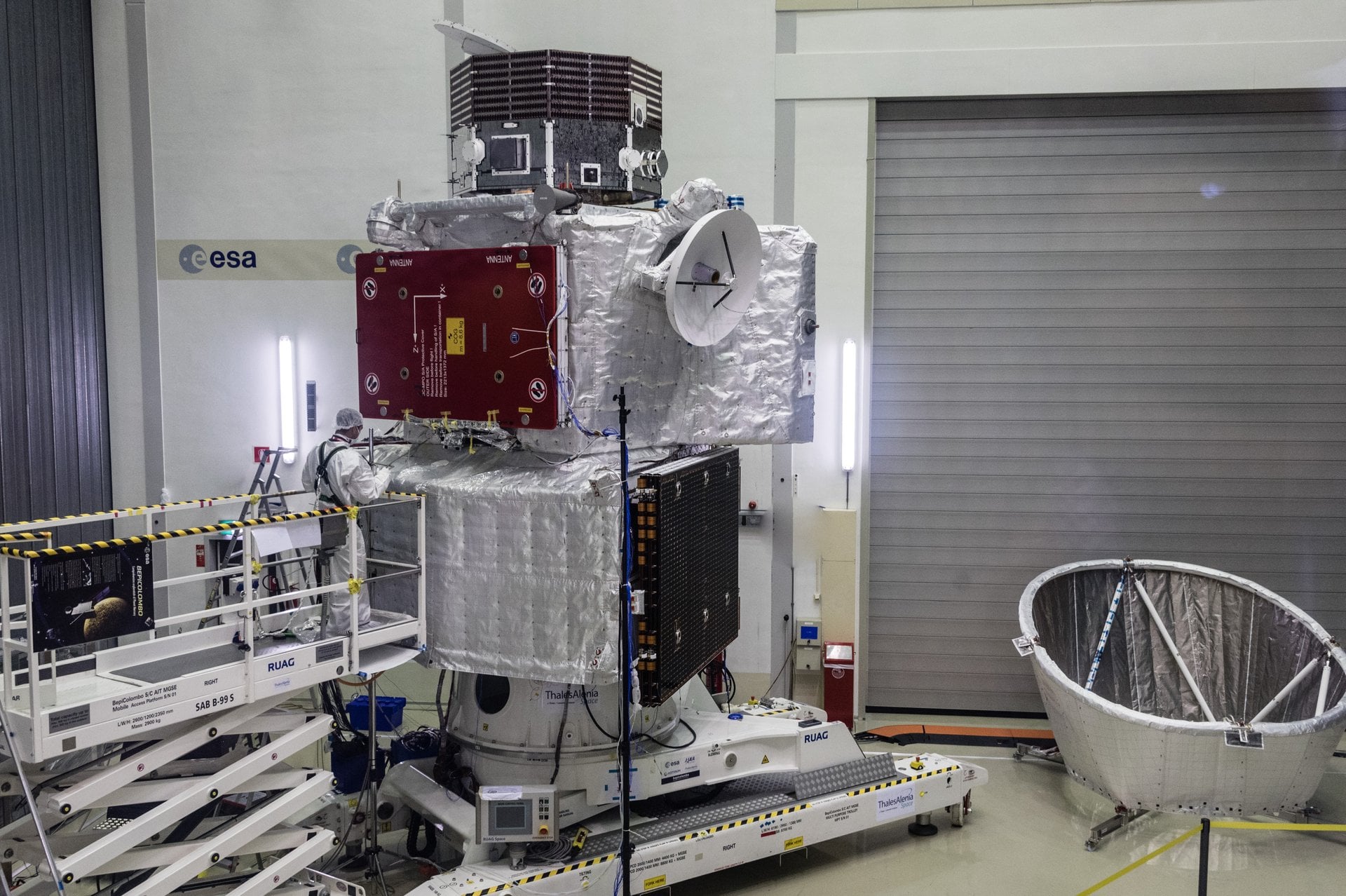 The BepiColombo spacecraft stack prior to launch. Credit: ESA
“Until early September, the Mercury Planetary Orbiter (MPO) which carries MIXS was attached to the Mercury Transfer Module (MTM) which provided power and propulsion during BepiColombo's 8 year cruise to Mercury,” says Fox. “During this time, MIXS' view was directly blocked by the transfer module, only following this separation has MIXS had a view of deep space for the first time. MIXS has been switched on periodically during cruise for checkouts of instrument health during which only the behavior of the detectors within could be monitored.”
The image is the result of 55 platform slews over the course of 39 hours on September 11 and 12th shortly after MTM disposal.
MIXS is designed to create a surface map showing the atomic makeup of Mercury at an unprecedented scale. Working in tandem with the Solar Intensity X-ray and particle Spectrometer (SIXS), MIXS will look at fluorescence of surface material created as a result of high energy solar x-rays impacting the surface. MIXS will also document the local environment in x-rays and magnetospheric interaction on the nighttime side of the planet.
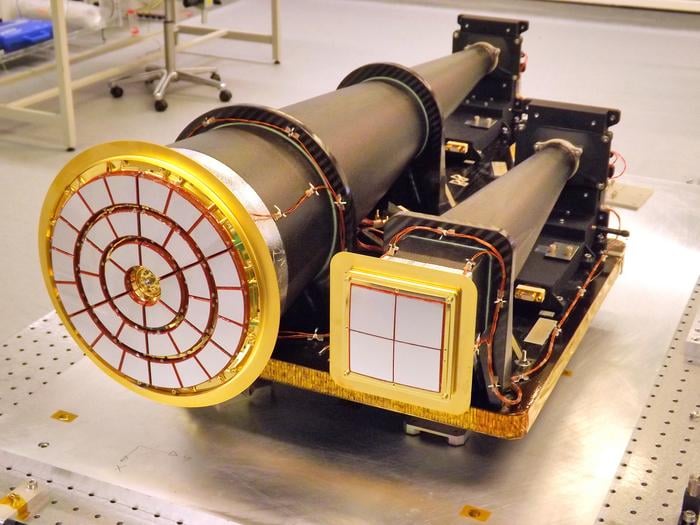 The MIXS instrument prior to launch. Credit: University of Leicester.
“The scientific advantage from having an X-ray telescope at Mercury is that (the) surface emits X-rays when hit by Solar X-rays or particles from the magnetosphere,” Alec McCrea (University of Leicester) told Universe Today. “These X-rays have characteristic energies corresponding to certain elements which can tell you what the surface is made of. An X-ray telescope can achieve this at a much higher resolution than achieved on previous missions due to both its smaller FOV and imaging capabilities.”
The arrival for the BepiColombo mission at Mercury occurred late last week on November 21st, when Mercury finally captured the attached MMO and MPO pair into an initial elliptical orbit, after a close 635 kilometer pass above the surface of the planet.
This marked a first a ‘weak stability capture’ for a planetary mission, as BepiColombo moved inside the gravitational influence of Mercury. The thruster fire was also a first for the spacecraft stack post transfer module separation in September.
There was a bit of drama last week as Estrack controllers noted the mission briefly entered safe mode and the planned thruster burn ended prematurely. The spacecraft still achieved 77% of the expected velocity change, enough to enter orbit. BepiColombo is now in a 75 hour orbit around Mercury, versus the original planned 58 hour orbit.
The Road to Mercury
This comes after one Earth, two Venus and six flybys past Mercury needed to enter capture and orbit around the innermost world. The arrival was also extended from December 2025 to this month, due to an issue with the thrusters on the MTM. This is JAXA’s and ESA’s first mission to Mercury, and only the second to orbit the innermost world since NASA’s Messenger mission ended operations on April 30, 2015, becoming the first human-made object to impact Mercury.
The first mission to see Mercury closeup was NASA’s Mariner 10 on 1974.
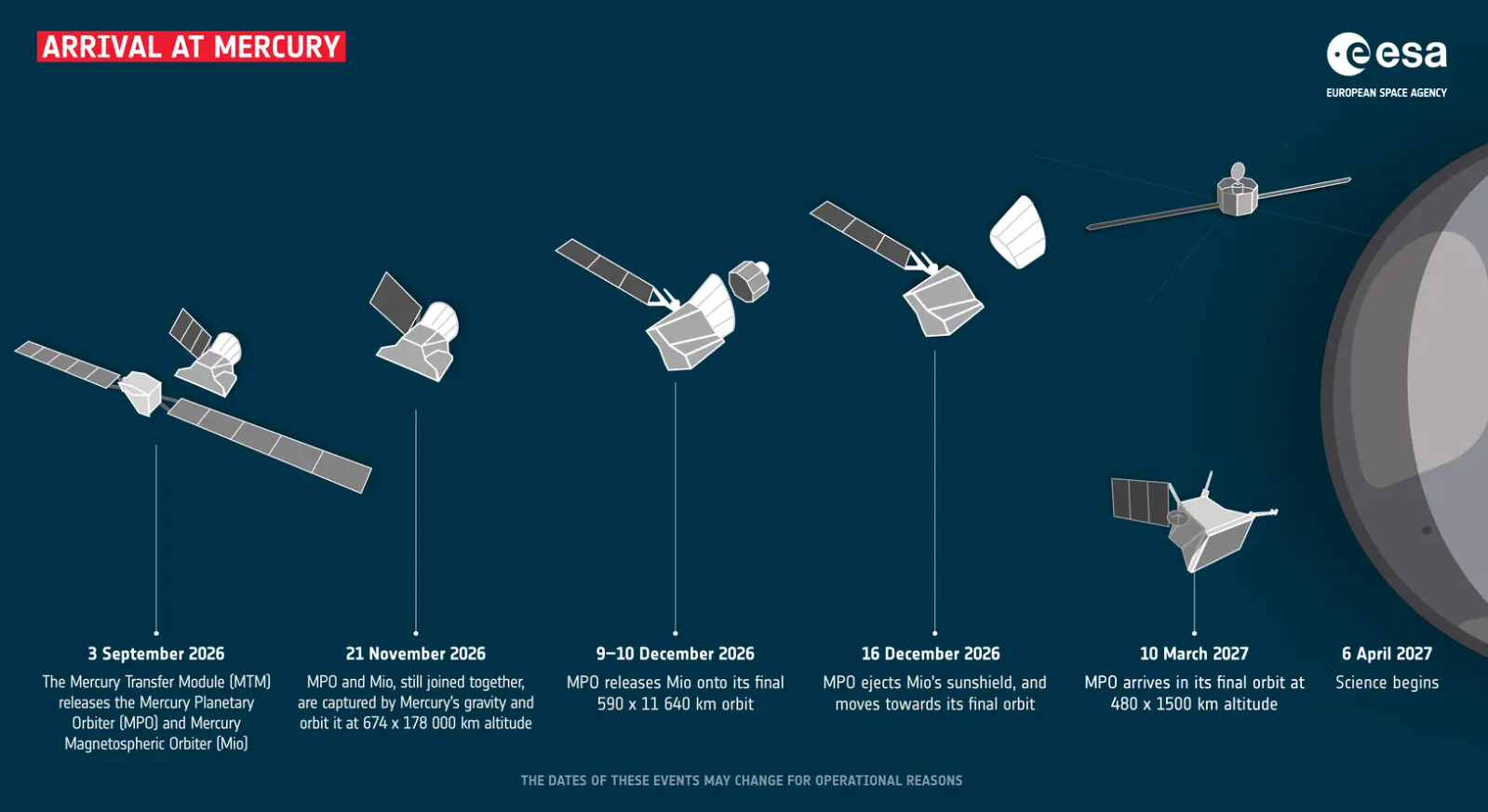 The timeline for BepiColombo's arrival at Mercury. Credit: ESA
Next comes the release of JAXA’s MMO (Mio) orbiter on December 9-10th, followed by the sun-shield ejection on December 16th. MPO will then settle down into a 480 by 1500 kilometer orbit early next year on March 10th, after which science operations can finally begin on April 6th. BepiColombo is expected to operate around Mercury until the end of the nominal mission in April 2028, with a possible extension until December 2029.
“Development of such instruments is active. For planetary X-ray fluorescence, a MIXS-like instrument is applicable to many airless bodies in the solar system and would be tailored as such,” says Fox. “Micropore optic X-ray telescopes though have since been flown on several astrophysics missions, including SMILE, Einstein Probe and the (Space Variable Objects Monitor) SVOM.”
If you’re up early this week, you can spot Mercury and wave at BepiColombo as well. The planet just passed greatest elongation west of the Sun this past weekend, and sits just below brilliant Venus at dawn.
It’ll be exciting to see what results BepiColombo and MIXS produce as they get down to work in 2027.