 Universe Today
Since the launch of Sputnik, humanity has talked to its spacecraft through radio waves. Radio is great for communication through any weather, but it has hit a limit – traditional radio frequencies are highly regulated by bodies like the International Telecommunications Union, which limits the scalability of radio communications networks to meet the growing demand of bandwidth to and from space. The obvious solution is to switch to infrared lasers, which have an extremely high data transfer rate. However, according to a paper available in pre-print on arXiv from Dr. Slava Turyshev – best known to UT readers for his work on turning the Sun’s gravity into a giant telescope – the raw speed of laser communication isn’t the bottleneck, it’s the system’s reliability.
First, let’s take a second to appreciate the leaps and bounds researchers have made passing data over space laser links recently. Perhaps the most impressive mission was a NASA demonstration called TBIRD, which beamed an astonishing 200 gigabits per second (Gb/s) from orbit, and completed a data transfer of five terabytes in a single five-minute pass over its receiving telescope. That is an astonishing speed for laser communication, but it had the advantage of near-perfect conditions.
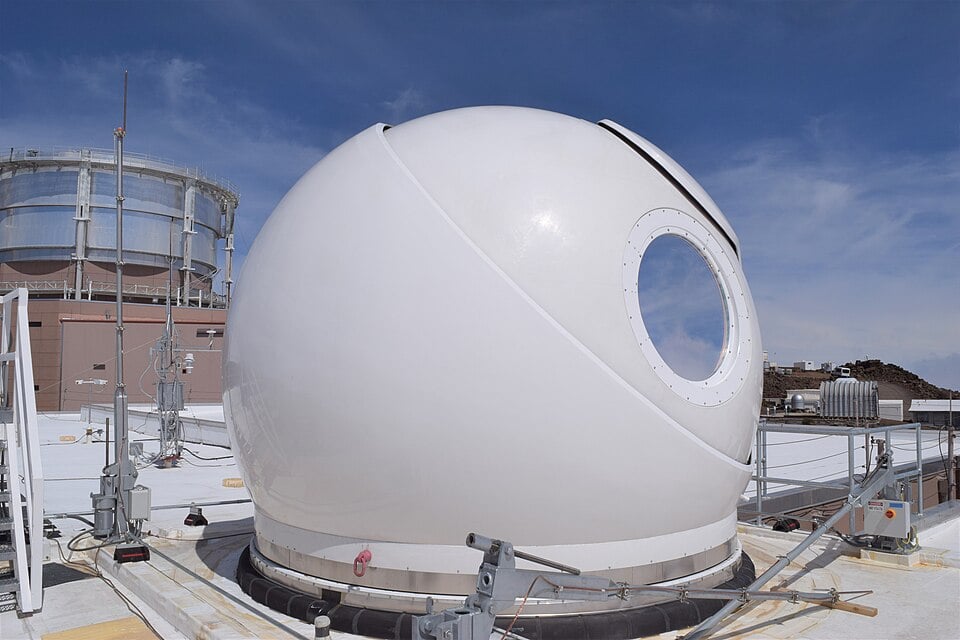
Those conditions matter for an optical ground station. One challenge is tracking. A radio communications link spreads its signal over a patch hundreds of kilometers wide, whereas a laser from low Earth orbit might illuminate a patch less than twenty meters across. As a spacecraft hurtles overhead at more than seven kilometers per second, keeping a beam thousands of times narrower locked onto a receiving telescope is far harder than hitting a radio dish.
Fraser takes a question about space-based laser communication.Another obstacle that radio frequency signals don’t have to worry about is airplane interference. Ground stations must automatically shut off their uplink lasers if an airplane passes overhead, so as not to blind the pilots (or the plane’s sensors) with a highly concentrated light beam. While each plane overflight is relatively brief, it can cause consistent disruption which isn’t a problem for radio communications frameworks.
The real challenge though is the atmosphere. Anyone that looks up at the sky on a cloudless night can see the stars twinkling. That is caused by swirling pockets of warm and cold air in our atmosphere, and in addition to making the stars seem to dance, it also distorts incoming laser light. To correct for this in optical communication systems, engineers have to use fast-moving deformable mirrors in systems called adaptive optics, or specialized light-sorting microchips. Neither option is cheap.
But the real difficulty in the atmosphere for optical communications is simple to explain – clouds. No laser in the optical or near-infrared range can punch through thick cloud cover. So when an optical base station is covered by thick cloud cover, it is essentially impossible to communicate with, knocking out both uplinks and downlinks unless another suitable base station happens to be available.
Fraser talks about the power of adaptive optics to make the atmosphere "disappear"According to the paper, pairing stations together does get some improvement. A single one can be expected to be available a little more than 60% of the time, but pairing two together in the American Southwest, for example, can bump that up to around 85%. According to another paper from the German Aerospace Center, setting up a network of eight separate optical stations around Australia and New Zealand drops the chance of an outage to just 0.02%.
However, base stations are expensive. Building eight stations for a single mission is economically infeasible – each station costs roughly two million dollars a year to build, staff, and operate. At that rate, delivering a single terabyte of information to a single mission, if it uses a single station, would cost somewhere between three to four thousand dollars. Scaling that up to eight stations to almost guarantee consistent coverage would mean it would cost $18K to send a single terabyte of data.
The only way that math works is by multiple satellite companies splitting the same ground network. If they could keep the ground stations busy at least half of the time, it could drop the price per terabyte into a reasonable range. To support those efforts, there is a push for standardization already in place.
Fraser answers a question about adpative optics alternatives.The Civil Standard (CCSDS 141.0-B / “O3K”) developed by the Consultative Committee for Space Data Systems defines hardware and handshaking specs for high-rate near-Earth links. To support that standard, the US Department of Defense also decided to get involved, introducing the US Space Development Agency’s Optical Communications Terminal Standard, requiring interoperability across terminals no matter the supplier, which includes requirements for CCSDS communication protocols.
All that being said, according to Dr. Turyshev’s paper, there is very little likelihood that purely optical communication will supplant radio for space communication anytime soon. A better approach would be to offer a hybrid partnership between the two protocols. Lasers can serve as the “heavy-lift” workhorses, downloading massive videos or Earth-observation imagery, and radio waves can maintain unbreakable lifeline support for steering or handling emergencies. That combined approach offers the best way to make sure astronauts and all of our critical space infrastructure stay connected, no matter the weather down here on Earth.
Learn More:
S. G. Turyshev - Optical Ground Stations for Space Communications:Systems Engineering, Availability, and Service Economics Through 2030
UT - One of NASA's Radio Dishes Can Now Track Space Lasers Too
UT - The Space Station is Getting Gigabit Internet
UT - NASA Achieves Impressive Bandwidth with its New Laser Communications System