 Universe Today
A recent decision will allow for observed time to begin to depart from accounted time starting next year.
Time and time-keeping is a hot topic once again, as many of us ‘fall back’ to Standard Time this coming weekend. Another time-related dilemma was also addressed this month, when a key conference did away with the leap second and the alignment of Universal Time (UT1) with Universal Coordinated Time (UTC). Somewhere off in the distant future, we’ll need to add minutes to the clock to come back into sync, up to, and perhaps including a 'leap hour.' Accounting for time is fascinating (if a bit break-brain breaking) stuff to consider.
The conference and the resolution came out of the 28th General Conference on Weights and Measures (CGPM) meeting held in Versailles France in early October. This resolution will do away with the occasional insertion of the leap second by the International Bureau of Weights and Measures (BIPM).
The new resolution now allows for time to depart from 0.9 up to a 3600 seconds (one hour). This will be effective starting next year on May 20, 2027.
“At the technical level, the change does not affect the underlying issue of the fact that the Earth’s rotation is not constant,” David Herald of the International Occultation Timing Association told Universe Today. “In years gone past, UT was the reference time scale, with a correction being needed when computing the position of planets etc. With atomic time and UTC, the issue was split between having a time scale that had the same speed as DT (Dynamic or Terrestrial Time), but was occasionally adjusted to keep it in line with the Earth’s rotation, and small corrections to the Earth’s orientation were needed to correctly position the paths of solar eclipses. With the new arrangement, time will be strictly uniform, so the time of an astronomical event can be reliably predicted years in advance. The issue of the irregular rotation of the Earth is dealt with where it belongs: the Earth’s rotation.”
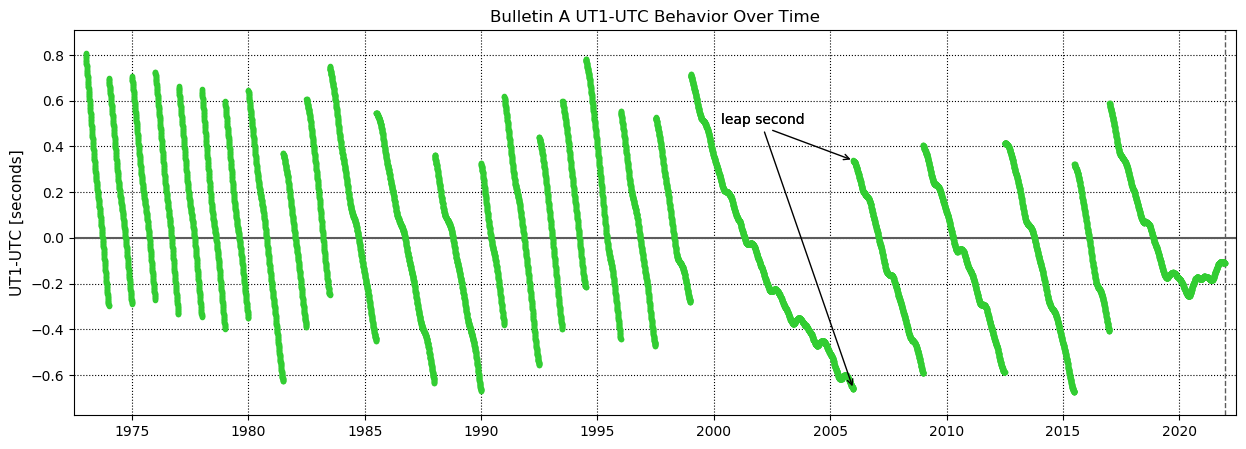 UT versus UTC over time, including the insertion of leap seconds. Credit: NIST.
A Brief History of the Second
This decision has been about a decade coming. We wrote about the leap second conundrum for Universe Today back in 2015. Earth’s rotation isn’t entirely uniform, owing mainly to earthquakes, tectonic plate shifts, and even ice loss. We are also slowing down (mainly due to tidal friction versus the Moon) to the tune of 2.3 milliseconds per day per century, requiring the insertion of an additional second on average every 500 days or so, to stay in step with observed time.
The addition of leap seconds was instituted in 1972, and since then, we’ve added 27 seconds overall, with the last (and now final) one being inserted on the end of December 31, 2016. The system also allowed for the subtraction of seconds, which was never instituted in practice. Earth’s rotational variance over the past decade has also slowed down very slightly.
The current definition of an SI (System of International units) second set in 1967 is based on atomic clocks using what’s known as the caesium standard. This standard may also change in the decade to come.
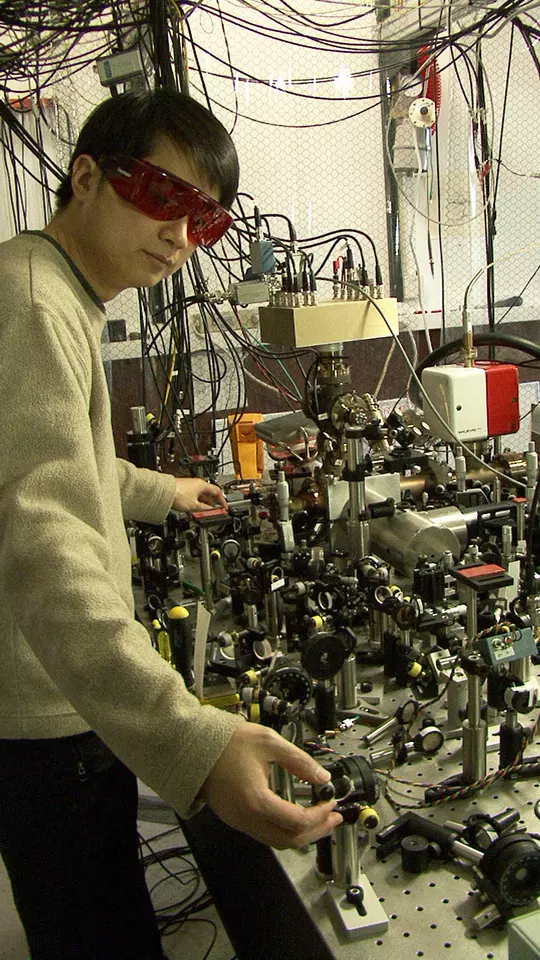 NIST's 'quantum logic' atomic clock. Credit: NIST
The inclusion of a leap second was also creating problems in our increasingly technical society. What happens, for instance, to the flurry of emails sent worldwide during said anomalous second? Linkedin, Reddit, and even Qantas airlines all experienced issues during the addition of the 2012 leap second.
Will you or anyone notice, now that the practice of adding leap seconds has ended? Probably not, as the total number of accumulated leap seconds over an average human lifetime is minuscule. Sure, local solar time will begin to depart from fixed time, but that pales versus the biannual shift most of us endure under the yoke of Daylight Saving Time. Plus, the Equation of Time (represented by the figure 8 analemma you see on the side of a classroom globe) offsets sundial time by up to a maximum value of nearly 17 minutes. Finally, your longitudinal placement within your time zone also plays a role in conspiring to assure that the Sun doesn’t always transit your local meridian exactly at noon.
What This Means to Astronomy
For astronomers, the main impact will be with precision astrometry and observations involving the rotation of the Earth.
“For astronomical events that do not depend on your location on the Earth (such as the phenomena of Jupiter’s satellites), the time of an event can be accurately calculated/predicted well into the future. This is a plus,” says Herald. “For events where your location on the Earth’s surface is important (e.g. a solar eclipse path), nothing will change.”
“You can accurately generate an eclipse path on the surface of a globe representing the Earth. But you do not know where an observer at a specific longitude/latitude will be located on that globe without correcting for the Earth’s rotation. And when you correct for the rotation, their position ‘along the track’ of the eclipse will change, so that the time of the event will also change for them."
This effectively, sets up a situation that works in reverse of what happened before the implementation of Dynamical Time. "It used to be adjusting the time to generate planetary positions," says Herald. "In the future, it will make that same adjustment to time to give the correct orientation of the Earth. In short, a philosophical situation of treating the problem at its cause (Earth’s rotation), and otherwise making no practical difference to calculating the accurate location of an eclipse path on the Earth’s surface.”
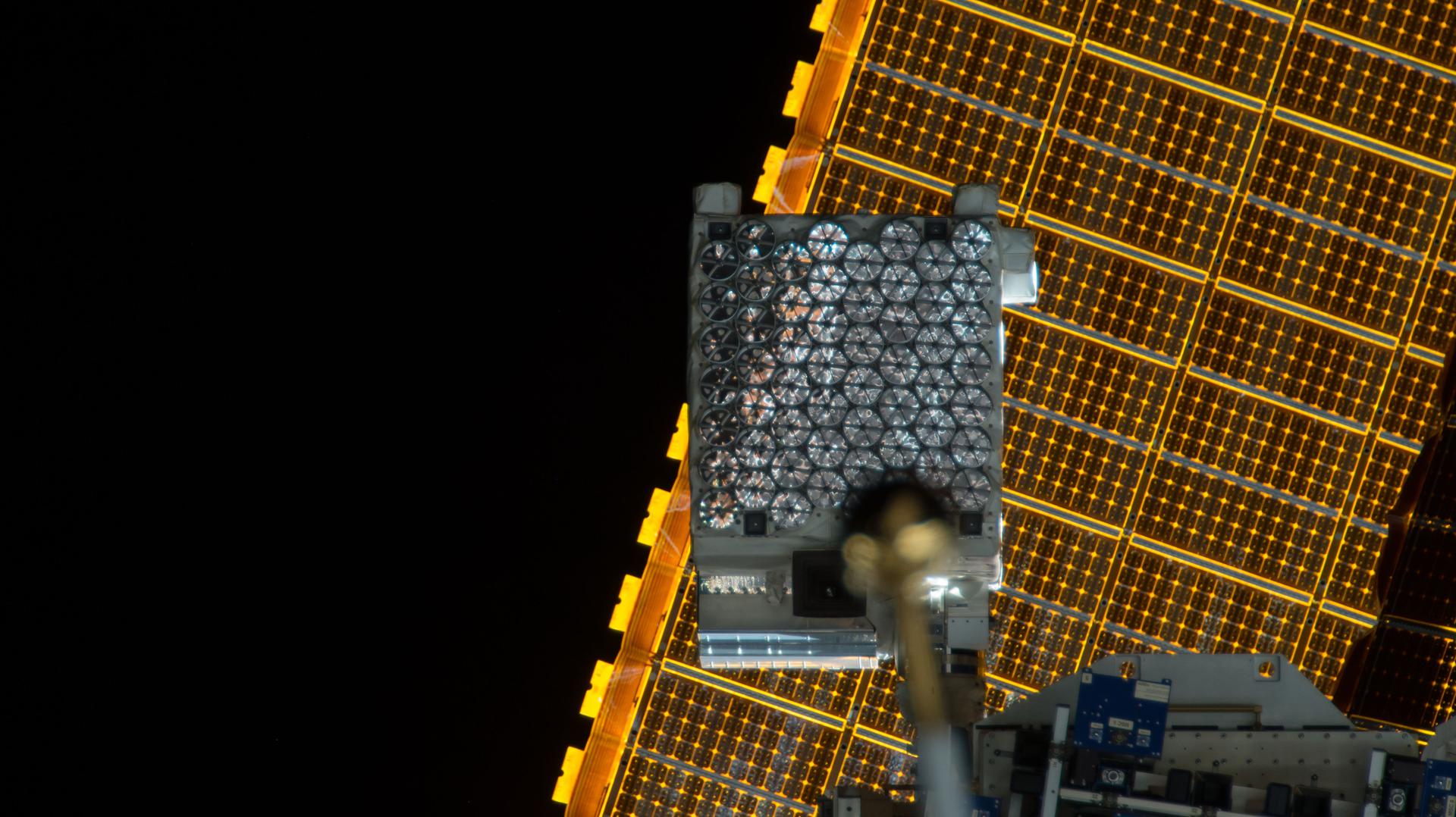 The NICER instrument mounted on the exterior of the International Space Station. Credit: NASA
Of course, keeping time on long duration space missions will also see us depart from fixing our clock to Earth’s rotation entirely. NASA’s NICER instrument on the ISS is observing the timing on remote pulsars which could be used one day for deep space navigation and time-keeping. Crewed missions to the Moon coming right up in the next decade will also need to agree on a fixed time scale. Mission controllers working with Mars mission are already accustomed to keeping ‘Mars time’ on a day just under 40 minutes longer than the one we experience here on the Earth.
Finally, this also means that this featured 'performance of the leap second' in Times Square was likely the last:
The leap second may be dead, but all hail the ‘leap hour’. Some day, perhaps centuries or even a millennium or two from now, the powers that reckon future time will convene and decide on bringing the two clocks back in sync. When they do, they’ll remember 2026 and the time humanity decided to do away with the leap second.