 Universe Today
Looking for biosignatures across the solar system requires looking for asymmetry. Amino acids, the building blocks of proteins, are famously either “left-handed” (L) or “right-handed” (D). We know abiotic processes (i.e. those that create amino acids but don’t involve life) create a 50/50 mixture of the two types, which is called a racemic mixture. But life as we know it almost exclusively relies on left-handed amino acids to fold proteins and right-handed ones to construct nucleic acids. So if we find an imbalance in the types of amino acids we analyze from somewhere in the solar system, it's a good indication that life is behind that imbalance.
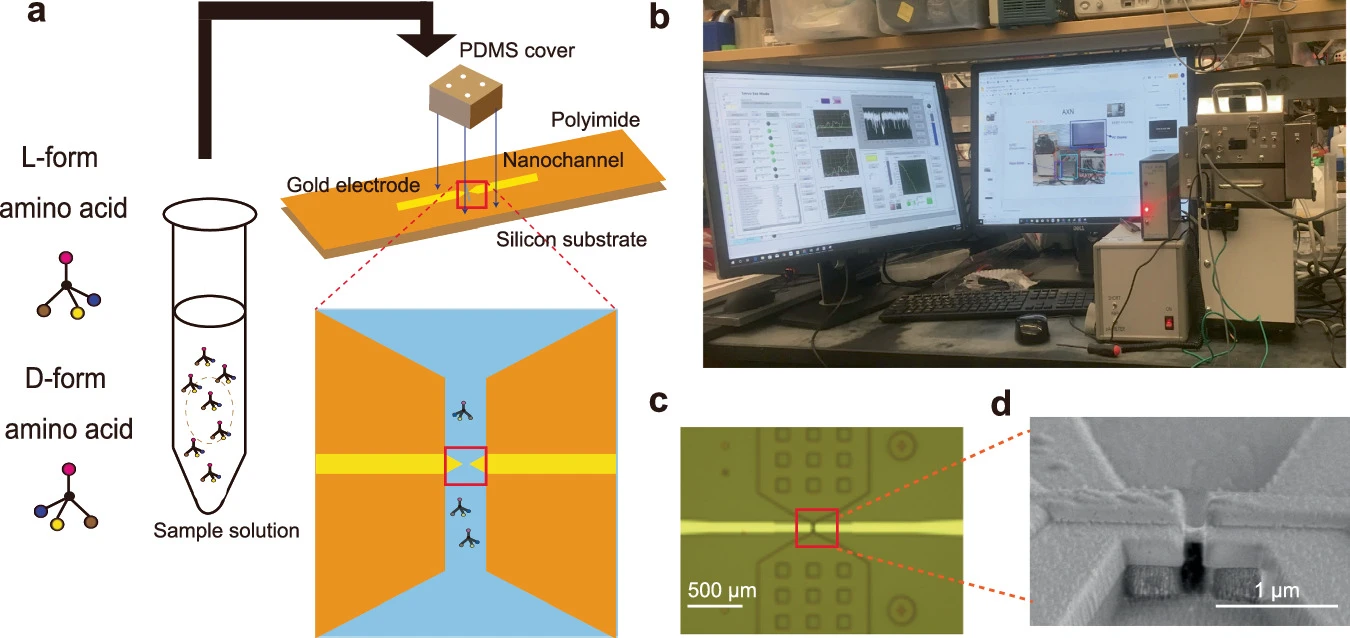
Differentiating between the two “chiralities”, as they’re called, is possible, but typically requires advanced equipment and chemical disposables that make them burdensome for spaceflight applications. But a new paper in Nature Communications from researchers led by Takahito Ohshiro and Masateru Taniguchi of Osaka University offers an alternative - a solid-state quantum tunneling sensor that can read the chirality of a single amino acid molecule using basically just some gold wire.
Amino acids aren’t particularly abundant in the solar system - typically they are found in trace amounts. And that means identifying the chirality of the relatively small sample size requires heavy optical polarimetry, fluorescent labeling, or complex chromatography. All of which require substantial equipment, such as optical lasers, carrier gases or reagents, which therefore requires substantial amounts of weight. And additional weight is a spacecraft’s worst enemy.
A TED-Ed talk on what Chirality is. Credit - TED-Ed YouTube ChannelInstead of these bulky existing solutions, the technology described in the paper is something called a nanogap device. It draws two atomically sharp gold wires apart until there is a gap of only between 0.56 and 0.58 nanometers between their tips. When a relatively low voltage (0.1V) is applied across the gap, instead of arcing between the points, electrons cross the barrier via quantum tunneling.
An amino acid drifting through that gap via diffusion would disturb the quantum field the electrons use to jump the barrier. This creates a distinct electrical spike, whose amplitude and waveform changes can act as a conductance signature that can be tied to the type and chirality of a given amino acid.
Specifically, the researchers found that the orientation of the gold nanowires caused them to interact differently with the different chirality of amino acids. Using a machine learning classifier, they were able to correctly distinguish between the L- and D- forms of a specific amino acid roughly 87.6% of the time.
Fraser talks about the history of the search for life on Mars.In the lab, the researchers decided to put their system to the test in a few ways. First was to run a relatively controlled experiment using all 20 standard biological amino acids, resulting in 39 total forms, since glycine doesn’t have any chirality. The instrument was able to identify specific molecules and their handedness simultaneously, and was able to do so down to sub-nanomolar limits.
To take that work a step further, the researchers took real world samples and tested them. One sample was of soil from the Atacama desert - a decent terrestrial analog for Mars - and one was from the famous Murchison meteorite that fell on Australia in 1969 and has been a giant in astrobiological research almost as long.
Analyzing these real-life environmental extracts was more complicated, and required some additional filtering mechanism to get rid of ambiguous spikes and signal noise. But, once filtered properly, the nanogap device compared favorably to an accepted liquid chromatography-mass spectrometry (LC-MS) device that is viewed as the “gold standard” of chirality testing.
However, there were some discrepancies between the device and the LC-MS system. It seemed other parts of the environmental samples had fouled the surface of the nanogap device, or introduced other types of background errors. Simply put, it's not easy to keep a sub-nanometer gap clean in real-world environments. But the researchers believe they can fix that problem with algorithm improvements, and eventually get their device to accurately match the gold standard LC-MS systems in all use cases.
That would be great as it would enable such chirality experiments to fly on future space missions without the burden of significant amounts of extra equipment. One potential candidate is the Electronic Life-Detection Instrument for Enceladus/Europa (ELIE) - a payload prototype which is designed to detect single-molecule biosignatures. The nanogap chirality detector has several advantages, including being much lighter, not requiring active cooling, and being able to withstand up to 300℃.
It will likely be awhile before we see a nanogap device blasting into orbit though. Nanowires with very strict gap tolerances likely wouldn’t do great in the vibratory environment of a rocket launch. But the underlying idea of using quantum tunneling as a chirality detection methodology is novel. If they can package the system up correctly and prove it works in deep space, there would likely be room on a life-hunting payload in the future for this idea.
Learn More:
University of Osaka - An electrical technique for identifying signs of life in space
T. Ohshiro et al - Chiral discrimination of amino acids in meteorite and desert soil extracts via single-molecule nanogap conductance
UT - Finding Organics on Mars Isn't Enough. ExoMars Will Look for Their "Handedness."