 Universe Today

When stars reach the end of their life cycles, they undergo gravitational collapse and shed their outer layers. More massive stars leave a black hole, while smaller stars leave a remnant known as a neutron star or a "white dwarf." The shed gas and dust form a nebula, a bright envelope illuminated by the white dwarf's radiation. But for some time, astronomers have speculated that new generations of planets may form as the gas and dust settle into a new accretion disk.
After combing through the Hubble Space Telescope's data archive, a team led by researchers from the University of Warwick uncovered a star that may host a planet formed from accreted matter shed by a stellar remnant. The system, known as HS 0209+0832, is a white dwarf star about 1% the Sun's radius but about 60% as massive. If confirmed, this planet will be the first "second-generation" planet ever confirmed.
The international team consisted of researchers from the University of Warwick's Centre for Exoplanets and Habitability, the Instituto de Astrofísica de Canarias (IAC), the Racah Institute of Physics, the Institut für Theoretische Physik und Astrophysik, the University of Wisconsin, the Massachusetts Institute of Technology (MIT), the Laboratory for Atmospheric and Space Physics (LASS), the Harvard & Smithsonian Center for Astrophysics (CfA), and the Space Telescope Science Institute (STScI).
A paper describing the team's findings was published on October 5th in Nature Astronomy.
Planetary systems typically form shortly after a new star is born, from leftover gas and dust that falls into a circumsolar accretion disk around it. This is how the Earth and other "first generation" planets of the Solar System formed ca. 4.5 billion years ago. When Hubble first observed HS 0209+0832 in 1999, it detected roughly 100 chemical signatures that could not be identified.
Using an updated chemical database, Williams and her colleagues reexamined the Hubble data and found that niobium (Nb) matched many of the signatures. Said Williams:
Rather than the white dwarf stage being a kind of epilogue to the story of a star and its planets, this research points to the systems we are familiar with only being the first chapter of a potentially much longer tale, with some new characters showing up. That’s a really exciting prospect to pursue.
What Hubble is showing us in this white dwarf system is something we haven’t seen before: a high abundance of the element niobium, the signature of which I was unfamiliar with when I first found it in the archival data.
While this element is found in our Solar System and used in commercial products, niobium has never been reported in any white dwarfs analyzed to date. What's more, the amount Hubble detected suggested the presence of a massive planet rich in the material. As a heavier element, niobium only forms through the processes at work in dying stars. In short, a planet containing as much as Hubble detected could have formed only after its star went supernova.
Once it ejected this material, the team theorizes that some of it coalesced into a gas giant planet while the remainder was dispersed long ago. Said co-author Nicholas Stone, a theoretical astrophysicist at the University of Wisconsin – Madison:
Niobium and other elements heavier than iron are astronomically special because, unlike many common elements, they are not formed in the cores of stars by thermonuclear fusion. Instead, these heavy elements can only be synthesized in the exotic conditions that briefly emerge inside dying stars. The presence of niobium is a signpost of these ‘death’ throes, and the expulsion of the dying star's innards into space.
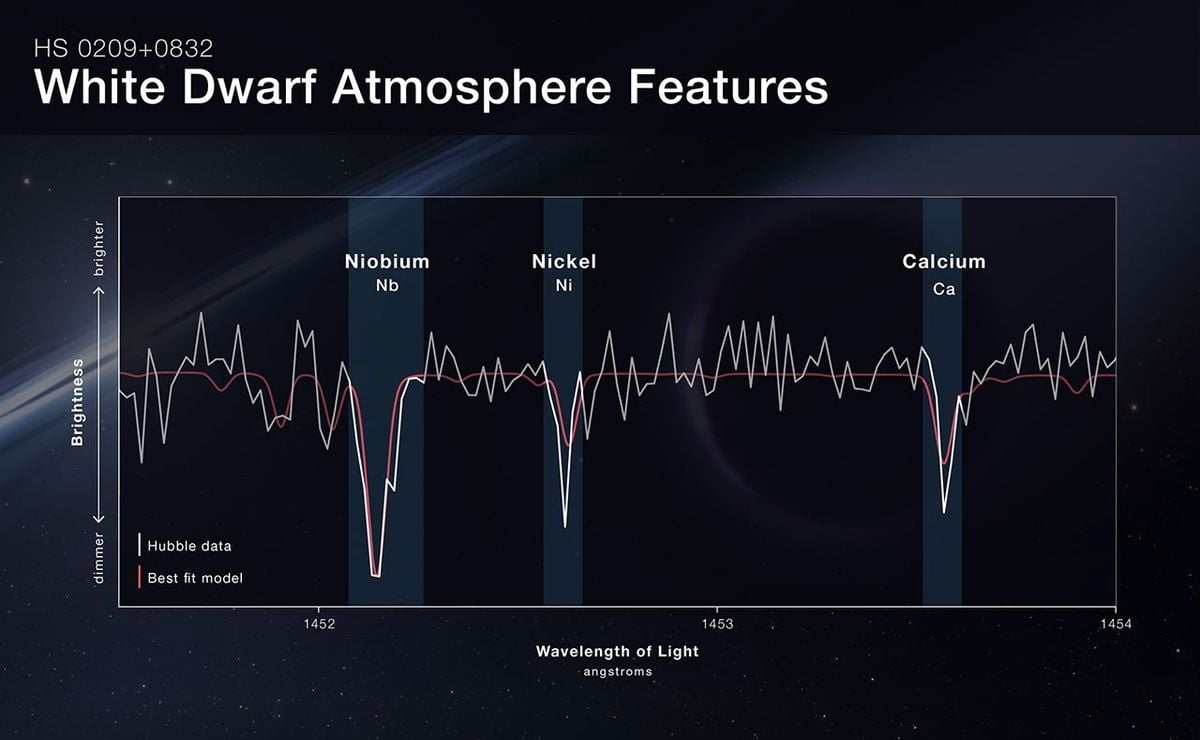 NASA’s Hubble Space Telescope spectrum shows the unusual abundances of certain elements it found in the HS 0209+0832 system. Credit: NASA, ESA, Leah Hustak (STScI)
The research team confirmed the Hubble observations with archival data from the now-retired Far Ultraviolet Spectroscopic Explorer (FUSE) mission. They also consulted data from the Transiting Exoplanet Survey Satellite (TESS), which observed the white dwarf for four months. Based on the available data, the team estimates that the candidate planet is a gas giant similar in size to Jupiter that orbits HS 0209+0832 at a distance of about 6 million km (3.7 million mi), much closer than Mercury's orbit around the Sun (58 million km; 36 million mi).
They also conclude that since HS 0209+0832 is relatively young, it is still very hot and blasting this planet with intense radiation that (combined with the planet's proximity) is rapidly stripping away its atmosphere. This could mean that the planet has a comet-like tail of material that falls into orbit around the star and is gradually accreted onto its surface, which is what allowed Hubble to detect traces of niobium.
"If the second-generation planet is there, I think it is likely to survive," said Williams. "Eventually the white dwarf will cool and then maintain a consistent temperature, with the planet in its stable habitable zone for millions of years." The team plans to examine this planet for several more years to learn about second-generation planets, how common they are, and how they evolve in orbit of white dwarfs.
Further Reading: NASA