Universe Today

Here's a number worth sitting with…. six millimetres. That's the diameter of a new optical component developed at the University of California San Diego that could fundamentally change how future space telescopes study the Sun. It’s even smaller than your little fingernail and it might be one of the most significant advances in solar observation in a generation.
The component is called a metasurface polarisation grating. Rolls off the tongue and maybe sounds intimidating, but the underlying idea is elegant. Light has a property called polarisation, which describes the direction in which its waves vibrate as it travels. Most of the time we ignore polarisation entirely, but in astronomy it carries extraordinarily useful information. The Sun's magnetic fields leave their fingerprints in the polarisation of the light they influence, and by measuring those fingerprints precisely, scientists can map what the magnetic field is doing and where it might be about to do something dramatic.
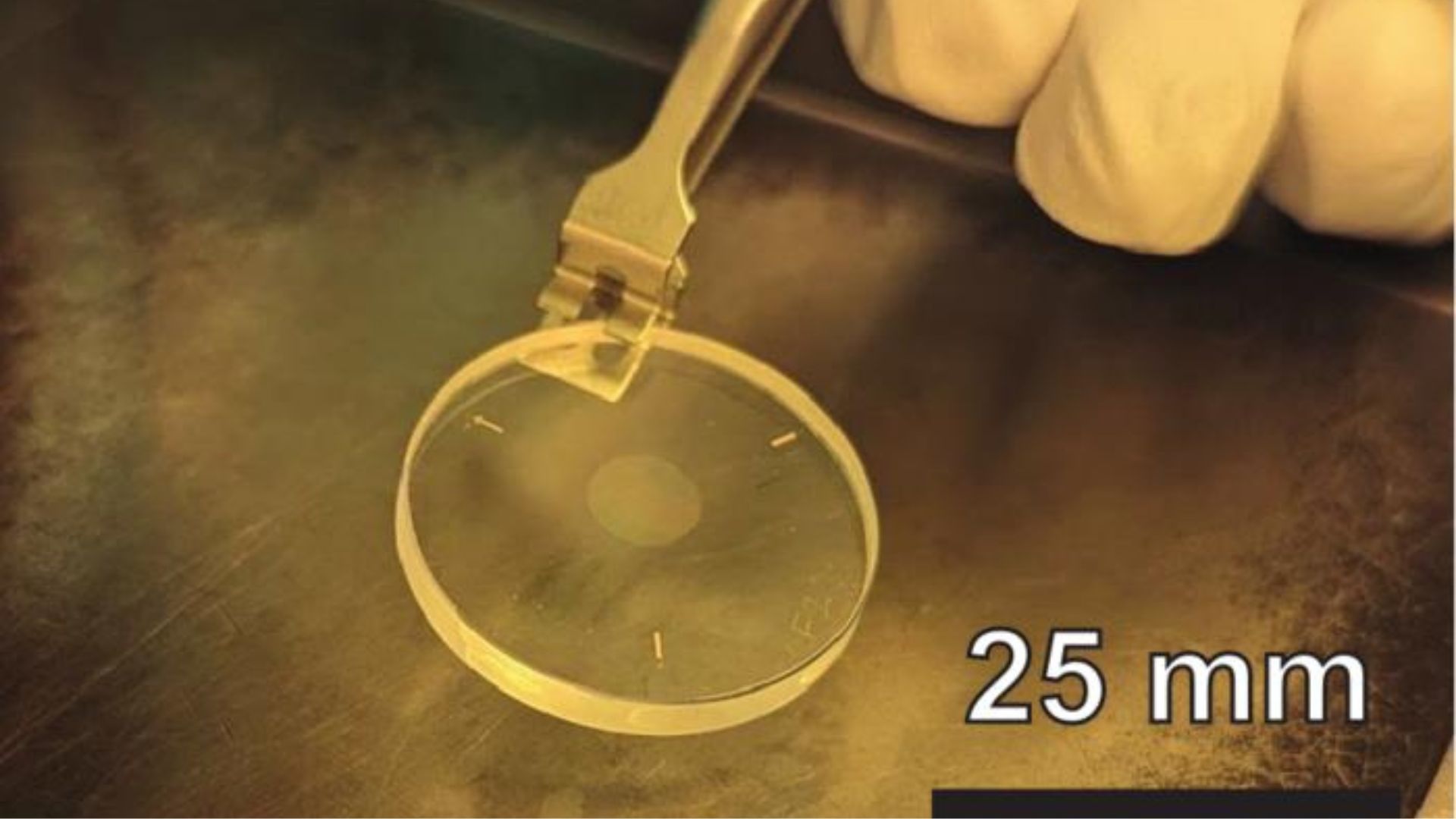 The metasurface is the six-millimeter-sized circle at the center of the disk that's held by tweezers (Credit : Noah Rubin/UC San Diego)
Current solar telescopes do this, but with a significant limitation. They measure polarisation one direction at a time, rotating a specialised optical component between each exposure and building up the full picture from a series of separate images. Think of it like taking four photographs of the same scene through polarised sunglasses held at four different angles, then stitching them together. It works, but it introduces a problem that becomes acute in space: between each exposure, the spacecraft vibrates. Imperceptibly, but enough. Those tiny movements shift the images fractionally, blurring exactly the fine detail the scientists need. Compensating for this requires sophisticated stabilisation systems that frequently cost more than the telescope itself.
The metasurface solves this by doing something beautifully simple. Instead of measuring one polarisation direction at a time, it splits incoming light into several polarisation channels simultaneously, capturing everything in a single snapshot. There’s no sequential exposures, no movement between images and no vibration problem. The result is a simpler instrument, a more compact system, and data that is cleaner and more complete than anything a rotating component can produce.
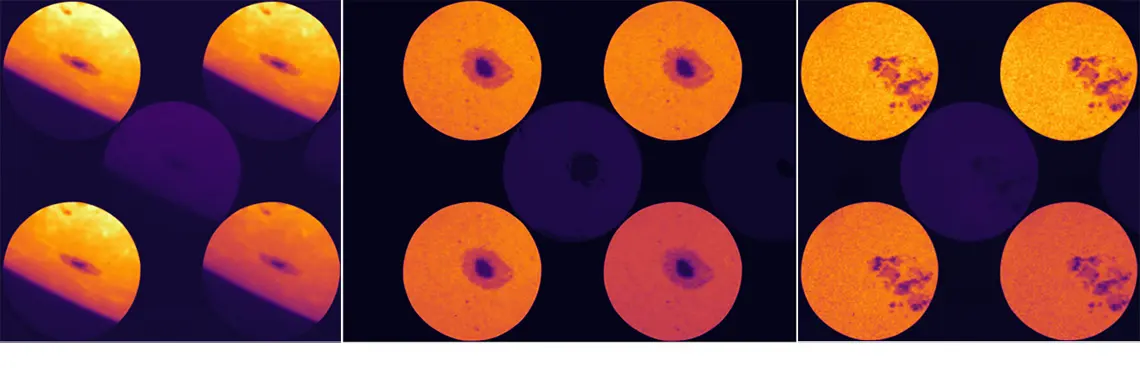 Examples of sunspot images acquired using the metasurface at a solar observatory. Each set consists of four images, with each image a different polarisation channel (Credit : Noah Rubin/UC San Diego Jacobs School of Engineering)
The device works because of nanoscale structures etched onto its surface, each smaller than the wavelength of light itself, engineered to manipulate light in ways that conventional optics simply cannot. Five years of development at UC San Diego, followed by space qualification testing with industry partner BAE Systems, has taken it from a concept to a component that has now been deployed at the Dunn Solar Telescope in New Mexico and successfully used to image sunspots and measure the magnetic fields within them.
The team compared their results with data from NASA's Solar Dynamics Observatory, the gold standard for solar observation from space. The match was, in their own words ‘very, very similar.’ That’s a significant moment since it means this tiny component, sitting inside a custom built telescope that itself sits at the end of a light path stretching 136 feet above the ground and 228 feet underground, is producing science that stands alongside the best space mission data available.
The next step is space itself. The team has submitted a proposal to NASA for a mission concept study exploring how the metasurface could be incorporated into a dedicated solar observation spacecraft. The Sun is not going to stop being dangerous but we may just have found a better way to watch it.
Source : A Small Optical Component Could Change How Telescopes View the Sun