Universe Today
The Very Large Array (VLA), the iconic field of radio antennas featured in the film Contact (inspired by Carl Sagan's novel), has a long and distinguished history of service. But after more than forty-five years of studying the radio sky and probing the mysteries of the Universe, the U.S. National Science Foundation National Radio Astronomy Observatory (NSF NRAO), which operates the VLA, is looking to create a new generation of telescopes that will pick up where the VLA leaves off.
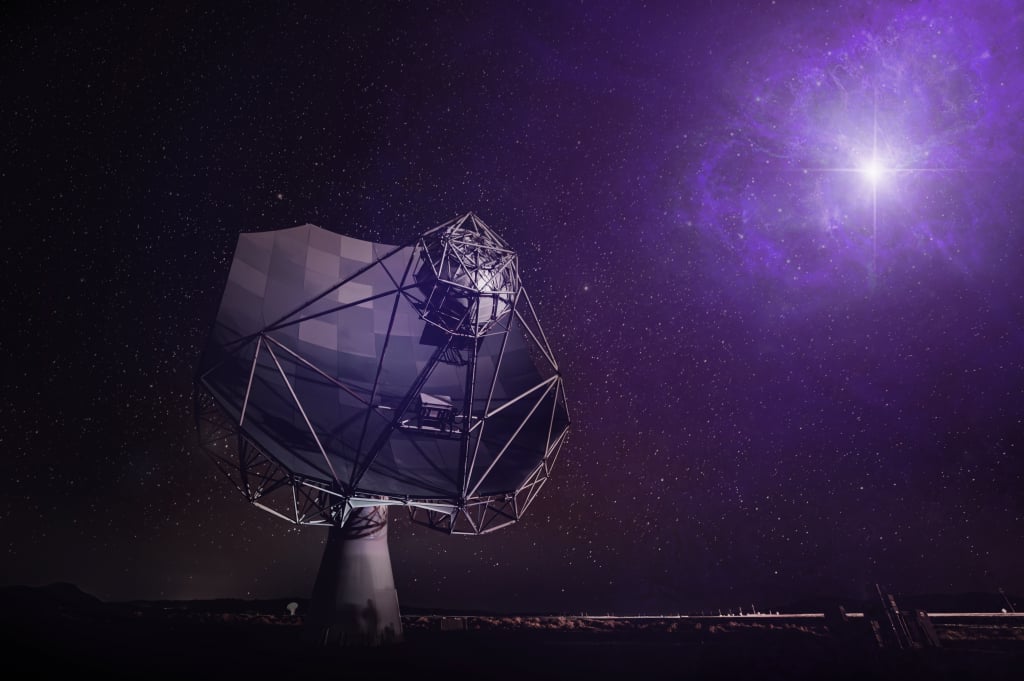
The first step in the process was the creation of the next-generation Very Large Array (ngVLA) prototype, a single radio antenna located on the NSF VLA grounds in the deserts of New Mexico. This prototype recently achieved a major milestone by gathering its "first light," making independent observations, and in collaboration with the NSF VLA. This achievement marks the transition from the construction phase to astronomical testing, and will serve as the blueprint for the proposed 244-antenna array.
Tony Beasley, Director of NSF NRAO and AUI Vice President for Radio Astronomy Operations, explained the significance of this event in an NSF NRAO press release:
First light from the ngVLA prototype antenna is a real-world demonstration of the engineering progress required to build America’s—and the World’s—next great radio astronomy facility. This milestone reflects the leadership and expertise we’ve tapped into amongst NRAO staff, our contractors, and the U.S. and international scientific community.
 Credit: NSF/AUI/NSF NRAO
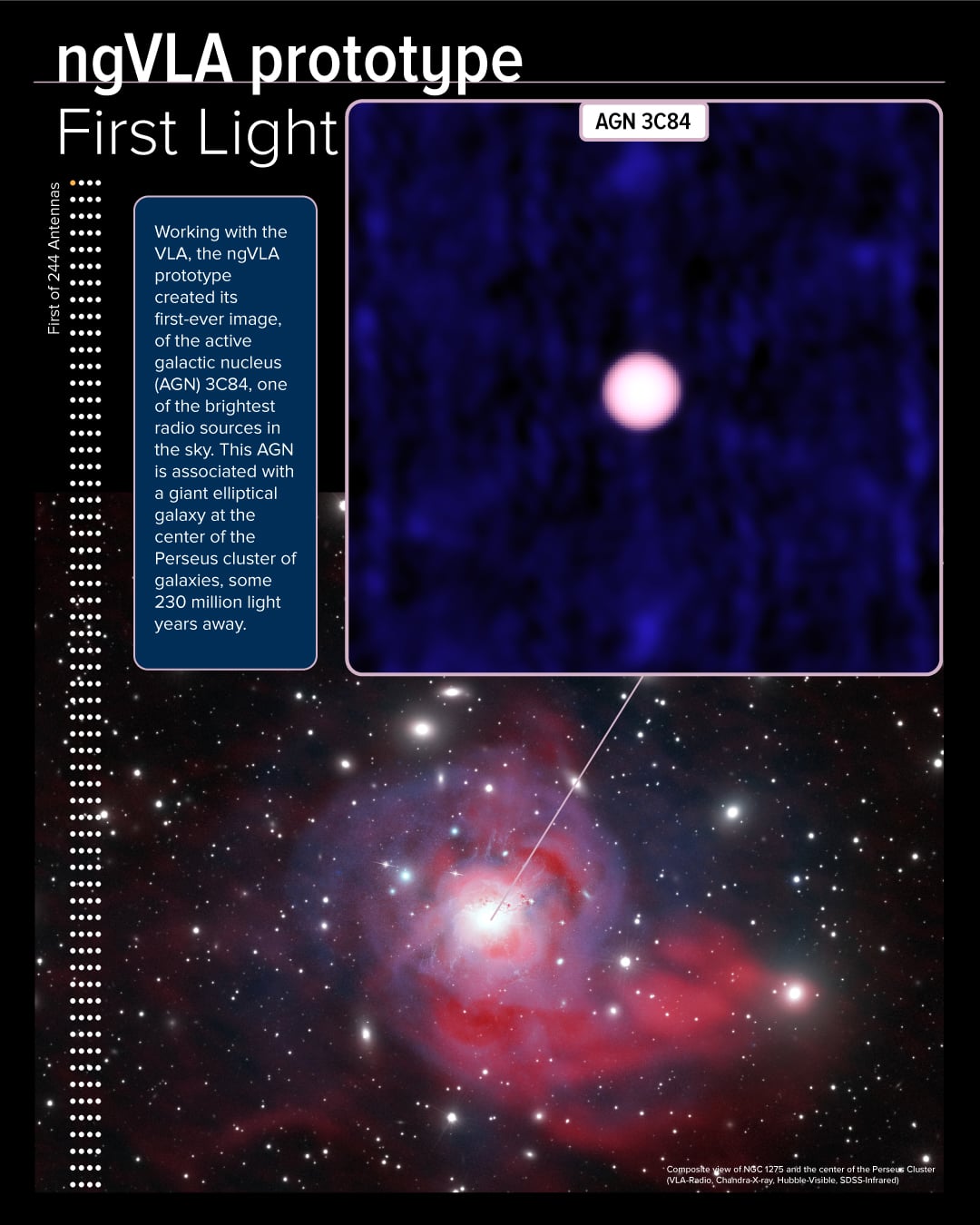
The prototype passed several tests as part of its observations, tracking the Sun, the Crab Nebula, and several other astronomical sources. This was followed by its working with the 27 antennas of the NSF Very Large Array to observe Perseus A, an extremely bright, active galactic nucleus (AGN) located about 230 million light-years from Earth. “We used the ngVLA prototype as the ‘28th antenna’ with the full VLA," Chris Carilli, an NSF NRAO scientist who helped conduct these test observations." We were pretty excited to see it work right out of the box—it’s now the newest element in one of the world’s most powerful radio telescopes!” added Paul Demorest, another NSF NRAO scientist.
The proposed ngVLA array will dwarf the VLA not only in terms of antennas but also in the space it occupies. Once complete, it will consist of 244 antennas across an area spanning more than 8,045 km (5,000 miles) in North America. The design will also improve on the sensitivity and spatial resolution of the VLA and the Atacama Large Millimeter/submillimeter Array (ALMA) at the same wavelengths, offering 10 times the effective collecting area and resolution.
In addition to astronomy, the project will benefit New Mexico's economy, providing construction jobs, long-term operational positions, tourism, and opportunities for education and outreach. The NRAO is currently opening new offices in Albuquerque to facilitate the expansion of the array, and a new headquarters at New Mexico Tech in Sorocco. Said Nigel Sharp, an NSF program director in the NSF Directorate for Mathematical and Physical Sciences (which funded the research and development of the ngVLA prototype):
This prototype antenna will prove useful for a wide range of projects because it provides high precision at a relatively low cost. The ngVLA has the potential to yield powerful new capabilities as the flagship instrument for radio astronomy — and its technological success will enable benefits for other fields of science and even new commercial applications.
In the coming months, NSF NRAO engineers will conduct further testing and calibration, fine-tuning the prototype's mechanics as scientists plan for future observations.
Further Reading: NSF NRAO