 Universe Today
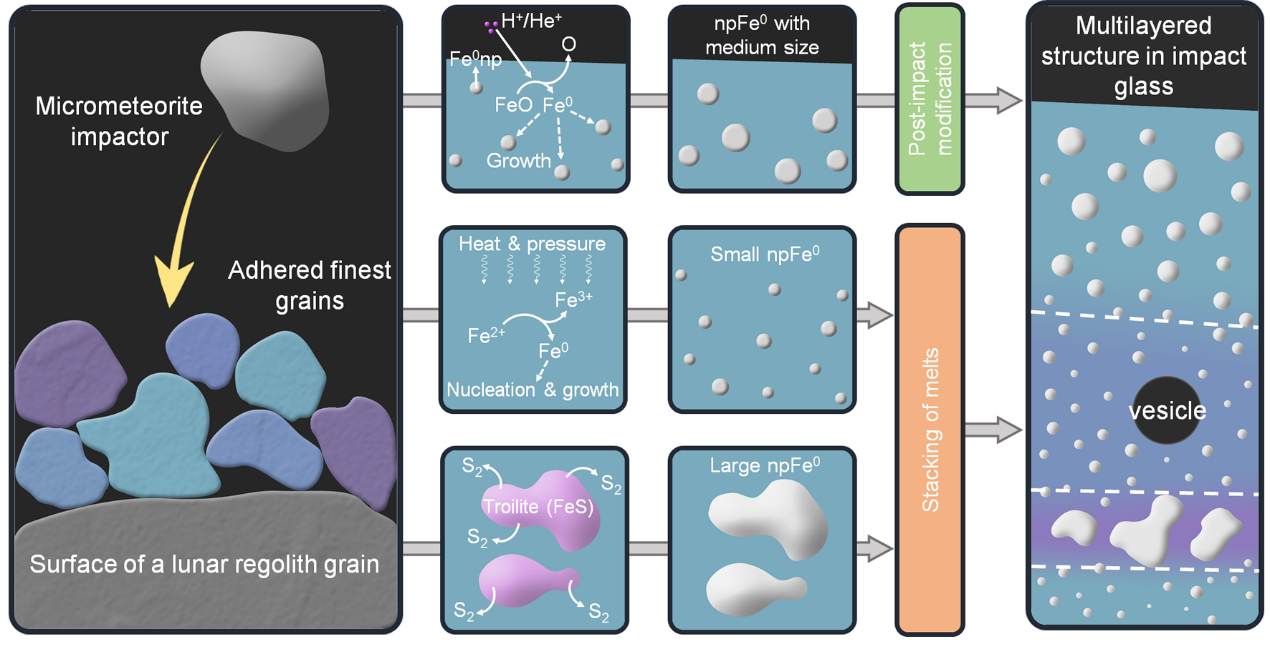
It might not seem like it, but the Moon is constantly being both sandblasted and baked. Its lack of a thick atmosphere allows micrometeorites to impact the surface at speed, and the solar wind isn’t held back either, baking the regolith with a constant flow of high-energy particles. These processes drive what is called “space weathering”, and it can drastically alter the physical and chemical properties of the lunar dirt over the course of billions of years. And we’re finally getting a better sense of what that means in practice thanks to two new papers from researchers at the Chinese Academy of Sciences and Peking University, which used advanced electron tomography and spectroscopic techniques to analyze samples returned from the Chang’e-5 mission to the near side of the Moon.
Specifically they used those techniques to peer inside microscopic beads of “impact glass” - droplets of lunar soil that were flash melted when a meteor hit them and then immediately froze in the vacuum of space. These samples are some of the most interesting on the lunar surface as they hold the keys to understanding what happens at the point of impact of some of the most dramatic space weather.
In one study, published in JGR: Planets, they discovered that these impacts don’t just liquify the rock, they trigger something called silicate liquid immiscibility. If you’ve ever shaken up a bottle of vinaigrette and watched the oil and vinegar immediately begin to separate, you’ve seen immiscibility in action. On the Moon, the flash melting of the soil from a meteorite impact causes molten iron-rich nanodroplets to separate from the rest of the silicon-rich liquid. When this “quenches” almost immediately, those iron-rich nanodroplets are frozen in place before they have a chance to fully settle or mix back together.
Fraser talks about how to design a sample return mission.A paper in the Proceedings of the National Academy of Sciences (PNAS) took it one step further. Using electron tomography, they reconstructed a three-dimensional map of the iron particles inside a shell of impact glass.
In just one tiny, reconstructed volume, they counted over 1,500 iron nanoparticles, averaging only 3.4 nanometers in diameter. They also noted that these particles were spread over three distinct layers. There were sulfur-rich layers that contained larger, irregular iron particles that were created by the impact itself. Another layer featured high concentrations of smaller particles that formed via disproportionation - a chemical reaction triggered by the extreme heat when iron ions are simultaneously oxidized and reduced into pure metallic iron. The outer layer of the glass was more subjected to the solar wind, with structural changes to prove it. Ultimately, the researchers estimate that pure metallic iron can comprise up to 30% of some of these layers.
These findings explain some curious features about the Moon - like why “mature” lunar soil looks darker and redder to our satellites. But perhaps its most meaningful impact will be on in-situ resource utilization. Living off the land on the Moon will require lots and lots of iron to build infrastructure. According to the researchers, up to 7.1% of the soil in some of these mature impact-glass regions could be pure iron - much higher than previous estimates of bulk soil iron content.
Fraser discusses the concept of Moon mining with Dr. Phil Metzger.There are plenty more samples where these ones came from though - Chang’e-6 has already supplied samples from the far side of the Moon that have yet to be subjected to this type of analysis. And as the Artemis missions start to ramp up there’s the prospect of actual lunar rocks being returned via astronauts for the first time in 50 years. They’ll surely be analyzed as intently as the samples from Chang’e-5, but only time will tell if there are any other secrets hidden in a shard of lunar glass.
Learn More:
CAS - Chang'e-5 Regolith Studies Reveal Nanoscale Space-Weathering Processes
Y. Dai et al - Conjugated Silicate Nanodroplets in Lunar Regolith: Unraveling Impact-Driven Phase Separation
Y. Dai et al - 3D insights into the multiorigins of nanophase Fe0 in the Moon surface
UT - Analysis of Chang'e-6 Samples Addresses Mysteries About the Far Side of the Moon.

