 Universe Today
There weren’t any humans strapped into the bucket seats of the Orion spacecraft for the Artemis I mission. But there were two anthropomorphic mannequins made to mimic human bone and soft tissue, but also equipped with hundreds of radiation sensors spread throughout their body as part of the Matroshka AstroRad Radiation Experiment. A recent paper led by Paweł Bilski of the Institute for Nuclear Physics of the Polish Academy of Sciences, and published in the journal Radiation Measurements, reports on the results of that experiment, including the operation of a new type of long-term passive radiation monitor made of lithium.
When dealing with radiation in deep space, scientists need to understand both its quantity and its physical quality. Cosmic radiation, the type astronauts are subjected to once they leave the confines of Earth’s magnetic field, contains a very wide array of atomic nuclei, from zippy hydrogen protons to heavy lead ions traveling at near the speed of light.
Biologists measure the potential danger from these particles using a metric called linear energy transfer - basically how much kinetic energy a charged particle can deposit into matter. Unsurprisingly, larger heavy ions deposit massive amounts of energy over a very short distance, causing biological havoc along the way.
Fraser talks about how we can protect astronauts from radiation.Tracking those heavy ions in deep space has been the job of plastic nuclear detectors. Typically made out of polymers like poly-allyl diglycol carbonate (better known as CR-39), these clear detectors create physical tears when a cosmic ray rips through them. When transferred back to Earth, researchers have to submerge the detector in hot, caustic sodium hydroxide for a few hours to etch it. This creates physical cones and pits in place of the etched tracks in the material which can be measured under a standard microscope. But that also means the reading the detector destroys it, generates hazardous waste, and requires specialized labor.
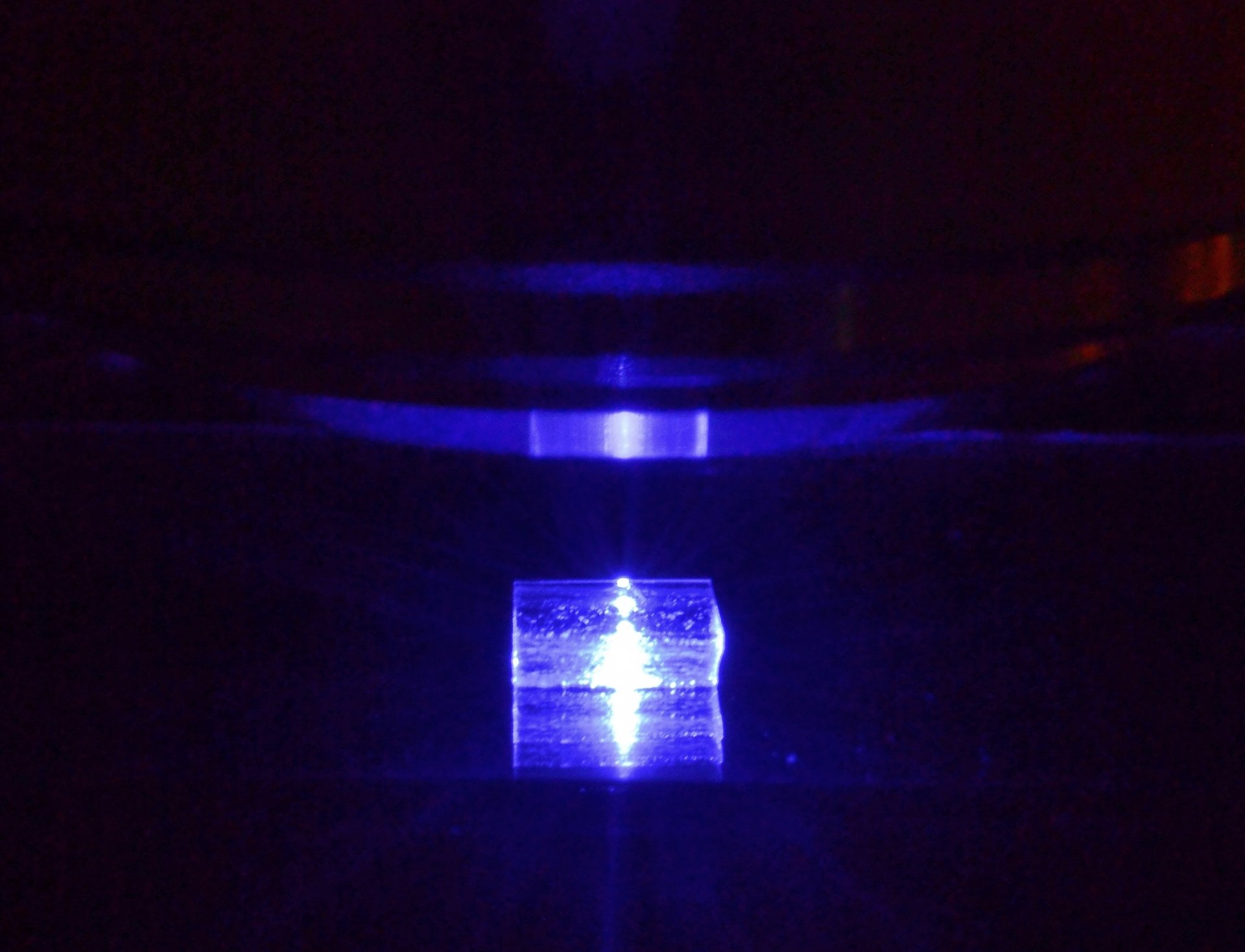
Dr. Bilski and his colleagues thought they could come up with a better alternative. They turned to millimeter-sized crystals of lithium fluoride, which are known fluorescent nuclear track detectors. Instead of creating physical holes in plastic, when particles encounter the crystal structure of the lithium fluoride salt, they knock loose some electrons, forcing the crystal lattice structure to change. And, crucially, creating a persistent optical blemish called a color center.
When a laser is later shown through the crystal structure under a microscope, the color centers glow in blue light along the path the particle traveled. That makes sense intuitively, but in deep space where the radiation is coming in from all angles, it makes it hard to differentiate where specific rays are coming from. Microscopes have to focus at a certain depth - but they are also subjected to light bleeding in from layers below and above their focal plane. They also have to differentiate particles that traveled perpendicularly to the surface, which appear like single bright points and particles that simply skim it, leaving a longer, dimmer streak.
Fraser and Pamela discuss space radiation and how bad it is for astronauts.To do so, the researcher came up with a mathematical framework to try to reconstruct the full energy spectrum of radiation delivered during the experiment. They used stacks of microscope images that had been separated by only a micrometer, and followed the tracks through the entire crystal structure. For intermediate energy transfer ranges, this worked great - they were able to match the traditional plastic detectors that were placed side-by-side on Zohar, one of the mannequins.
But for high energy transfers, there was a disconnect between the new sensors and more traditional plastic ones. The newer sensors overestimated the radiation dose by around 30%, and the researchers suspect that discrepancy was caused by the nuclear physics of the fluoride crystal itself. Sometimes when a high-energy “secondary neutron” collides with a lithium nucleus inside the detector, it can knock that lithium atom out of alignment in the crystal structure. In this case, that knockback creates its own glowing track that could be confused for a radiation trail. To combat this, the researchers used a series of test crystals using lithium-7, intended to suppress those secondary reactions - in fact the researchers ignored the data from natural lithium detectors specifically because of this secondary reaction, and while the lithium-7 doesn’t stop knockon collisions, it does lessen them.
Despite these calibration challenges, this paper represents a leap forward for passive space-based dosimetry. That will become increasingly important as we branch out to long-term stays on the Moon and other deep space missions that carry an actual human astronaut rather than just a mannequin. Crystals like the ones tested on Artemis I should give surgeons a better idea of what they’re dealing with when they’re up beyond the protective reach of the magnetic field for longer stretches of time.
Learn More:
IFJ PAN - Artemis I: Crystals of experimental detectors record radiation doses near the Moon
P. Bilski et al - Application of LiF fluorescent nuclear track detectors for measurements of cosmic radiation at the lunar orbit within the MARE experiment
UT - Space Radiation Sparks A Biological Cascade Of Cancer
UT - We Know How Much Radiation Astronauts Will Receive, But We Don't Know How to Prevent it

