Universe Today
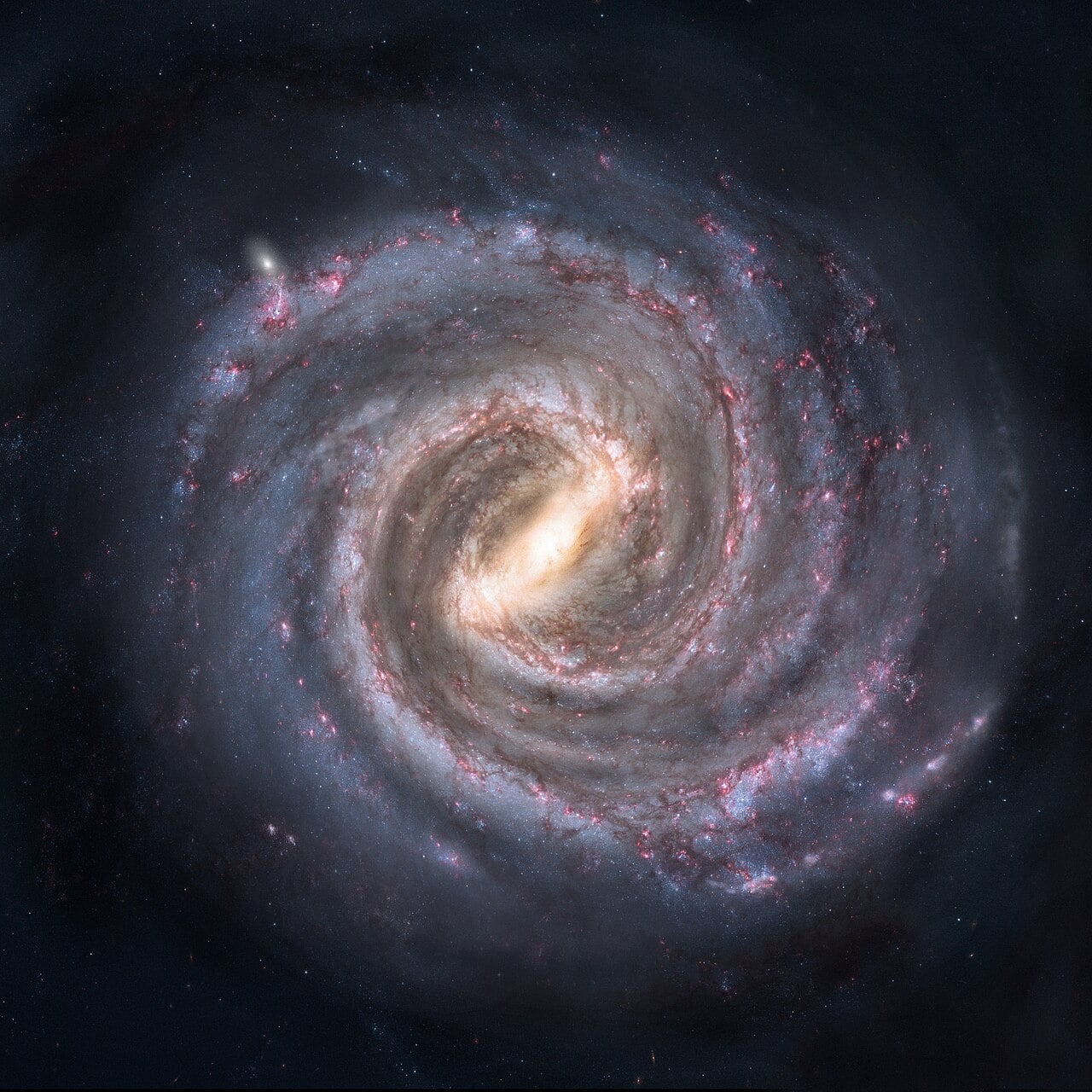
Picture the Milky Way not as a silent pinwheel of stars but as something that quietly sings. Scattered through it are millions of pairs of dead stars, mostly white dwarfs, whirling around each other and stirring ripples in spacetime as they go. Individually these ripples are far too faint to notice. Together they blur into a constant background hum, and a planned European space mission called LISA is being built to listen for it.
LISA, the Laser Interferometer Space Antenna, will fly three spacecraft in a vast triangle, measuring distortions in spacetime as gravitational waves wash through. Of all the signals it hopes to catch, this galactic hum is the surest bet. Almost everything else LISA might detect depends on uncertain physics, but the Milky Way's binaries are definitely there, and definitely chirping.
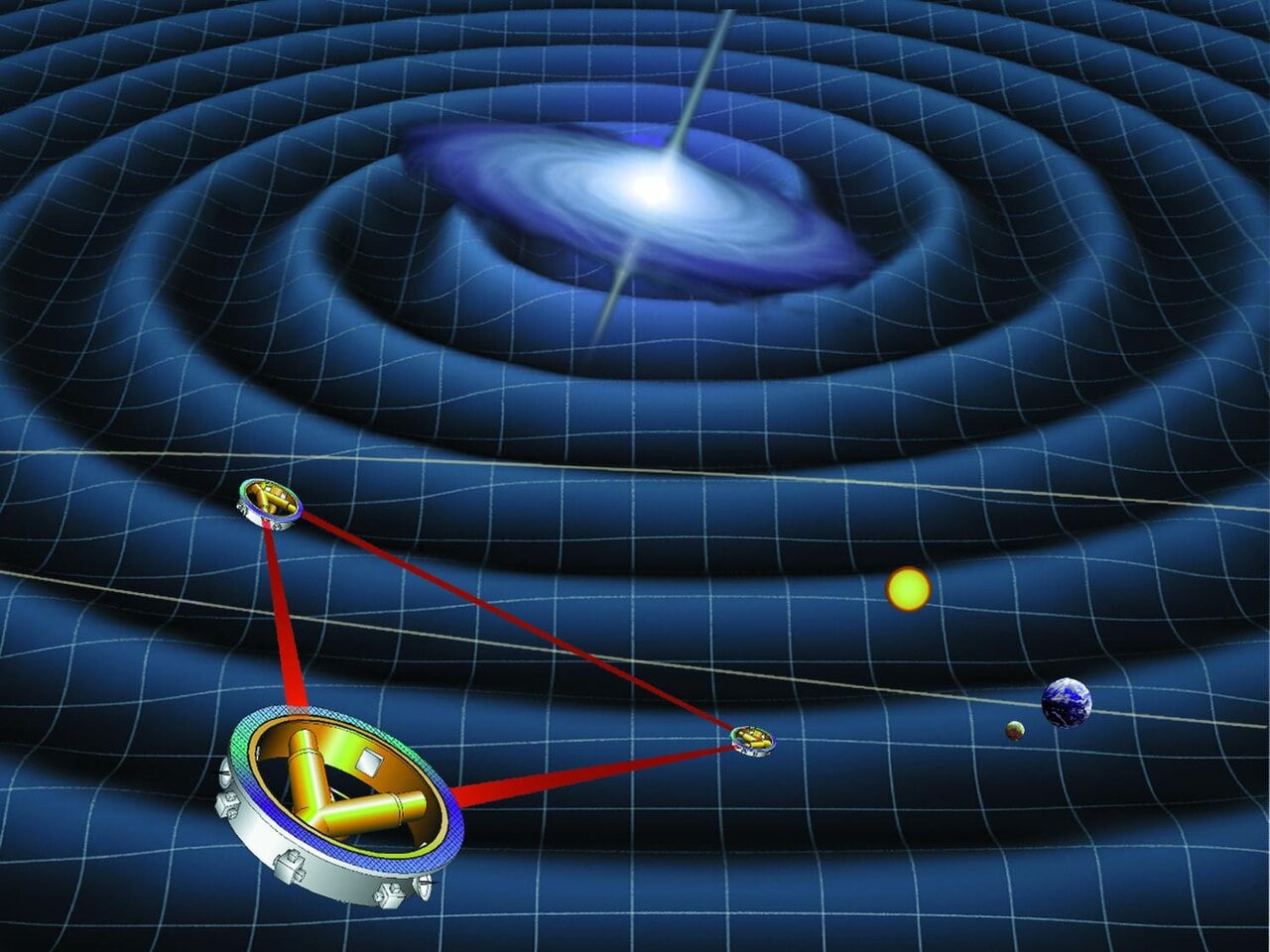 Artist impression of the LISA space mission configuration (Credit : NASA)
Here's the subtlety that two researchers in Paris have now flagged. The hum is not the same in every direction. The Galaxy is lopsided, crowded with stars toward its centre and sparse out at the edges, so the signal is naturally stronger in some patches of sky than others. Astronomers already knew that but what they had overlooked is that the whole thing is spinning.
Stars orbit the galactic centre at a brisk 230 kilometres per second. As they swing towards us or away from us, the gravitational waves they emit get stretched or squeezed, exactly the way a passing siren rises and falls in pitch. This is the Doppler effect, the same phenomenon that reddens the light of receding galaxies, applied here to ripples in spacetime. The crucial point is that the shift is different in every direction across the sky, because every line of sight cuts through a different slice of the Galaxy's rotation.
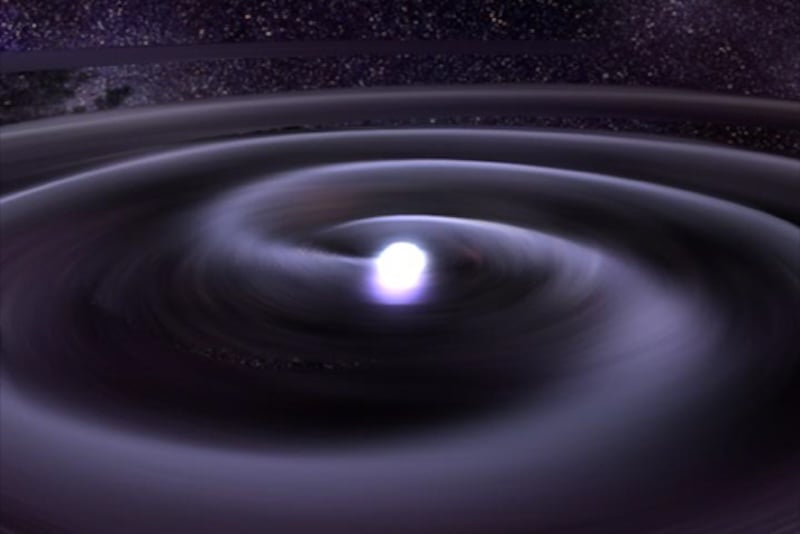 A pair of dead stars spiralling together, radiating ripples in spacetime — just a part of the cacophony of Milky Way's gravitational wave information (Credit : NASA/GSFC/D. Berry)
The team worked out, for the first time, the precise formula for this rotational Doppler boost, then they asked a sharp practical question. What happens if LISA's analysts forget about it? Using two independent statistical methods, they found the answer is unwelcome. Ignore the spin, and you misjudge the properties of the hum by an amount comparable to the experiment's own precision, skewing estimates of how many binaries the Galaxy holds and how heavy they are.
The fix is reassuringly tidy and accounting for the rotation adds no new unknowns, just a corrected template the analysts already know how to build and there is a tantalising bonus too. Because the hum encodes the Galaxy's motion, LISA might one day measure the Milky Way's rotation independently of any starlight survey, offering a fresh handle on its hidden scaffolding of dark matter.
Source : The Doppler effect of the Milky Way rotation on LISA