Universe Today

Try to picture a city sized ball of dead star, heavier than the Sun, spinning 220 times every second. Now picture it circling a companion in an orbit so perfectly round that, if you traced it against a drawing compass, you would struggle to tell the difference.
The pulsar is called PSR J1810−0623, and it belongs to a special class of objects that sit at the crossroads of some of the biggest questions in stellar astrophysics. Understanding how it came to spin so fast, and orbit so perfectly, means reading a story that has been unfolding for hundreds of millions of years.
To read the story, it helps to have the right instrument for the job. FAST, the Five hundred metre Aperture Spherical radio Telescope, is the largest single dish radio telescope on Earth, a vast bowl nestled into a natural hollow in the hills of southwest China. Its sheer collecting area makes it extraordinarily sensitive to the faint, fleeting signals of distant pulsars, which is precisely why it keeps finding objects like this one that smaller telescopes would never notice.
 A pulsar fires beams of radiation from its magnetic poles as it spins. Each time one of those beams sweeps across Earth, we catch a pulse. The fastest, like PSR J1810−0623, flash hundreds of times a second (Credit: NASA's Goddard Space Flight Centre)
Pulsars are the collapsed cores left behind when massive stars die. They are neutron stars, almost unimaginably dense, and they fire beams of radio waves out into space as they spin. When one of those beams sweeps across Earth, we see a pulse, like the flash of a lighthouse, and the fastest of them flash hundreds of times a second.
Pulsars are not born spinning this quickly and left alone, they slow down over time. So when astronomers find one rotating 220 times a second, they know it has been given a push. That push comes from a companion star. Over enormous stretches of time, material spills from the companion onto the neutron star, dragging it round faster and faster, like spinning a bicycle wheel by feeding a belt onto its rim. Astronomers call this recycling, and PSR J1810−0623 has been recycled with remarkable thoroughness. Its magnetic field has decayed to a hundred million Gauss, a sign of just how long and steady that process was.
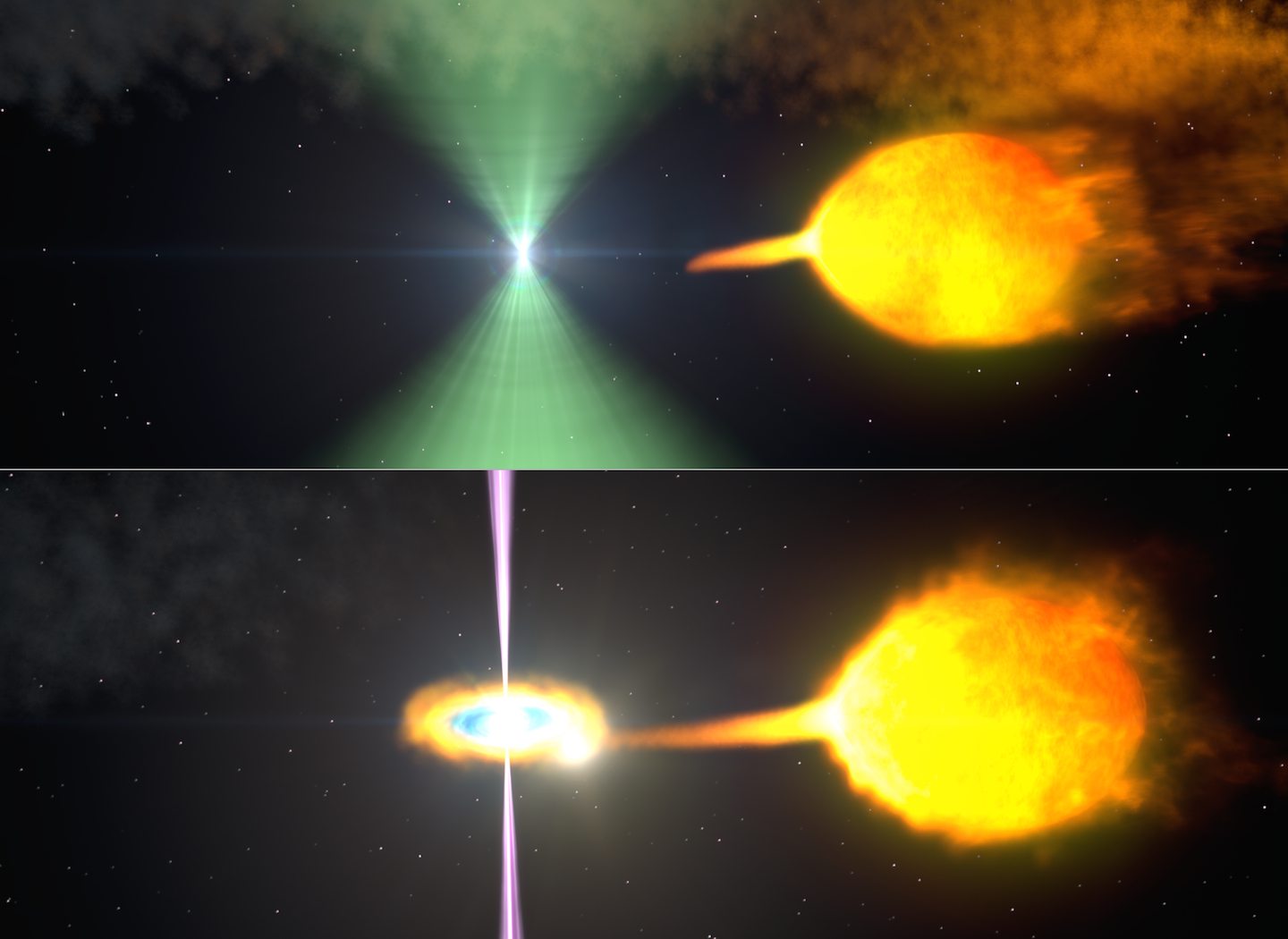 These artist’s renderings show one model of pulsar J1023 before (top) and after (bottom) its radio beacon (green) vanished. Normally, the pulsar’s wind staves off the companion’s gas stream. When the stream surges, an accretion disk forms and gamma-ray particle jets (magenta) obscure the radio beam (Credit: NASA’s Goddard Space Flight Centre)
The companion is still there, a burnt out carbon/oxygen white dwarf weighing about two thirds of the Sun, and the two circle their common centre every 15.4 days. But it is the shape of that orbit that makes this find exceptional. Its eccentricity is roughly 0.000015, which is about as close to a flawless circle as nature gets. That roundness is not a coincidence. Long, gentle mass transfer between two stars slowly smooths an orbit out, and this orbit is rounder than almost any comparable system known, even beating the celebrated PSR J1614−2230.
The reward for finding such a clean example is precision. Astronomers can now use this system as a natural laboratory to weigh the neutron star, test theories of how binaries evolve, and even probe gravity itself. Its radio signals are already mapping the magnetic field of our galaxy along the line of sight. One almost perfect circle, and a great deal still to learn.
Source : FAST discovers a rare millisecond pulsar with an extremely circular orbit