Universe Today
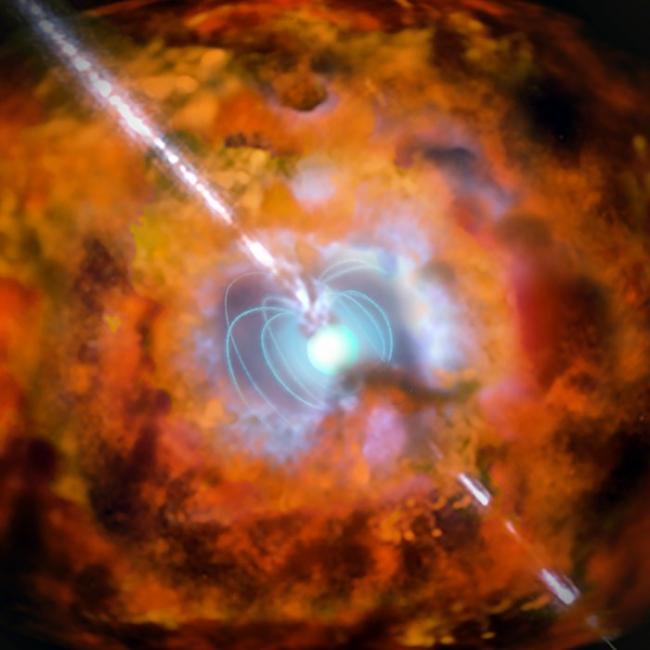
The Submillimeter Array (SMA), an 8-telescope radio interferometer located near the summit of Maunakea in Hawaii, reached an important milestone early this year. On January 26th, 2026, scientists from the Harvard & Smithsonian Center for Astrophysics (CfA) demonstrated this new alert system's ability to rapidly respond to astronomical phenomena identified by space telescopes. Within minutes of a gamma-ray burst (GRB) being identified, the SMA made the first observations of such an event at millimeter and submillimeter wavelengths.
This followed an automated alert from NASA's Neil Gehrels Swift Observatory, which detected a flash of gamma rays from a source located about 1.8 billion light-years from Earth. Within 90 seconds of detection, the system alerted the on-duty operator. Within 13 minutes, the telescopes were on target while a separate automated analysis generated images of the explosion in near real time. The entire process happened almost entirely without human intervention, demonstrating the alert system's ability to narrow the gap for millimeter/submilliter observations of transient events.
GRBs are the most powerful outbursts in the Universe, rapid but extremely energetic events that are produced by relativistic jets - streams of charged particles traveling at close to the speed of light. These jets are produced when massive stars collapse (a supernova) or when compact objects, such as neutron stars, merge (a kilonova). They are followed by an afterglow that X-ray and optical telescopes have been able to track within minutes or even seconds of an event.
Unfortunately, millimeter-wave telescopes have traditionally lagged in this respect.
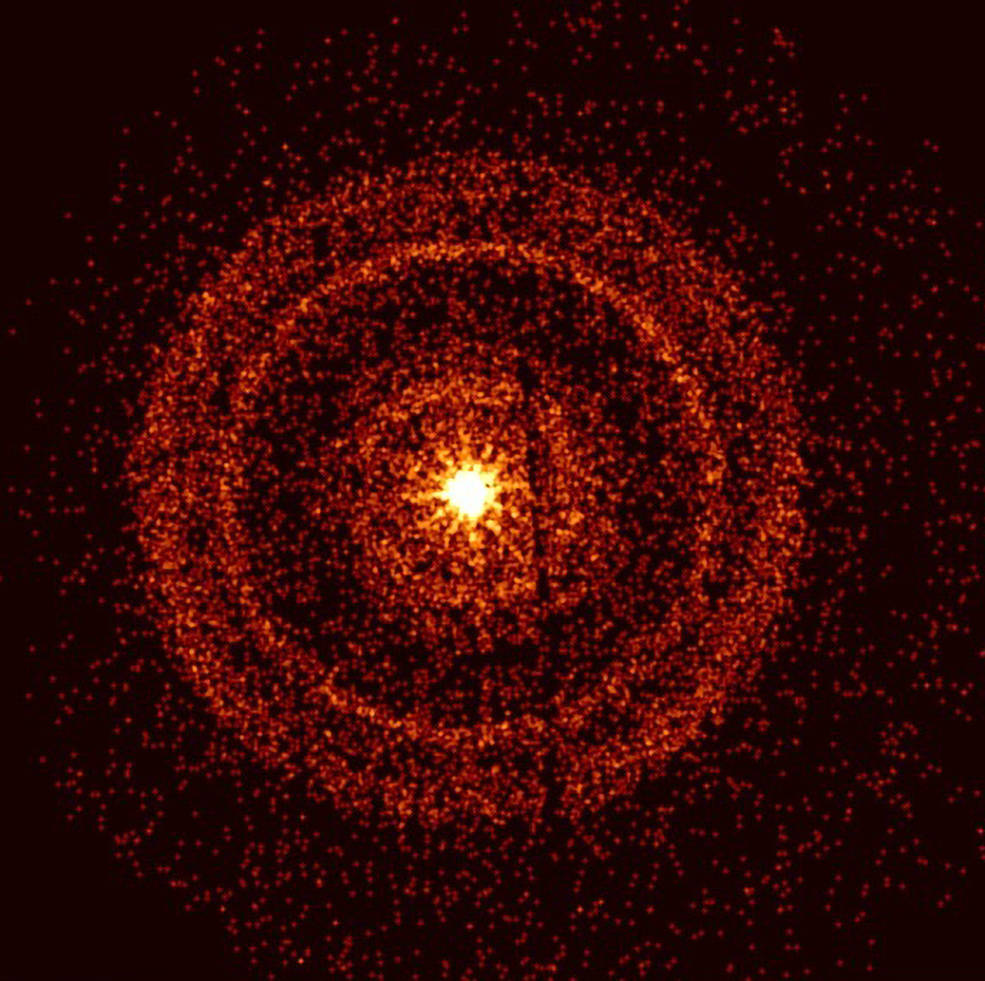 Swift captured the afterglow of GRB 221009A, the brightest gamma-ray burst ever recorded, detected on October 9th, 2022. (Credit: NASA/Swift)
Addressing this is of great importance to astronomers, since it would yield valuable data on what accompanies GRBs. As they indicate in their paper, which appeared in The Astrophysical Journal Letters, the interaction of relativistic jets with their environment produces a forward shock (FS) propagating in the local medium, and a reverse shock (RS) propagating back into the ejecta. Since the FS emission is sensitive only to the explosion energy, RS radiation remains key to studying the jet's composition, magnetization, and other properties.
Said CfA astrophysicist Garrett Keating, the Deputy Director of the SMA, who led the rapid-response effort:
It was an incredible thing to watch in real time. Being able to react and process data this quickly is a big departure from how SMA usually operates, but it was absolutely critical for capturing an event where minutes matter. This was the first time we had the full system online. We learned a lot from the experience, and think we can get the response time down to as little as two to three minutes.
Two days later, follow‑up observations showed that the source had faded, a further indication that the SMA had captured a transient afterglow rather than a background source of radiation. These observations marked the launch of the SMA Sub/millimeter Program to Rapidly Investigate Novel Time‑domain Sources (SMA SPRINTS), which utilizes the SWA and its wideband upgrade (wSMA) to provide rapid follow-up observations of transient events.
The response time in this case was roughly two orders of magnitude faster than what is typical for millimeter and submillimeter telescopes. This is a big plus, given that traditional interferometry - where light from multiple observations is combined to visualize phenomena that are difficult to detect - is time-consuming and does not provide astronomers with direct images from a telescope. This new capability, made possible by the rapid-response system, is therefore a game-changer for the field.
 Vera C. Rubin Observatory and the Milky Way Galaxy (Credit: Rubin Observatory/NSF/AURA/B. Quint)
As new facilities, such as the Vera C. Rubin Observatory and the Nancy Roman Space Telescope, begin sending numerous alerts, the wSMA will help radio astronomers be ready to capture such events. Said co-author Tanmoy Laskar, an Assistant Professor of Physics and Astronomy at the University of Utah:
This new capability opens a unique window into the physics behind some of the most powerful stellar explosions. With the SMA, we can now probe the structure and composition of the ejecta in unprecedented detail, bringing us closer to understanding how these explosions launch their powerful jets.
Further Reading: CfA, The Astrophysical Journal Letters.