Universe Today
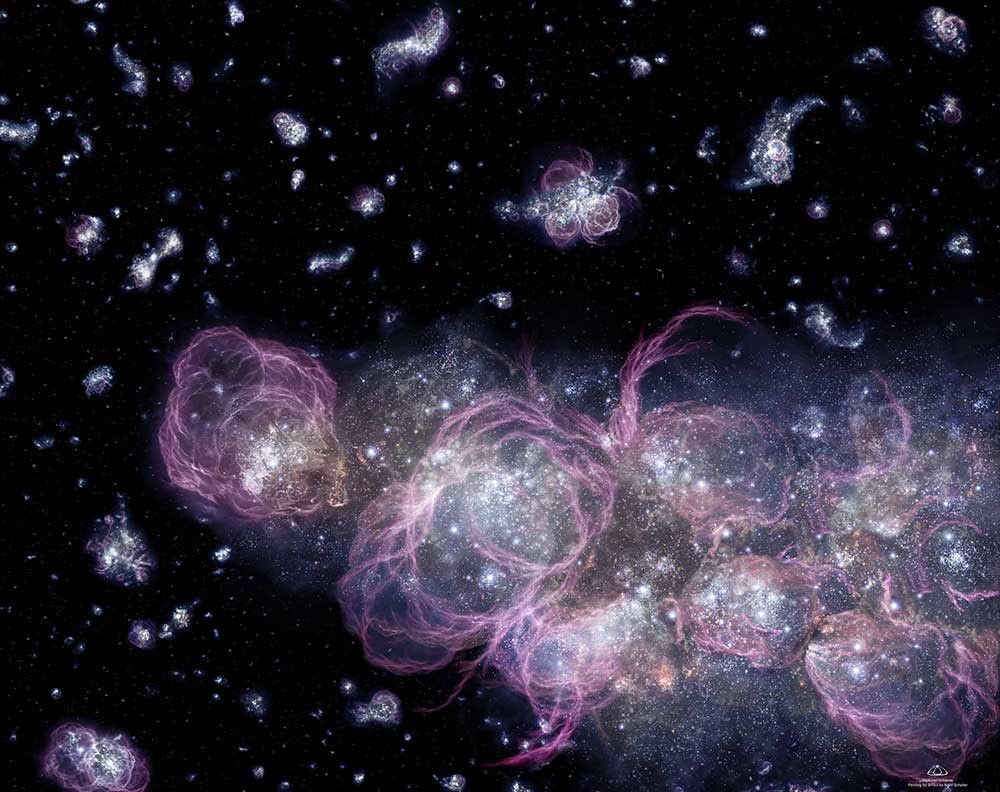
Galaxies and their stars in the early Universe look a lot weirder than those we see today, and astronomers want to know why. A team of researchers at the University of Utah decided to survey certain stars in nearby galaxies as analogs of those that existed when the Universe was still in its infancy. The survey, called the "Treasury of Extremely Metal-Poor O Stars (TEMPOS), used the ultraviolet (UV) light streaming from those relatively close-by stars as detected by the Hubble Space Telescope's Cosmic Origins Spectrograph.
The resulting study could give astronomers much better models of the monster "Population III" stars that first formed a few hundred million years after the Big Bang, according to study leader Grace Telford (assistant professor of Physics and Astronomer in Utah). Her team's dataset from the survey is identifying those stars for deep astrophysical studies. Massive ones like those in the survey (and that mimic what stars were like in the early Universe) have a huge influence on the evolution of their galaxies.
“They burn very hot, bright and fast and they end their short lives as supernova explosions that deposit a lot of energy and material into the surrounding gas,” said Telford. “They govern the evolution of their host galaxies by heating and essentially regulating the gas that’s then available to cool and form into new stars.”
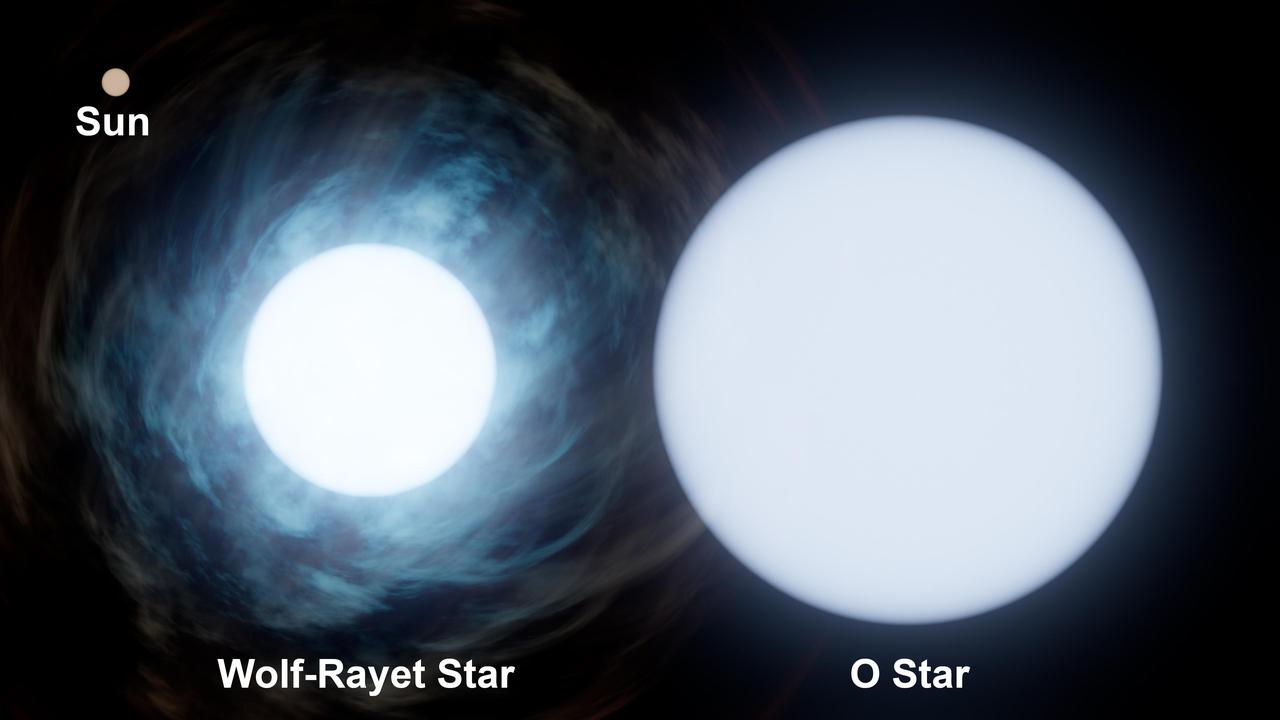 Relative size of the sun (upper left) compared to two stars in binary system Wolf-Rayet 140. O-type stars are short-lived and some of the biggest and brightest stars in the universe. Wolf-Rayet stars are O-type stars near the end of their life that release huge amounts of mass into space via stellar winds, exposing their hot, inner layers. Credit: NASA/JPL-Caltech
Why Massive, Early Stars are Weird
One of the Hubble Space Telescope's main tasks has always been to look as far back in cosmic time as it can. Its views of distant galaxies began with its first deep field survey, back in 1995. Even then, the tiny, distant galaxies it found looked strange, not quite like those we see today. Astronomers wanted to know the formation story of the early Universe; were the stars first or the galaxies? What they found was that the first stars were likely these monsters, formed from the huge abundance of hydrogen available in the infant cosmos. Those stars were more than ten times more massive than the Sun, and their behavior — shine bright and burn hot and fast — meant they didn't live nearly as long as stars such as the Sun (which is a Population I star).
They were also what astronomers call "metal-poor". Those first stars were mainly hydrogen and helium. Elements heavier than those two, such as carbon, oxygen, nitrogen, and so on, are referred to as "metals". So, a metal-poor star is mostly hydrogen. These early ones fit the description. But, as most stars do, they converted hydrogen into helium, and then into heavier metals, all the way up to iron. When they died in massive, catastrophic supernova explosions, the elements created in the stellar forge got scattered to the interstellar medium.
The Universe's earliest galaxies, which consisted of hydrogen and these stars, were also metal-poor. That changed as their stars died and scattered their remains through space. Studying these strange, massive stars at early epochs provides a lot of unique insight into what conditions were like in the earliest galaxies. Massive stars in modern times don't provide the same "feel" for ancient conditions, according to Telford. That's why it was important to look for metal-poor stars in galaxies that are an analog for the early Universe. “Massive stars at low metallicity are particularly important for building accurate models of early galaxies,” Telford said. “And we can’t just study how metal-rich massive stars in the Milky Way behave to interpret those observations.”
TEMPOS and the Galaxies
The TEMPOS catalog comprises a look at nearby low-mass dwarf galaxies that are more like ancient galaxies than the Milky Way. The Milky Way (and the Sun) are definitely not metal-poor, so that's why the team looked outside our galaxy for answers. The TEMPOS research focused on 29 massive, metal-poor stars in galaxies that have metallicities far less than the Sun (. The UV spectra from those stars showed their metal content as well as the characteristics of their stellar winds. Those winds carry material away from the stars, much like the solar wind does for our Sun.
The winds from the massive stars are a prime way that these objects lose mass to space (before their deaths). The metallicity determines how strong those winds are as metal ions couple the star's radiation to the material it loses. Generally, for these stars, the lower the metallicity, the weaker the winds. That means they lose less mass over their lifetimes through stellar winds. The TEMPOS data reflect those characteristics. The very lowest metallicity stars have very sharply declined wind speeds. If these stars lose less mass over their lifetimes (before exploding as supernovae), then their evolution and eventual deaths play a role in the way their host galaxies evolve.
One element in particular plays a role in stellar winds, and that's iron. Only the most massive stars form iron in their cores, those that die in supernova explosions. It's fairly rare in metal-poor regions, but astronomers do want to know how much of it exists in a galaxy. The TEMPOS team did detect iron absorption features in the UV spectra taken using the Hubble COS. The result is intriguing and will require more study and data. Basically, they found that massive stars in high-metallicity galaxies have stronger iron signals than stars in the metal-poor galaxies. If this result plays out in more distant early galaxies, then it's possible that metal-poor stars at early epochs still can have a range of iron abundances. This will tell astronomers how massive-star physics work and how it changes with the amount of iron, even in very low metallicity regions of the infant Universe.
The TEMPOS work has immediate application to observations of the early cosmos being done by JWST. It's currently extending our view to some of the earliest epochs of the observable Universe and may be on the verge of actually gaining good views of the earliest stars to be born. The data from the survey is made publicly available via the Space Telescope Science Institute's Mikulski Archive for Space Telescopes.
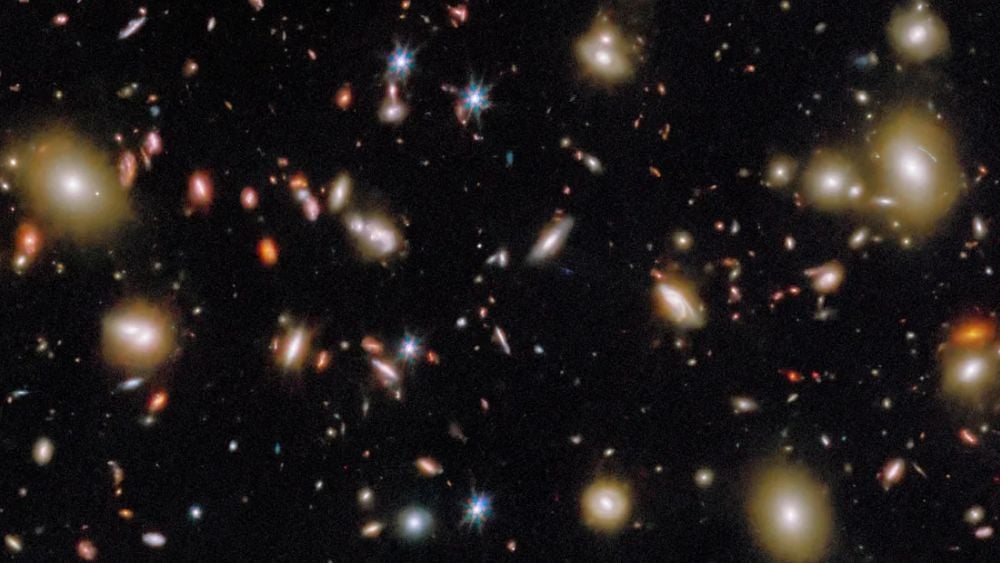 This JWST image is a deep-field view of the Universe that showcases a portion of the COSMOS-Web field acquired with the powerful space telescope. It contains a wide variety of galaxies. The reddest, dot-like galaxies are some of the most distant and earliest galaxies ever seen. Image Credit: ESA/Webb, NASA & CSA, G. Gozaliasl, A. Koekemoer, M. Franco, and the COSMOS-Web team
For More Information
Galaxies in the Early Universe are Weird. These Stars May Explain Why