Universe Today
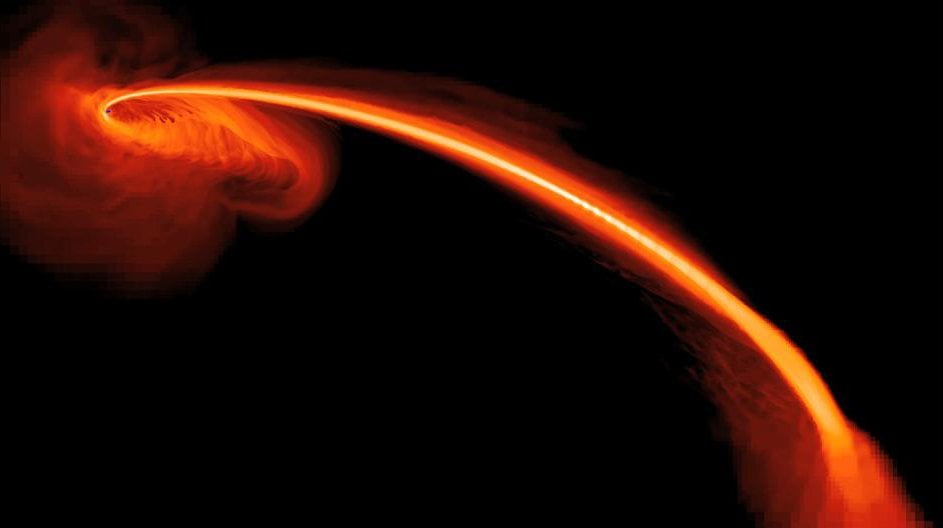
Astrophysicists at Syracuse University in New York think they've found a hitherto-hidden explanation for strange activity during so-called repeating partial Tidal Disruption Events (rpTDEs). These are interactions between a supermassive black hole and a star that wanders too close for comfort, but not close enough to get swallowed up.
The "repeating" part of the event occurs because the near-misses occur over and over again. As the star gets closer to the black hole during its orbit, the extreme gravitational pull tears off material from the star. That causes it to lose a little mass. The stolen starstuff brightens things up for a while, but then loses energy as it falls toward the black hole. That's why astronomers see a flare that gradually fades away. It almost appears like the black hole itself is brightening for a little bit and then dimming down over the course of days or weeks. That would also happen if the star got gobbled up, but it would be the last flare ever created by that star system.
Strangely enough, successive flares after the first one stay dim for some stars. And that's been hard to explain. The Syracuse team, consisting of doctoral student Ananya Bandopadhyay, working with postdoctoral researcher Benjamin Amend and associate professor Eric Coughlin, came up with a suggestion: a star's spin may play a role in the dimming flares, and it has to be rapidly spinning to reproduce the dimming flares.
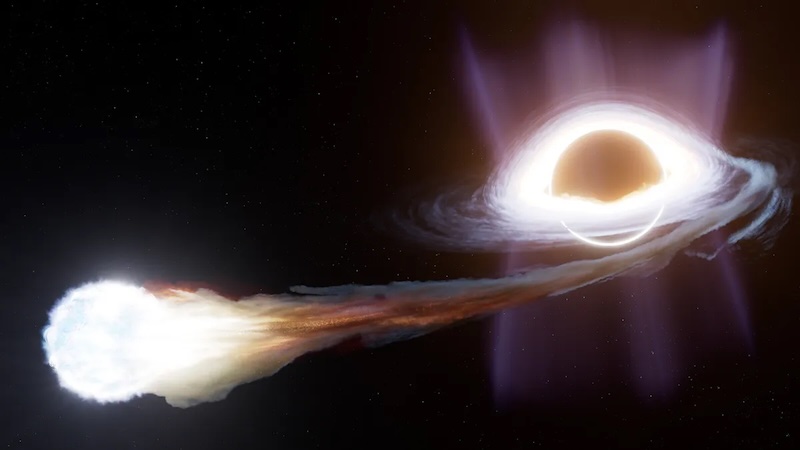 An artist’s impression of a tidal disruption event, where a star gets too close to a black hole and is torn apart, its debris forming an accreting disk of material around the black hole. If the star isn't torn apart, it loses some of its material to the black hole, creating a repeating tidal disruption event. (Credit: Ralf Crawford (STScI)
Tracking the Dimming Mystery
As the star gets closer to the black hole, it loses mass, but how much it loses depends on its internal structure, according to Bandyopathy. Low-mass stars are "fluffier," she pointed out, which makes them more susceptible to mass loss due to the tidal pull of the black hole's gravity. Higher-mass stars are tougher, built more in layers. They can lose mass from their outer shells without disappearing completely into the black hole.
That mass-loss explanation made sense for most tidal disruption events the team observed. But one pattern kept cropping up. Out of ten repeating flare events identified, four of them produced dimmer flares than expected. Mass loss didn't seem to explain that behavior, and in fact, the predicted flares for those four stayed dimmer than models predicted. “We were puzzled by this for two years,” Bandopadhyay said.
So, they had to look for another reason the four repeating flare events stayed dim, including considering the star's rate of spin on its axis. That led the team to do hydrodynamical simulations of high-mass main-sequence stars that had been disrupted by a supermassive black hole. They also had to consider other aspects of the tidal stripping by the black hole. These events exert a torque that speeds up the star's spin each time. That eventually leads to less material getting stripped from the star as it encounters the black hole. And, as you might expect, that caused the flares to be dimmer than expected. But does it work with all stars? That was another question the team had to answer, and that led them to the binary star solution.
Spin Tells the Tale
So, if spin is an important part of the dimming-flare mystery, how does that work? The team found that a star that was already spinning quite rapidly doesn't get spun up even more during each encounter. If the star stays pretty much the same spin rate, then the amount of material that gets stripped each time remains roughly the same, and that affects the brightness of the resulting flare. So, it appears that the spin plays a big role in the flare brightness. But how does a star get spun up so rapidly that its mass loss remains constant over each close encounter with the black hole?
The team has seen some stars repeatedly orbit a black hole in a matter of months, according to Eric Coughlin. “It is also extremely difficult to ‘bind’ a star to a supermassive black hole so tightly that it orbits the black hole in a matter of months, and yet they seem to do so in rpTDEs,” Coughlin said.
This is where something called the Hills mechanism comes into play. It describes two closely orbiting stars (a binary pair) that pass by a supermassive black hole. Sometimes, that binary gets separated by the gravitational pull of the black hole. One star gets caught in the black hole's gravitational web while the other gets hurled out to space. If the pair is a close binary, they're usually tidally locked, and each has a high spin rate. The captured star retains its very high spin rate, and then goes on to become part of a repeating tidal disruption event.
It's possible that some stars around the Milky Way Galaxy's supermassive black hole, Sagittarius A*, could be these tidally captured fast-spinning stars. If so, their behavior bears watching as they orbit closer and closer to the black hole in the future.
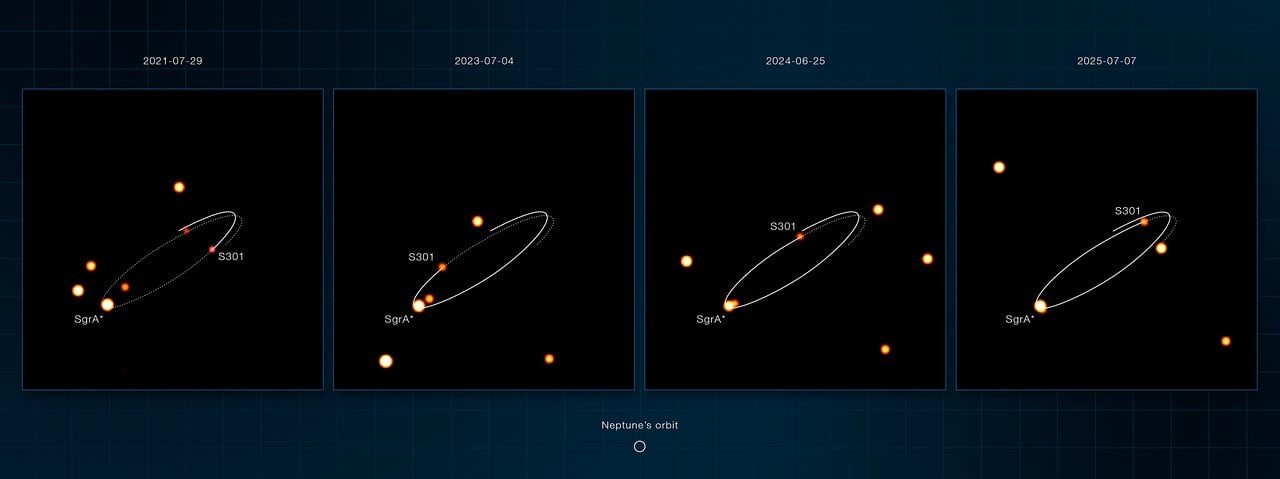 A sequence of images taken by the GRAVITY instrument at ESO's Very Large Telescope show the several stars orbiting Sagittarius A. THe closest is labeled S 301 and it passes closer to the black hole than any other star. It orbits the black hole every 8.7 years, getting as close to Sag A* as the distance between Saturn and the Sun, and its moving at just over 8 percent of the speed of light. Astronomers don't know its type yet, but it appears to be a cool star and is extremely faint. Credit: ESO*
For More Information
The Spin Behind Fading Black Hole Flares
The Role of Stellar Spin in Repeating Partial Tidal Disruption Events