Universe Today
NASA's Lunar Reconnaissance Orbiter (LRO) spacecraft has made a once-in-a-lifetime find of a newly formed crater on the Moon's near side, some 330 km from the edge of the Mare Crisium. The crash left a 728-foot-wide crater that spans the length of two football fields, NASA noted.
The newfound McGetchin Crater is thought to have been created by a bolide that struck the Moon in the spring of 2024. But it was only detected in LRO images late last year, as noted in two papers appearing in the journal Science Advances and also reported here at Universe Today earlier this week.
It’s going to be a treasure trove for geology in terms of the immediate effects of impacts capable of excavating deep beneath the Moon’s outer surface, Erik Asphaug, Professor of Planetary Sciences, Lunar and Planetary Laboratory at the University of Arizona in Tucson, told me via email.
It’s the largest new crater found on the Moon by the Lunar Reconnaissance Orbiter Camera (LROC) since it entered lunar orbit 2009. The previous largest new crater identified by LROC was only about 70 meters across.
On average, we'll get an new crater this size forming on the moon every 132 years, Timothy Glotch, Professor and Chair of Geosciences at Stony Brook University in New York, told me via email. But we can't say when the last crater of this size formed because the LRO has only been continuously monitoring the lunar surface since 2009, Glotch told me.
The Dangers Of Fast Moving Ejecta
Visible imagery shows that the ejecta from the crater extends for perhaps hundreds of crater radii beyond the crater itself, says Glotch. This provides new information for how NASA has to plan for sustainable infrastructure that may be exposed to fast-moving ejecta that may impact equipment and habitats left on the surface, he says.
The Importance Of Cold Spots
Scientists working with LRO’s Diviner thermal instrument, found a 4-mile-wide area around the crater that is about 16 degrees Fahrenheit cooler at night than its surroundings, says NASA.
LRO’s Lunar Radiometer found that the new crater, like all new craters over some thirty meters in diameter, has ejecta that is colder at night compared to the surrounding lunar regolith, says Glotch.
The cold spot forms due to disturbance of the regolith around the crater. Lunar regolith is the thin, surface layer of micrometeorites, fragmented rock and dust that covers the whole of the lunar surface.
The cold spot for McGetchin Crater is some 7 km across which indicates that the impact on the local regolith extends far beyond the actual crater itself.
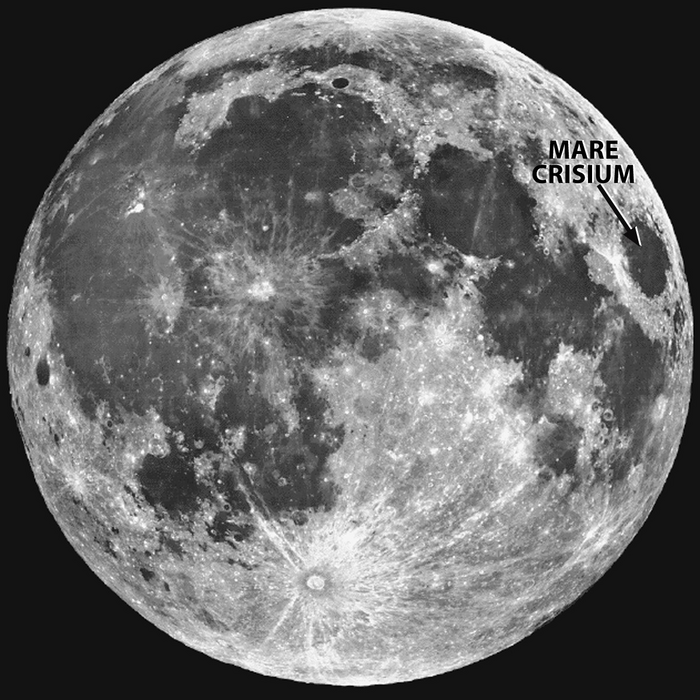 Mare Crisium, an ancient, 350-mile-diameter impact basin that subsequently filled with lava. The basin is one of many large dark spots on the Moon’s surface visible to the naked eye. They were dubbed lunar maria, Latin for "seas," by early astronomers who mistook them for actual seas. Credit: Lick Observatory
In fact, the effects of such cold spots have been known for decades.
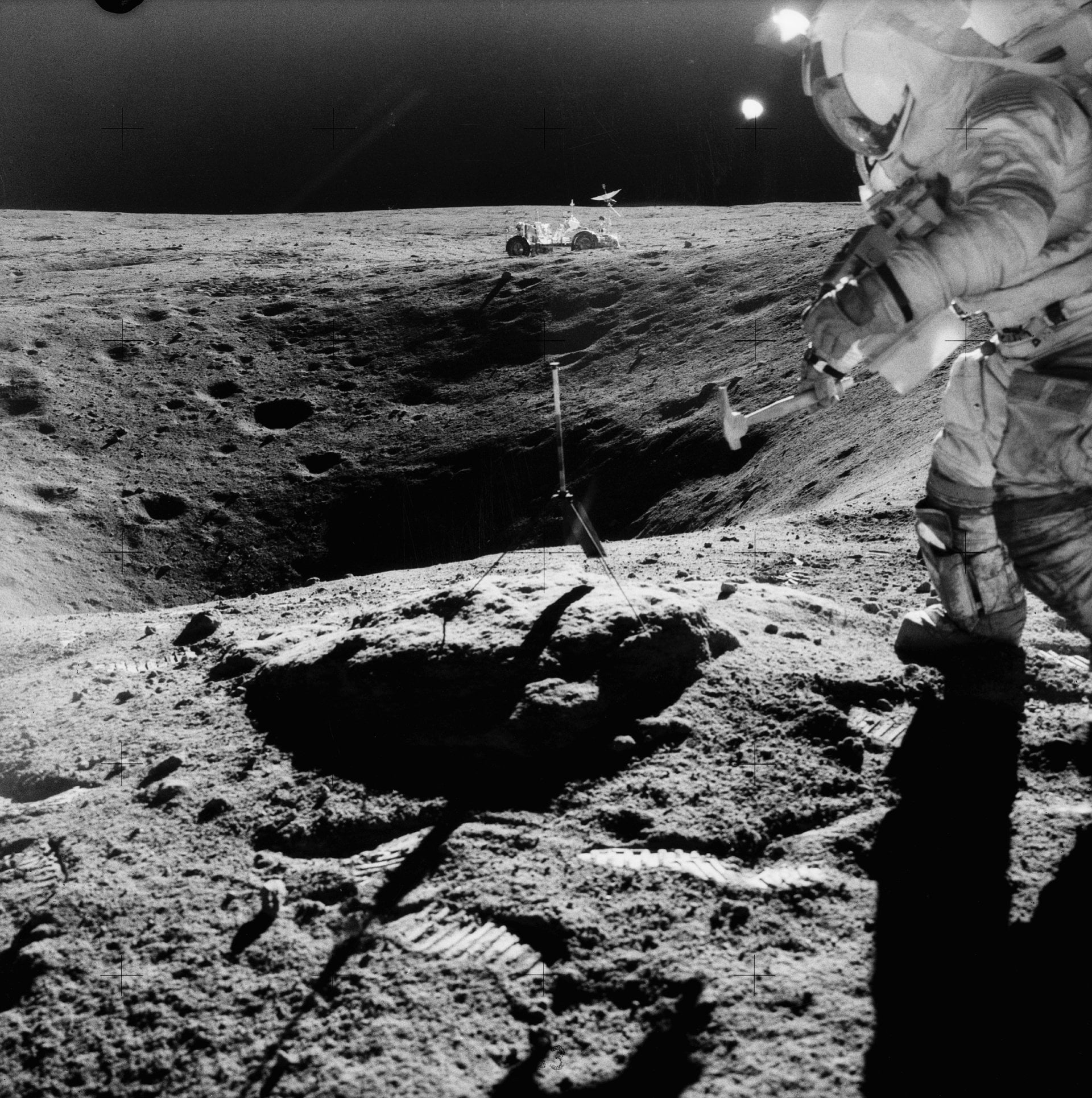
NASA’s Apollo 16 lunar mission landed on a faint cold spot associated with the South Ray crater and the astronauts’ footprints within the cold spot were deeper than at other sites, the authors of a 2026 paper appearing in the journal Science Advances note. This indicated that the lunar regolith had been decompacted due to the impact that caused the crater, the authors note.
Such cold spots fade on timescales of up to two million years.
This makes them reliable markers of some of the youngest impact craters on the Moon, the authors note. Their young age has enabled their use in investigations of regolith thickness, the recent impact cratering rate and as potential source craters for lunar meteorites found here on Earth, the Science Advances authors write.
What’s Next?
NASA needs a new advanced orbiter to follow LRO when it eventually runs out of fuel, says Glotch. A new advanced orbiter could observe the surface at much better spatial resolution than we currently have, he says.
The Need For A New Lunar Lander
This would be a fantastic mission target for someone doing relatively inexpensive fundamental lunar science in an area where operations could be relatively simple, says Asphaug. Data could be communicated back to Earth with low-latitude near-side high bandwidth, he says. You would be able to find out directly whether lunar melt was created and if so, how thick it was, and whether it stayed as a lens inside the crater or was widely distributed, says Asphaug.
Lunar Fluff
LRO’s Diviner instrument showed us that we can do a kind of seismology by proxy, by understanding how powerful stress waves radiating from this event would fluff up lunar regolith to a depth of centimeters or more, says Asphaug. This tells us about transmission of stress waves with distance, which modelers will use in decades to come to figure out how impacts couple their energy into the lunar surface, he says.
The Need For A New Lunar Seismic Network
Apollo seismometers shut down in the late 1970s and plans for a lunar seismic network have been on the table for decades.
It’s a shame that there was no seismic network in place at the time of this crater’s formation, says Asphaug. But a seismic recording of an impact of this size would be of great global significance in terms of understanding the deep Moon, he says.