Universe Today
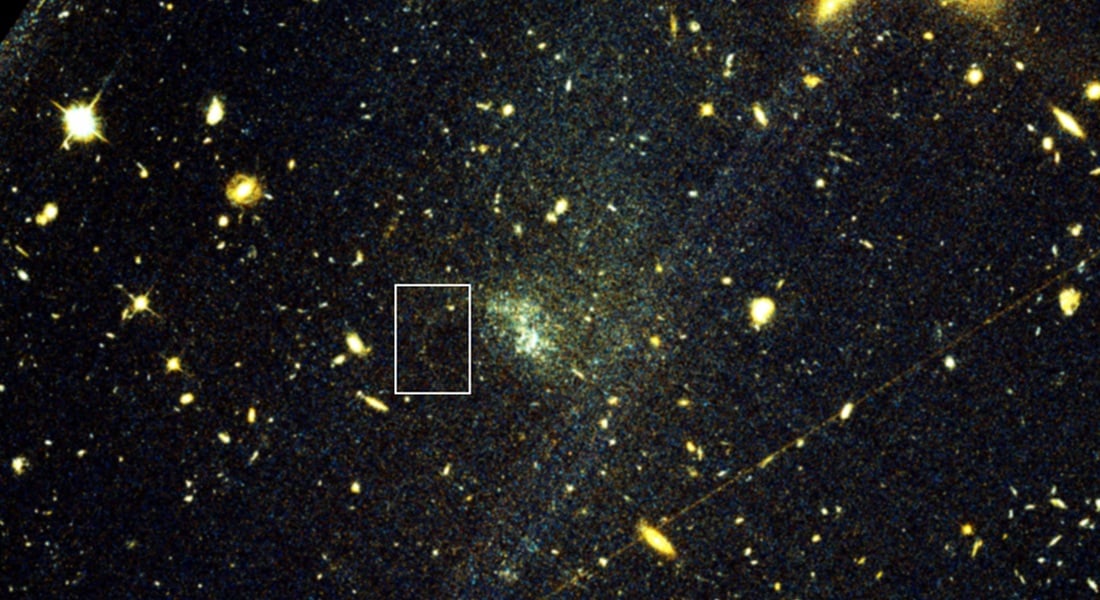
Dark matter continues to challenge astronomers as they work to solve the mystery of this so-far-unseen material that permeates the Universe. It's not that the stuff doesn't exist. It does, but we just can't see it. The only way it can be detected is by its gravitational effects on ordinary matter. A team of researchers led by University of Copenhagen PhD student Julie Kiel Holm has found a stream of stars stretching out more than 3,000 light-years from a globular cluster that appears to have been shaped by dark matter in a distant galaxy.
The stream shows up in the ultra-diffuse galaxy UGC9050-Dw1, which lies at a distance of 115 million light-years. The team used Hubble Space Telescope and the Canada-France-Hawai'i Telescope imaging of the galaxy to spot and study the stream. The galaxy itself is interesting due to its "disturbed" nature. Prior to this finding, such streams had only been seen in the Milky Way. So, finding a stellar stream from a globular cluster associated with UGC9050-Dw1 is a first.
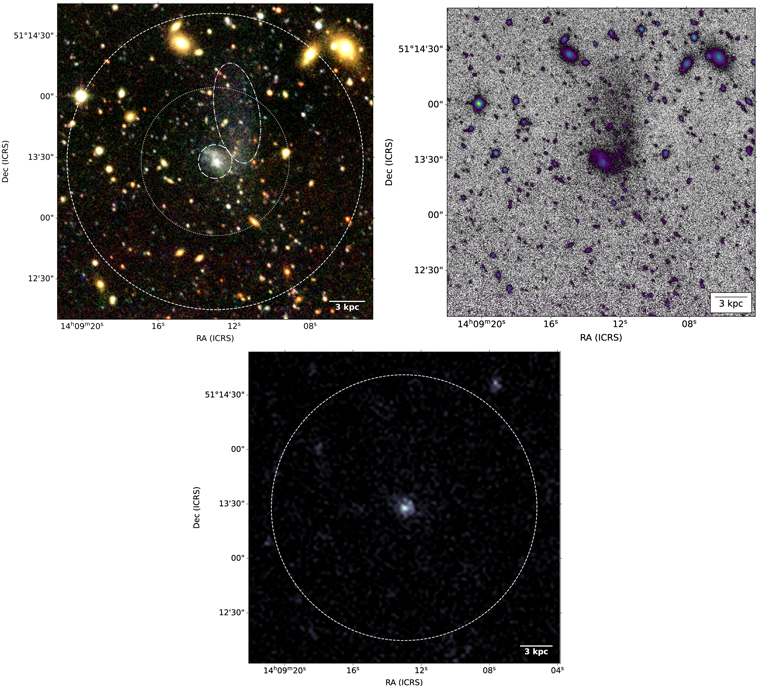 A technical illustration from an Astrophysical Journal paper about UGC9050-Dw1. Upper left: a Canada-France-Hawai'i Telescope composite color image of UGC 9050-Dw1, constructed from the g, r, and i bands of the W3−1−3 field. The white dotted circular aperture marks r UDG (36 6), and the dashed circular aperture marks 2 × r UDG (73 2). Upper right: a high-contrast g-band CFHT image of UGC 9050-Dw1 constructed with a histogram stretch, with a colored log-stretched mask to emphasize brighter regions. Bottom: GALEX NUV image of UGC 9050-Dw1. UV emission in this UDG is associated with the central core feature. Additional speckles within the region of the UDG are consistent with noise. Creative Commons Attribution 4.0 license. Credit: Fielder, et al. 2023
UGC galaxies emit very little light, mostly because they have few stars and little to no gas to form new ones. They can be as big as the Milky Way in size, but don't have the same mass. Astronomers are still figuring out how they form, but one possibility is that they're the result of interactions that tear stars away from galaxies and their clusters. The dimness of these ultra-diffuse galaxies makes it hard to detect such objects as stellar streams.
According to University of Copenhagen Professor Sarah Pearson, the finding has implications for at least two areas of study. One is a chance to observe details in distant UGC galaxies, but also a look at the role of dark matter in shaping them. Holm, Pearson, and a team of researchers recently published a paper in Nature on their discovery (cited below). “This opens entirely new possibilities," Pearson explained. "Not only can we now search for globular cluster stellar streams in other galaxies, but in the long term, we may also be able to measure the dark matter content of more ultra-diffuse galaxies."
Understanding Globular-related Stellar Streams and Dark Matter
Globular clusters are an integral part of many galaxies. They are globe-shaped collections of stars packed into a small volume of space. They are similar to so-called "dwarf spheroidal" galaxies and are usually found hovering around the cores of spirals, but can also be found in other galaxies. They contain very old stars, often older than the galaxies they orbit. The Milky Way has about 150 of them, and there may be more hidden near the core or behind clouds of gas and dust.
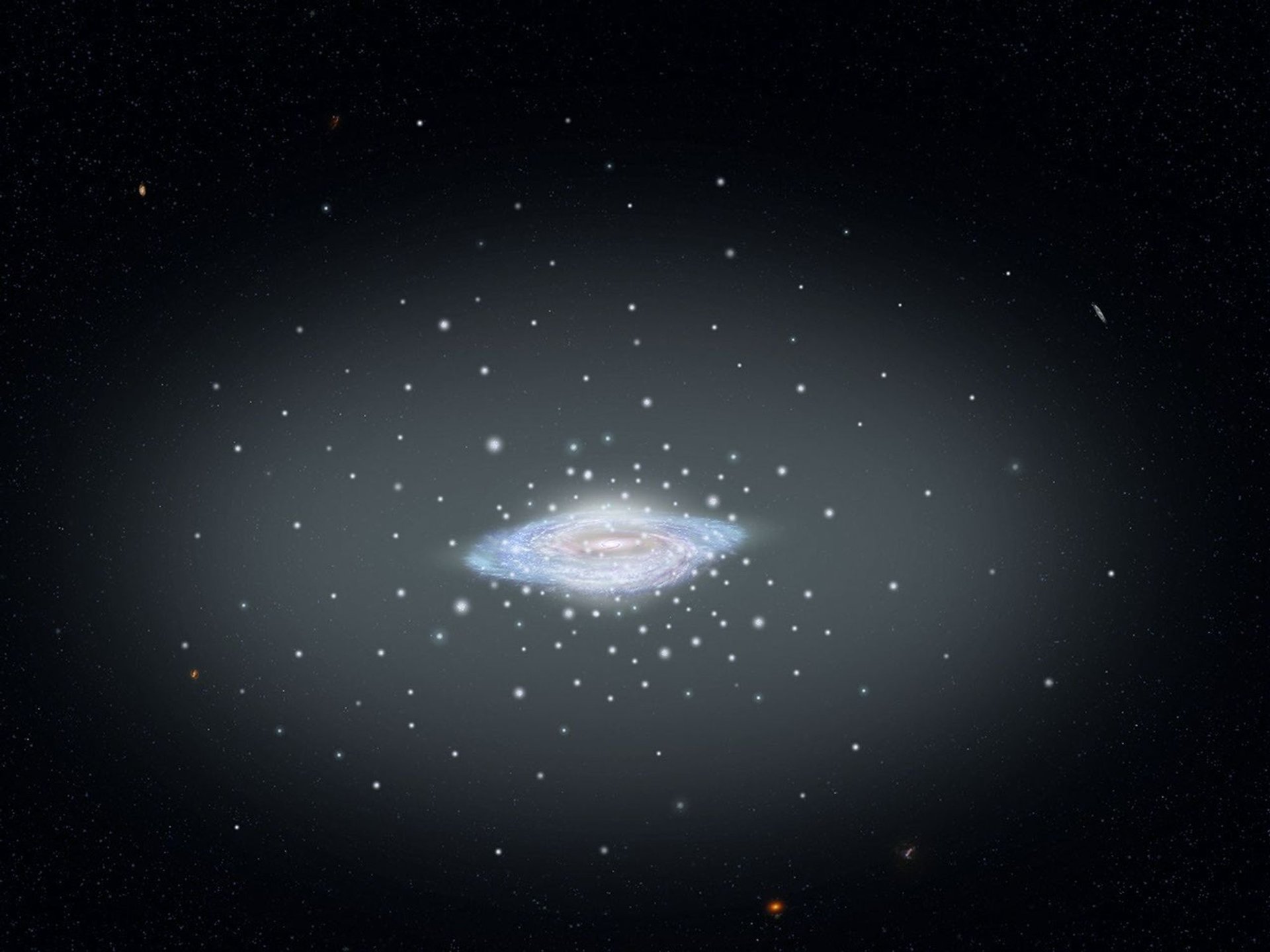 An illustration of globular clusters associated with the Milky Way Galaxy. Most galaxies have globular clusters. Credit: NASA/ESA, A. Feild.
Astronomers have found stellar streams coming from Milky Way globulars, and the current explanation for their existence is that those stars have been stripped away by gravitational interactions between the cluster and its host galaxy. That process, tidal stripping, tells a story about what the cluster stars have experienced over time. That same streaming action also gives astronomers another tool to map dark matter since its gravitational influence can be at play in tidal stripping.
Holm and the team selected the galaxy UGC9050-Dw1 to study its globular clusters. That's when they found the faint glow of a tidal stream stretching away from one of the clusters. Based on this finding, they concluded that the galaxy must have a large amount of dark matter. That was something that they expected to find in an ultra-diffuse galaxy, according to Holm. “Our results are consistent with previous studies and what they have shown about dark matter in this ultra-diffuse galaxy. We are measuring it with a completely new tool, demonstrating that this method also works beyond our own galaxy,” said Holm.
Dark Matter and the Universe
Since dark matter is a major part of the Universe, astronomers are using any method they can to understand its distribution and effects. “We show that a well-established tool from studies of the Milky Way can be used to understand other galaxies, where measuring the distribution of dark matter has traditionally been very challenging,” said Holm.
"Although this discovery only focuses on one stellar stream from one distant globular, the finding has implications for understanding dark matter across the Universe. As it affects globular cluster stars by shaping streams of their stars during tidal stripping events, those streams give astronomers another way to evaluate its presence in a wide range of galaxies. “The insights into dark matter that we have previously been able to gain from globular cluster stellar streams have been limited to a single galaxy – our own," Holm explained. "Being able to observe these streams in entirely different kinds of galaxies opens the door to using them to build a much broader understanding of how dark matter behaves."
Dark matter not only plays that shaping role in the "modern Universe" but has also played a role since nearly the beginning of cosmic time. Particles of this mysterious "stuff" existed in the very early Universe. One astronomer has suggested that gravitational waves played a role in helping to create this material, possibly transforming into dark matter itself. However it formed, it has shaped galaxies and star formation since early times. It continues to do so, even as astronomers develop new tools to map and understand it.
For More Information
Breakthrough in Unusual Galaxy May Help Unravel the Mystery of Dark Matter
First Globular Cluster Stellar Stream Detected Beyond the Milky Way
The Disturbed and Globular-cluster-rich Ultradiffuse Galaxy UGC 9050-Dw1
Gravitational Waves May Have Created Dark Matter in the Early Universe