Universe Today
How do scientists know the mass of the Universe? Measuring it has traditionally relied on knowing how many stars there are in galaxies, as well as clouds of gas and dust, and associated dark matter. Astronomers generally use the mass of the brightest stars to estimate the mass of an entire galaxy. That means the rest of a galaxy's stars and its dark matter get undercounted and are essentially invisible. For decades, astronomers estimated the number of small, unseen stars in clusters and galaxies using a mathematical rule that assumed stars formed in roughly the same mass proportions everywhere in the Universe. That tool is called the initial mass function (IMF). It describes how many stars of each size there are in a given cluster or galaxy. However, there are challenges with the way it's currently applied because of assumptions it contains.
Employing the IMF is an important part of stellar studies. It, along with the formation history of stellar clusters and galaxies, helps astronomers understand the origin and evolution of all stellar populations. The IMF is currently based on an average estimate made by observing the stars in our Milky Way. Astronomers then use it to make mass estimates of other galaxies. However, it's preferentially biased toward the larger stars. It's like coming up with the mass of all the humans on Earth by measuring the mass of the biggest ones and then using that as an average. The IMF's reliance on the masses of larger stars leaves out a complete understanding of the distribution of smaller-mass stars. And that has larger implications for an accurate estimation of the mass of the Universe.
A team of astronomers at the University of Missouri has published a paper (cited below) describing current IMF assumptions and proposing a way to get better estimates of the ratio of large and small stars in a galaxy. It all goes back to the environment in which those stars formed and can give astronomers a more accurate estimate of a galaxy's mass, its age, and evolution. “One of astronomy’s basic assumptions may be oversimplified,” said Charles Steinhardt, an astronomy professor and co-author of the team's paper. “Other galaxies weren’t breaking the laws of physics — we were measuring them with the wrong yardstick.”
Star Formation and the IMF
Stars form in batches inside giant molecular gas clouds. Each cloud has the capacity to create stars with a range of masses. The IMF helps astronomers give a "rough" estimate of stellar masses in a given region. It turns out that Sun-sized stars are more abundant than the high-mass bright ones, while those a bit smaller than the Sun are even more abundant. But there aren't as many stars as you go down the "mass spectrum". Compared to the Sun and more-massive stars, the smallest ones are faint and more difficult to see.
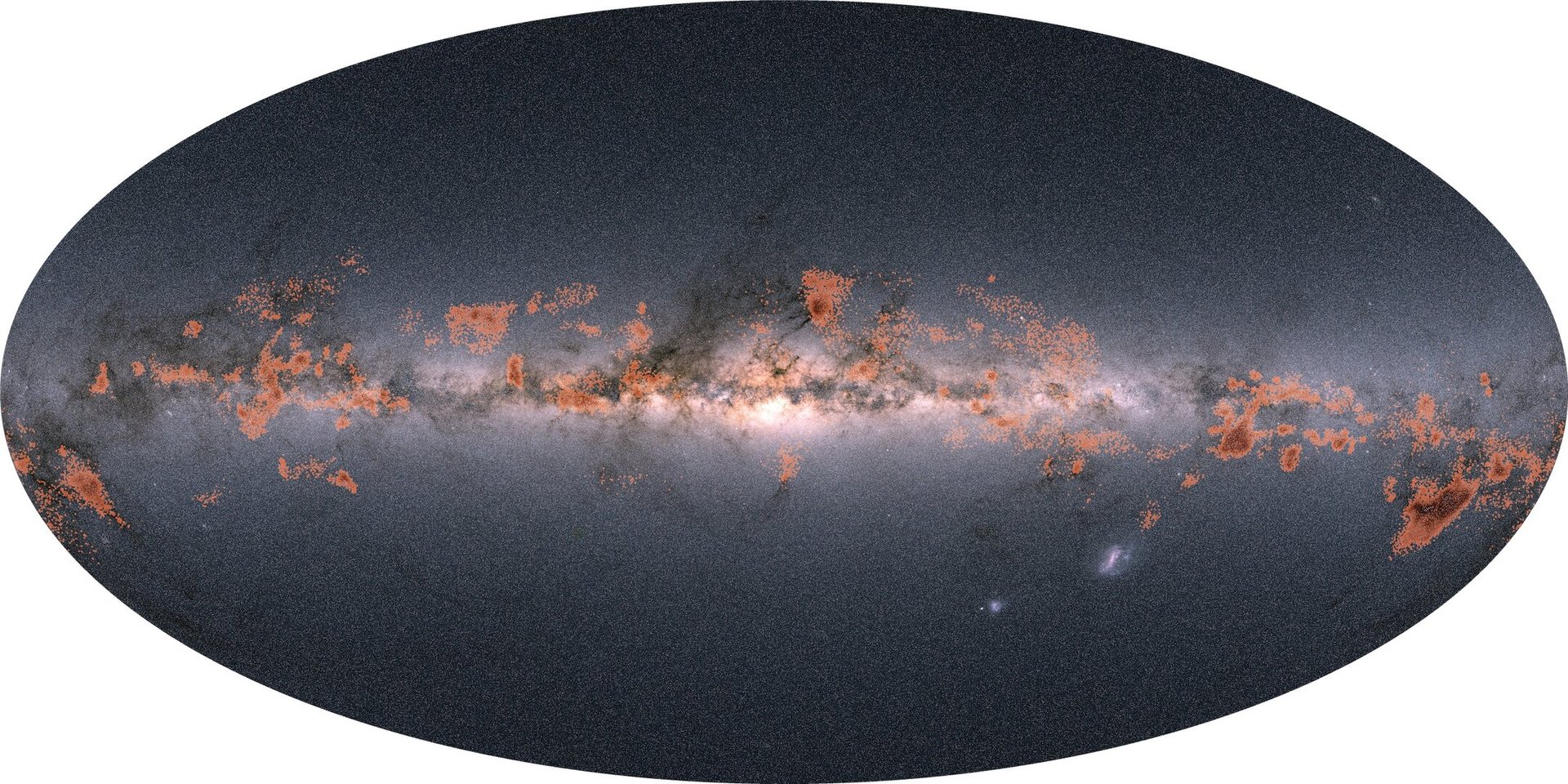 This image shows a view of stellar ‘families’ – clusters and co-moving groups of stars in the Milky Way – identified using data from the second data release of ESA’s Gaia mission. Families younger than 30 million years are highlighted in orange, on top of an all-sky view based on Gaia observations. Cluster observations are helping astronomers fine-tune a tool called the "initial mass function" used to estimate the numbers of stars in galaxies and clusters. Credit ESA.
To get around the bias towards measuring the IMF using larger stars, the Missouri team looked into data from the Gaia satellite. It's a star-mapping observatory that has detected and charted around 2 billion stars in the Milky Way. The team especially looked at star clusters because their member stars formed in the same cloud. The question the scientists wanted to answer was: do stars form in the same proportions of mass everywhere in the Universe?
It turns out they really don't. So, can astronomers improve the IMF as a mass measurement tool that reflects reality? The answer lies in correcting the underlying assumptions of the IMF. The team reasoned that if its assumptions are true for every galaxy or cluster, each one would have a similar mix of stars of different masses. It turns out they don't. Different clusters have different ratios of stellar masses, ranging from supermassive giants to tiny dwarfs barely bright enough to see, according to undergraduate team member Carter Meyerhoff. “The pattern we found is surprisingly clean,” Meyerhoff said. “Instead of applying the same model to every galaxy, astronomers could account for the conditions under which stars formed and select the IMF that best matches that environment.”
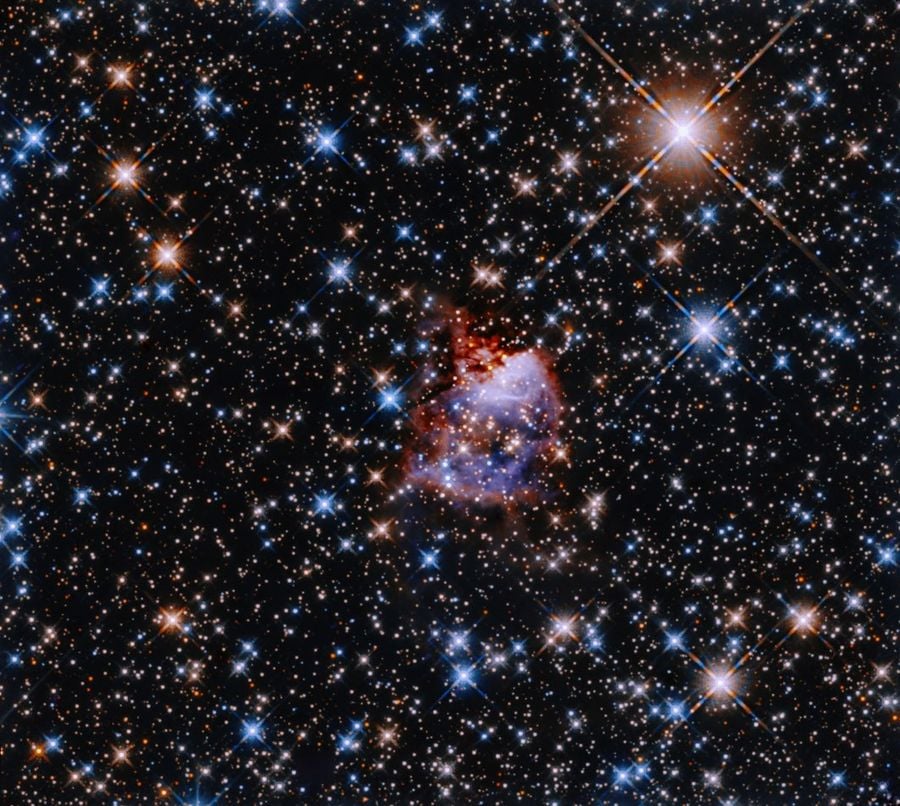 This Hubble image shows the star formation region G033.91+0.11. A central nebula lies in the center of a glittering backdrop of multicoloured stars. The nebula is reflecting light from a bright and massive young protostar. Scientists use the initial mass function to estimate the mass ratios of stars created in such starbirth regions. Image Credit: NASA, ESA, and R. Fedriani (Instituto de Astrofisica de Andalucia); Processing: Gladys Kober (NASA/Catholic University of America)
Updating the IMF's Assumptions
Does this mean the IMF is dead and astronomers need a new tool? Not so fast. What this finding suggests is that astronomers take individual star-forming environments into account when analyzing the mass of a cluster or galaxy. Its assumptions need to change with each set of different stellar populations. It should also reflect the changes that take place in star-forming regions that affect the birth rates of different sizes of stars. According to Steinhardt, this gives astronomers a much more flexible way to apply the IMF. “We’ve found that the Universe is more complicated than we assumed,” he said. “But we’re also getting closer to measuring it correctly.”
The Missouri study also highlights a growing consensus among astronomers between the theory of star formation, the computer simulations of these events, and observations. It means the IMF shouldn't be one standard, universal measuring stick. More-accurate applications of the IMF will change how astronomers measure the masses of galaxies and clusters. In turn, that could change our understanding of the history of the Universe.
For More Information
Mizzou Discovery Could Change How Scientists Measure the Universe
Direct Evidence for Stellar Initial Mass Function Variation in the Milky Way