Universe Today
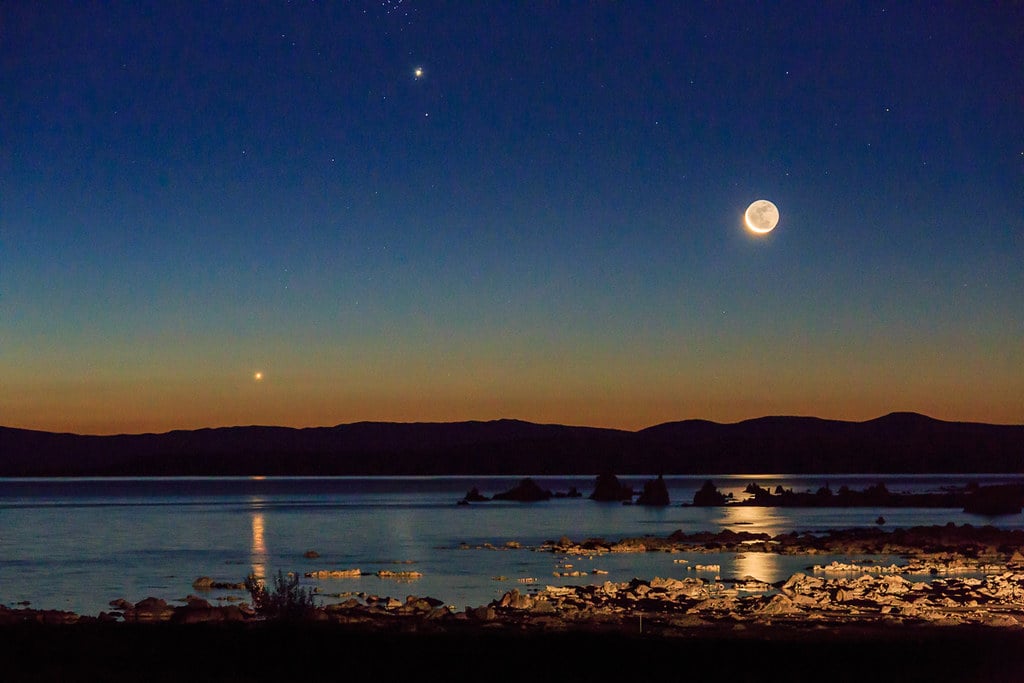
The Moon joins a complex sky scene at dusk next week.
The Moon has a busy week ahead of it. If skies are clear, be sure to get outside on the evenings of May 18th/19th and surrounding nights to check out the evolving view to the west, in one of the best sky shows for 2026.
The changing sky scene couldn’t come at a better time, as May springtime temperatures give way to summertime astronomy in the northern hemisphere. Southern observers get the added bonus of following Comet C/2025 R3 PanSTARRS’ encore act, as it slides out of Orion past Sirius at dusk.
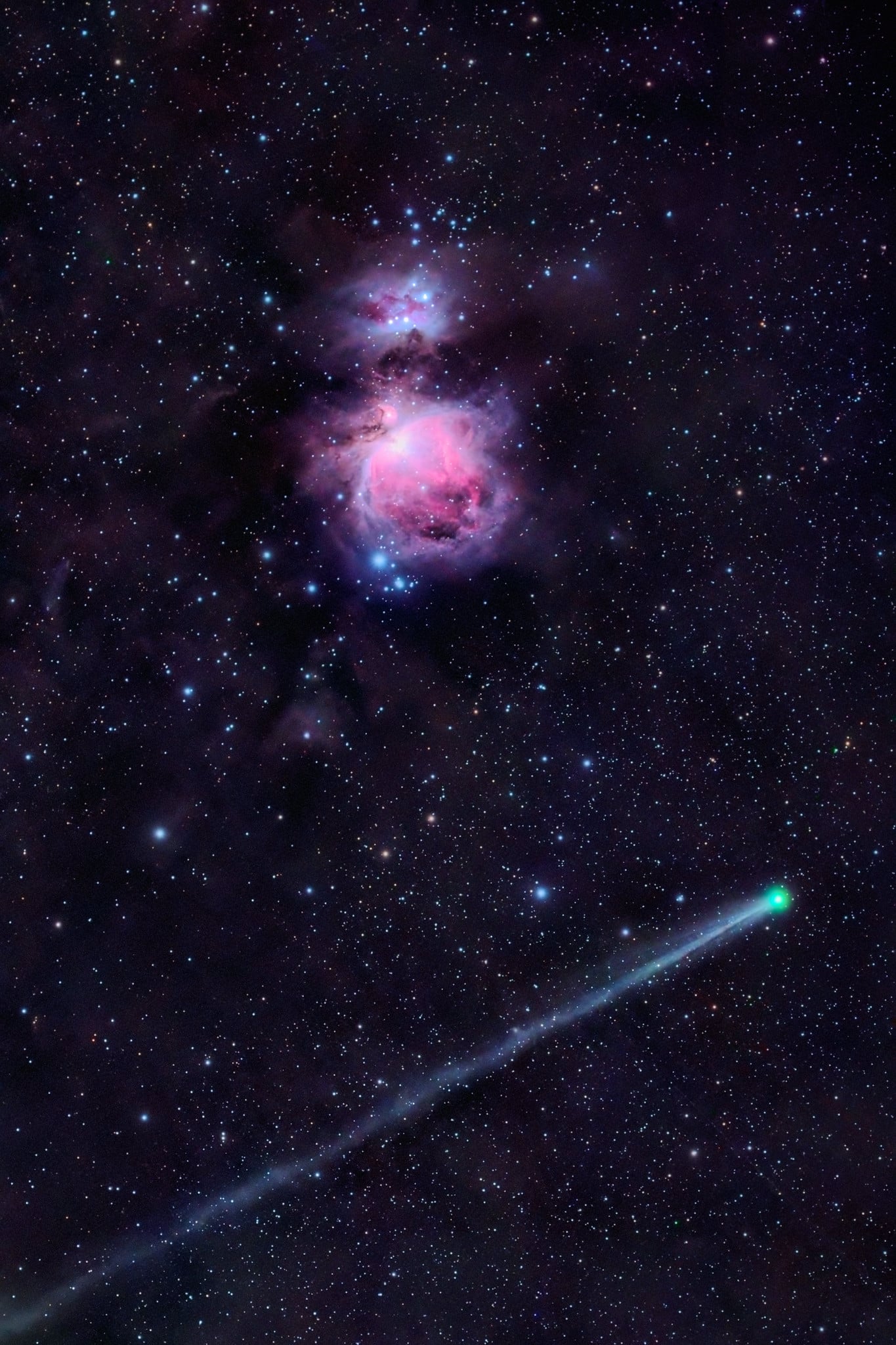 Outbound comet C/2025 R3 PanSTARRS passes the Great Orion Nebula (Messier 42) on May 9th. Credit: Alan Tough.
The stage is set this weekend, as brilliant Jupiter and Venus dominate the dusk skies. I fully expect the field lots of questions along the lines of “what are those two bright objects to the west?” in the coming weeks.
Next, the Moon passes New phase on Saturday May 16th at 20:02 Universal Time (UT) marking the start of Brown Lunation Number 1279. Watch for the slender crescent Moon low to the west on Sunday evening May 17th, becoming more prominent the next evening on the 18th.
A ‘Blue Moon’ actually occurs on May 31st, in the sense of the second Full Moon of the month.
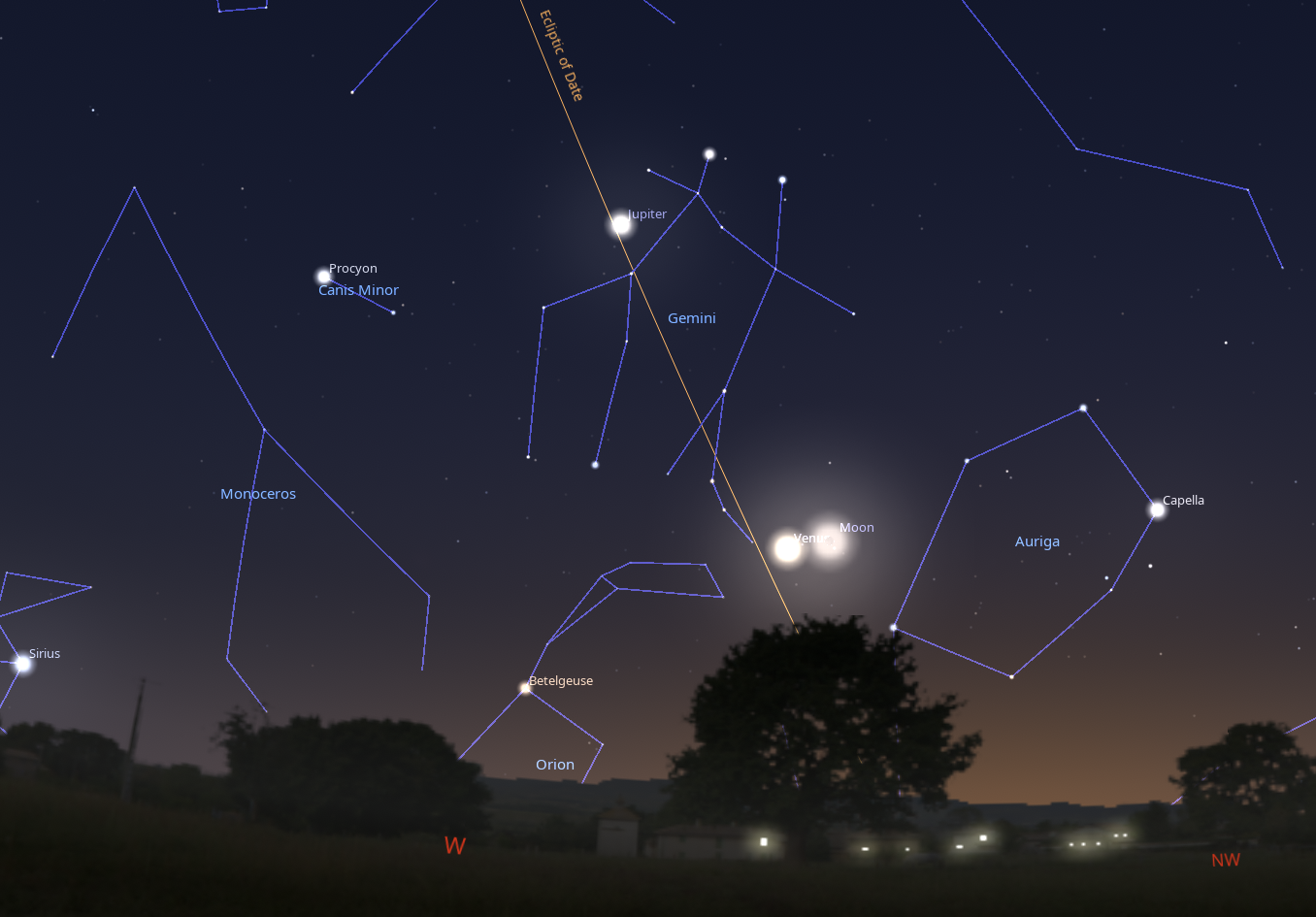 Looking west on the evening of May 18th. Credit: Stellarium.
Then the first act of the celestial drama begins, as the Moon passes within 3 degrees of Venus on Tuesday, May 19th at 3:00 UT. Shining at -4th magnitude, Venus presents an 83% illuminated gibbous disk, versus the Moon’s +8% illuminated waxing crescent.
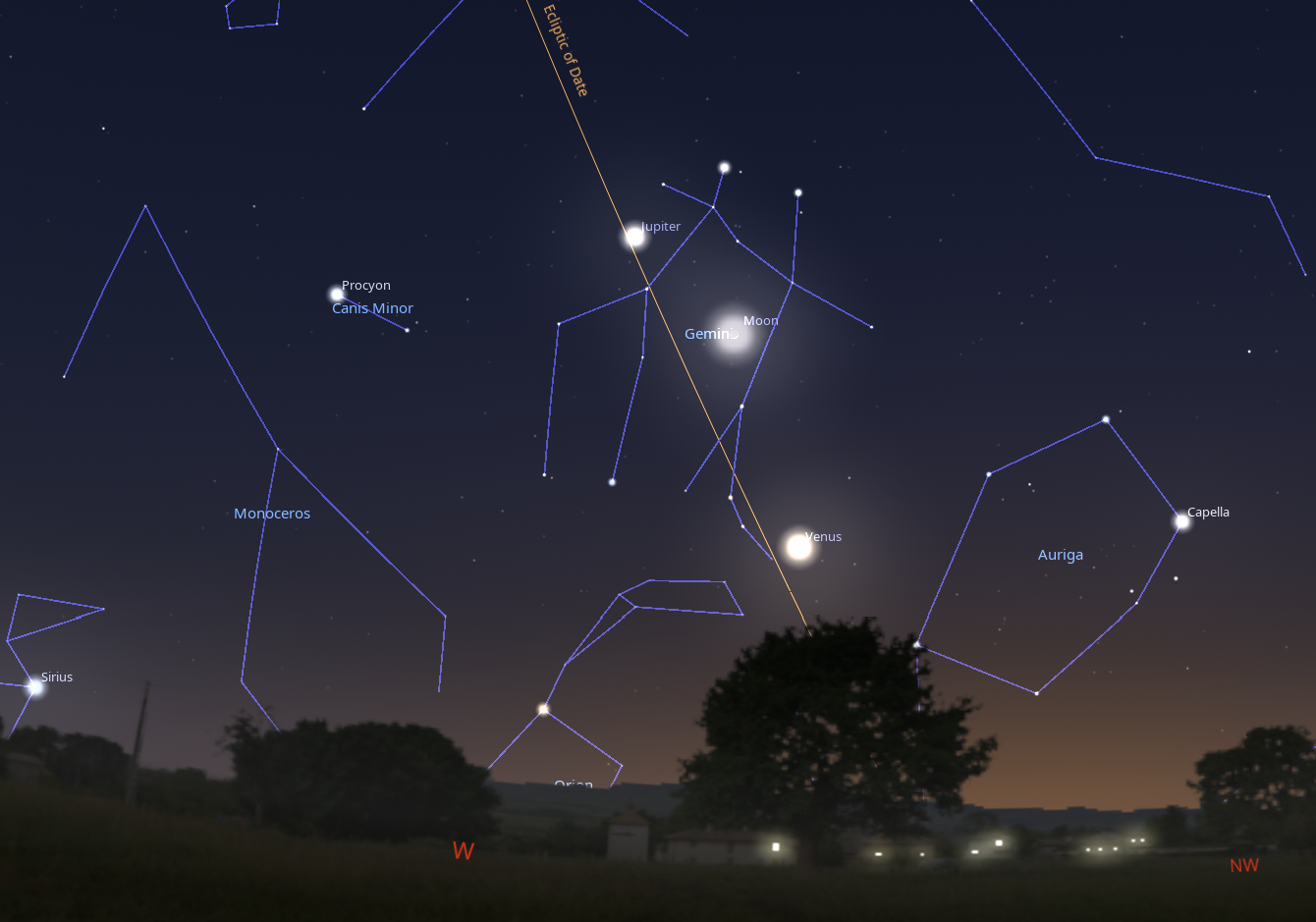 Looking westward on the following evening, May 19th. Credit: Stellarium.
On the following evening, the +19% crescent Moon makes a similar 3 degree pass near -1.7 magnitude Jupiter on Wednesday, May 20th at 15:00 UT. Telescope users in the Americas will also want to watch for a fine double shadow transit involving Europa and Ganymede on Friday evening, May 15th.
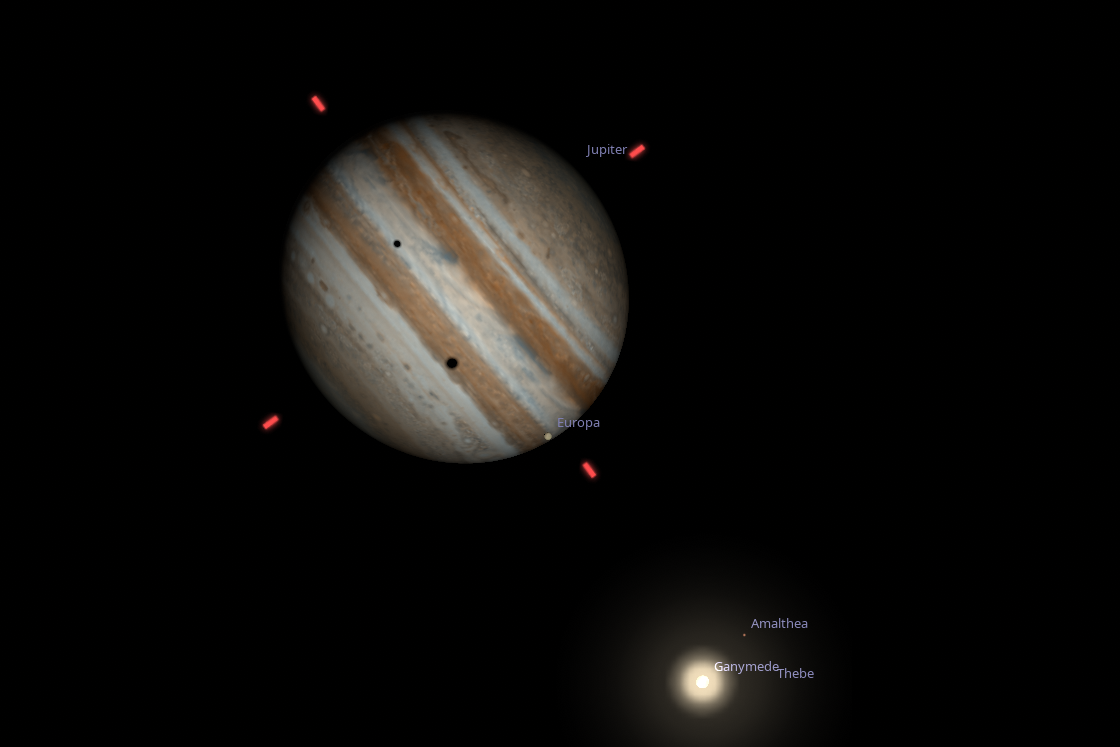 Friday's double shadow transit. Credit: Starry Night.
These two conjunctions offer a good study in daytime planet spotting. Jupiter is the tougher of the two, though Venus is quite an easy catch when the Moon is nearby. Attendees of President Lincoln’s March 4th, 1865 inauguration were entertained by just such a daytime celestial sight.
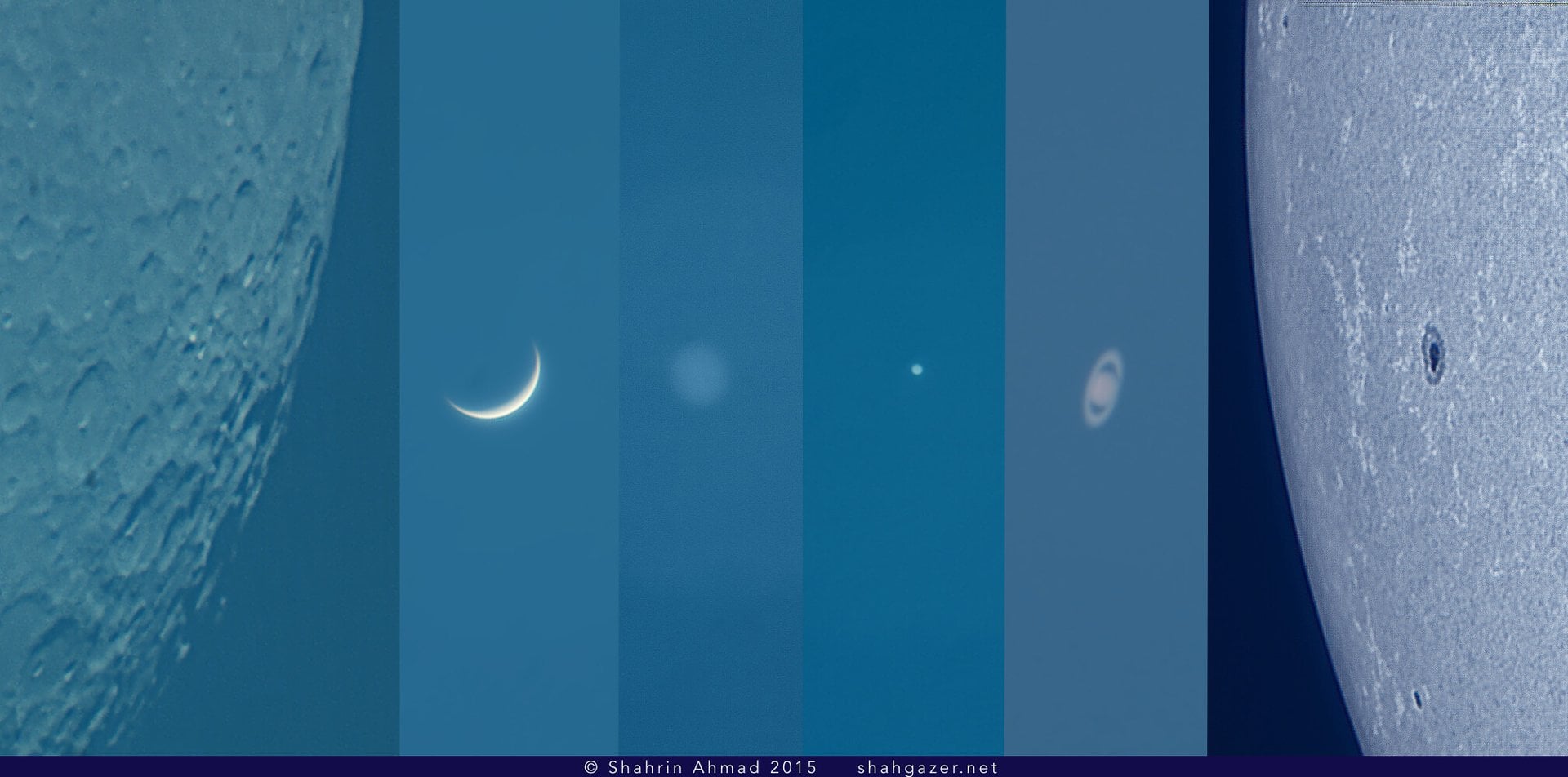 A montage of daytime astronomy captures. Credit: Shahrin Ahmad.
...and Mercury makes three. Mercury is nudging its way into the May dusk sky as well. The planet is actually fresh off of an ‘anti-transit,’ passing behind the Sun as seen from our Earthly vantage point on May 14th. Unfortunately, we’ll have to wait until November 12/13th 2032 to see the next transit of Mercury from the Earth. Greatest elongation for Mercury 24.5 degrees east of the Sun occurs on June 15th.
The Moon makes one more pair of notable stops in May. First, the waxing crescent Moon crosses though the open cluster Messier 44 (Praesepe) on May 21st, then occults the bright +1st magnitude star Regulus on May 23rd for the Pacific. The 49% Moon is just before 1st Quarter phase at the time. This is part of a cycle of lunar occultations for Regulus going out until December 28th of this year.
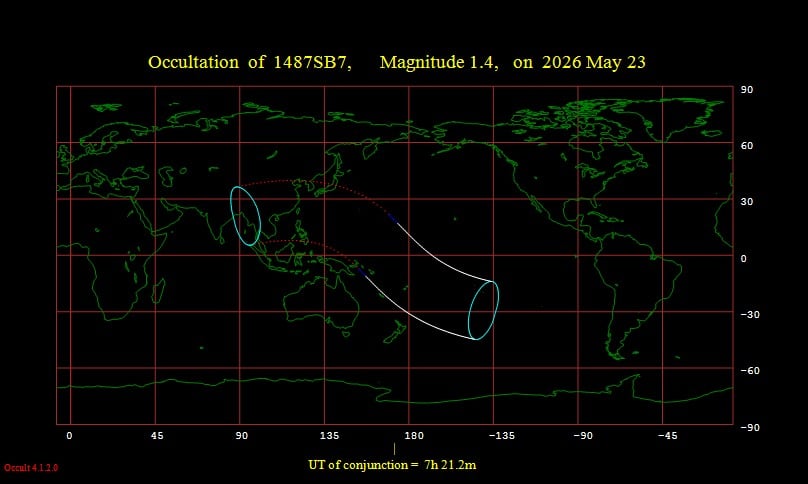 The Moon occults Regulus for the South Pacific. Credit: Occult 4.2.
Venus vs Jupiter: A Teaser
And there’s more in store. Venus and Jupiter get ever closer night by night in May, before passing just 1.6 degrees from each other on the evening of June 9th. That’s the two brightest planets, in one wide field of view.
Fun fact: in 2013, military patrols on the China-India border reported sighting bright objects, seeming to hover over the mountains from night to night. These turned out to be—you guessed it—apparitions of Venus and Jupiter, as identified by the Indian Institute of Astrophysics based in Bengaluru, India. Remember, knowledge of the sky and the celestial goings on above can save lives, or at least avert a geopolitical incident.
Be sure to enjoy the free sky show over the next week, starring our Moon and partner planets.
*Lead image credit: be sure to check out more great astro-photos courtesy of Jeff Sullivan and follow the Universe Today Flickr page. *